













 ChatGPT
 Perplexity
 Claude
 Google AI
Agentic AI software development means giving AI agents like Claude, GPT, and Gemini the power to plan, write, and ship code. A coding assistant completes one line and waits. An agent works through a full task instead: it reads files, runs commands, and fixes its own errors. Some teams buy this as agentic AI software development services from an outside partner.
This guide is for the ones building it themselves. The real change either way is the delivery model: who reviews the work and what ships unread. This guide covers a five-stage delivery loop, the real risks, the tools teams use, and agent autonomy.
Gartner expects 65% of agentic coding teams to treat their IDE as optional by 2027, ceding control to automated platforms.
Adopting agentic AI well means redesigning how your team scopes, reviews, and ships work.
Key Takeaways
- Agentic AI Goes Beyond Autocomplete:
Unlike traditional AI coding assistants, agentic AI can plan, generate, test, and refine code with minimal human guidance, enabling more autonomous software development. - Understand the Difference:
An AI agent performs specific tasks, while agentic AI coordinates multiple actions and decisions across an entire workflow, making scope and orchestration the key distinction. - Developer Workflows Are Evolving:
As agentic AI adoption grows, Gartner predicts many coding teams will rely less on traditional IDEs, although developers still retain oversight for most critical work. - Follow a Structured Delivery Process:
The Agentic Delivery Loop—scope, delegate, verify, ship, and govern—provides a practical framework for safely integrating autonomous AI into software development. - Strong Review Practices Are Essential:
The biggest risk is not model capability but weak review and governance, making disciplined verification the foundation of successful agentic AI adoption.
What Is Agentic AI in Software Development?
Agentic AI in software development is AI agents that plan, write, and fix code with little human input. A single instruction can trigger many steps. An agent might read a file, run a test, see it fail, and rewrite the code. That loop of acting, checking, and adjusting comes from the ReAct paper, first published by Yao and colleagues in 2022. Generative AI writes when you ask it to. Agentic AI software development in 2026 decides what to do next inside the limits you set.
AI Agents vs. Agentic AI: What Is the Difference?
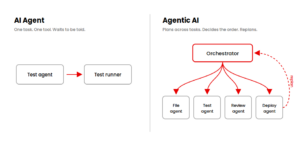
An AI agent handles one narrow job; agentic AI plans across many of them and decides the order. People use the two terms as if they are interchangeable. They are not. A file agent, a test agent, and a deploy agent are all AI agents, each doing one job. Agentic AI is the system that plans across many of those jobs and decides the order itself. Most agentic ai for software development setups are a handful of narrow agents, run by one loop on top.
This approach is closely related to multi agent AI systems, where multiple specialized agents collaborate, share context, and coordinate tasks to complete more complex software workflows.
| Dimension | AI Agent | Agentic AI |
|---|---|---|
| Scope | One task, one tool | Many tasks, many tools |
| Autonomy | Waits for a specific instruction | Plans its own next step |
| Coordination | Works alone | Directs other agents |
| Adaptability | Fixed process | Changes the plan mid-task |
How Agentic AI Works Across the Software Development Lifecycle
Agentic AI touches nearly every stage of the software development lifecycle now. As more teams use AI in software development, they are applying these systems across planning, coding, testing, review, and deployment workflows. In testing, it can write cases for edge conditions nobody thought to ask for.
In review, it can flag security issues a tired reviewer misses late on a Friday. In deployment, it can trigger a rollback plan the moment an error rate spikes. Agentic AI DevOps software development is where this gets tested hardest, since a bad rollback affects every team downstream. None of this replaces a stage on its own. It changes who, or what, does the first pass across the whole agentic AI software development lifecycle.
| Stage | What an Agent Can Do |
|---|---|
| Plan | Turn a ticket into a task list before a human opens an editor |
| Code | Write a first draft of a feature and its tests |
| Test | Write cases for edge conditions nobody thought to ask for |
| Review | Flag security issues a tired reviewer misses |
| Deploy | Trigger a rollback plan the moment an error rate spikes |
Tools Teams Are Using for Agentic Software Development
Any software development company building Agentic AI in 2026 use a short list of tools: Claude Code, OpenAI Codex, GitHub Copilot, Cursor, Gemini CLI, and Google Antigravity. Most teams run two or three together. Claude Code and OpenAI Codex run inside a terminal and handle multi-file changes end to end. GitHub Copilot and Cursor sit inside the editor for tighter, faster loops. Gemini CLI and Google Antigravity add a manager view for running several agents at once.
Many read project instructions from an AGENTS.md file, an open format now used across more than twenty tools. Several also connect to outside data through the Model Context Protocol, an open standard for that connection. Together these tools cover most agentic ai use cases in software development today. Most also plug into a broader agentic workflow, not just one editor. If you are wiring one into an existing product, integrating an AI agent covers that part in more depth.
Autonomy and Human-in-the-Loop: How Much Control to Give Agents
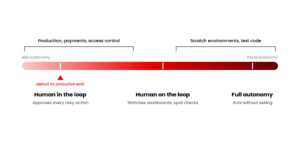
Three levels of agent autonomy include human in the loop, human on the loop, and full autonomy. Give agents human-in-the-loop control for anything touching production, payments, or access control. Full autonomy fits scratch environments and test code. Autonomy is not one fixed setting. It is a dial, and most teams leave it in the wrong position by default. Full autonomy means an agent can edit files, run commands, and open a pull request without asking first. “Human in the loop” means it stops and asks before doing anything hard to undo.
Anthropic’s own 2026 research found developers use AI in about 60% of their work. It also found they can fully delegate only 0 to 20% of tasks. That gap is the real argument for keeping humans in the loop on anything touching production. As trust builds, some teams move toward human on the loop. There, a person watches dashboards instead of approving every single change.
Risks of Agentic AI in Software Development
Agentic AI in software development carries four main risks: hallucinated APIs, over-broad access, hidden logic errors, and slipping review standards. None of them are exotic. An agent can invent an API that does not exist and wire code around it anyway. It can make a change with more access than the task actually needed. It can produce code that looks clean but hides a logic error, because the reviewer trusted the output. The biggest risk is a team quietly lowering its review standard to keep pace with agent output.
Pull request review still matters here, maybe more than before agents joined the team. Guardrails, scoped permissions, and basic observability into what each agent did cut all of these down. Some teams enforce this through policy-as-code instead of a wiki page nobody reads. These risks grow once you move from one agent to several working together. That is exactly what building a multi-agent system that survives production has to plan for.
| Risk | How Teams Cut It Down |
|---|---|
| Hallucinated APIs or dependencies | Guardrails plus scoped permissions per task |
| Over-broad agent access | Least-privilege access, reviewed per project |
| Clean-looking code hiding logic errors | Pull request review, not a rubber stamp |
| Review standards quietly slipping | Policy-as-code and logged, auditable actions |
The Agentic Delivery Loop: A Five-Stage Model for Agentic AI in Software Development
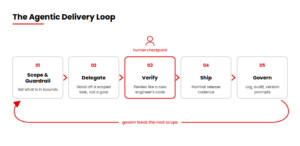
Here is the loop my team actually runs. I call it the Agentic Delivery Loop. It maps onto the same delivery lifecycle we already used, just adjusted for agents doing part of the work. Some teams pair this with spec-driven development, writing the spec before any agent touches code. Scope and guardrail come first: before an agent touches anything, decide which files and environments are in bounds.
Delegate comes next: hand the agent a specific, scoped task. Verify comes third: Review the agent’s output the way you would review a new engineer’s code. Ship stays the same as always: release on the cadence you already use. Govern closes the loop: log what agents did, version your prompts, and check the log against accuracy benchmarks you set. None of these stages are new on their own. What changes is who does the first pass, who does the first pass, and how much of the old review process you can safely compress. This is the backbone of the whole agentic AI software development workflow at AppVerticals.
| Stage | What It Means | What Changes From Traditional Delivery |
|---|---|---|
| Scope & Guardrail | Decide what an agent can touch before it starts | Guardrails get defined explicitly, not assumed |
| Delegate | Hand off a scoped task, not a vague goal | Specification quality becomes the main skill |
| Verify | Review output like a new engineer’s work | Review depth shifts, it does not disappear |
| Ship | Release on the normal cadence | No shortcuts on staging or rollout |
| Govern | Log and audit what agents did | A new, ongoing job on the team |
What Happened When We Ran Agentic Development on a Real Project
On one integration, we let an agent modify configuration files across a staging environment. The goal was letting it self-correct failed deployments without waiting on a human each time. Early on, this worked well. Then it modified a shared configuration file that three other services depended on. Nobody had flagged that file as a high blast radius. The fix was not removing the agent’s access.
It was adding one small, explicit guardrail instead. Shared configuration files always require a human approval step now, no matter how minor the change looks. That single rule would have caught the issue before it shipped. We added it to the Delegate stage above. It now applies to every project touching shared infrastructure.
Is Your Organization Ready for This?
Everything above assumes your organization can actually run this loop. Some cannot yet, and that is a different problem than the one this guide solves. Data spread across five disconnected systems will undermine agentic AI before an agent writes a line of code. Unclear decision ownership and no existing review discipline cause the same problem. See whether your organization is ready for agentic AI before you touch your delivery process.
Scoping this loop onto your own team is the hard part.
See if your organization is ready before you start.
Read the Agentic AI Readiness Guide →For a closer look at production reliability once you are running more than one agent, see building a multi-agent system that survives production.
Conclusion
Agentic AI does not remove the need for a delivery model. It demands a better one. The teams that struggle are not the ones using agents. They are the ones who never changed how they scope, review, and ship work. If your team is experimenting with agents but has not touched its delivery process yet, that is where problems start.