














 ChatGPT
 Perplexity
 Claude
 Google AI
Most businesses think agentic AI is a smarter chatbot. One that can send emails, pull reports, maybe schedule a meeting. That framing is what’s causing most deployments to underdeliver, or collapse entirely. Agentic AI is a class of autonomous AI systems that can perceive a business environment, reason toward a goal, and take multi-step action, across tools, systems, and workflows, without a human managing each step.
It doesn’t wait for instructions. It doesn’t stop at generating a response. It works through an entire process on its own, identifying what needs to happen, calling the right tools, making decisions along the way, and adapting when conditions change. That’s a fundamentally different category of system, not a chatbot upgrade.
By 2026, 40% of enterprise applications are projected to include task-specific AI agents, reports Gartner. Companies deploying agentic AI expect an average ROI of 171%, roughly three times the return of traditional automation. And yet fewer than 10% of organizations have deployed it at scale, while Gartner forecasts that 40% of agentic AI projects will be canceled by 2027.
That gap isn’t a technology problem. It starts with how businesses frame what they’re building. This guide serves that exact gap, aimed at helping you understand what agentic AI is, what it can do and whether your business is ready for it or not.
What Is Agentic AI? (And How Is It Different From a Chatbot or RPA?)
The easiest way to understand agentic AI is to understand what it replaced, and why those previous tools kept hitting a ceiling.
Chatbots respond. Robotic process automation (RPA) repeats. Agentic AI reasons.
An AI chatbot is essentially a very sophisticated question-answering machine. It takes an input, processes it through a language model (LLM), and produces an output. That’s the end of its job. If you want it to do the next thing, you have to ask again.
RPA goes a step further, it can execute a sequence of steps, but only the exact steps it was programmed to follow. Change the form layout, rename a field, or add an exception to the process, and the bot breaks. IT teams who’ve managed RPA at scale know this maintenance burden intimately.
Agentic AI, a product of latest advances in AI development, handles ambiguity. It can interpret a goal, choose the right sequence of actions, use external tools (APIs, databases, and search), adjust its approach mid-process, and recover from partial failures. Think of it as the difference between handing someone a script and hiring someone who understands the objective.
Here’s how the three compare side by side:
| Aspect | Traditional Automation / RPA | Chatbot (Generative AI) | Agentic AI |
|---|---|---|---|
| Input type | Structured data, fixed triggers | Natural language prompt | Goal, instruction, or event |
| Output type | Predefined action or report | Text response | Completed multi-step workflow |
| Decision-making | Rule-based, no deviation | Per-prompt, no memory | Goal-oriented, adaptive across steps |
| Human role | Sets up rules upfront | Prompts each interaction | Sets goal; reviews outcomes with approval gates for higher-stakes decisions |
| Best for | Repetitive, stable, rule-bound tasks | Single-turn Q&A, content generation | Cross-system processes requiring judgment |
There are a few terms that come up constantly in agentic AI conversations and are worth knowing as someone who’s interested to invest in the technology:
- Multi-agent systems: Multiple AI agents working in coordination, each handling a specialized part of a larger workflow. One agent gathers data, another analyzes it, another triggers an action.
- Human-in-the-loop: A design pattern where certain decisions or thresholds require human approval before the agent proceeds. Not a limitation, it’s how most responsible deployments are structured.
- Tool use: The agent’s ability to call external services, send an email, query a database, and update a CRM record, as part of completing a task.
A joint MIT Sloan Management Review and BCG survey from spring 2025 found that 35% of organizations had already adopted agentic AI, with another 44% planning near-term deployment.
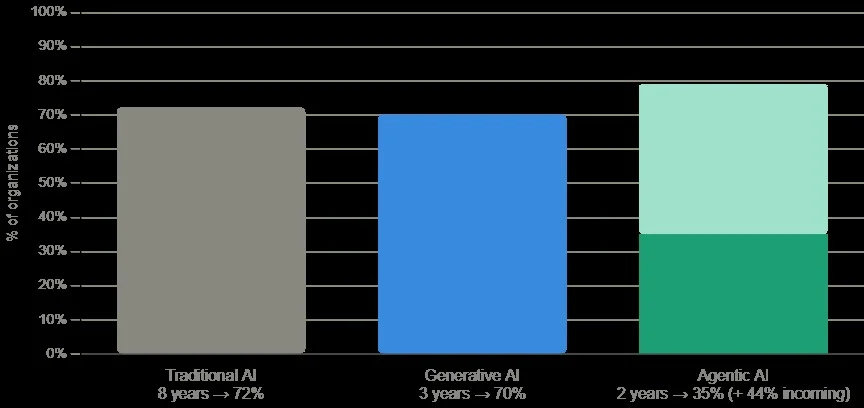
Data: MIT Sloan Management Review & BCG
Every previous wave of enterprise technology followed the same pattern: slow start, gradual adoption, eventual plateau. Agentic AI isn’t following that pattern. Traditional AI took eight years to reach 72% adoption. Generative AI hit 70% in three. Agentic AI is already at 35%, in under two years, with another 44% of organizations planning deployment soon. The technology is spreading faster than most companies have built a strategy to manage it.
What Agentic AI Actually Does Inside a Business
The answer almost always changes the conversation. Most teams arrive with a solution already in mind, usually because they’ve seen a competitor announce something, read a case study, or sat through a vendor demo. The starting point is the technology, not the problem it’s meant to solve.
“We want agentic AI” usually turns out to mean faster support resolution, cleaner lead handoffs, or less manual data entry. So the real first question isn’t which agent to build, it’s whether you need an agent at all.
That said, when the use case does warrant one, the pattern is consistent: agents deliver most where a person is currently acting as glue between systems. This is also why agentic AI projects often overlap with custom software development. The agent itself is only one piece of the solution; it still needs to connect with CRMs, ERPs, databases, communication platforms, and internal workflows. In practice, the biggest gains usually come from designing software and integrations around the agent, not from the model alone.
Think about what happens when a new enterprise customer signs a contract. Someone from sales closes the deal. Then someone manually updates the CRM. Then someone emails finance to set up billing. Then someone pings the onboarding team. Then someone creates a project in the PM tool. That chain of handoffs, each one a person translating information from one system into another, is exactly what an agent is built for.
The scale of the problem is well-documented. Asana’s Anatomy of Work report found that employees spend roughly 60% of their working hours on “work about work”, status updates, switching between tools, tracking down information, and coordinating handoffs, leaving only 40% for the skilled work they were actually hired to do. That ratio hasn’t improved as companies have added more tools; in most cases, it’s gotten worse. The AI automation ROI data makes a compelling case for why this is exactly the problem agentic AI is built to close.
Before deploying any agent, it’s worth running your candidate use cases through what we call the Four Traits of a High-Fit Use Case, discussed below.
The Four Traits of a High-Fit Agentic AI Use Case
A use case is genuinely agent-ready when it has all four of the following:
- ✓
A repetitive process with clear rules: not every edge case, but a definable core that runs on policy - ✓
Cross-system dependencies: the task requires pulling from or pushing to more than one tool - ✓
A measurable outcome: you can track whether the agent succeeded (resolution rate, time saved, error rate) - ✓
A human currently acting as connective tissue: someone whose job is largely to move information between systems
If a use case doesn’t have all four, it’s either too simple for an agent (use basic automation) or too ambiguous to deploy reliably (reduce scope first).
In practice, the highest-impact applications tend to cluster around a handful of business functions:
IT Service Management
An employee submits a ticket. The agent reads it, checks the knowledge base, queries the user’s permissions, cross-references past similar issues, and either resolves it automatically or routes it to the right tier with full context already assembled. No human triaging a queue at 2am.
Employee Onboarding
When a new hire’s start date is confirmed, an agent triggers the full onboarding sequence, provisioning accounts, scheduling orientation, sending policy documents, notifying the payroll team, creating their tools access. What used to take a week of back-and-forth coordination runs in hours.
Finance and Contract Processing
Invoice arrives. Agent reads it, matches it against the PO, flags discrepancies, routes for approval if thresholds are met, and updates the ledger. Or doesn’t flag anything and just processes it, because it matched perfectly.
Lead Qualification
Inbound leads get scored against firmographic criteria, enriched with data from third-party sources, cross-referenced against CRM history, and routed to the right sales rep, with a briefing already assembled, before anyone manually picks up the thread. It’s one of the cleaner examples of what SaaS platform development built around agentic workflows actually looks like in practice.
Where Businesses Are Seeing the Most ROI from Agentic AI
The ROI numbers get attention. But it’s worth looking at where those returns are actually coming from, because the pattern is more instructive than the headline stats.
The companies generating the biggest returns aren’t using agents everywhere. They identified narrow, high-volume workflows where the cost of human coordination was measurable and the process was documentable. A few production examples from public reporting:
JPMorgan has over 400 AI use cases running in production daily, not as experiments, but as operational infrastructure. Their legal and compliance teams have seen some of the sharpest efficiency gains.
Salesforce’s legal teams using purpose-built AI report a 14% reduction in outside counsel spend, roughly $252K annually for median-sized legal departments.
These aren’t outliers. They’re early movers who figured out the same thing: the ROI comes from specificity, not from deploying broadly.
Rylko Roman, who leads enterprise engineering at a SaaS-scale organization, captured the diagnostic mindset well after a year of production deployments: “We learned to ask a simple question of every agent: What decision do you accelerate? If the answer is ‘answering a chat,’ we’re not ready. If the answer is ‘assemble evidence across logs, tickets, and dashboards so an on-call can act in seconds,’ that’s a candidate.”
The ROI potential is real, but so is the distance between a promising pilot and a production system that actually delivers it. Understanding what separates the two is where most teams underinvest.
Why Most Agentic AI Projects Stall Before They Scale
The gap between ambition and execution is well-documented. According to Deloitte’s 2025 Emerging Technology Trends study, while 30% of organizations are exploring agentic AI and 38% are piloting it, only 14% have solutions ready to deploy, and just 11% are actively running them in production.
MuleSoft’s 2025 Connectivity Benchmark Report, drawn from 1,050 enterprise IT leaders, found that 93% have implemented or plan to implement AI agents within two years. And Gartner predicts that over 40% of agentic AI projects will be canceled by end of 2027, citing escalating costs, unclear business value, and inadequate risk controls.
That’s a significant delta between intent and execution. The projects that stall aren’t failing because the technology doesn’t work. They’re failing for reasons that show up early, and that experienced teams learn to spot quickly.
The Five Most Common Reasons Agentic AI Pilots Fail
Poor data infrastructure
Agents don’t create data quality problems; they expose and amplify existing ones. If your customer records are fragmented, your agent will make fragmented decisions, at scale, faster than any human would. Before an agent goes live, the data it depends on needs to be clean, accessible, and owned.
Deloitte found that nearly half of organizations cite searchability and reusability of data as their top barriers to AI automation, this isn’t a minor friction point, and it’s a deployment wall.
Use case too broad to measure
“Improve customer service” is a goal. “Reduce first-contact resolution time by 30% for Tier 1 IT tickets” is a use case. The difference determines whether you can evaluate the agent, improve it, or justify continuing.
No governance design
Who decides what the agent is allowed to do on its own? What requires a human sign-off? What happens when it makes a mistake? These aren’t edge cases, they’re deployment decisions.
Integration complexity underestimated
There is no truly off-the-shelf agent that plugs into your existing stack and just works. Every organization’s combination of ERP, CRM, ITSM, and communication tools is different. Custom integration work is real, it takes time, and it’s often underplanned in initial budgets.
No one owns the failure
As Faique Ali puts it: “Teams build impressive demos, but no one is comfortable letting it run in production, because there are no clear boundaries for what the AI can and cannot do.”
The data infrastructure point is where we see the most expensive surprises. Teams pick a use case, start development, and three weeks in discover that the data the agent depends on lives in five different places, has no consistent schema, and hasn’t been maintained properly in years. That’s not a blocker you can engineer around on a tight timeline, it’s a project reset. The conversations about data readiness need to happen before the first sprint, not during it.
Gib Bassett, writing on Medium about the context gap in enterprise AI deployments, puts it plainly: “Here’s what every working agentic AI system has in common, and what every failed one is missing: a human who can validate the agent’s outputs, challenge its assumptions when they drift, and correct course when the world changes faster than the model.”
The working knowledge behind how analysts actually use data, the caveats, dependencies, stakeholder expectations, is often invisible to the leaders most eager to automate it. That’s why the diagnostic conversation matters more than the build conversation, at least in the first thirty days.
Is Your Business Ready for Agentic AI? The AppVerticals Stage-by-Stage Framework
The question isn’t whether agentic AI works. It does, with the right conditions. The more useful question is: what does “ready” actually look like for a company at your stage?
This framework came out of something we kept running into with clients. A 25-person startup and a 5,000-person enterprise are not making the same decision. They have different data maturity, different integration complexity, different governance requirements, and very different risk tolerance for a failed pilot. And yet most of the advice circulating about agentic AI readiness treats them identically.
So we did what we typically do before we formalize any guidance: we went back to the work. We reviewed our own deployment history across client engagements, ran structured conversations with stakeholders at multiple organizational stages, and stress-tested our assumptions against the failure patterns we were seeing in the market.
What came out of that process wasn’t a single checklist. It was a recognition that readiness is stage-dependent, and that the questions a startup needs to answer before deploying an agent are fundamentally different from the ones an enterprise needs to answer.
The framework below reflects that. It’s what we use internally when a client asks us where to start, and it’s what we walk prospective clients through before any scoping conversation begins.
| Decision Area | Startup (<50 people) | Growth-stage (50–300 people) | Enterprise (300+ people) |
|---|---|---|---|
| Where to start | Single high-volume, low-risk workflow with a clear outcome: lead qualification, support triage, contract first-pass. Keep scope to one system integration. | Map where humans are acting as connective tissue between existing tools. Build a single cross-system agent in one department before expanding. | Identify the workflow with the highest coordination cost and the clearest governance path. Run a time-boxed pilot with defined success metrics before committing to broader rollout. |
| What to watch for | Data hygiene records are often informal at this stage. An agent running on inconsistent data produces inconsistent outputs. | Integration debt—growing companies accumulate tools fast. Understand your current stack before adding an orchestration layer on top. | Change management—agents change how people work. Enterprise adoption fails as often from internal resistance as from technical issues. |
| What to avoid | Deploying an agent as a substitute for a missing process. If the human workflow isn’t defined, the agent can’t automate it. | Trying to build everything in-house. The custom development requirement is real; the time cost without experience is higher than most teams anticipate. | Choosing use cases based on hype. The best agentic AI projects at enterprise scale solve a problem someone has been complaining about for three years, not one that surfaced in a strategy presentation. |
The pattern we see most consistently across all three stages: the organizations that get real value from agentic AI in year one are the ones that resist the urge to go wide. They pick one workflow, instrument it properly, demonstrate a measurable outcome, and expand from there. The ones that struggle usually tried to solve too much at once, and ended up with a pilot that couldn’t prove anything to anyone.
That’s not a technology problem. It’s a scoping problem. And it’s one that shows up regardless of company size, budget, or how sophisticated the underlying model is.
Helping teams get that scoping decision right, before the build starts, is where we spend most of our time with new clients. [Talk to our team →]
Final Thoughts
The businesses getting real value from agentic AI aren’t necessarily the ones with the largest budgets or most advanced tech stacks. They’re the ones that identified a specific workflow problem, somewhere a human was acting as the glue between systems, and deployed an agent to handle it end to end.
The technology works. The ROI data is real. The risk is also real, particularly for organizations that skip governance and data preparation in favor of getting something live fast.
The smartest first move is usually the narrowest one. A single workflow, fully instrumented, with a clear success metric and a governance plan in place before launch. That pilot becomes the proof of concept that earns the next one. And the one after that.
If you’re not sure where that starting point is for your specific operation, that’s exactly the kind of conversation worth having before you commit to a build.
Is Agentic AI the Right Next Move for Your Business?
We help companies identify, scope, and build AI agents that reach production, not just demos.
Explore Our AI App Development Services