












 ChatGPT
 Perplexity
 Claude
 Google AI
A multi-agent AI system uses two or more coordinated AI agents, each with its own role, to complete work a single agent handles poorly on its own. A working prototype can be running within days on a framework like LangGraph or CrewAI. The harder number is this one: Cemri et al.’s 2025 MAST taxonomy, the most rigorous public study on the subject, found that these systems fail in production at rates of 41% to 86.7%.
By the time a team asks for help building a multi-agent system, they have usually already decided they need one. They want to know which framework to use. The harder conversation is whether they need multiple agents at all. That is the one that actually prevents a rebuild six months later.
This guide gives you a scored way to decide. It covers the real failure modes to design around and what actually holds up once real users hit it.
Key Takeaways
- A multi-agent AI system uses two or more coordinated AI agents. Start with one agent unless your task genuinely needs more.
- Cemri et al.’s 2025 MAST taxonomy found failure rates of 41% to 86.7% across seven frameworks, driven by specification issues, inter-agent misalignment, and task verification gaps.
- Run your use case through the four-factor single-agent versus multi-agent decision test before writing any orchestration code.
- Three architecture decisions matter more than framework choice: agent memory, tool permissions, and observability.
- A production multi-agent build typically costs $20,000 to $40,000 or more, over roughly 8 to 16 weeks.
- Pick an orchestration pattern (supervisor, blackboard, or peer-to-peer) and a framework (LangGraph, CrewAI, Microsoft Agent Framework, or OpenAI Agents SDK) deliberately.
What Is a Multi-Agent AI System?
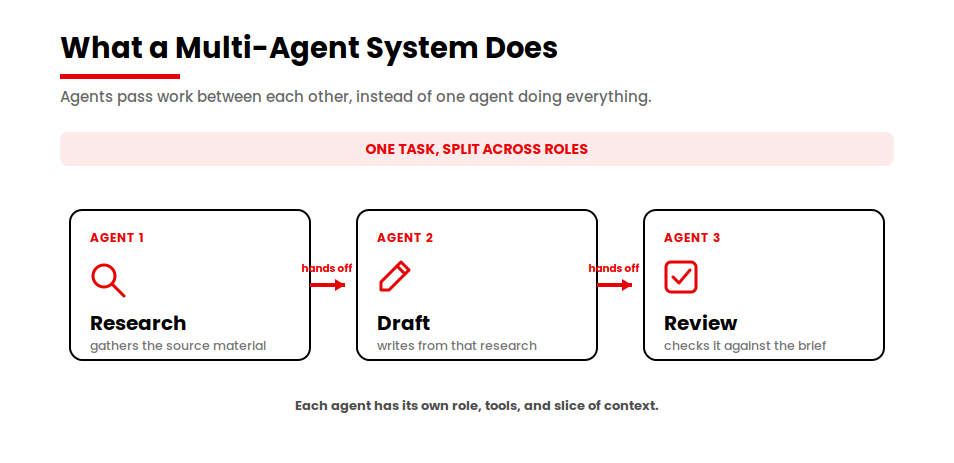
A multi-agent AI system is a group of AI agents that work together to complete a task. Each agent gets a defined role, a set of tools, and its own slice of context. The agents pass work between each other instead of one agent trying to do everything. A common example: one agent researches a topic, a second agent drafts content from that research, and a third agent checks the draft against the original brief before it ships.
As more engineering teams use AI in software development, multi-agent systems are becoming a way to automate complex workflows such as code generation, testing, reviews, and deployment tasks that require multiple specialized capabilities.
Multi-agent systems sit one level above AI agent development in general. A single agent is still the right starting point for most teams. Multi-agent architecture becomes relevant once one agent is doing several unrelated jobs badly, or once a task genuinely splits into independent pieces that benefit from specialization.
Do You Actually Need Multi-Agent, or Will One Agent Do?
Multi-agent systems AI news coverage over the past year has swung between two extremes: breathless hype and flat dismissal. Most multi agent systems in AI get scoped the same way: someone assumes multi-agent is the upgrade path from a single agent, without checking whether the task actually needs it. Sometimes that assumption is right. Often a single agent with better tooling would have done the job.
The answer depends entirely on the task in front of you.
A single agent with more tools, an effective system prompt, and better context handling solves most problems that look like they need multiple agents. Adding agents adds coordination overhead: message passing, shared state, and new failure surfaces that a single agent never has to deal with. Every additional agent is a new place for the system to lose track of what it is doing.
Multi-agent architecture earns its complexity in a narrower set of cases: when a task splits into genuinely independent subtasks that can run in parallel, when different subtasks need different tools or different levels of model capability, or when a single agent’s context window and instruction set become unmanageable because it is doing too many unrelated jobs at once.
The mistake I see most often when scoping AI Transformation engagements at AppVerticals is teams reaching for a multi-agent architecture before a single, well-scoped agent has been tried and found lacking. Most teams over-build before they under-build. I see it most often when a client asks for coordination before a single agent has even been tried.
The Single-Agent vs. Multi-Agent Decision Test
Run your use case through these four questions before you write any orchestration code.
- Task independence. Can the work be split into pieces that do not depend on each other’s output in real time? If every step needs the previous step’s full context, a single agent with good memory handling is usually simpler and more reliable than a handoff chain.
- Coordination need. Does the task require specialized skills, tools, or model capabilities that genuinely differ between subtasks? A research step and a code-generation step might justify separate agents, each with separate tool access. A single writing task rarely does.
- Latency tolerance. Multi-agent systems add round trips. Each handoff is another model call, another chance for a stall. If your use case needs a quick, single-turn response, added agents work against you.
- Team capacity. Multi-agent systems need someone who can debug distributed state, trace failures across agent boundaries, and maintain an orchestration layer over time. If nobody on the team can do that today, a single agent buys time to build that capability before adding coordination complexity.
| Factor | Points to Single-Agent | Points to Multi-Agent |
|---|---|---|
| Task independence | Steps depend on shared, evolving context | Steps are genuinely parallel or independent |
| Coordination need | One skill set covers the whole task | Subtasks need different tools or capabilities |
| Latency tolerance | Fast, single-turn response required | Multi-step, asynchronous work is acceptable |
| Team capacity | No one available to own an orchestration layer | A team can maintain distributed state and tracing |
If most of your answers land in the single-agent column, build one agent first. You can always split it into a multi-agent architecture later, once you know exactly where the seams should go.
Not sure where your use case lands?
A short scoping call will tell you whether your task needs one agent or several before you write a line of orchestration code.
Why Multi-Agent AI Systems Fail in Production: The MAST Taxonomy
The most rigorous public data on why multi-agent systems fail comes from Cemri et al.’s 2025 paper, “Why Do Multi-Agent LLM Systems Fail?” The research team built MAST, the Multi-Agent System Failure Taxonomy, from 1,600+ annotated execution traces across seven open-source multi-agent frameworks: MetaGPT, ChatDev, HyperAgent, OpenManus, AppWorld, Magentic, and AG2.
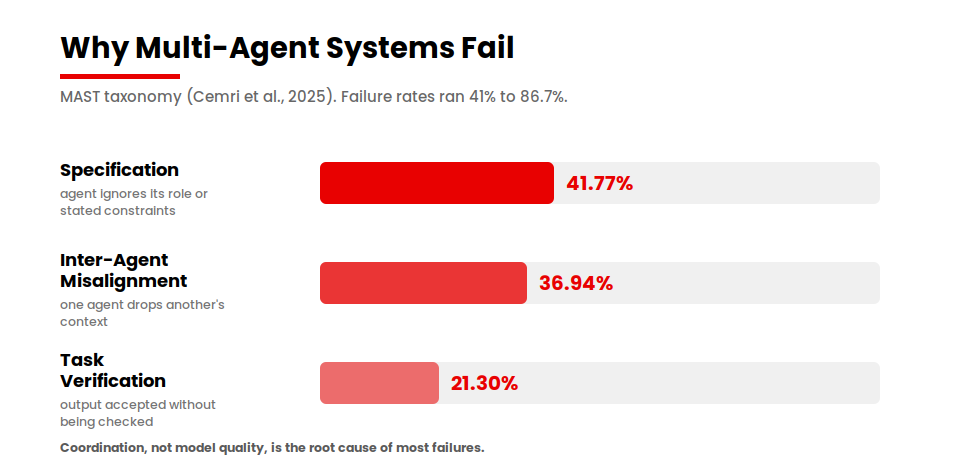
Their empirical analysis found task failure rates from 41% to 86.7% across those frameworks. MAST groups the failures into three categories:
- Specification issues
- Inter-agent misalignment
- Task verification
| Category | Share | Example Failure Mode | What It Looks Like | How to Design Against It |
|---|---|---|---|---|
| Specification issues | 41.77% | Disobey task or role specifications | An agent ignores stated constraints or acts outside its assigned role | Add explicit constraint checks in each agent’s instructions and validate outputs before handoff |
| Inter-agent misalignment | 36.94% | Ignored input, reasoning-action mismatch | An agent drops another agent’s context, or its stated reasoning contradicts the action it takes | Pass structured, validated handoff data between agents instead of free-text summaries |
| Task verification | 21.30% | Inadequate output checking | An output is accepted as complete without being checked against the original task | Add an independent verifier agent that does not share a prompt or context with the producing agents |
A useful pattern across all three categories: coordination problems cause most of these failures. Model quality is rarely the root cause. Better prompts and bigger models narrow specification issues, but they do very little for inter-agent misalignment or verification gaps. Those require deliberate design.
The Architecture Decisions That Determine Whether It Survives
Three architecture decisions do more to determine whether a multi-agent system survives production than the choice of framework.
Agent memory. Decide up front what state each agent can see and for how long. Shared memory that every agent can read and write invites race conditions, where two agents act on the same piece of state at the same moment and produce conflicting results. Scoped memory, where each agent only sees what it needs, is slower to build but far easier to debug later.
Tool calling and permissions. Every agent should have access to only the tools its role requires. An agent that can call any tool in the system is also an agent that can cause damage outside its intended scope when it misfires. Tool access should mirror the same boundaries you would set for a human employee with that job.
Observability. You cannot fix what you cannot see. Every agent handoff, every tool call, and every piece of reasoning should be logged in a way that lets you trace a failure back to the exact agent and step that caused it. Without this, debugging a multi-agent system means guessing.
Two open protocols are worth understanding before you design your architecture. The Model Context Protocol, or MCP, standardizes how a single agent connects to its tools, data sources, and external systems. The Agent-to-Agent protocol, or A2A, standardizes how independent agents discover each other and communicate across frameworks. MCP solves agent-to-tool communication.
A2A solves agent-to-agent communication. Using both correctly from the start avoids rebuilding your integration layer later.
A well-designed system also has an explicit answer for nontermination: what happens when agents keep handing work back and forth without reaching a conclusion. Every orchestration loop needs a maximum number of turns, a timeout, or an escalation path to a human, or it will eventually run in a deadlock that nobody notices until the bill arrives.
Orchestration Patterns: Supervisor, Blackboard, and Peer-to-Peer
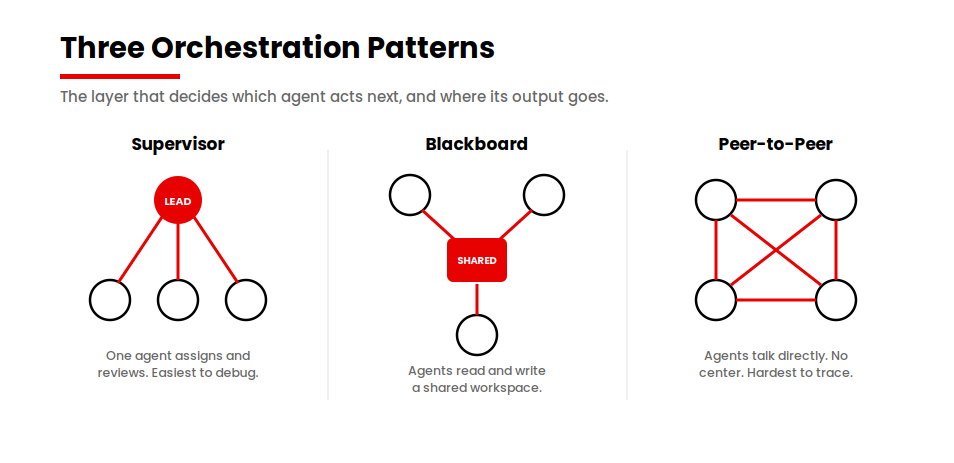
Multi agent orchestration is the layer that decides which agent acts next, what it sees, and where its output goes. Three patterns cover most production systems.
Supervisor pattern. One orchestrator agent, sometimes called a supervisor agent, receives the task, breaks it into subtasks, and assigns each subtask to a specialized agent. The supervisor agent reviews the results and decides what happens next. This pattern is the easiest to reason about and debug, because there is one place that owns the overall flow.
Blackboard pattern. Agents read from and write to a shared workspace, the blackboard, instead of talking to each other directly. Any agent can act when it has something useful to contribute. This pattern suits problems where the right sequence of steps is not known ahead of time, but it makes race conditions more likely if the blackboard is not carefully scoped.
Peer-to-peer pattern. Agents communicate directly with each other without a central coordinator. This pattern scales well across frameworks when agents use an open protocol such as A2A to discover and message each other, but it is the hardest pattern to trace when something goes wrong, since there is no single place to look for the full picture.
Most production systems we build at AppVerticals start with a supervisor pattern. It gives you a single point of control while you are still learning where your system’s real failure points are. Moving to blackboard or peer-to-peer patterns makes sense once the supervisor becomes a bottleneck.
Framework Choice: LangGraph, CrewAI, Microsoft Agent Framework, and OpenAI Agents SDK
Framework choice matters less than most teams assume, but it still shapes how much control you have and how much the framework does for you by default. Anyone scoping multi ai agent systems for production ends up comparing the same handful of frameworks. These frameworks are becoming foundational tools for teams building agentic AI software development workflows, where AI agents can coordinate tasks across coding, testing, deployment, and other engineering processes.
LangGraph models an agent system as a stateful, cyclic graph. Nodes represent agents or steps, edges define the flow between them, and the framework handles checkpointing and state persistence. It gives the most explicit control over execution paths, which makes it a common choice for regulated workflows that need an audit trail of every decision.
CrewAI models agents as a team, or crew, with defined roles, goals, and tasks. It is the fastest of the four to get a working prototype running, since you describe agents in natural language rather than defining a graph. Teams that start with CrewAI for a quick prototype sometimes migrate to a more explicit framework once they need finer control over execution paths in production.
Microsoft Agent Framework is the current, actively developed successor to AutoGen and Semantic Kernel, which Microsoft merged into a single 1.0 release in April 2026. Existing AutoGen projects continue to run, but new builds on the Microsoft stack should start on Agent Framework rather than standalone AutoGen. It combines AutoGen’s multi-agent conversation patterns with Semantic Kernel’s enterprise features, including session state management and native support for MCP and A2A.
The OpenAI Agents SDK uses an explicit handoff model: one agent finishes its part of the work and hands off to the next agent, carrying context through the transition. It is the most tightly integrated with OpenAI’s own models and tooling and the least flexible if your stack needs to run on multiple model providers.
| Framework | Coordination Model | Best Fit | Learning Curve |
|---|---|---|---|
| LangGraph | Directed graph with explicit state and checkpointing | Regulated or audit-heavy workflows needing precise control | Moderate to steep |
| CrewAI | Role-based crews with natural-language agent definitions | Fast prototypes and role-based business workflows | Low |
| Microsoft Agent Framework | Multi-agent orchestration with enterprise session state, native MCP and A2A | Azure-native enterprise teams and teams migrating off AutoGen | Moderate |
| OpenAI Agents SDK | Explicit agent-to-agent handoffs carrying context | OpenAI-centric stacks that want a lightweight handoff model | Low to moderate |
None of these frameworks fixes the coordination and verification problems described in the MAST taxonomy above. They give you the plumbing. The failure modes still have to be designed against directly, regardless of which framework you choose.
What a Production Multi-Agent Build Actually Costs
Budgeting for multi agent systems AI starts with agent count and integration depth. Based on the delivery tiers we use internally at AppVerticals, a multi-agent system with agents delegating across domains typically runs $20,000 to $40,000 or more over roughly 8 to 16 weeks. That range covers a system with three to five coordinated agents, an orchestration layer, and basic observability.
It does not include ongoing inference cost, which scales with usage the same way it does for any AI feature. Our AI app development cost guide breaks down that ongoing run cost separately from the build cost.
What pushes a build to the high end of that range: the number of agents, how much custom tool integration each agent needs, how much observability and guardrail work the project requires, and how tightly the system needs to integrate with existing internal systems and data. Cost scales with how many LLM agents are running and how many tools each one calls.
A three-agent system reading from one data source costs far less than a five-agent system writing to multiple production systems with human approval gates in between.
One real example from our own delivery work: an AI Proposal Assistant we built used several specialized agents, a drafting agent, a review agent, a scoring agent, and a user-assistance agent, grounded in retrieval-augmented generation against the client’s own documents. That build sat in the $30,000 to $40,000 or more tier. The full architecture is described in our guide to integrating AI agents into an existing product.
| Scope | Typical Range | Timeline |
|---|---|---|
| 2 to 3 agents, single data source, basic observability | $20,000 to $28,000 | 8 to 10 weeks |
| 3 to 5 agents, multiple integrations, standard observability | $28,000 to $35,000 | 10 to 13 weeks |
| 5+ agents, human approval gates, full observability, and guardrails | $35,000 to $40,000+ | 13 to 16 weeks |
A Practical Build Checklist Before You Ship
A checklist matters more for multi agent AI systems than for a single agent, since there are more places for something to fail quietly. Before a multi-agent system goes into production, confirm each of the following:
- You ran the single-agent versus multi-agent decision test above, and multi-agent genuinely won on the merits.
- Every agent has a scoped set of tools that mirrors what a human in that role would be allowed to touch.
- Memory boundaries are explicit: you know exactly what each agent can read and write and where race conditions could occur.
- An independent verification step exists that does not share context with the agents producing the work.
- Every agent handoff is logged well enough that you can trace a bad output back to the exact step that caused it.
- There is a maximum turn count, timeout, or human escalation path to prevent non-termination and silent deadlocks. Treat this as one of your guardrails.
- You picked an orchestration pattern, supervisor, blackboard, or peer-to-peer on purpose.
If any of these are missing, the system is not ready for real users, even if the demo looks convincing.
The Decision in Front of You
Multi-agent architectures work, in the right shape, for the right task. What decides your outcome is whether your task is one of them. Design for the failure modes that take these systems down once real traffic hits. Run your use case through the decision test above before you write orchestration code. If it clears the bar, the next step is scoping the architecture with a team that has shipped these into live client production instead of only a demo.
Talk to our AI Transformation team about your build
We will help you decide whether your task needs one agent or several and scope the architecture around the failure modes above before you commit engineering time to it.
Start with a scoping conversation.Keep reading
If you are weighing this decision, these posts go deeper on the pieces that matter most: how to integrate an AI agent into an existing product, whether agentic AI fits your business at all, and the build-versus-buy decision for custom AI applied more broadly.