














 ChatGPT
 Perplexity
 Claude
 Google AI
By the time a CTO brings me into an AI governance discussion, the company usually has more AI systems than accountable owners. One team has launched a generative assistant, another has enabled an AI feature inside a SaaS platform, and a third is testing AI agents that can take action inside business workflows.
An AI governance framework is the operating system of roles, decisions, controls, and evidence used to manage those systems across their lifecycle. I use the NIST AI Risk Management Framework (AI RMF) and ISO/IEC 42001 as reference points, then translate their principles into practical engineering gates, review processes, and production controls.
This guide explains how to move from AI governance principles to a working operating model, one where every AI system has clear ownership, defined risk decisions, documented controls, and a response process when its behavior, data, or business impact changes.
AI governance becomes effective when it is embedded into how teams build, deploy, monitor, and improve AI systems, not treated as a compliance exercise added after deployment. Let’s explore:
What Is an AI Governance Framework?
A working framework directs how a company selects, designs, acquires, releases, monitors, changes, and retires AI systems. It connects organizational policy to the decisions product, engineering, security, privacy, legal, and business teams make during delivery.
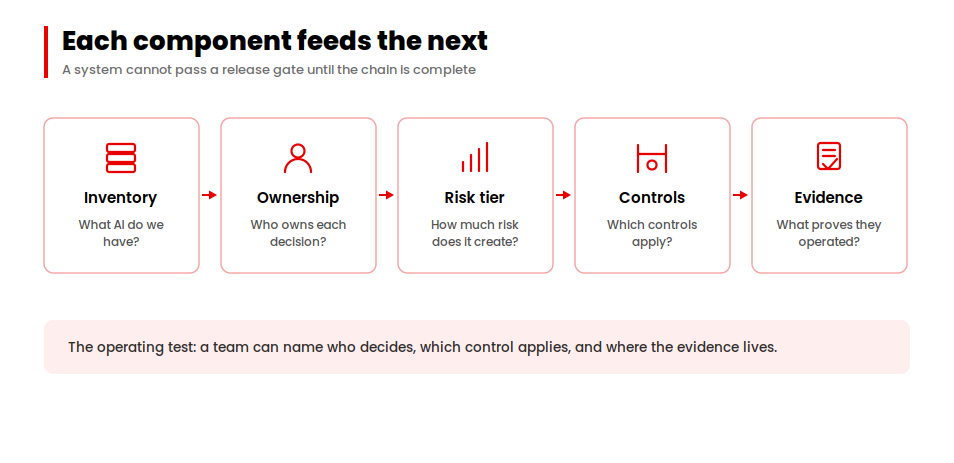
I test the framework through five questions:
- What AI do we have? Maintain an inventory of models, AI-enabled products, third-party services, prompts, data sources, and agents.
- Who owns each decision? Assign business, technical, risk, security, privacy, and incident responsibilities.
- How much risk does each system create? Classify systems using business impact, affected people, data sensitivity, autonomy, and regulatory exposure.
- Which controls apply? Tie the risk tier to design reviews, evaluations, access controls, approval gates, monitoring, and human oversight.
- What evidence proves those controls operated? Retain assessments, test results, approvals, logs, incident records, and retirement decisions.
The lifecycle begins when someone proposes a use case. Governance continues through design, development, release, operation, incident handling, and retirement.
Third-party AI belongs inside that scope. NIST includes risks arising from third-party software, data, hardware, and supply-chain relationships within its Govern function.[^1] An API call to a foundation model still creates data, ownership, monitoring, and contingency requirements for the company using it.
Regulations, contractual commitments, industry expectations, and internal risk appetite shape the framework. Legal counsel should interpret regulatory obligations for the company’s jurisdictions and use cases.
The framework’s operating test is simple: teams can identify who decides, which control applies, and where the evidence lives.
What Should an AI Governance Framework Include?
For a mid-market company, I build the framework around six connected components:
| Framework component | Decision it supports | Minimum useful output |
|---|---|---|
| Governance structure | Who can approve, reject, pause, or escalate an AI system? | Named owners and decision rights |
| AI inventory | Which models, vendors, data sources, prompts, and agents are in use? | Searchable system record |
| Risk classification | How much review and control does each system require? | Documented risk tier |
| Policies and controls | Which safeguards apply before and after release? | Control requirements by tier |
| Evidence management | How can the company demonstrate that a control operated? | Versioned assessment, test, approval, or log |
| Monitoring and response | What happens when behavior, context, or risk changes? | Thresholds, alerts, escalation, and rollback procedure |
Each component should feed the next. An inventory record supports the risk assessment, the risk tier selects the controls, and those controls determine the evidence required for release.
The framework also needs an exception process. Each exception should identify the approving authority, rationale, compensating safeguards, expiration date, and follow-up action.
Governance Roles and Decision Rights
I advise CTOs to separate accountability from participation. Several people can contribute to a review, while one named person remains accountable for the final decision.
A governance committee can coordinate legal, security, privacy, product, engineering, data, and business perspectives. Its charter should define which decisions it owns, which decisions stay with delivery teams, and when an issue reaches executive leadership.
NIST’s Govern function calls for documented responsibilities, clear communication lines, workforce training, and executive responsibility for AI development and deployment risk.[^1] I translate those outcomes into a decision-rights model:
| Role | Primary accountability | Typical decision right |
|---|---|---|
| Executive sponsor | Business purpose and risk acceptance | Fund, pause, or discontinue the use case |
| Business owner | Intended use and operational impact | Approve workflow use and human oversight |
| Product owner | Requirements and user impact | Accept product behavior within approved boundaries |
| Engineering or model owner | Technical performance and system operation | Approve technical readiness |
| Security and privacy owners | Access, data handling, and threat exposure | Require remediation before release |
| Governance approver | Risk-tier requirements and evidence completeness | Approve or reject the governance gate |
| Incident owner | Containment, escalation, and recovery | Disable, roll back, or restrict the system |
Decision rights should resolve difficult scenarios in advance. Who can disable a customer-facing feature during an incident? Who accepts residual risk after an evaluation exposes a known limitation? Who approves a provider change when the surrounding application code stays the same?
One person may hold several roles for a low-risk internal system. Higher-risk systems benefit from independent review, especially when the delivery owner faces launch pressure.
Ownership comes first.
AI Inventory and Risk Tiers
An AI inventory is a living record of systems that use or depend on AI. I include internally trained models, third-party model APIs, embedded SaaS features, generative applications, recommendation systems, and autonomous agents.
Each record should capture:
- Business purpose and prohibited uses
- Business owner and technical owner
- Users and affected groups
- Deployment status and environment
- Model or service provider
- Model and prompt versions
- Training, fine-tuning, and retrieval data sources
- Personal, confidential, or regulated data exposure
- Downstream systems and available actions
- Human-review requirements
- Geographic availability
- Risk tier and assessment date
- Monitoring owner
- Incident and retirement links
Architecture determines the inventory boundary. In the Dad Crafted Decor project, we built an AI-powered cabinet customization ecosystem combining digital space measurement, real-time visualization, smart design suggestions, and customized ordering.
The product included a Gemini large language model integration, kitchen reimagination, iOS and Android augmented reality, automated quote generation, role-based access, and real-time style switching. A model-only inventory would miss the permissions, customer interactions, visual outputs, and commercial workflows around that model.
The project’s recorded outcomes include reduced decision uncertainty, faster customization approvals, fewer revision cycles, and greater buyer confidence before order confirmation. Those outcomes came from the connected product workflow, so the governance boundary should cover that workflow too.
Once the inventory exists, assign risk tiers. This four-level model gives mid-market teams a practical starting point:
| Risk tier | Illustrative characteristics | Governance response |
|---|---|---|
| Tier 1: Limited | Internal productivity support, low-sensitivity data, advisory output | Registration, acceptable-use controls, basic owner review |
| Tier 2: Moderate | Customer-facing content or operational recommendations with human review | Documented evaluation, access control, output review, monitoring |
| Tier 3: High | Material influence over employment, health, financial, safety, or regulated decisions | Independent review, formal approval, stronger testing, detailed evidence |
| Tier 4: Autonomous or critical | Multi-step actions, external side effects, privileged tools, or limited human review | Explicit action permissions, runtime policy enforcement, approval checkpoints, rollback and containment |
This model is illustrative. Sector rules, legal obligations, contractual commitments, use cases, and risk appetite may require different labels or thresholds.
I consider several dimensions before assigning a tier:
- Severity of a plausible harmful outcome
- Number and type of people affected
- Sensitivity of the data
- Degree of decision influence
- Agent autonomy and tool access
- Reversibility of an action
- Ability to detect a failure
- Dependence on third-party models or data
- Geographic and regulatory exposure
- Quality of human review
A customer-support assistant and a hiring recommendation system may both generate text or scores. Their consequences differ sharply, so their control profiles should differ too.
Policies, Controls, and Evidence
A policy sets an expectation. A control converts that expectation into a required action, and evidence records that the action occurred.
Consider the policy statement, “AI systems must undergo appropriate testing before production use.” The framework must define appropriate testing by risk tier, identify the approver, set pass criteria, and store the results.
| Layer | Example | Owner | Evidence |
|---|---|---|---|
| Policy | Sensitive customer data requires approved handling | Executive or policy owner | Published and approved policy |
| Standard | Tier 3 systems require privacy and security review | Governance owner | Standard mapped to risk tiers |
| Control | Block production release until both reviews pass | Engineering and governance | Workflow approval record |
| Test | Evaluate unauthorized data disclosure scenarios | Security or evaluation owner | Versioned test results |
| Monitoring | Alert on suspected sensitive-data exposure | Operations owner | Alert and investigation log |
Collect evidence within the delivery workflow. Reconstructing it months later creates gaps around versions, reviewers, assumptions, exceptions, and production conditions.
Common evidence artifacts include:
- Use-case registration
- Risk and impact assessment
- Data-source documentation
- Model card or system card
- Threat model
- Privacy assessment
- Evaluation plan and results
- Human-oversight design
- Vendor review
- Release approval
- Change record
- Monitoring dashboard
- Incident log
- Retirement record
A model card records a model’s intended use, evaluations, limitations, and relevant data or performance considerations. A system card extends the view to prompts, retrieval sources, tools, guardrails, interfaces, and human workflows around the model.
Governance evidence also exposes AI technical debt. Undocumented prompts, unclear dependencies, weak evaluation coverage, and unowned monitoring rules accumulate delivery risk.
Evidence closes the loop.
How to Build an AI Governance Framework
The AI governance framework development process should begin with visibility and ownership. Policies become more precise once teams know which systems exist, who operates them, and how those systems can affect people or business processes.
I use a phased implementation because mid-market companies have finite review capacity:
| Phase | Primary objective | Core outputs | Illustrative planning window |
|---|---|---|---|
| Phase 1 | Establish visibility and ownership | Scope, inventory, owners, decision charter | Weeks 1–3 |
| Phase 2 | Classify risk and select controls | Risk method, tiers, control profiles | Weeks 3–6 |
| Phase 3 | Integrate release gates and evidence | Workflow gates, templates, repository | Weeks 6–9 |
| Phase 4 | Monitor production and handle incidents | Thresholds, alerts, response process | Weeks 9–12 and ongoing |
These windows are planning assumptions for a focused initial rollout. Portfolio size, regulated use cases, procurement dependencies, existing risk processes, and engineering capacity can change the schedule.
Start with visibility.
Phase 1: Inventory and Ownership
Define the scope first. Decide how the initial framework will cover production systems, pilots, third-party tools, employee use of public generative AI, embedded SaaS capabilities, and systems under procurement.
I prefer broad discovery with prioritized control implementation. This surfaces company-wide exposure while directing the deepest assessment toward systems with meaningful impact.
Use several discovery channels:
- Product and engineering interviews
- Cloud and API usage reviews
- Procurement and vendor records
- Software-license data
- Security architecture documentation
- Data science and MLOps repositories
- Employee surveys
- Product roadmaps and experiment backlogs
MLOps means the engineering practices used to deploy, version, monitor, and maintain machine-learning systems. Its repositories and pipelines often reveal models that procurement records or policy reviews missed.
Every discovered system needs a provisional business owner and technical owner. An unowned system should stay out of production until someone accepts accountability.
The first governance charter should define:
- Scope of authority
- Membership and named decision owners
- Risk decisions reserved for executives
- Review cadence
- Escalation path
- Emergency authority
- Exception process
- Record-retention responsibility
Measure inventory coverage against procurement records, repositories, provider accounts, and business-unit declarations. The baseline is useful only when it reflects the real portfolio.
Phase 2: Risk Tiers and Controls
Next, define the risk taxonomy and control profiles. A control profile is the set of safeguards required for a risk tier or use-case category.
Keep the first scoring method understandable. If every classification requires a specialist interpreter, adoption will suffer and teams will apply the method inconsistently.
A practical assessment covers:
- Intended purpose and foreseeable misuse
- Affected users or groups
- Decision impact
- Data classification
- Model capability
- Autonomy
- External communication
- Security exposure
- Third-party dependency
- Human-review quality
- Failure detectability
- Reversibility
- Legal and contractual considerations
Map each tier to required controls. Tier 1 may require registration and an owner review. Tier 3 may add independent evaluation, privacy and security approval, detailed documentation, executive risk acceptance, and enhanced monitoring.
Control depth should also reflect system type. A predictive model needs data-quality, performance, fairness, and drift controls. A generative application adds prompt, retrieval, output, and misuse controls. An agent adds permissions, tool restrictions, action approvals, and rollback.
The risk register should link each risk to:
- System and owner
- Risk statement
- Cause and plausible impact
- Existing control
- Planned treatment
- Residual risk
- Approver
- Review date
- Evidence location
NIST describes AI risk management as an iterative use of Govern, Map, Measure, and Manage. Govern establishes accountability, Map establishes context, Measure evaluates identified risks, and Manage prioritizes and responds to them.
Context drives the measurement. Thresholds and owners turn that measurement into action.
Phase 3: Release Gates and Evidence
A release gate is a checkpoint that holds an AI system or material change until required conditions are satisfied. Gates can operate during intake, design, development, staging, production release, and major post-release changes.
Delivery teams should know the evidence requirements while planning the work. A broad evaluation request introduced immediately before launch creates weak testing and pressure for exceptions.
For each risk tier, define:
- Required reviewers
- Required artifacts
- Evaluation categories
- Pass and escalation thresholds
- Open-risk treatment
- Exception authority
- Approval validity period
- Change events requiring reassessment
Integrate the gate with systems engineers already use. A ticketing workflow can collect approvals, a document repository can hold assessments, and a continuous integration and continuous delivery pipeline can enforce release status.
Continuous integration and continuous delivery (CI/CD) is the automated process used to test and release software changes. For AI systems, the pipeline can also verify approved model versions, evaluation results, policy checks, and environment restrictions.
A release evidence package should answer:
| Evidence category | Questions for the approver |
|---|---|
| Purpose and ownership | Who owns the use case, operation, and incident response? |
| Architecture | Which models, prompts, data sources, tools, and vendors are involved? |
| Risk decision | Which tier applies, who assigned it, and when will it be reviewed? |
| Evaluation | Which scenarios were tested under the current version and configuration? |
| Security and privacy | Which threats and data exposures were reviewed? |
| Human oversight | Where can a person inspect, reject, or reverse an outcome? |
| Operational readiness | Which metrics, thresholds, alerts, and rollback steps are active? |
| Approval | Who accepted the remaining risk, and for how long? |
Version the evidence against the system configuration. A report for one model, prompt, retrieval index, or tool configuration may lose relevance after any of those components change.
Material-change triggers commonly include switching model providers, changing system prompts, adding a data source, expanding to a new user population, granting a new agent tool, changing an evaluation threshold, or entering a new jurisdiction.
Release only what you can trace.
Phase 4: Monitoring and Incidents
Production behavior can change while application code stays stable. User behavior shifts, retrieved content changes, providers update models, and attackers discover new input patterns.
Monitoring should connect technical signals with business consequences. Latency and token counts reveal little about harmful outputs, failed actions, or degrading decision quality.
Depending on the system, I monitor:
- Task success and failure
- Accuracy or quality indicators
- Data and model drift
- Hallucination and unsupported-claim rates
- Harmful or prohibited content
- Prompt-injection attempts
- Retrieval quality
- Sensitive-data exposure
- Bias or outcome disparities
- Human override rates
- Agent tool calls
- Permission denials
- Failed and reversed actions
- Complaints and user feedback
- Provider outages or model changes
Drift means the data, user behavior, environment, or model performance has changed enough to weaken earlier assumptions. A threshold should identify when drift requires investigation, reassessment, or retraining.
The incident process should define severity, triage ownership, containment authority, notification rules, evidence preservation, root-cause analysis, and return-to-service criteria. It should connect with existing security and operational incident processes.
Containment options include disabling a feature, removing a tool permission, switching models, forcing human review, restricting affected users, reverting a prompt, isolating a retrieval source, or rolling back a release.
Post-incident work should update the risk register, tests, controls, prompts, training material, and approval criteria. NIST describes governance as a cross-cutting and continuous function across the AI lifecycle.
The incident changes the framework.
Build an AI Governance Framework That Scales
Create a practical AI governance model with clear ownership, risk controls, and production safeguards.
How NIST AI RMF and ISO/IEC 42001 Fit Together
The NIST AI RMF and ISO/IEC 42001 address related governance needs from different angles. I use them together when the combination fits the organization’s objectives, obligations, and operating environment.
The NIST AI RMF is a voluntary framework for incorporating trustworthiness considerations into the design, development, use, and evaluation of AI systems.Its Core uses four functions: Govern, Map, Measure, and Manage.
ISO/IEC 42001:2023 specifies requirements for establishing, implementing, maintaining, and continually improving an Artificial Intelligence Management System, commonly shortened to AIMS. It uses a management-system approach for policies, objectives, responsibilities, review, and continual improvement.
| Decision area | NIST AI RMF | ISO/IEC 42001 |
|---|---|---|
| Primary role | AI risk-management outcomes and actions | Requirements for an organizational AI management system |
| Core structure | Govern, Map, Measure, Manage | Establish, implement, maintain, and continually improve AIMS |
| Typical implementation use | Structure risk analysis, measurement, treatment, and profiles | Structure policy, responsibility, planning, review, and improvement |
| Adoption model | Voluntary and adaptable | International management-system standard |
| Certification context | NIST defines no AI RMF certification | Can support formal management-system certification where pursued |
| CTO value | Common language for risk decisions and technical controls | Repeatable organizational system for AI responsibility |
I map the operating model in two directions. The management-system layer establishes ownership, policy control, review, and improvement. The risk layer structures how teams understand context, evaluate behavior, and select treatment.
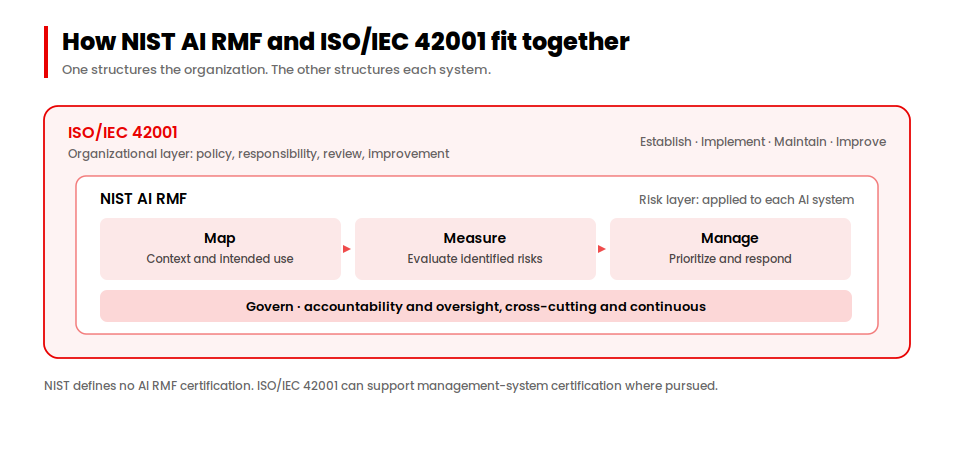
For example, ISO/IEC 42001 can structure the policy-management and review process. The NIST AI RMF can structure risk outcomes within individual systems or portfolios.
NIST states that AI RMF 1.0 is being updated, with a revised version in progress. Framework owners should assign someone to monitor revisions and assess their effect on controls, profiles, and terminology.
ISO/IEC 42001 applies to organizations that develop, provide, or use AI-based products and services. Certification goals, customer commitments, sector rules, and procurement requirements should determine how extensively the standard is implemented and audited.
Map every requirement or outcome to a live owner, workflow, and artifact.
Generative and Agentic AI Governance Controls
Generative and agentic AI introduce risks tied to prompts, retrieved information, model updates, memory, tools, permissions, and runtime context.
A generative AI system creates content such as text, images, audio, code, or structured data. An agentic AI system can plan multiple steps, use tools, and take actions toward a goal with some degree of autonomy.
Actions change the risk.
| Control area | Generative AI focus | Agentic AI focus |
|---|---|---|
| Instructions | System prompts, templates, and prompt versions | Goals, policies, plans, and action constraints |
| Data | Training, fine-tuning, and retrieval sources | Data plus tool inputs, memory, and action context |
| Evaluation | Quality, grounding, safety, privacy, bias | Goal completion, policy compliance, action safety |
| Access | User access and data permissions | Tool permissions and delegated authority |
| Oversight | Output review and escalation | Approval before sensitive or irreversible actions |
| Monitoring | Outputs, prompt attacks, retrieval, model behavior | Tool calls, action chains, denied actions, side effects |
| Recovery | Disable feature, revert prompt or model | Revoke tools, stop execution, roll back actions |
Generative AI Controls
A generative AI governance framework should treat prompts, retrieval configurations, evaluation sets, and model versions as governed system components. Each one can alter behavior without a conventional application release.
Prompt and instruction management: System prompts need an owner, version history, approved purpose, protected storage, test coverage, and change process. Test prompt-injection scenarios where a user or retrieved document attempts to override system instructions.
Retrieval governance: Retrieval-augmented generation, or RAG, supplies selected information to a model at request time. Govern source approval, permissions, indexing, freshness, deletion, citation behavior, and malicious-content defenses.
Output evaluation: Create evaluation sets that reflect real tasks, risky edge cases, prohibited requests, and affected user groups. Test factual grounding, task success, safety, privacy, bias, and refusal behavior where relevant.
Data protection: Define which data can enter prompts, logs, fine-tuning pipelines, and retrieval stores. Apply retention, redaction, access, encryption, and provider controls based on data classification.
Model and provider changes: Track the provider, model, version, configuration, region, and contract terms. Reassess changes that can affect capability, safety behavior, data handling, latency, or cost.
Runtime monitoring: Monitor unsupported claims, unsafe outputs, sensitive-data exposure, refusals, complaints, and retrieval failures. Each threshold needs an owner and a documented response.
Store enough context to investigate an event while respecting privacy and retention requirements. Design that balance before production logging begins.
Agentic AI Controls
An agentic AI governance framework must define which actions an agent may take, under which conditions, and using whose authority.
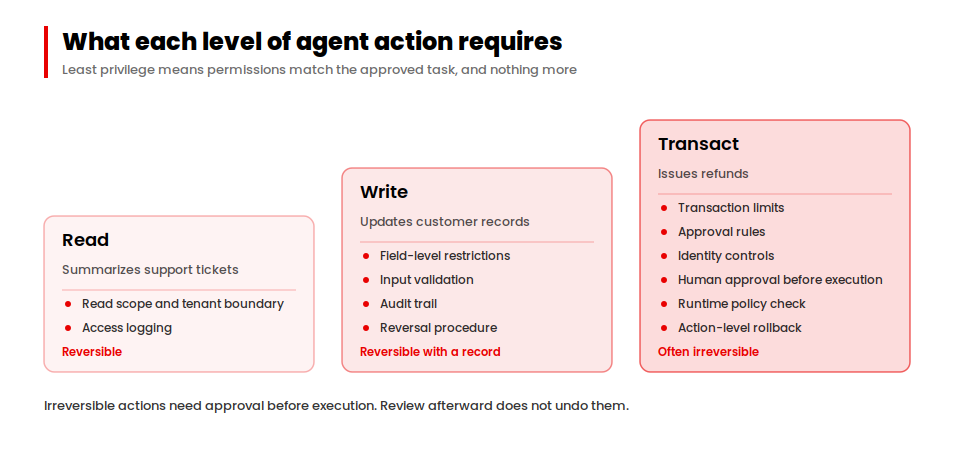
I start with least privilege. Least privilege means the agent receives only the permissions required for its approved task and only for the necessary duration and context.
An agent that summarizes support tickets may need read access. An agent that updates customer records needs write access, field-level restrictions, validation, and an audit trail. An agent that issues refunds needs transaction limits, approval rules, and identity controls.
Define the permission model across:
- Allowed and prohibited tools
- Read, write, delete, and execute rights
- Data scopes and tenant boundaries
- Transaction limits
- Time restrictions
- Network destinations
- Credential storage
- Approval thresholds
- Maximum execution steps
- Maximum cost or resource use
Place human approval before high-impact, irreversible, or externally visible actions. The approval interface should show the planned action, relevant inputs, expected effect, and any policy warning.
Agents also need runtime policy enforcement. A deterministic control should check each proposed action against permissions and business rules before execution.
Log the initiating user, agent and prompt version, tool, arguments, authorization decision, result, timestamp, and approval. Step, time, tool-call, and resource limits help contain loops and repeated failed actions.
Rollback should be designed at the action level. Reversing a database update differs from retracting an email, cancelling a payment, or restoring deleted data. Irreversible actions require stronger pre-action approval.
Monitor unusual tool sequences, repeated permission denials, unexpected destinations, excessive retries, policy violations, and divergence from the approved goal. Kill switches and credential revocation should operate independently of the agent.
The agent must stop on command.
AI Governance Framework Implementation Checklist
I use this checklist to assess whether an enterprise AI governance framework can support production decisions. Evidence is the real test.
Scope and Ownership
- Governance scope covers internally built, acquired, embedded, generative, and agentic AI.
- Every system has a business owner and technical owner.
- High-impact risk acceptance has a named executive authority.
- Governance committee responsibilities and escalation paths are documented.
- Emergency pause and rollback authorities are clear.
- Exceptions have approvers, expiration dates, and compensating controls.
Inventory and Classification
- A central AI inventory exists.
- Inventory records include model, data, prompts, retrieval, tools, owners, and deployment status.
- Third-party AI and embedded SaaS capabilities are included.
- Risk tiers use documented criteria.
- Classification considers impact, data, autonomy, reversibility, and affected groups.
- Material changes trigger reassessment.
Policy and Control Design
- Acceptable and prohibited uses are defined.
- Control profiles are mapped to risk tiers.
- Security, privacy, legal, product, and engineering responsibilities are aligned.
- Vendor and model-provider reviews are defined.
- Human-oversight requirements are specific.
- Generative AI and agent controls are covered separately where needed.
Evaluation and Release
- Evaluation plans reflect intended use and foreseeable misuse.
- Test sets include representative and high-risk scenarios.
- Pass, fail, and escalation thresholds are defined.
- Release gates integrate with engineering workflows.
- Evidence is versioned against the model, prompt, data, and configuration.
- Residual risks have an accountable approver.
- Approval duration and review dates are recorded.
Production Monitoring
- Technical and business-risk metrics have owners.
- Alert thresholds connect to documented actions.
- Provider and model changes are monitored.
- Human overrides, complaints, and incidents feed governance reviews.
- Agent tools and actions are logged.
- Kill switches, access revocation, and rollback procedures are tested.
Incident and Retirement Management
- AI incidents use defined severity levels.
- Containment authority is available outside normal review cycles.
- Logs preserve enough context for investigation.
- Root-cause findings update tests and controls.
- Retirement includes access removal, data handling, record retention, and dependency review.
- Inventory records reflect retired or replaced systems.
Mark each item as implemented, partially implemented, planned, inapplicable, or unowned. Then prioritize gaps using portfolio risk.
Useful operating indicators include inventory coverage, systems with named owners, overdue reviews, unresolved high-risk findings, monitoring coverage, expired exceptions, and incident-response test completion.
Fix the unowned high-risk gaps first.
When to Get Implementation Support
Implementation support becomes useful when the framework spans more teams, systems, or obligations than one internal owner can coordinate.
Common signals include:
- Business units maintain separate inventories or review methods.
- Security, legal, product, and engineering use conflicting risk definitions.
- High-impact systems lack independent evaluation.
- Evidence is assembled manually before customer or audit requests.
- Teams cannot identify which model, prompt, or retrieval version produced an outcome.
- Agents have broad credentials or unclear approval boundaries.
- Existing software-release processes lack AI-specific change triggers.
- Leadership lacks a portfolio-level view of risk and exceptions.
- ISO/IEC 42001 alignment or certification preparation is under consideration.
- NIST AI RMF outcomes need to be translated into technical controls.
The scope of support should match the gap. Some companies need a governance operating model, while others need engineering implementation across inventory tooling, workflow gates, evaluation pipelines, monitoring, and agent permissions.
The following table is a qualitative planning aid. It uses relative impact because approved pricing data was unavailable for this guide.
| Cost and effort driver | Lower relative impact | Higher relative impact |
|---|---|---|
| Portfolio size | Small, known set of AI systems | Distributed portfolio with shadow or embedded AI |
| Risk profile | Internal advisory use cases | Regulated, customer-impacting, or safety-related decisions |
| Architecture | One model and a contained workflow | Multiple providers, retrieval sources, tools, and agents |
| Existing controls | Mature security, privacy, risk, and CI/CD processes | Fragmented processes and manual approvals |
| Evidence state | Versioned tests and release records already exist | Evidence must be reconstructed |
| Geographic reach | One primary operating context | Multiple jurisdictions and contractual regimes |
| Agent autonomy | Read-only or recommendation use | Write, execute, communicate, or transact permissions |
| Assurance objective | Internal operating baseline | Customer assurance, formal audits, or certification preparation |
An implementation partner should be able to move between policy design and technical enforcement. Ask how risk tiers become release gates, how evaluation evidence is versioned, and how agent actions are constrained at runtime.
AppVerticals’ AI governance services cover governance operating models and technical implementation. A useful engagement starts with the current portfolio, decision rights, delivery workflow, and highest-risk gaps.
My first action would be to identify every production or customer-facing AI system and assign a business owner, technical owner, and provisional risk tier. That baseline shows where policy, engineering controls, and operational evidence need attention.
Start there.
Conclusion
AI governance is no longer a policy document that sits with legal or compliance teams. As AI systems become embedded into products, workflows, and customer experiences, governance needs to become part of the engineering lifecycle. The companies that build clear ownership models, risk controls, monitoring processes, and decision frameworks early will be better positioned to scale AI safely without slowing innovation.
A practical AI governance framework creates the structure needed to move from AI experimentation to responsible production, ensuring every system has the right oversight, measurable controls, and accountability throughout its lifecycle.
Build Reliable AI Systems With the Right Foundation
Explore our approach to building secure, scalable, and production-ready AI solutions.
Explore AI Development Services