















 ChatGPT
 Perplexity
 Claude
 Google AI
AI in software development is the use of machine learning and generative AI across the software development lifecycle (SDLC), from generating and reviewing code to writing tests, documentation and release notes. Used well, it lets engineers spend less time typing and more time on architecture, validation and judgment. The raw capability is already here. On SWE-bench, a benchmark of real coding tasks, the AI solve rate jumped from 4.4% in 2023 to 71.7% in 2024. Yet most teams we work with do not see that lift in production and the reason sits upstream of the model, in the quality of the data and context the AI has to work with.
Adoption has run ahead of readiness. 84% of developers now use or plan to use AI tools, according to Stack Overflow’s 2025 survey, which means most codebases are already absorbing AI output whether or not they were prepared for it.
Key Takeaways
- AI in software development now spans the whole SDLC, from code generation to testing, review and documentation.
- Model capability is no longer the bottleneck, with AI solving 71.7% of SWE-bench coding problems, up from 4.4% two years earlier.
- Most failures trace to weak data and context, such as undocumented code, missing conventions and no retrieval layer.
- The cost is measurable, with duplicated code up roughly eightfold and delivery stability down 7.2% as AI adoption rises.
- AI code assistants suggest, while autonomous AI agents act, so each needs a different level of oversight.
- AI writes production-ready code only inside a review and test system that reliably catches its errors.
- The Data-Readiness Ladder gives teams five stages to move from ungoverned prompting to governed AI in CI/CD.
- Fix the inputs first and AI compounds value across the codebase instead of technical debt.
What Is AI in Software Development?
AI in software development refers to systems that use machine learning and generative models to write, review, test, explain and maintain software. It covers everything from in-editor autocomplete and chat assistants to retrieval pipelines that ground answers in your own code and autonomous agents that carry a task from a ticket to a pull request.
The practical shift is in where engineers spend their attention. Instead of typing every line, a developer describes intent and the AI drafts an implementation the developer then shapes, corrects and approves. The craft moves toward specification, review and system design. That shift is real and useful. It also creates the exact failure mode this article is about: an AI that drafts confidently against poor context produces plausible, wrong output at speed.
How to Use AI in Software Development?
AI is used at every stage of the SDLC and the value it adds depends heavily on how well each stage is documented and instrumented. The table below maps the common use of ai in software development we see in client work, along with the part of the job that stays human.
| SDLC stage | What AI does well | What stays a human decision |
|---|---|---|
| Planning and requirements | Drafts user stories, summarizes tickets, surfaces edge cases and ambiguities | Prioritization, scope and trade-off calls |
| Coding | Autocomplete, boilerplate, scaffolding, converting between languages | Architecture, naming and whether to reuse or create |
| Testing and QA | Generates unit tests, edge cases and synthetic test data | Coverage strategy and reviewing assertions for intent |
| Code review | Summarizes diffs, flags smells, proposes fixes | Judging intent and approving the merge |
| Documentation | Drafts docs, comments, changelogs and release notes | Verifying accuracy against real behavior |
| Maintenance | Explains legacy code and proposes refactors | Deciding what to consolidate and what to leave |
Notice the pattern. AI is strongest where the input is clear and the output is checkable and weakest where context is missing and correctness is subjective. That single observation predicts most of what follows.
Why AI in Software Development Underdelivers: The Data and Context Problem
The models are good. In my experience, the gap between a team that gets 2x leverage from AI and a team that quietly ships more defects comes down to what surrounds the model: the codebase, the conventions, the retrieval context and the review gates. An AI assistant sees a narrow window of your project and fills the rest from patterns in its training data. When your own context is thin, it guesses and it guesses in a way that looks right.
The measurable fallout is now well documented. GitClear analyzed 211 million changed lines of code and found that in 2024, duplicated code blocks appeared roughly eight times more often than before and copy-pasted code outpaced refactored code for the first time in their dataset. Duplication is the signature of an assistant that cannot see your existing helpers, so it re-implements them. Every clone becomes a place a future bug or security fix has to be applied again.
Delivery data tells the same story. Google’s 2024 DORA research found that for every 25% increase in AI adoption, teams saw an estimated 7.2% drop in delivery stability. The reason is not that the code is garbage. It is that AI makes it easy to ship larger, faster changes and larger changes strain teams that lack strong testing and review. The 2025 DORA report confirms the same tension, noting that AI adoption still carries a negative relationship with stability unless control systems catch up.
Even individual productivity is less obvious than the marketing suggests. In a randomized controlled trial, METR found that experienced open-source developers were actually 19% slower with early-2025 AI tools on their own mature repositories, even though they believed they were faster. On complex, well-understood code, the overhead of prompting, reading and correcting AI output can exceed the time it saves. That is a context problem.
The most expensive mistake we see. A team switches on AI autocomplete across an undocumented legacy codebase and ships a sprint of duplicated, lightly tested code. Three weeks later, the data the AI depended on turns out to live in five places with no consistent schema. That is not a bug you patch. It is a reset. The readiness conversation has to happen before the first sprint.
AI Code Assistant vs Autonomous AI Agent: What Is the Difference?
An AI code assistant suggests and an autonomous AI agent acts. That difference sounds small and changes almost everything about how you govern it. An assistant proposes a line or a block that a developer accepts or rejects in the editor. An agent takes a goal, plans steps, calls tools, edits multiple files, runs tests and reports back, with far less human input between steps.
How AI code assistants and autonomous AI agents differ
| Dimension | AI code assistant | Autonomous AI agent |
|---|---|---|
| Core action | Suggests code and answers | Executes a multi-step task |
| Scope | A line, function or file, in the editor | Across files, tools and repositories |
| Human role | Accept or reject each suggestion | Set the goal, approve at checkpoints |
| Best for | Autocomplete, boilerplate, explanations, tests | Ticket-to-PR work, test-and-fix loops, migrations |
| Main risk | Silent duplication and wrong context | Small errors compounding across steps |
| Oversight needed | Per-suggestion review | Guardrails, approval gates and logging |
The governance jump between the two is the part teams underestimate. An assistant’s mistakes are visible and local. An agent’s mistakes can propagate before anyone looks. We cover the operating model for this in more depth in my guide to agentic AI for businesses.
Which of the two you reach for also feeds a build-or-buy decision. An assistant usually rides on a commercial API, while heavier agent work on proprietary data can justify a tailored model. We walk through where that line sits and what it costs in custom AI development.
How Are AI Agents Used in Software Development?
AI agents are used to own repeatable, multi-step engineering tasks end to end, under supervision. The strongest current use cases are the ones where a person was already acting as glue between systems and where success is measurable. These workflows are becoming the foundation of agentic AI software development, where teams use AI agents to handle broader parts of the software lifecycle while maintaining human oversight.
A few that hold up in production:
Agents triage a bug report, reproduce it, propose a fix, open a pull request and attach the failing and passing tests. They run dependency upgrades across a repository and fix the breakages. They convert a legacy module to a new framework, one reviewed pull request at a time. They generate and maintain documentation as code changes. In each case, the agent handles the mechanical breadth while an engineer sets the goal and approves the merge.
The teams getting value from agents keep scope narrow and instrument everything. The ones that struggle hand an agent a vague mandate and a messy codebase, then wonder why the demo never reached production. Moving from a promising pilot to a reliable system is its own discipline, which we break down in AI integration services.
Can AI Write Production-Ready Code?
AI can write production-ready code but only inside a system that reliably catches its mistakes. The model will produce code that compiles and looks correct. Whether that code is safe to merge depends on your tests, your review and your ability to trace what the AI assumed. Treat AI output as a confident draft from a fast junior engineer who has never seen your architecture.
The survey data backs the caution. In Stack Overflow’s 2025 survey, 45% of developers said debugging AI-generated code takes more time than expected and trust in AI accuracy fell even as usage rose. The lesson is not to slow down. It is to put the verification layer in place first, so speed does not turn into rework.
How to Use AI in Software Development: The Data Readiness Ladder
Over the last few years of shipping AI into live products, we kept seeing the same thing. The result an AI delivers is capped by the level of context and control around it. So we describe readiness as a ladder. Each rung raises the ceiling on what AI can safely do in your codebase. You do not need to reach the top to start but you should know which rung you are on before you scale.
The Data-Readiness Ladder (climb L0 to L4)
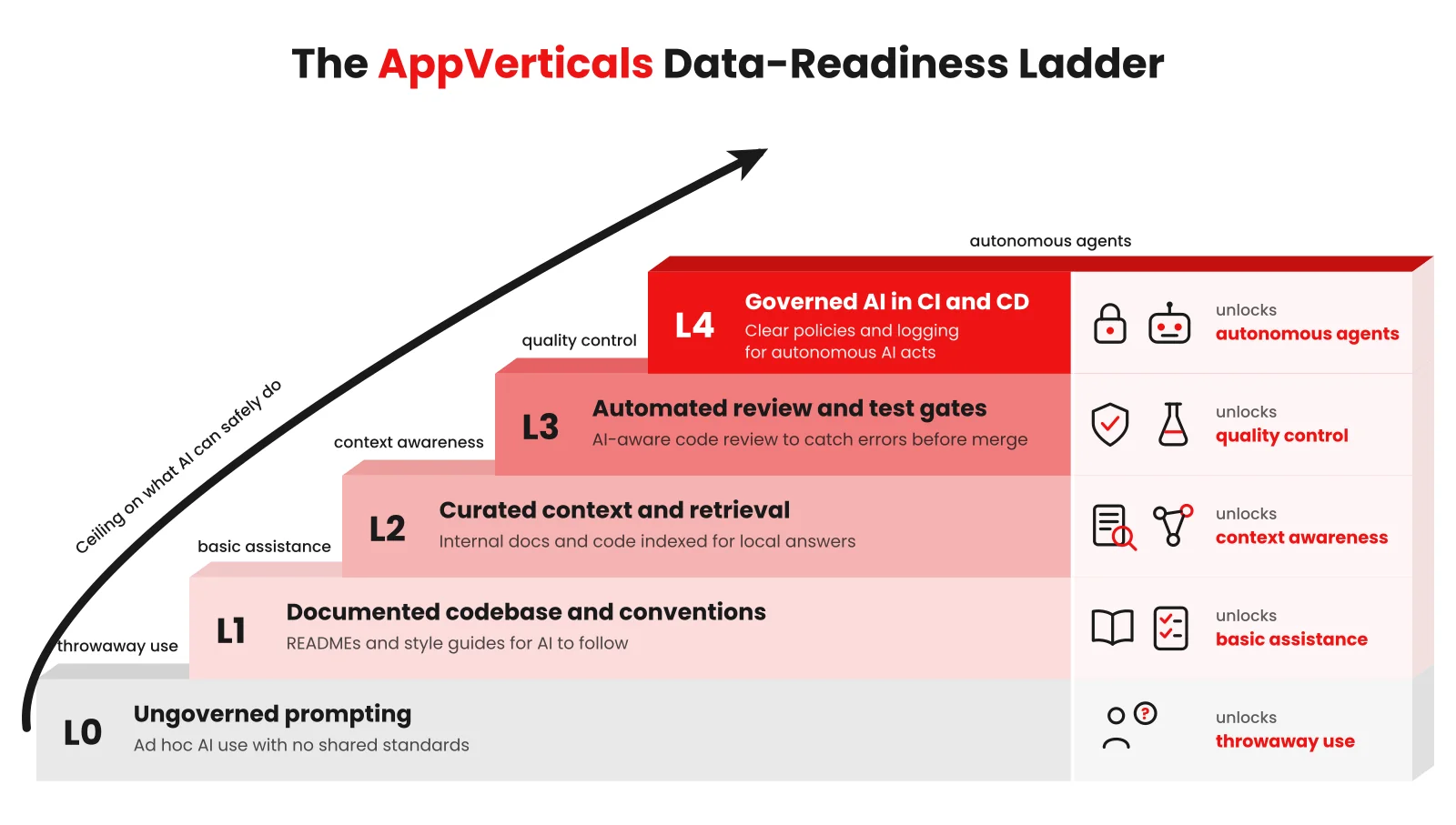
Most teams we meet are stuck between L0 and L1 and blame the model for weak results. The fix is unglamorous. Document the codebase, index your own context and put review and test gates in front of every AI-assisted change. In my experience, standing up L1 to L3 for a mid-sized codebase is usually a matter of a few focused engineering weeks, not a full quarter.
Not sure which rung you are on?
We assess your codebase, data and review gates, then build the readiness layer AI needs to perform.
Explore our Generative AI Development services
Benefits of AI in Software Development When the Data Is Ready
Once a team is on the higher rungs, the benefits stop being anecdotal. AI removes the mechanical drag from engineering: it drafts boilerplate, generates first-pass tests, explains unfamiliar code and turns a change into a documented pull request. That frees senior engineers for the work that actually moves a product, which is design, trade-offs and correctness.
The same leverage shows up in specialized builds. On mobile teams, AI scaffolds platform-specific screens, generates test data for device edge cases and drafts the boilerplate that differs between iOS and Android, which frees the team to focus on performance and user experience. We look at those use cases in the AI in mobile apps guide.
McKinsey’s research on developer productivity found that AI can help engineers complete some tasks in roughly half the time, while also noting that the gains shrink or disappear on complex tasks unless developers know how to direct the tool. That caveat is the whole game. The benefit is available to teams that have done the context and review work and it stays out of reach for teams that have not. Generative AI is also reshaping how businesses build software more broadly, a theme we explore in generative AI in business.
Risks, Security and Copyright Considerations
The risks of AI-generated code are manageable once you name them. Hallucinated APIs and libraries slip into code that compiles but fails in edge cases. Duplicated logic spreads maintenance cost across the codebase. Security weaknesses appear when generated code copies insecure patterns from training data. Copyright and licensing exposure arises when output resembles protected source. And over-reliance quietly erodes the team’s ability to catch these problems at all.
Every one of these is a governance and testing question before it is a model question. High-stakes output gets a human review checkpoint. Generated code goes through the same tests and static analysis as any other code, ideally stricter. Provenance and logging make it possible to trace what the AI produced. Ownership is assigned, so a specific person is accountable for what merges. The DORA stability findings and GitClear’s duplication data are both symptoms of skipping this layer, not arguments against AI.
The Future of AI in Software Development
The near future is less about smarter models and more about teams learning to integrate them. The 2025 DORA report already shows this shift, with throughput recovering as organizations build the testing and platform foundations that let AI accelerate them without breaking stability. Agents will take on more multi-step work and the human role will keep moving toward specification, review and system design.
My prediction is simple. As models converge in capability, the durable advantage moves to whoever engineers their data and context best. The codebase that is documented, indexed, tested and governed will get compounding returns from each new model. The one that is not will keep paying interest on technical debt. That is why we treat readiness and not model selection as the first conversation with a client. It is also the groundwork covered in how to prepare your organization for AI adoption.
Final Thoughts
The capability question is settled. AI can read, write and reason about code well enough to change how software gets built. The open question for your team is whether the data and context around the model are ready to turn that capability into stable, maintainable software. On the low rungs of the ladder, AI compounds technical debt. On the high rungs, it compounds value.
If you are planning to embed AI across your SDLC, start with readiness and the results will follow. That is the work we do with clients before a single line of AI-assisted code ships.
Ready to make AI work in your SDLC?
We assess your data, context and review gates, then build AI into your delivery pipeline without trading speed for technical debt.
Explore our Generative AI Development services →
Keep reading: How to Prepare Your Organization for AI Adoption, the data, governance and workforce groundwork that has to be in place first.