













 ChatGPT
 Perplexity
 Claude
 Google AI
The build cost is the number clients budget for. The inference cost is the number that surprises them six months later when the product has users and every active session is quietly adding to an API bill nobody modeled.
AI app development cost ranges from about $15 a month for a no-code prototype to more than $300,000 for a custom, enterprise-grade app built on proprietary models. Most business apps with AI features, such as a GPT or Claude-powered assistant, recommendations or document analysis, cost between $40,000 and $150,000 to build, plus inference and maintenance that scale with usage. The biggest drivers are your development approach, data readiness, integration depth and how much traffic the AI must serve. The cost that surprises teams most is not the build but the per-call API cost that grows with every active user.
I’ve scoped and built AI features across enough products to know where the real budget surprises come from. This article walks through every cost layer, from the upfront build to the monthly run bill that follows it.
For a wider market context on adoption rates and where budgets are heading, our AI in app development statistics guide pairs well with the cost ranges in this article.
How Much Does AI App Development Cost? (ranges by app type)
AI app development cost depends almost entirely on which of four build paths you choose because each path carries a different mix of engineering effort, AI sophistication and ongoing run cost. A no-code prototype that wires a drag-and-drop builder to an off-the-shelf API can be live for the price of a monthly subscription, while a custom enterprise platform with fine-tuned, proprietary models can run past $300,000 before it ever serves a single user at scale. Understanding where your idea sits on that spectrum is the fastest way to turn a vague budget into a number you can actually plan around.
The table below maps the four most common AI app types to what each one typically includes, the build cost you should expect, a realistic timeline and the ongoing monthly cost that follows launch. Because the largest variable for most teams is the post-launch run cost rather than the build, the final column matters as much as the headline price.
| App type | What’s included | Typical build cost | Timeline | Ongoing monthly cost |
|---|---|---|---|---|
| No-code prototype | Drag-and-drop app plus an API key | $15 to $500 per month | 1 to 3 weeks | $15 to $500 |
| AI API-integrated app | App shell plus one AI feature on an API | $25K – $50K | 4 to 6 weeks | API usage plus hosting |
| Mid-complexity AI app | Custom features plus integrations | $50K – $100K | 3 to 4 months | API plus infra plus upkeep |
| Custom or enterprise AI app | Proprietary or fine-tuned models | $150K – $300K+ | 4 to 6+ months | Infra plus retraining (15 to 25 percent per year) |
Choosing the right app type for your stage
A no-code prototype is the right starting point when you need to validate an idea quickly rather than ship a production product, since it lets you put an AI feature in front of real users in days without committing engineering budget. The AI API-integrated app is where most funded startups and mid-market teams begin because it pairs a properly built app shell with a single high-value AI feature running on a managed API, which keeps the upfront cost contained while still delivering a polished experience.
Mid-complexity and enterprise builds become justified once your usage volume, compliance requirements or differentiation strategy demand deeper integration, custom model behavior or infrastructure you control end to end.
What else does AI app development cost beyond the AI layer?
It is worth noting that the AI layer is only one part of the bill because every figure above must also cover the mobile app the model sits inside: the interface, frontend, backend, authentication, security and work required to publish it in the app stores.
This is precisely the gap that most generic AI cost guides leave open because they price the model or the solution rather than a complete, shippable app with intelligence built into it.
If you are comparing this against a conventional build, our breakdown of app development cost covers that base layer in detail, including how AI integration and inference change the math.
What Drives the Cost of AI App Development?
The cost of AI app development is driven primarily by your development approach, the readiness of your data, the depth of your integrations and the volume of usage the AI must serve after launch. These four factors explain most of the difference between a $40,000 build and a $300,000 one and they interact with each other, which is why two apps that look similar on paper can carry very different price tags. Understanding each factor individually makes it far easier to see which levers you can pull to bring a number down without gutting the product.
Development approach and data readiness
Development approach is the single largest determinant because the choice between a no-code platform, an AI API and a custom model sets the floor for everything else. A managed API removes the cost of training and hosting a model, whereas a custom or fine-tuned model adds machine learning engineering, data pipelines and MLOps work that can easily double a budget. Data readiness is the factor teams underestimate most often during scoping, since clean, labeled and well-structured data is a prerequisite for any custom model and the work of collecting, cleaning and labeling that data frequently costs more than the modeling itself.
Integration depth, compliance and usage volume
Integration depth is the next major driver because an AI feature that has to read from and write to your existing systems, respect your permissions model and stay in sync with live data, the kind of work agent integration demands, is a meaningfully larger engineering effort than a standalone assistant. Compliance requirements in regulated sectors such as healthcare and finance add security architecture, audit trails and review cycles that lengthen timelines and raise costs. Finally, team location and seniority shape the rate you pay per hour and the volume of usage your AI must handle determines your ongoing inference bill, which is the factor that most often turns a comfortable build budget into an uncomfortable annual run cost.
Market research from firms such as Grand View Research and McKinsey continues to show enterprise AI spend rising year over year, which means usage-driven costs are likely to grow rather than shrink as adoption deepens.
AI App Development Cost by Feature (chatbot, recommendations, computer vision, predictive analytics, voice)
AI app development cost varies widely by feature and the cheapest features to add are the ones that can run on a pre-trained, general-purpose API rather than a model you have to train yourself. A conversational assistant, a recommendation engine or a document-analysis feature can usually be built on top of an existing large language model, which keeps the engineering effort focused on integration and user experience rather than model development.
Features that depend on specialized perception or domain-specific accuracy, such as custom computer vision or high-stakes predictive analytics, sit at the expensive end because they often require custom training, labeled datasets and ongoing tuning.
These cost differences are largely driven by how AI is implemented inside the product, from simple API-powered assistants to deeply integrated machine learning features. Understanding the different ways businesses are using AI in mobile apps can help identify which capabilities are worth investing in and which can be added later.
The most affordable AI features to add
A chatbot or AI assistant is generally the most economical AI feature to add because mature APIs from providers like OpenAI, Anthropic and Google handle the heavy lifting and you pay mainly for integration and prompt engineering. Recommendation systems are similarly approachable when they rely on managed services or off-the-shelf models, though cost rises once you need real-time personalization tuned to proprietary behavioral data.
Voice features, including transcription and voice interfaces, have become relatively affordable thanks to strong speech APIs, although latency and accuracy requirements can push the work upward.
The features that push budgets the highest
Computer vision and predictive analytics are where budgets climb fastest. A computer vision feature that recognizes generic objects can lean on existing models but a feature that must detect something specific to your domain, such as a particular defect on a production line or a clinical marker in a medical image, typically demands a custom-trained model and a carefully labeled dataset.
Predictive analytics carries a comparable pattern, since a model that forecasts outcomes from its own historical data needs that data to be clean, sufficient and representative before it can be trusted.
An AI investment app is a useful illustration of how these costs combine because a robo-advisory or portfolio-insight feature pairs a relatively affordable language-model assistant with a far more demanding predictive layer that has to be accurate, explainable and compliant, which is why this category usually lands in the mid-complexity to enterprise band rather than the API-integrated one.
The practical takeaway is that you can sequence features by cost, shipping the API-friendly ones first and reserving custom-trained features for the moment their business value clearly justifies the investment.
AI APIs vs. Custom Models: The Cost Trade-off (with break-even)
For most teams, the right starting decision is to build API-first and move to a custom model only once usage economics justify it because an AI API is dramatically cheaper to launch, even though it carries a per-call cost that grows with scale.
A managed API lets you ship in weeks instead of months and removes the upfront expense of training and hosting a model, which is exactly what an early-stage product needs when the priority is validating demand. A custom or fine-tuned model reverses that trade-off, demanding a larger upfront investment in exchange for lower marginal cost and greater control once your volume is high enough to amortize it.
The table below lays out the trade-off across the factors that actually move a decision, so you can see why the API path wins for most launches and where the custom path begins to make sense.
| Factor | AI API integration | Custom model |
|---|---|---|
| Upfront build cost | Low, mostly integration work | High, includes training and MLOps |
| Time to launch | Weeks | Months |
| Per-use / inference cost | Per-call fee that scales with usage | Lower marginal cost, fixed infra to run |
| Data needed | Little to no to start | Large, clean, labeled dataset required |
| Control and customization | Limited to prompts and configuration | Full control over behavior and weights |
| Best for | Launching, validating, most apps | High volume, differentiation, strict data control |
When does a custom AI model become cheaper than an API?
The break-even point is the moment your monthly API bill, growing with every active user, approaches the combined cost of building and running a custom model. Below that threshold, the API is both cheaper and faster, which is why it suits the overwhelming majority of products at launch. Above it, a fine-tuned or self-hosted model can lower your marginal cost per request enough to pay back its higher upfront cost over time and it gives you tighter control over latency, behavior and data residency.
The disciplined approach is to launch on an API, instrument your usage carefully and revisit the custom-model question only once your real traffic data shows the break-even is within reach, rather than committing to expensive model development on a forecast that may never materialize.
The Hidden and Ongoing Costs of AI Apps (inference, maintenance, retraining)
The hidden costs of AI apps are almost entirely post-launch and the largest of them is inference, the per-call API or compute cost that scales directly with the number of active users your AI has to serve. Teams routinely budget carefully for the build and then treat the running cost as an afterthought, which is the most common and most expensive mistake in AI app planning. These ongoing costs, which include inference, model monitoring and retraining, data pipeline upkeep and cloud infrastructure, frequently add 15 to 25 percent of the build cost every year and can exceed the original build over the lifetime of a successful app.
How to model your inference cost
Inference is worth modeling rather than guessing because its behavior is predictable once you know three numbers: how many AI calls an active user triggers, how many tokens each call consumes and the price per token of the model you are using. As an illustration, assume an average AI interaction uses roughly 1,500 input tokens and 500 output tokens, priced at Claude Sonnet 4.6 rates of $3 per million input tokens and $15 per million output tokens. That works out to about 1.2 cents per AI interaction. If a typical active user triggers three such interactions a day, each user costs roughly $1.08 a month in inference alone and that single figure is what scales as you grow.
| Monthly active users | Approx. interactions per month | Estimated monthly inference cost |
|---|---|---|
| 1,000 | ~90,000 | ~$1,080 |
| 10,000 | ~900,000 | ~$10,800 |
| 100,000 | ~9,000,000 | ~$108,000 |
Note: Figures use Claude Sonnet 4.6 rates at time of writing ($3 input / $15 output per million tokens), with three interactions per active user per day as an illustrative assumption. Substitute your own numbers for actual planning.
Why can the run cost exceed the build cost?
The scaling table makes the core risk visible. At 10,000 monthly active users, the annual inference bill of roughly $130,000 already rivals the cost of a mid-complexity build, and for an app that cost $80,000 to $120,000 to develop, it exceeds the original build outright within the first year.
Inference is also only one line in the ongoing total. Models need monitoring to catch quality drift, custom models need periodic retraining as your data and the world change, and the data pipelines that feed everything need maintenance.
The encouraging part is that several provider-level levers can cut the inference figure substantially:
- Prompt caching: Reuses repeated context such as system prompts and reference documents, with current providers offering up to 90 percent savings on cached input.
- Batch processing: Applies a 50 percent discount to requests that do not need a real-time response.
- Prompt trimming: Lowers the cost of every call by reducing the number of tokens you send in the first place.
- Model routing: Sends simple requests to smaller, cheaper models and reserves the most capable model for the moments that truly need it.
- Usage limits: Cap per-user consumption so that a small number of heavy users cannot drive a runaway bill.
These mechanisms work best when they are designed in deliberately rather than discovered after the first large invoice arrives. The wider lesson for budgeting is to treat run cost as a planning input from the very first scoping conversation, because the assumptions you make about calls per user and tokens per call decide whether your app stays profitable as it grows. Modeling those choices before you build is far cheaper than re-architecting around them after launch, which is why the inference model belongs in your estimate alongside the build figures rather than in a separate conversation months later.
How Long Does It Take to Build an AI App?
An AI app typically takes 2 to 6 months to build, with the timeline driven far more by data preparation and integration than by the choice of model itself.
A simple API-integrated app or a focused MVP can ship in 6 to 10 weeks because the AI capability is largely handled by a managed service and the engineering effort concentrates on the app shell, the integration and the user experience. A custom AI app with proprietary models, deep integrations into existing systems and compliance obligations generally takes 4 to 6 months or more, since each of those elements adds its own design, build and review cycle.
What drives the timeline most
The single biggest reason AI timelines slip is data. When a feature depends on a custom model, the work of sourcing, cleaning, labeling and validating training data routinely takes longer than building the model and that work cannot be compressed without sacrificing accuracy.
Integration is the second major timeline driver because connecting an AI feature to live systems, permissions and real-time data is meaningfully more involved than running it in isolation. The practical implication is that you can buy speed by starting API-first and keeping the first release narrow, then expanding once the product has proven itself with real users.
How to Estimate your AI App Development Cost (the AI App Cost Stack + worked example)
The most reliable way to estimate your AI app development cost is to break the build into the layers that actually generate cost and price each one separately, rather than reaching for a single industry range. We call this framework the AI App Cost Stack and it gives you a repeatable method you can apply to any AI app idea before you brief a developer. For the broader principles behind sizing a build like this, our guide to software development cost estimation covers the estimation fundamentals that the stack below applies specifically to AI products.
The six layers of the AI App Cost Stack
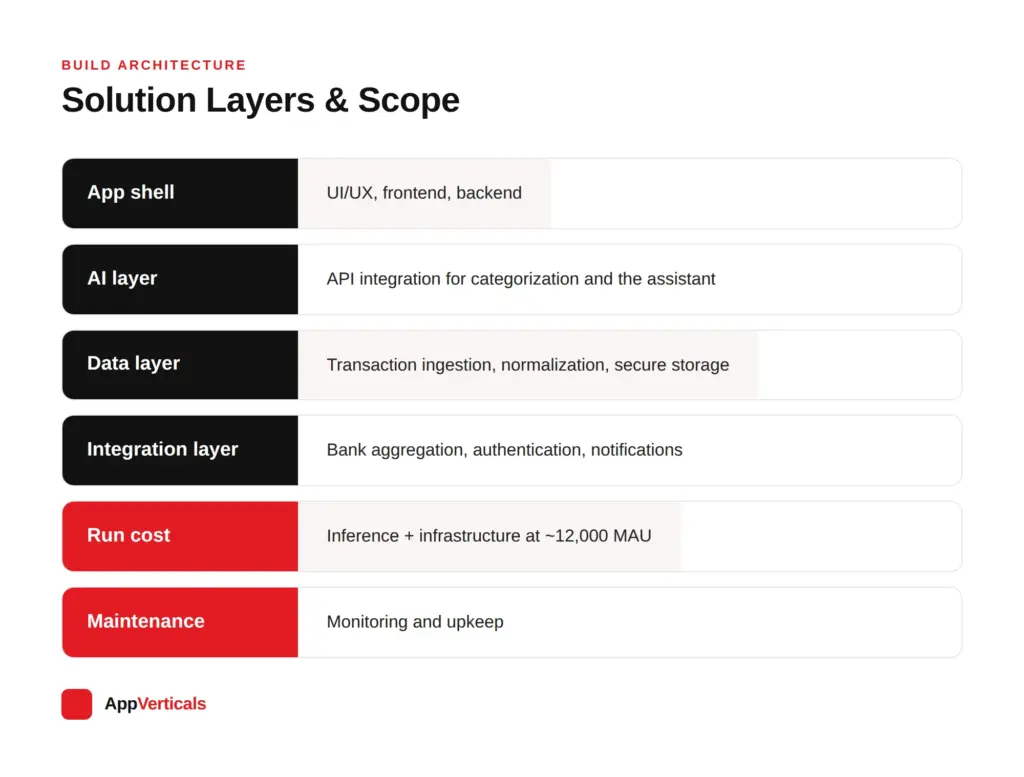
The AI App Cost Stack has six layers and pricing each one in turn produces both a build cost and a monthly run cost:
Worked example: AI-powered budgeting app
An AI-powered personal budgeting app connecting to users’ bank accounts, automatically categorizing transactions, and using a GPT or Claude-powered assistant to answer questions and surface spending insights.
| Cost Stack layer | What it covers | Estimated cost |
|---|---|---|
| App shell | UI/UX, frontend, backend | $45,000 |
| AI layer | API integration for categorization and the assistant | $18,000 |
| Data layer | Transaction ingestion, normalization, secure storage | $15,000 |
| Integration layer | Bank aggregation, authentication, notifications | $12,000 |
| Run cost | Inference + infrastructure at ~12,000 MAU | ~$6,000/month |
| Maintenance | Monitoring and upkeep | ~18% of build per year |
The build totals roughly $90,000, squarely in the mid-complexity band. The monthly run cost of ~$6,000 adds up to roughly $72,000 a year once the app is live. That run cost is the number a single industry range would have hidden entirely.
To apply the framework to your own idea, estimate each layer from what you already know about your core AI feature, your integrations and your expected usage and treat the run cost as a first-class line item rather than a rounding error.
How to Reduce AI App Development Cost without Cutting Value
Build an MVP first
The most effective way to reduce AI app development cost without sacrificing value is to build an MVP first, shipping one high-value AI feature on a pre-trained API, validating it with real users and only then expanding. This approach protects you from the most expensive failure mode in AI development, which is spending six figures on features that turn out to be unwanted and it generates the real usage data you need to make every subsequent investment decision with evidence rather than guesswork. An MVP also spreads cost across phases, which keeps early budgets manageable and lets revenue or proven traction fund the next stage of the build.
For more on that approach, our how to build an MVP guide covers the sequencing in detail.
Stay API-first and phase the roadmap
Beyond the MVP, the strongest cost lever is the API-first principle described earlier because starting on a managed API removes the upfront expense of model development and lets you defer the custom-model question until your traffic data proves it is worth answering.
Phasing the roadmap reinforces both choices, since releasing capabilities in deliberate stages lets you retire ideas that do not earn their place before they consume engineering budget. On the run-cost side, designing in caching, prompt optimization, model right-sizing and usage limits from the start keeps your inference bill from scaling faster than your value does.
What you should not cut to save money
It is equally important to recognize what should not be cut because trimming the wrong things raises the total cost of ownership rather than lowering it. Skimping on data quality, security or the underlying app architecture tends to create rework and remediation costs that exceed whatever was saved, particularly in regulated industries.
The disciplined path is to spend deliberately on the foundation and the first proven feature, defer everything speculative and let real usage rather than ambition drive the pace of investment. When you are ready to scope that path properly, our AI development services team can help you sequence the build so that cost follows validated value.
Conclusion
The real question is not what AI app development costs in general but what your specific app will cost to build and to run once people actually start using it. Once you know your core AI feature, your integrations and your expected usage, you have enough to turn a vague range into a number you can plan around and the AI App Cost Stack gives you a repeatable way to get there.
If you prefer, estimate your build yourself with the AppVerticals app cost calculator to see where your project lands.
Ready to scope your AI app properly?
Talk to our team about your build ranging from a focused MVP to a full production deployment!
Explore Our AI Development Services