












 ChatGPT
 Perplexity
 Claude
 Google AI
Grocery app development covers the four connected systems a grocery business needs to sell online: a customer ordering app, a picker app for store staff, a driver app for delivery, and an admin panel that ties them together. In the US a full build typically runs $45,000 to $280,000 over three to twelve months, depending almost entirely on how you fulfil orders.
The budget conversation usually starts with features. It should start with fulfilment. Whether you hold your own stock, aggregate other people’s stores like Instacart, or run a dark store for fifteen-minute delivery decides your architecture, your integration list and most of your cost before a single screen is designed.
This guide covers the four surfaces you have to fund, the inventory and substitution problems that break grocery products after launch, the POS and compliance work nobody scopes early enough, cost bands by model, how these apps actually make money, and how to evaluate the company you hire to build it.
Key Takeaways
- Grocery app development runs $45,000 to $280,000 in the US depending on fulfilment model, with a workable MVP from $35,000.
- A working grocery product needs four surfaces; customer app, picker app, driver app and admin panel, and only two can safely be deferred past v1.
- Stock accuracy, not the storefront, is what sinks most grocery builds. Substitution and weight-variable pricing have to be designed before the catalogue is.
- Items sold by weight mean the order total is unknown at checkout, which forces pre-authorisation and delayed capture rather than charge-at-checkout.
- Accepting SNAP/EBT online requires USDA FNS authorisation, a procurement track that typically adds four to nine months and runs parallel to development.
- Switching fulfilment models later replaces the inventory, pricing and dispatch layers, which makes the model decision the most expensive one in the project.
- Timelines run three to twelve months by model, and ongoing maintenance runs 15–20% of build cost per year, with grocery at the top of that band.
What Grocery App Development Actually Covers
A grocery platform is four pieces of software that have to agree with each other in real time.
The customer app handles browsing, cart, checkout and order tracking. The picker app is what store staff carry while they walk the aisles filling the order. The driver app handles assignment, navigation and proof of delivery. The admin panel manages catalogue, pricing, promotions, zones and reporting.
Add a vendor panel if other people’s stores sell through your platform, and you have five.
The general mechanics of connecting buyers, sellers and couriers are shared across categories, and our guide to how on-demand platforms are structured covers that ground. Grocery diverges in three specific places: stock changes faster than in any other category, a meaningful share of items are priced by weight rather than by unit, and a single order can contain sixty line items instead of three.
Those three facts drive almost everything that follows.
The Four Fulfilment Models Behind Every Grocery App
Fulfilment is the question of who owns the stock and who touches it between the order and the door. Four models cover almost every grocery product on the market.
Inventory-owned. You hold the stock in your own stores or a warehouse. Walmart’s grocery operation works this way. You control availability and margin, and you carry the full cost of stock, space and staff.
Marketplace aggregator. You connect customers to stores you do not own. Instacart is the reference. You scale without holding inventory, and you inherit every partner’s stock accuracy problem as your own.
Hyperlocal or dark store. You run small fulfilment sites, closed to the public, positioned for speed. Gopuff built on this. Delivery windows compress to minutes, and the fixed cost arrives before the demand does.
Subscription or replenishment. Customers commit to recurring baskets. Predictable demand, simpler picking, and a much harder acquisition problem.
| Model | Who Holds Stock | Named Example | Integration Load | Best Fit |
|---|---|---|---|---|
| Inventory-owned | You | Walmart | Heavy — POS, ERP, stock | Existing retailers with stores |
| Marketplace aggregator | Partner stores | Instacart | Heavy — per-partner catalogue sync | Platforms without retail assets |
| Hyperlocal / dark store | You, in micro-sites | Gopuff | Medium — WMS, dispatch | Dense urban zones, funded operators |
| Subscription | You or a 3PL | — | Light — recurring order engine | Curated or specialist ranges |
Grocery is not food delivery, and the distinction matters more than it looks. A restaurant order is three items from a fixed menu that either exist or do not. A grocery order is sixty items from a catalogue that changes hourly. If you are weighing the two categories, our breakdown of food delivery app development covers what that category needs, and almost none of the inventory problems below apply to it.
Choosing a Fulfilment Model: What It Costs to Change Your Mind Later
Operators change fulfilment model more often than they expect. An aggregator gets tired of partner stock errors and starts holding inventory. A retailer with three stores opens a dark store because one postcode generates a third of its orders.
The migration is where the money goes, because each model puts a different system at the centre of the platform.
| Moving From → To | Systems Replaced | What Survives | Proposed Rebuild Cost |
|---|---|---|---|
| Aggregator → Inventory-owned | Catalogue sync, availability service, pricing engine | Customer app, driver app, accounts | $45,000 – $90,000 |
| Inventory-owned → Dark store | Picking logic, location model, dispatch zoning | Catalogue, payments, customer app | $35,000 – $70,000 |
| Aggregator → Dark store | Almost the entire fulfilment layer | Customer app and accounts only | $70,000 – $150,000 |
| Any → Subscription | Order engine, billing, basket logic | Catalogue, fulfilment, apps | $20,000 – $45,000 |
Two design decisions make these migrations cheaper, and both cost very little at the start. Keep the availability service separate from the catalogue service, so where stock lives can change without the product data changing. And keep pricing in its own layer rather than inside catalogue records, so zone and channel pricing can be reconfigured instead of re-entered.
The most expensive decision in a grocery build is reversible, which is exactly why people make it casually. Teams spend weeks debating native against cross-platform, then settle the fulfilment model in a single meeting. The platform decision affects one surface. The fulfilment decision affects every system behind all of them.
The Four Surfaces a Grocery App Needs (and the Two You Can Defer)
Buyers usually budget for one app and discover three more during scoping. Some of those can genuinely wait.
| Surface | Job | v1 or Deferrable | Proposed Cost to Add Later |
|---|---|---|---|
| Customer app | Browse, order, track | v1 — required | $40,000 – $80,000 |
| Admin panel | Catalogue, pricing, orders, zones | v1 — required | $20,000 – $40,000 |
| Picker app | In-store picking, substitutions, weights | v1 if you hold stock | $25,000 – $45,000 — data model is hard to retrofit |
| Driver app | Assignment, navigation, proof of delivery | Deferrable | $22,000 – $42,000 |
| Vendor panel | Partner onboarding and self-service | Deferrable to about 20 partners | $18,000 – $35,000 |
The driver app is the most commonly deferred surface, and usually the right one to defer. Third-party courier networks supply their own driver tooling, and your own staff can work from a shared dispatch view for the first few months. What you lose is live location, proof of delivery and route history.
If you are funding a first version and want to understand where the floor sits, the same deferral logic that governs what an MVP costs to build applies here, with the caveat that a grocery MVP starts higher than a general one because the integration work is not optional.
The vendor panel is the other deferrable surface, and the threshold is people rather than volume. Below roughly twenty partner stores, onboarding by hand is annoying but workable. Above it, someone on your team is doing full-time data entry.
For Shop Local Delmarva we built exactly that split: a consumer discovery app on one side, and a web portal on the other where business owners enrol themselves, manage their listings and keep their own information current. Moving enrolment to self-service is what stops partner count from becoming a hiring decision.
Inventory Truth: The Grocery App Development Problem Nobody Scopes
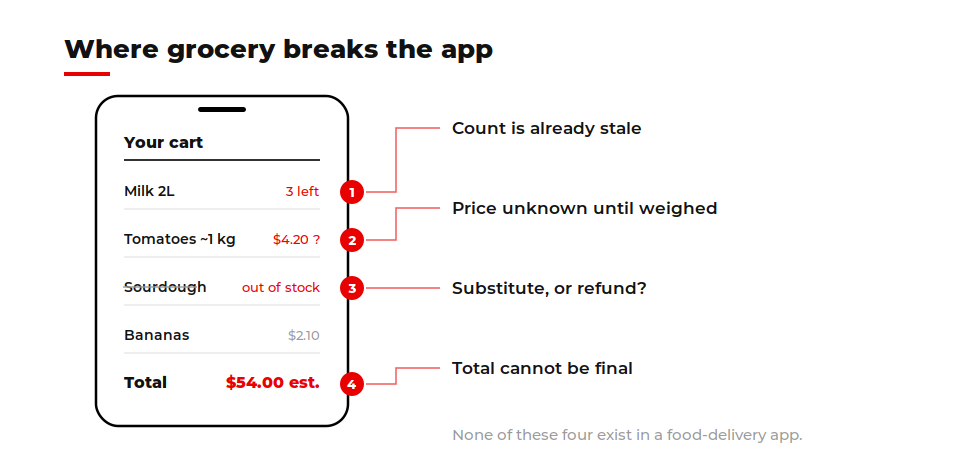
Here is where grocery separates from every other on-demand category. When someone orders a meal, the restaurant either has it or does not, and the answer is known in seconds. When someone orders forty grocery items, the answer changes between the moment they add to cart and the moment a picker reaches the shelf. Stock accuracy is a moving target, and everything downstream depends on it.
Your POS probably cannot answer the question
Most retail point-of-sale systems were built to record what was sold, not to answer what is available right now. Querying them live, per item, per store, at the rate a busy storefront demands, is not what they were designed for.
The workable pattern is a middleware inventory service holding a synced view of stock, which the app reads from. Sync runs on a schedule with a safety buffer so you do not sell the last three units to three customers at once. You accept a small amount of staleness in exchange for a system that does not fall over. Budget $12,000 to $30,000 for that layer, and scope it in week one. It is the most common cause of grocery timelines slipping and it is almost never in the original estimate.
Substitution is a business decision with an engineering bill
An item is out of stock. Something has to happen next, and both options cost money.
Customer-approved substitution needs a live notification, a response window, a default action when nobody replies, and a way to handle the customer who answers after the driver has left. It generates support load.
Automatic substitution needs preference rules, a substitution ranking per product category, and a much stronger refund path for when you get it wrong. It generates refunds.
Neither is wrong. What is wrong is discovering in month five that nobody decided, because the flow touches the customer app, the picker app, the order state machine and the payment logic simultaneously. Either approach costs roughly $8,000 to $18,000 to build properly, and considerably more to bolt on afterwards.
Items priced by weight break the checkout you assumed
Produce, meat, fish and deli are sold by weight. The customer orders about a kilo of tomatoes. The picker puts 1.08 kg in the bag. The price changes at that moment.
This has a consequence most teams meet late: the order total is unknown at checkout. You cannot charge a final amount for a basket whose value has not been determined.
The pattern that works is pre-authorisation at checkout for an estimated total with a headroom margin, then final capture once picking completes and real weights are known. Your payment provider has to support delayed capture and partial capture. Stripe’s authorisation and capture documentation sets out the mechanics, and it is worth confirming support before choosing a provider rather than after. Expect $10,000 to $22,000 for catchweight handling end to end.
If a material share of your catalogue is sold by weight, your payment architecture is decided for you. Pre-authorisation and delayed capture are not an enhancement you add in v2. They change the order state machine, the refund logic and the accounting reconciliation, and retrofitting them means reopening all three.
Grocery App Features That Change the Build, Not the Brochure
Feature lists in this category are usually organised by panel, which tells you what the user sees and nothing about what it costs. Organised by engineering weight, the same list looks different.
- Light — changes the screen, not the system. Product browsing, search and filters, favourites, order history, ratings, push notifications, promo codes. Typically $1,500 to $6,000 each.
- Medium — touches the backend meaningfully. Delivery slot selection, multi-store cart, loyalty accrual, recurring orders, driver assignment rules. Typically $8,000 to $20,000 each.
- Heavy — reshapes the architecture. Real-time inventory sync, substitution workflow, catchweight pricing, multi-vendor settlement, zone-based pricing, demand forecasting. Typically $12,000 to $40,000 each.
Everything in the heavy tier deserves a decision before design starts. Everything in the light tier can be sequenced without much consequence.
Personalised recommendations and demand forecasting now appear on nearly every grocery product, which makes them a baseline expectation rather than a reason to choose you. Budget $15,000 to $40,000 for them and do not expect them to differentiate the product on their own.
On platform choice, the customer app is well served by cross-platform because browsing and checkout are exactly what those frameworks handle well. The picker app deserves separate thought, since barcode scanning and in-store hardware sometimes justify native. It is a per-surface decision, and our breakdown of native versus cross-platform trade-offs applies cleanly.
SNAP, EBT and Alcohol: The US Compliance Layer
Accepting SNAP and EBT online
If you sell food to US households, a meaningful share of your addressable market pays with SNAP benefits. Accepting them online is not a payment integration you switch on. Retailers must be authorised by the USDA Food and Nutrition Service and must work through an approved third-party processor, with the online transaction flow certified separately from in-store acceptance.
Two things follow. The first is timing: authorisation and certification typically add four to nine months and run parallel to development, so the application should be filed at project kickoff rather than near launch. The second is architecture: EBT splits a basket into eligible and ineligible items, which means your cart, tax logic and settlement have to handle a single order paid by two tenders. Budget $15,000 to $35,000 for the integration itself.
The USDA Food and Nutrition Service retailer requirements are the authoritative source and should be checked directly rather than through secondary summaries.
Alcohol delivery and age verification
Alcohol is regulated state by state and sometimes county by county. Delivery may require a separate licence, a specific handoff procedure, ID scanning at the door, refusal logging, and hour-of-day restrictions that differ across your delivery zones.
In build terms this means a per-zone rules engine rather than a global setting, an ID capture flow in the driver app, and an audit trail you can produce on request. Expect $12,000 to $28,000 for compliant alcohol handling, and treat the licensing timeline as a separate track from the software.
Payment security
Card data handling brings PCI DSS obligations. Most grocery operators reduce scope substantially by never touching card data directly and letting a tokenising provider handle it. That decision is worth making explicitly at architecture stage, because the alternative raises both your build cost and your annual compliance burden. Our fintech software development work covers the same payment-architecture ground in more depth.
| Requirement | Applies To | Proposed Lead Time | Proposed Build Cost |
|---|---|---|---|
| USDA FNS authorisation for online SNAP | Any retailer selling eligible food | 4 – 9 months, parallel track | $15,000 – $35,000 |
| State alcohol delivery licensing | Operators delivering alcohol | 2 – 6 months, varies by state | $12,000 – $28,000 |
| PCI DSS scope reduction via tokenisation | All operators taking cards | Concurrent with build | Included in payments scope |
| Age verification and refusal logging | Alcohol and restricted items | Concurrent with build | Included above |
USDA authorisation is a lead-time problem, not a code problem. The integration work is measured in weeks and the approval is measured in months, which means the only expensive mistake is filing late. Start the application in discovery, before a single screen is designed.
Integrating With the Systems You Already Run: POS, ERP and Inventory
If you already operate stores, the app is not the hard part. Connecting it to what you run is.
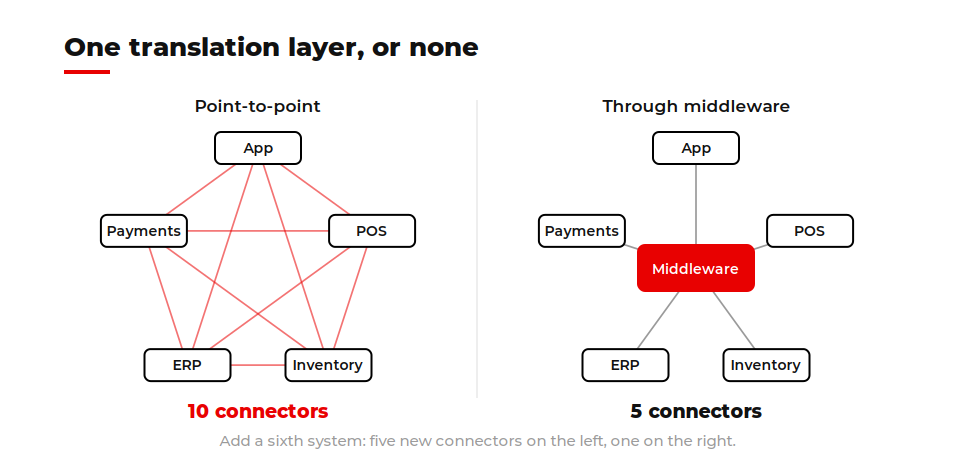
Four integration surfaces come up almost every time. Point of sale for product data, pricing and transaction records. Inventory or warehouse management for stock levels and movements. ERP for finance, purchasing and supplier data, where one exists. Payments, with the pre-authorisation requirement covered above.
The realistic pattern is a middleware layer owning translation between your systems and the app, rather than point-to-point connections between each pair. Point-to-point looks cheaper for the first two integrations and becomes unmaintainable at the fourth.
We built that pattern for JFA, a B2B parts distributor, where the ordering platform had to keep Stripe payments, invoicing and a NetSuite ERP in agreement across the full order lifecycle. The grocery version of that problem is the same shape with faster-moving data. More of this work sits in our case studies.
Integrating against a system never designed to be queried in real time is a scoping problem long before it is a technical one. The question to answer in discovery is not whether an integration is possible. It is what the system can deliver, how often, and what you do in the gaps.
For operators without any of these systems, the sequence inverts: the app becomes the system of record and you build inventory management inside it. That is a larger build and it is often the right call, because retrofitting a POS around an app you have already shipped is worse.
Grocery Store App Development for Retailers and Chains
If you already run stores, your build is a different project from a founder’s. You have stock, a POS, staff, suppliers and pricing that already works. The app has to fit that reality rather than replace it.
| What You Already Run | What It Means for the Build | Confirm First |
|---|---|---|
| A modern cloud POS with an API | Fastest path. Middleware sync, weeks not months. | Read rate limits and whether stock is exposed per location |
| A legacy or on-premise POS | Add $15,000 – $35,000 and 4 – 8 weeks for a connector or scheduled export | Whether the vendor permits third-party access at all |
| ERP for purchasing and finance | Order and settlement data must round-trip, not just push | Which system is the source of truth for price |
| Multiple locations with different pricing | Zone and store-level pricing layer required from day one | Whether promotions differ by store |
| Manual or spreadsheet inventory | The app becomes the system of record. Larger build, cleaner result. | Who owns catalogue maintenance after launch |
The single most useful thing a multi-store retailer can do before talking to any development company is check whether stock levels are trustworthy per location. If the answer is no, the first phase of the project is inventory accuracy, not app design, and any partner who does not say so is quoting a template.
Multi-store catalogue and vendor mechanics overlap substantially with general marketplace architecture, which we cover in our guide to building a multi-vendor marketplace platform.
Grocery Delivery App Development: Dispatch, Routing and Last Mile
Delivery is where grocery meets logistics, and the mechanics are borrowed rather than invented.
Four things decide whether the delivery side works. Assignment logic, which decides who takes an order and when. Batching, which groups orders heading the same direction and is where delivery cost per order actually falls. Routing, which sequences stops. And visibility, which is what customers and dispatchers see.
We built the delivery side of that for Lulo Freight, a freight platform where shippers needed real-time visibility and drivers needed a working mobile surface, after their previous development partner left the project incomplete. The lesson that transfers to grocery is that dispatch visibility is a data problem before it is an app problem. If your order records do not carry a clean state machine from picked to en route to delivered, a driver app will not rescue you.
The cost mechanics of dispatch, routing and driver tooling are broken down further in our logistics app development cost guide, and the different categories of logistics software piece covers where a grocery delivery layer sits against full fleet systems.
One decision worth making early: own fleet or third-party couriers. Third-party is faster to launch and more expensive per order. Own fleet costs more upfront and gets cheaper as density rises. Most operators start third-party and move in-house once a zone reaches consistent daily volume.
White Label vs Custom Grocery App Development
White-label grocery platforms are real products and they suit some operators genuinely well. They also carry a migration cost that is rarely discussed at the point of sale.
| Criterion | White-label | Custom Build |
|---|---|---|
| Upfront cost | $5,000 – $25,000 plus monthly licence | $45,000 – $280,000 |
| Time to launch | 4 – 10 weeks | 3 – 12 months |
| POS / ERP integration | Limited to what the platform supports | Built to your systems |
| Catchweight and substitution | Rarely handled well | Designed to your rules |
| SNAP/EBT | Depends entirely on the vendor | Built in |
| Ownership | You license it | You own the code |
| Migration cost later | $30,000 – $80,000 to remodel catalogue, pricing and order history | $0 – $20,000 for data migration or architecture changes if required |
The honest rule is this. If you are testing whether online grocery works for your business at all, and you have a simple catalogue with few weight-variable items, white-label is a reasonable way to find out cheaply. If you already know the demand exists, hold your own stock, or need SNAP acceptance, the case for starting white-label weakens quickly because you will be paying twice.
Custom does not have to mean everything at once. A phased custom build that starts with the customer app and admin panel, then adds picker and driver surfaces, often lands close to white-label’s first-year cost while leaving you with an asset you own.
How Much Does It Cost to Develop a Grocery App?
A grocery app costs $45,000 to $280,000 to build in the US. A workable first version starts at $35,000. The spread is that wide because the fulfilment model, not the feature list, decides most of the number.
Cost by fulfilment model
| Fulfilment Model | What the Build Includes | Proposed Cost | Proposed Timeline |
|---|---|---|---|
| Subscription / replenishment | Customer app, admin panel, recurring order engine, payments | $45,000 – $85,000 | 3 – 5 months |
| Marketplace aggregator | Customer app, admin, vendor panel, per-partner catalogue sync, dispatch | $80,000 – $160,000 | 5 – 8 months |
| Inventory-owned (existing stores) | Customer app, picker app, admin, POS and inventory integration, catchweight, substitution | $90,000 – $180,000 | 6 – 9 months |
| Hyperlocal / dark store | All of the above plus WMS, zone logic, compressed dispatch | $140,000 – $280,000 | 9 – 12 months |
Cost by component
If you are phasing the build, these are the individual pieces.
| Component | Proposed Cost |
|---|---|
| Customer app, iOS and Android via cross-platform | $22,000 – $45,000 |
| Admin panel | $15,000 – $30,000 |
| Picker app | $18,000 – $35,000 |
| Driver app | $20,000 – $40,000 |
| Vendor panel | $15,000 – $32,000 |
| Real-time inventory middleware | $12,000 – $30,000 |
| Substitution workflow | $8,000 – $18,000 |
| Catchweight pricing and delayed capture | $10,000 – $22,000 |
| SNAP/EBT integration | $15,000 – $35,000 |
| Multi-vendor settlement and payouts | $12,000 – $28,000 |
| Loyalty programme | $8,000 – $20,000 |
| AI recommendations and demand forecasting | $15,000 – $40,000 |
| Ongoing maintenance, per year | 15–20% of build cost |
Why quotes for the same brief vary so widely
Directories listing grocery app development companies publish a median hourly rate around $37. US onshore teams bill three to five times that. Both numbers are real, and the difference is not margin.
| Rate Band | Typically | What Changes |
|---|---|---|
| $25 – $45 / hr | Offshore delivery teams | Lowest sticker price. Retail systems experience and US compliance knowledge vary widely. Timezone gap affects integration work most, because POS debugging is interactive. |
| $50 – $85 / hr | Nearshore or hybrid | Overlap hours improve. Often the best value where the scope is well defined before work starts. |
| $100 – $175 / hr | US-based or US-led hybrid | Full overlap, direct accountability, familiarity with USDA and state-level requirements. This is the band our model figures above assume. |
| $175 – $300 / hr | Enterprise consultancies | Procurement-grade process and documentation. Justified for multi-country or heavily regulated programmes. |
The useful question is not which band is cheapest per hour. It is which band delivers the integration and compliance work without a second engagement to fix it. The rate-band question applies across all categories, and our guide to what it costs to hire an app development company covers the trade-offs in general terms.
For how these bands compare against app development generally, see our mobile app development cost breakdown. If you want a figure against your own scope rather than a range, run the cost calculator before the first vendor conversation.
Scope your grocery build around what you already run
A scoping conversation starts with your fulfilment model, your POS and your stock accuracy, not a feature list. You will leave with a surface list, an integration list and a realistic band, whether or not you work with us.
How Do Grocery Apps Make Money?
Grocery apps make money from delivery fees, basket minimums, subscription memberships, partner commission, and retail media. Most operators run three or four of these at once, because grocery margin is thin enough that a single revenue line rarely covers fulfilment cost.
| Revenue Line | How It Works | Typical Share of Revenue |
|---|---|---|
| Delivery and service fees | Per-order charge, often scaled by basket size or slot demand | Largest single line for most delivery-first operators |
| Subscription membership | Flat monthly or annual fee waiving delivery charges | Smaller, but the strongest retention lever |
| Partner commission | Percentage of basket value from stores selling through a marketplace | Primary line for aggregators |
| Retail media | Suppliers pay for placement, sponsored search and promotions | Highest margin line, needs scale before it works |
| Markup on catalogue price | Online price set above shelf price | Common and quietly significant for aggregators |
Whether owning a grocery app is actually profitable
The honest answer is that grocery delivery is structurally hard to make profitable on delivery fees alone, and the operators who do well add a second and third revenue line early. Retail media is the one that changes the arithmetic most, because supplier-funded placement carries almost no marginal cost. It also needs order volume before suppliers will pay for it, which makes it a year-two lever rather than a launch plan.
Two numbers decide the outcome before any of this matters. Basket size has to clear the cost of picking and delivering it, which is why basket minimums exist. And order density per delivery zone determines whether batching works, which is the single biggest factor in cost per delivery.
An operator with fewer, larger orders concentrated in a tight zone will usually beat one with more orders spread thinly. That is a decision about where you launch, not about what you build, and it is worth settling before the app scope is fixed.
Order density beats order count. A grocery operation doing 200 orders a day inside three postcodes can batch, route efficiently and pay a driver properly. The same 200 orders spread across a city cannot, and no amount of routing software fixes it. Pick the zone before you pick the feature set.
How to Develop a Grocery App: The Sequence That Works
The order of operations matters more in grocery than in most categories, because the expensive decisions sit early and the visible work sits late.
| Phase | What Happens | Proposed Duration |
|---|---|---|
| 1. Discovery and model selection | Fulfilment model chosen, integration audit, surface scope, SNAP application filed if relevant | 2 – 4 weeks |
| 2. Integration and data design | Catalogue model, availability service, substitution rules, capture logic, pricing layer | 3 – 6 weeks |
| 3. Build | Customer app and admin first, then picker, then driver | 12 – 24 weeks |
| 4. Pilot store | One location, limited catalogue, capped daily orders, real pickers | 4 – 6 weeks |
| 5. Rollout | Store by store, zone by zone, with capacity tuned per zone | 4 – 12 weeks |
The pilot phase is the one that gets cut when a timeline tightens, and cutting it is expensive. A single store running real orders for two weeks surfaces substitution disputes, weight discrepancies and picker workflow problems that no amount of QA finds, because they are operational rather than technical.
Run it with deliberate constraints. One store, limited catalogue, capped daily orders, and staff who will tell you what is annoying. The broader delivery sequence for any mobile product is covered in our mobile app development guide, and grocery follows it with two additions: the integration phase comes before the build rather than during it, and the pilot is non-negotiable.
Delivery Slots, Zone Pricing and Capacity: Lessons From a Multi-Role Platform Build
Two of the hardest mechanics in grocery are not grocery-specific, which means you can learn them from platforms in other industries.
The first is capacity. A delivery slot is a finite resource shared between customers who want it, staff who service it, and a business that needs it filled evenly rather than in spikes. Oversell it and you fail orders. Undersell it and you pay for idle staff.
The second is pricing that varies by context. Delivery fees changing by zone, basket value, time of day and demand are a configuration problem, and the moment they live in code rather than a configurable layer, every promotion becomes a release.
We built both for a multi-role US property-services platform; resident app, service-provider mobile app, property-manager portal and admin, all on one system. The two modules that mattered most were a capacity management system balancing workload across providers against real availability, and a pricing configurator adjusting service and add-on pricing dynamically by market and property attributes rather than through hard-coded rates.
That platform now manages 6,477 properties with more than 685,000 customers onboarded, supported by 67 service providers across 7,581 property management companies.
The mechanics transfer directly. Service providers map to pickers and drivers. Property attributes map to delivery zones and basket composition. The lesson is the same in both contexts: build capacity and pricing as configurable services on day one, because the alternative is a code deployment every time operations wants to change a fee.
How to Choose a Grocery App Development Company
The criteria that matter in this category are narrower than a generic vendor checklist suggests. Five questions separate companies that have built grocery from companies that have built apps.
| Ask | What Good Looks Like | Red Flag |
|---|---|---|
| What would you integrate with first? | They ask about your POS, stock accuracy and catchweight share before discussing screens | They start with the storefront and UI |
| How do you handle substitution? | They explain the trade-off between support load and refunds and ask which you prefer | They call it a feature and move on |
| What would you defer from v1? | They ask about your courier arrangement before quoting four surfaces | A four-app quote with no questions |
| What does the pilot look like? | One store, limited catalogue, capped orders, defined exit criteria | QA straight to multi-store rollout |
| Who owns the code and the data? | Unambiguous, in writing, including third-party accounts | Vague answers or platform lock-in |
Engagement models and where risk sits
| Model | Best For | Risk Sits With |
|---|---|---|
| Fixed price | Tightly defined scope, usually phase 1 only | The vendor, who prices that risk in |
| Time and materials | Integration-heavy work where discovery changes things | You — requires active involvement |
| Dedicated team | Multi-phase programmes past six months | Shared, with you owning direction |
| Phased fixed price | Most grocery builds. Fixed per phase, re-scoped between | Balanced. Usually the right default here. |
One practical note on quotes. If three companies return wildly different numbers for the same brief, the brief was not specific enough about integration. Grocery quotes diverge on what the vendor assumed about your POS, not on their hourly rate. Give every vendor the same integration detail and the spread narrows sharply.
Conclusion
The fulfilment model is the decision that matters. It sets your integration list, your surface count and most of your budget, and every other choice in this guide follows from it. Operators who settle it deliberately in discovery spend less overall than those who start from a feature list and meet the implications in month four.
If you already hold stock and run a POS, you are closer to a working grocery product than you probably think. The real work sits in inventory accuracy rather than the storefront, and the first phase should confirm your stock data is trustworthy per location before anyone designs a screen.
If you are aggregating other people’s stores, the work sits in vendor onboarding and dispatch instead. Your stock accuracy problem becomes your partners’ stock accuracy problem, which is harder to solve because you do not control it.
Either way, three things decide how the project goes: the model you pick, how much of your catalogue is sold by weight, and how early you file for the approvals you need. Substitution flows, catchweight pricing and a late USDA application account for most of the overruns in this category.
A scoping conversation gets short once you can answer those three questions. Bring them to any development company and the quotes you get back will finally be comparable.
Pressure-test the budget you have in mind
Five questions, and you get a band tied to your fulfilment model rather than a generic app estimate.
Run the cost calculator