












 ChatGPT
 Perplexity
 Claude
 Google AI
MVP development cost in 2026 runs from about $25,000 for a single-workflow build to $150,000 and up for an AI-heavy or compliance-driven product. Most funded startup MVPs land between $35,000 and $80,000 and ship in six to twelve weeks. The number tracks what you are trying to prove, not how many features you list.
For founders who need more than a prototype, professional MVP development services bring product discovery, design, engineering, QA, and launch planning into one defined scope.
I have scoped and priced more than thirty MVPs, and the conversation opens the same way almost every time. A founder arrives with a number they read somewhere and a feature list they wrote at two in the morning, and the two have nothing to do with each other.
I cover process separately in how to build an MVP. So this guide gives you the numbers I actually quote, the method underneath them, and the places founders lose money without noticing. Cost by tier, by industry, by team model, by build route. Then SaaS, AI, timelines, and the year-one costs that rarely appear on a proposal.
So this guide gives you the numbers I actually quote, the method underneath them, and the places founders lose money without noticing. Cost by tier, by industry, by team model, by build route. Then SaaS, AI, timelines, and the year-one costs that rarely appear on a proposal.
Eric Ries defined the MVP as the version of a product that lets a team collect the maximum amount of validated learning with the least effort. Hold onto that phrase, least effort, because it is the only thing standing between a lean first release and a wishlist with a price tag.
Key Takeaways
- MVP development cost runs $25,000 to $150,000+ in 2026. Most funded startup MVPs land between $35,000 and $80,000 over six to twelve weeks.
- Scope is the biggest single driver. Every extra role, workflow or dashboard adds engineering time. Cut the spec to the one problem your first release must solve and the budget follows.
- A SaaS MVP typically costs $30,000 to $70,000. Multi-tenancy and billing are the two components founders underestimate most.
- AI cuts about 10 to 20 percent off delivery, and AI features in the product add $15,000 to $50,000 plus a recurring inference bill.
- Your team model changes your risk profile, not just your invoice. Freelancers lower the upfront number and move coordination and QA onto you. Agencies bundle accountability. In-house makes sense after validation.
- No-code is a legitimate path. For demand validation and single-workflow products, $3,000 to $20,000 gets you to market.
- QA and year two are the most underestimated lines. Budget 25 to 30 percent of development for QA, and 20 to 30 percent of build cost annually for maintenance.
MVP Cost Breakdown: Simple, Mid-Level And Complex
Founders get into trouble when they ask what an MVP costs without first saying which kind of MVP. A login-and-dashboard product, a marketplace and an AI-assisted mobile app all sit under the same three letters and carry completely different delivery, testing and infrastructure loads.
Think in tiers instead.
| MVP Tier | 2026 Budget Band | Usually Includes | Typical Timeline |
|---|---|---|---|
| Simple MVP | $25,000 – $35,000 | Landing page, auth, basic CRUD flow, simple dashboard, no-code or cross-platform build | 3–8 weeks |
| Mid-complexity MVP | $35,000 – $80,000 | Multi-role workflows, payments, admin panel, analytics, third-party integrations | 6–12 weeks |
| Complex MVP | $80,000 – $150,000+ | AI features, real-time sync, advanced permissions, custom architecture, compliance logic | 3–6+ months |
Most founders arrive with a number in mind and no scope. The first thing I do is map the requirement module by module: what each one takes in effort, which specialist handles it, and what that converts to in dollars. That exercise moves the founder’s original figure almost every time, in both directions.
Not sure which tier you are in?
Answer a few questions about your workflows, your roles and your integrations, and get a starting range in about two minutes.
Try the app development cost calculator.
Simple MVPs
A simple MVP is the cheapest honest route to market because it commits to one job. A single-user SaaS workflow, a booking flow, a waitlist with a concierge backend behind it, or a no-code app with auth and one core action.
We are building a CRM-integration MVP right now that fits this shape exactly. It proves one business workflow, a sync between CRM and operations, without touching the rest of the stack.
Integration-only MVPs are an underrated path for enterprise buyers. The surface area is small, the success criteria are obvious, and the budget stays in the low five figures while the organization learns whether the workflow is worth owning.
Mid-complexity MVPs
This is where most serious startup MVPs land. Multiple user roles, an admin view, third-party services, a real design layer, and enough logic to test whether anyone will pay.
Highlights App sits here. It captures the best moments from padel-court cameras and delivers them to a player’s phone within five to ten minutes, triggered by a physical button that saves the previous minute or two of play. Built on React Native and Node, deployed on AWS with load balancing and auto-scaling, with clip sharing, a free-to-premium upgrade path and an ad layer.
Video capture, a media processing pipeline, social sharing and monetization together carry enough scope to sit comfortably in the middle band. The team is validating in beta before scaling, which is the right sequence.
Complex MVPs
Add advanced backend logic, AI modules, regulated data, multi-platform delivery or enterprise security expectations, and pricing climbs quickly.
Coca-Cola Dubai is the clearest example I have of an MVP-first engagement that grew. The first release was scoped tightly around three things we had to prove: load behavior, page speed and accessibility. Those were the questions. Everything else waited.
What it grew into was a 92-screen B2B trade platform for Coca-Cola’s UAE channel, delivered in nine months by a ten-person design and engineering team, running at 2M+ peak users, 99.98% uptime, a 1.2-second median page load and zero critical bugs at launch. Around 150 prototype iterations ran before any production code was written.
The platform is not an MVP and I would not describe it as one. The point is the sequence. Proving load, speed and accessibility first is what made the rest of that scope safe to commit to.
What Exactly Is An MVP, And What Should It Include?
An MVP is the smallest product that generates real learning. Marty Cagan’s test is the one I use in scoping calls: it has to be valuable enough that people choose it, usable enough that they can figure it out, and feasible enough that you can actually deliver it with what you have.
Miss any one of those three and you have a prototype or a deck, which is fine as long as you priced it as one.
Across our project history, the MVPs that never progress to full development mostly fail on market fit rather than engineering. The product worked. Nobody needed it. Earlier customer discovery would have caught that before a line of code existed.
So what belongs in the build? One core workflow executed properly, whatever authentication that workflow requires, and enough instrumentation to see what users actually do. That is the whole list.
What does not belong: settings screens nobody has asked for, an admin console you could replace with a spreadsheet for six months, onboarding for a product whose value is still unproven, and any feature that exists because a competitor has it.
The test I apply to every line of a spec is simple. If this feature were missing, would the experiment still produce an answer? If yes, it waits.
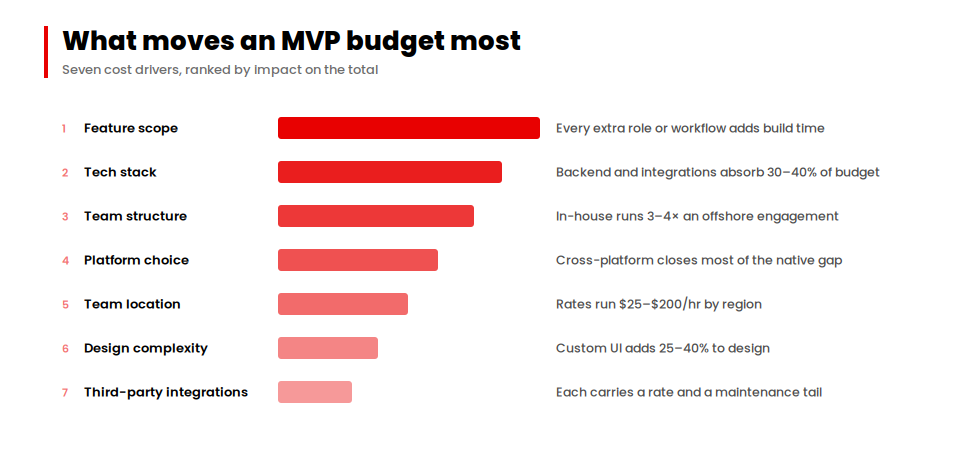
What Drives MVP Development Cost? The Seven Biggest Variables
Feature scope.
Scope is the biggest driver, full stop. Every extra workflow, role or dashboard expands engineering time. Michael Seibel’s advice at Y Combinator is to launch something bad, quickly, and that is a cost-control instruction as much as a speed one.
Platform choice.
A web-only MVP is cheaper than separate native iOS and Android apps. Cross-platform frameworks compress that gap substantially, which is why Highlights App reaches both stores from one codebase.
Tech stack.
Simple stacks move faster. Real-time features, AI services, event-driven architecture and custom security controls all cost more to build and more to keep running. Backend setup, APIs and integrations routinely absorb 30 to 40 percent of an MVP budget.
Team structure.
Freelancers lower the upfront number and move coordination and quality risk onto you. Agencies cost more and absorb project management, QA and delivery accountability. In-house teams run three to four times an offshore agency engagement once you count salaries, benefits, hiring and management time.
Team location.
Rates vary widely by region, from roughly $100–$200 an hour in the US and Western Europe down to $25–$50 in South Asia. The number that actually matters is cost per shipped feature. A cheap hour that produces rework is the most expensive hour you can buy.
Design complexity.
Basic interface work is cheap. Branded design systems, custom components and multi-state flows are not, and fully custom UI adds 25 to 40 percent to design investment against a template-driven build.
Third-party integrations.
Payments, messaging, analytics, storage and distribution each carry a rate and a maintenance tail. Stripe takes 2.9% plus 30 cents on domestic cards. Twilio SMS starts around $0.0083 a message. Apple’s developer program is $99 a year, Google Play $25 once.
Where the gap between a $25K and an $80K MVP actually comes from
The difference is feature shape, not feature count. Real-time video, live streaming and media capture push budgets up because they need media servers, encoding, storage and delivery infrastructure that a data-entry app never touches.
A CRUD dashboard with authentication is not the same engineering problem as a media pipeline. Highlights App turning raw court footage into a shareable clip in minutes is exactly the kind of backend lifting that separates the two bands.
MVP Development Cost by Industry
| Industry | Typical 2026 Budget | Why It Costs What It Costs |
|---|---|---|
| SaaS MVP | $30,000 – $70,000 | Multi-role dashboards, admin logic, analytics, billing |
| Mobile app MVP | $25,000 – $50,000+ | Native or cross-platform choice, store prep, push, device testing |
| Marketplace MVP | $30,000 – $80,000+ | Search, profiles, payments, reviews, supply and demand workflows |
| Ecommerce MVP | $30,000 – $60,000+ | Catalog, checkout, payments, fulfillment integrations |
| Fintech MVP | $60,000 – $150,000+ | Fraud, security, auditability, compliance |
| Healthtech MVP | $60,000 – $150,000+ | HIPAA and data privacy, role permissions, sensitive data handling |
| AI MVP | $80,000 – $200,000+ | Model calls, prompt engineering, evaluation, guardrails, infrastructure |
Three of our own projects show the spread. Toyota Libya is a lean single-workflow integration at the bottom, Highlights App is a consumer mobile product with a media pipeline in the middle, and Coca-Cola sits at the top of the range and past it.
Same delivery team, three very different cost profiles, because cost follows technical shape rather than brand size.
The two rows that surprise founders are fintech and healthtech. Neither is technically harder than a marketplace in the ordinary sense, and both cost double because of what surrounds the code.
Regulated products need audit trails, data residency decisions, access controls that survive review, and documentation nobody sees in a demo. On a healthtech MVP handling protected health information, compliance work is routinely a quarter of the build. Budget it as scope rather than overhead, because that is what it is.
SaaS MVP Development Cost
SaaS is the fastest-growing question I get, and it prices differently from a mobile MVP because the expensive parts are invisible in a demo.
A SaaS MVP commonly lands between $30,000 and $70,000. That covers multi-user flows, billing logic, dashboards and enough admin capability to run the thing. Add real-time features, AI modules or enterprise security requirements and it clears $100,000 quickly, often before the advanced features are properly scoped.
| SaaS MVP Component | What It Covers | Cost |
|---|---|---|
| Multi-tenant foundation | Account isolation, org and user hierarchy, roles and permissions | $8,000 – $20,000 |
| Subscription billing | Plans, upgrades, downgrades, proration, failed-payment recovery | $7,000 – $18,000 |
| Core product workflow | The thing customers are actually paying for | $12,000 – $35,000 |
| Admin and support console | Impersonation, usage visibility, manual overrides | $6,000 – $15,000 |
| Analytics and instrumentation | Event tracking, activation and retention reporting | $4,000 – $10,000 |
| Integrations | SSO, webhooks, the two or three tools your customers already run | $5,000 – $18,000 |
Two of those rows get underestimated constantly. Multi-tenancy is architectural, so retrofitting it after launch means rewriting your data layer rather than adding a feature. And billing looks like a Stripe integration until you meet proration, dunning and mid-cycle plan changes.
My advice on a first SaaS release is to build multi-tenancy properly and keep the billing crude. You can invoice fifty early customers by hand. You cannot un-share their data after the fact.
How Does AI Integration Drives the MVP Development Cost
Two separate questions hide inside this one, and founders routinely conflate them. Putting AI features in your product costs money. Using AI to build the product saves some.
AI features in the product.
A retrieval-based assistant over your own content runs $15,000 to $40,000. Fine-tuning or a custom evaluation harness pushes past $50,000. On top of the build there is an inference bill that scales with usage, which arrives monthly and never stops. Budget it from day one.
The part people skip is evaluation.
An AI feature that is right 85 percent of the time in a demo and wrong in front of a paying customer is a product problem, and building the guardrails and test harness to know which one you have is real engineering. That work is usually a third of the AI line item.
AI-assisted delivery.
On a typical MVP, AI-assisted engineering moves the total by roughly 10 to 20 percent. The savings sit in boilerplate: standard screens, API clients, test scaffolding, migration scripts. Integration work, compliance code and anything depending on a business decision do not compress.
At the very low end, AI changes what is possible. A founder with $10,000 could not get a working product two years ago. Now something lightweight enough for fifty to a hundred testers is achievable. It will not scale, and scaling is not the job at that budget.
MVP Timeline and What Each Phase Costs
Founders budget in dollars and plan in weeks, and the two need to line up before anything gets committed.
| Phase | What Happens | Duration | Share of Budget |
|---|---|---|---|
| Discovery | User flows, feature prioritization, technical planning | 1–3 weeks | 5–10% |
| Design | Wireframes, screen set, design system | 2–4 weeks | 10–15% |
| Build | Frontend, backend, integrations, admin | 4–16 weeks | 50–60% |
| QA | Functional, device, regression and security testing | Runs alongside build, 1–3 week tail | 15–20% |
| Launch | Store enrollment, deployment, analytics setup | 1–2 weeks | 2–5% |
Simple MVPs run three to eight weeks end to end. Mid-complexity builds take six to twelve. Anything enterprise-scale is three to nine months or longer.
Store review is the step people forget. Apple usually turns a submission around in a day or two, and a rejection on a payment or account-deletion technicality restarts the clock. I plan two submission cycles into every first release.
Freelancer Vs MVP Development Company Vs In-House
| Model | Best For | Cost Reality | Main Trade-off |
|---|---|---|---|
| Freelancer | Very narrow scope, strong founder oversight | Lowest upfront, $5,000 – $25,000 | Coordination, QA and continuity all land on you |
| Offshore agency | Fast validation with broader support | Mid-range, $20,000 – $70,000 | Vendor quality varies widely |
| US or EU agency | High-accountability delivery | Higher upfront, $60,000 – $150,000+ | Stronger process, premium rates |
| In-house team | Long-term product roadmap | Highest fixed cost, $400,000+/year | Salary, hiring and management overhead |
A freelancer is a one-person team with no niche depth, no separation between building and testing, and no accountability structure when something slips. That is fine for a narrow build with an involved founder. It stops working the moment the product needs a specialist you did not know you needed.
What an agency premium buys is separation of duties. Product management, design, engineering and QA as distinct functions with quality gates between them. Coca-Cola’s platform needed a ten-person team working in one rhythm, and that kind of orchestration is difficult to assemble from contractors.
In-house makes financial sense after validation, rarely before it. Hiring a team to test a hypothesis is an expensive way to find out the hypothesis was wrong.
The question worth asking any agency before you sign is who is actually on your team, and whether those are the same people in month six. Seniority shown in a pitch and seniority writing your code are different things at a lot of firms.
Ask for named individuals, ask what else they are staffed on, and ask what happens if one of them leaves mid-build. The answers tell you more about your real cost than the rate card does.
Once you have defined the scope, platforms, integrations, and team model, use our calculator to estimate your MVP development cost and see how those decisions may affect your starting budget.
No-Code Vs Custom MVP Development
| Approach | 2026 Cost Range | Time to Launch | Best For |
|---|---|---|---|
| No-code (Bubble, Webflow, Glide, Softr) | $3,000 – $20,000 | 2–6 weeks | Demand validation, internal tools, single-workflow products |
| Low-code hybrid | $15,000 – $40,000 | 4–10 weeks | Early-stage SaaS, MVPs that may scale into custom |
| Custom code (web) | $25,000 – $80,000 | 8–16 weeks | Unique logic, performance needs, defensible IP |
| Custom code (native mobile + backend) | $50,000 – $150,000+ | 12–24 weeks | App store products, hardware integrations, complex UX |
No-code is a legitimate MVP path and I recommend it more often than founders expect. If the question is whether anyone wants this, a Bubble build answers it for a tenth of the cost of a custom one.
The limit shows up at scale and at the edges. Custom logic, performance under load, and owning your own IP are the three reasons to move, and none of them matter in month one.
The honest risk is the rebuild. A no-code product that finds real traction usually gets rewritten, and founders who did not plan for that treat it as a failure rather than a milestone. Price the rebuild into your second round from the start and no-code becomes the cheapest validation you can buy.
Where I would not use it: anything handling regulated data, anything where response time is the product, and anything you intend to sell to an enterprise buyer who will ask about your architecture.
Can you really build an MVP for $10,000?
Yes, but with challenges worth stating plainly.
If you come to me with $10,000, my honest answer is usually not to build yet. What you need is a Figma prototype and a pitch deck, something visual you can put in front of investors to raise the round that funds a real build.
With AI-assisted development in the mix, we can now get something lightweight in front of fifty to a hundred testers at that budget. It will not scale. At $10,000 the goal is validation, and validation is a legitimate thing to buy.
Six Budgeting Mistakes That Increase MVP Development Cost
Treating the MVP like version 1.0.
Every feature not tied to proving your core hypothesis is dead weight, and dead weight costs money. Founders who arrive with a forty-feature spec rebuild half of it after the first round of user feedback.
Confusing learning goals with engineering goals.
Building something that works and finding out whether anyone wants it are different objectives. Steve Blank’s framing is that an MVP is not always a smaller version of the final product, and the cheap hack that tests the goal is often the right answer.
Underestimating QA.
A bug that takes two hours to fix in development can take two weeks after launch, once real users have hit it. Plan 25 to 30 percent of development cost for QA. Underfunded QA is the most predictable source of expensive late-stage rework I see.
Misreading the audience.
Chasing intuition instead of validated demand is the most expensive mistake in this list. A founder once came to us wanting to merge TripAdvisor and Yelp into one app, ambitious on paper, with no evidence anyone wanted it. Development is a fraction of the work. Getting people to show up is the rest.
Ignoring year two.
Year one is the cost to build. Year two is the cost to keep it alive, and that scales with traction. More users mean higher infrastructure bills, more support and faster pressure to iterate. Maintenance runs 20 to 30 percent of build cost annually.
Hiring on hourly rate alone.
The cheapest quote is rarely the cheapest outcome. Founders who come back to us after a failed low-cost engagement almost always spend more in total than if they had chosen correctly the first time.
How to Budget For Your MVP
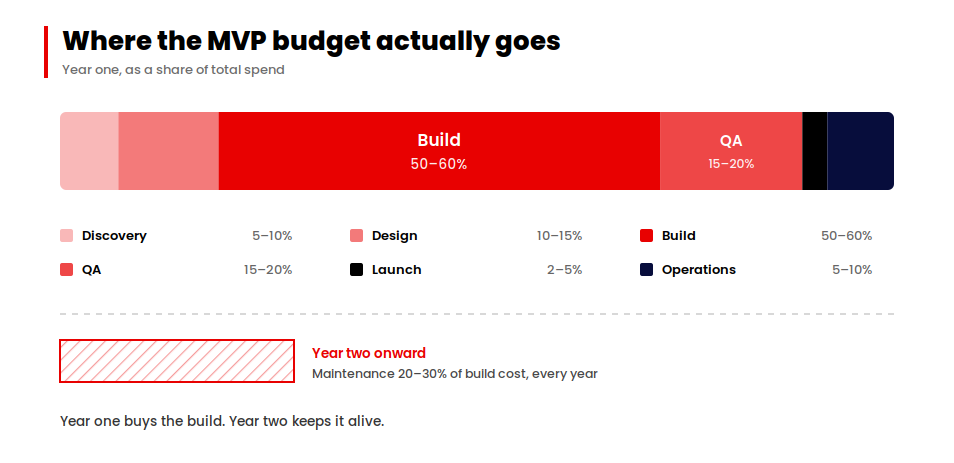
The healthiest budgets start with the question most founders skip: what must this product prove in the next ninety days? Answer that and budgeting gets simpler, because you stop buying features and start buying evidence.
| Year-one Bucket | What to Include | Share of Year-one Budget |
|---|---|---|
| Discovery | User flows, prioritization, technical planning | 5–10% |
| Build | Frontend, backend, integrations, admin | 50–60% |
| QA | Functional, device, regression, security | 15–20% |
| Launch | Store enrollment, deployment, analytics | 2–5% |
| Operations | Cloud, messaging, payments, monitoring | 5–10% |
| Maintenance | Fixes, iterations, support | 20–30% of build cost, annually |
The AppVerticals MVP Costing Framework
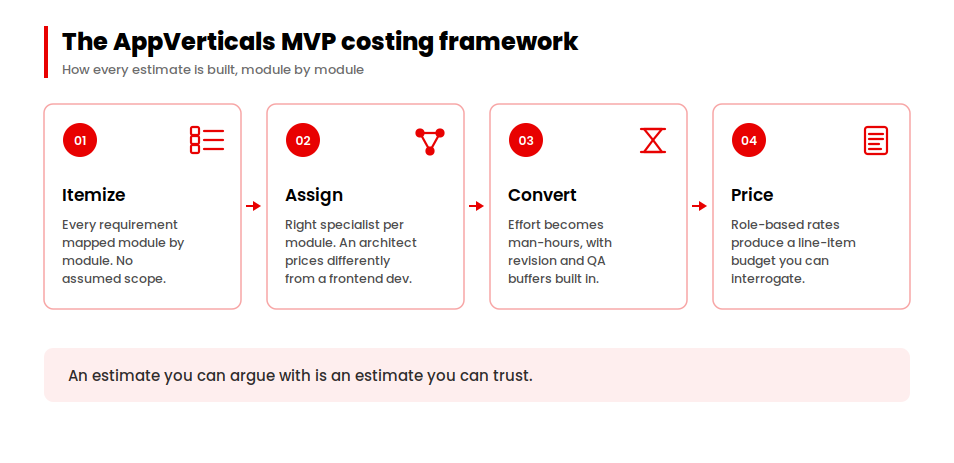
Most founders get a single number at the end of a scoping call with no view of how it was reached. Every estimate we produce is built the same way, module by module.
Step one. Sit with the founder and itemize every requirement, module by module. No assumptions about what was implied.
Step two. Assign the right specialists to each module and estimate level of effort. A module needing a solution architect prices differently from one needing a frontend developer.
Step three. Convert effort into man-hours per module, with buffers for revision and QA cycles built in rather than bolted on.
Step four. Apply role-based rates to arrive at a line-item budget you can interrogate. If a number looks wrong, you can see which module produced it.
That last part matters more than the total. An estimate you can argue with is an estimate you can trust.
Conclusion
Define what the product has to prove before you price it. That single sentence does more for a budget than any tier table, including mine.
Then be honest about which tier the answer puts you in. Count the roles, count the integrations, and ask whether the thing you are building is a workflow, a platform or a media pipeline. Those three shapes price very differently.
If the number and the ambition are far apart, buy evidence instead of features. Every founder who has taken that trade has come back with a better second brief. The second brief is a different exercise, and what changes when you scale past the MVP covers the team, architecture and cost shifts it has to account for.
Get a number you can build against
We scope, price and ship MVPs across SaaS, fintech, healthtech and consumer mobile, from single-workflow integrations to platforms that grow well past their first release.
Explore our MVP development services.Want the number before the commitment?
Tell us what your MVP needs to prove in the next ninety days and we will come back with an honest range, a delivery model recommendation, and the question most founders forget to ask. Book a scope call.