 ChatGPT
 Perplexity
 Claude
 Google AI
The best mobile app development companies in New York State include AppVerticals, Fueled, Lickability, thoughtbot, JetRockets, Netsmartz, ITX, Sette Labs, Astrochimp, and Envative. Each offers different strengths, from startup MVP development and consumer applications to enterprise software and connected devices.
Choosing the right partner means looking beyond New York City. Businesses in Buffalo, Rochester, Albany, Syracuse, and other parts of the state may benefit from specialized development teams with relevant industry experience.
This guide compares ten providers based on their mobile capabilities, project experience, New York presence, and suitability for different business needs.
Key Takeaways
- Provider fit matters: Some companies specialize in native mobile experiences, while others focus on complex business systems.
- New York extends beyond NYC: Rochester, Albany, and Syracuse have development companies worth evaluating.
- Project costs vary: A lean MVP may cost $20,000-$40,000, while complex mobile platforms can exceed $150,000.
- Review project evidence: Relevant case studies are more useful than general claims about technical expertise.
- Confirm ownership: Ask about source code, repositories, app store accounts, and post-launch support before signing.
New York Mobile App Development Companies at a Glance
The table below compares New York mobile app development companies by location, project fit, and published technical capabilities.
| Rank | Company | New York presence | Best for | Mobile technologies |
|---|---|---|---|---|
| 1 | AppVerticals | NYC | MVPs and full-cycle development | iOS, Android, Flutter, React Native |
| 2 | Fueled | New York City | Design-led mobile products | iOS, Android |
| 3 | Lickability | New York City | Native mobile experiences | Swift, Kotlin, cross-platform |
| 4 | thoughtbot | New York City presence | Product strategy and engineering | iOS, Android, React Native |
| 5 | JetRockets | New York City | Startup apps and custom backends | React Native |
| 6 | Netsmartz | Pittsford/Rochester | Enterprise applications | Mobile and custom software |
| 7 | ITX | Rochester | Product strategy and engineering | Mobile and web products |
| 8 | Sette Labs | Albany | Connected devices and IoT | iOS, Android |
| 9 | Astrochimp | Syracuse | Cross-platform applications | React Native, Expo |
| 10 | Envative | Rochester | Custom mobile and IoT software | iOS, Android, hybrid |
How We Selected These Companies
We evaluated New York app development agencies based on their documented location or service presence in the state, mobile development capabilities, and published project experience.
The assessment considered mobile technologies, backend capabilities, product discovery, testing, deployment, post-launch support, and available independent client feedback.
We also considered the types of clients each company serves. A firm experienced in enterprise integrations may suit a different project than a studio specializing in polished consumer applications.
Company information was reviewed through published service pages, portfolios, and available industry directories. The ranking is an editorial shortlist, not an independently verified performance ranking.
Disclosure: AppVerticals publishes this comparison and is included in the list. The remaining companies were selected using publicly available location, service, portfolio, and review information.
1. AppVerticals
Location: New York City service presence
Best for: Startups, growing businesses, and organizations needing complete mobile products.
AppVerticals provides mobile application development covering product discovery, UI/UX design, native iOS and Android engineering, Flutter, React Native, backend development, and post-launch support.
Businesses evaluating a mobile app development company in NYC can review its local service capabilities alongside its published project portfolio.
The company’s experience spans healthcare, real estate, education, logistics, and marketplace applications.
Relevant Project Experience
AppVerticals’ Spruce case study describes a property services platform rebuilt around five user roles. The work included a React Native service-provider application, scheduling, capacity management, pricing, and administrative workflows.
According to the published case study, the resulting platform supports 685,000 customers across 6,477 properties.
Another example is Classic Pool Tile and Stone. AppVerticals developed native iOS and Android applications with AR measurement and geometric calculations to replace manual pool templating.
The company reports reducing a process that previously took three to four days to minutes.
What to verify: Current team availability, project-specific pricing, and relevant references.
2. Fueled
Location: New York City
Best for: Consumer applications, digital products, and experience-focused development.
Fueled offers product strategy, design, mobile development, and broader digital engineering services.
Its portfolio spans mobile applications, customer experiences, enterprise platforms, and AI-related products.
One published example involves Neelo, a gamified iPad application designed to help children develop social-emotional skills.
Fueled describes rebuilding the product after its initial prototype proved unsuitable as a production foundation.
That distinction matters for businesses that have validated an idea but need stronger architecture before introducing it to a wider audience.
Fueled also appears in Clutch’s New York State mobile development directory, where a $75,000 minimum project figure was listed during research.
What to verify: Current minimum engagement, delivery team, and mobile technology recommendations.
3. Lickability
Location: New York City
Best for: Native iOS applications and refined mobile user experiences.
Lickability specializes in mobile design and engineering, with particular expertise in Apple’s development ecosystem.
Its published portfolio includes work for The Atlantic, Mastodon, RevenueCat, and independent app founders.
For RevenueCat, the company describes creating a mobile experience that makes subscription analytics accessible outside the desktop environment.
Lickability also publishes examples involving interface improvements, subscription functionality, and ongoing app maintenance.
The company states that smaller development projects typically fall within a $50,000-$100,000 range, while fully featured applications generally start above $100,000. These figures differ from directory minimum-project thresholds and should be scoped individually.
What to verify: Platform-specific team availability and estimated cost for the intended scope.
4. thoughtbot
Location: New York City presence
Best for: Product discovery, senior engineering, and application modernization.
thoughtbot works with organizations on product strategy, design, and software development.
Its published mobile projects include GasBuddy, where the team improved an existing mobile experience through research, design systems, and interface modernization.
For PathCheck, thoughtbot describes helping develop a React Native application supporting digital pandemic response.
That project involved accessibility, privacy considerations, and integration with the Google and Apple Exposure Notification framework.
These examples are relevant to businesses balancing product usability with technical constraints.
What to verify: Current New York delivery arrangements, staffing, and project minimums.
5. JetRockets
Location: New York City
Best for: Startup products, MVPs, and applications requiring custom backends.
JetRockets provides software and mobile development services for startups and established businesses.
Its portfolio includes Telos, an AI-assisted personal development application built with React Native.
The published project describes integration with the client’s existing backend team and the development of a mobile experience for iOS and Android.
JetRockets identifies React Native, OpenAI, and Google Cloud services among the technologies used.
The case study is useful for founders evaluating agencies that must collaborate with existing design or engineering teams.
What to verify: Current team structure, minimum engagement, and post-launch support commitments.
6. Netsmartz
Location: Pittsford, Rochester area
Best for: Enterprise mobile applications and broader technology modernization.
Netsmartz is a technology services company with a published headquarters address in Pittsford, near Rochester.
Its broader offerings include software engineering, cloud solutions, enterprise systems, and technology consulting.
The company may be relevant to organizations whose mobile applications must work alongside established business software.
For these projects, backend integrations, data handling, security, and internal workflow requirements can be as important as the mobile interface.
What to verify: Recent mobile deployments, platform-specific expertise, and maintenance arrangements.
7. ITX
Location: Rochester
Best for: Product strategy, user experience, and complex software engineering.
ITX is a Rochester-based software product development company offering research, design, engineering, and technical consulting.
Its published approach emphasizes continuous discovery and aligning product decisions with user needs.
One case study describes work on a member benefits portal for a healthcare services organization with substantial data and usability requirements.
Although that example is broader than a standalone mobile app, it illustrates the company’s experience with complex digital products and user-centered design.
ITX may be especially relevant to established organizations seeking long-term product development support.
What to verify: Recent native or cross-platform mobile work and proposed team composition.
8. Sette Labs
Location: Albany
Best for: Mobile applications connected to hardware and IoT devices.
Sette Labs develops software and firmware for mobile and embedded systems.
Its services include iOS and Android applications, cloud infrastructure, connected-device integration, and software testing.
The company’s published approach emphasizes technical planning, collaboration, and identifying potential project risks.
These capabilities are particularly relevant when a mobile app must communicate with smartwatches, Bluetooth accessories, or specialized equipment.
Such products require device testing and reliable data exchange in addition to conventional application development.
What to verify: Experience with the intended hardware, device protocols, and production testing requirements.
9. Astrochimp
Location: Syracuse
Best for: Cross-platform mobile applications and focused product development.
Astrochimp is a Syracuse-based development studio building websites, mobile applications, and custom software.
Its published mobile services focus on React Native and Expo for iOS and Android.
The company’s portfolio includes Reps and Sets, a workout-tracking application, and Moxxio, a nutrition-tracking product.
Other published examples include SeQRcode, a QR-scanning application.
These projects provide concrete examples of consumer-facing mobile development using a shared codebase.
What to verify: Current delivery capacity, backend scope, and long-term maintenance availability.
10. Envative
Location: Rochester
Best for: Custom mobile applications, connected products, and enterprise integrations.
Envative provides software development services covering web applications, mobile engineering, IoT, and backend systems.
Its published portfolio includes Quickpass, a project involving mobile applications, web software, and connected access-control devices.
The company also describes work on mobile software supporting athlete performance monitoring and data synchronization.
Businesses should examine how Envative approaches cross-platform compatibility, security, and operational testing.
What to verify: Recent comparable projects, technology choices, and post-launch service terms.
Mobile App Development Markets Across New York State
Businesses evaluating app developers in New York can find teams with different industry specializations across the state.
New York City
New York City has a broad market for consumer technology, fintech, healthcare, ecommerce, media, and enterprise applications. Companies such as Fueled, Lickability, thoughtbot, and JetRockets provide different combinations of product design and engineering.
Buffalo
Buffalo businesses may require applications supporting healthcare, manufacturing, finance, logistics, and public services. When evaluating providers, buyers should compare relevant project experience rather than assume the nearest agency offers the best technical fit.
Rochester
Rochester has established software development expertise through firms such as Netsmartz, ITX, and Envative. Their capabilities are relevant to enterprise products, healthcare workflows, manufacturing, and connected systems.
Albany
Albany’s business environment creates opportunities for government-related software, healthcare, education, enterprise platforms, and connected products. Sette Labs offers a specialized option for mobile and embedded development.
Syracuse and Central New York
Businesses in Syracuse and Central New York may need applications for manufacturing, education, field services, and regional operations. Astrochimp provides a local example of cross-platform mobile engineering.
Location matters for communication and industry familiarity, but relevant technical experience should remain the primary selection factor.
How Much Does Mobile App Development Cost in New York?
Mobile app development costs depend on the number of platforms, feature complexity, integrations, security requirements, and development team.
The following figures are broad planning estimates drawn from common project scopes, not verified New York-specific market averages.
| Project type | ypical scope | Planning budget |
|---|---|---|
| Lean MVP | One core workflow, basic authentication, limited integrations | $20,000-$40,000 |
| Refined MVP | Core workflow, basic backend, limited integrations | $40,000-$80,000 |
| Production mobile app | Multiple features, custom backend, polished UX, integrations | $80,000-$150,000+ |
| Complex or enterprise app | Advanced workflows, security, real-time features, and extensive integrations | $150,000-$500,000+ |
Project complexity also influences development timelines, as illustrated below.
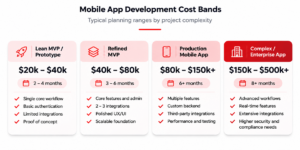
These figures are starting points. Native development for both platforms, real-time workflows, regulated data, and extensive third-party integrations can increase costs significantly.
AppVerticals’ mobile app development cost guide provides a more detailed breakdown of development stages, pricing factors, and ongoing maintenance.
How to Choose a New York App Development Company
When comparing mobile app developers in New York, review their mobile app case studies to assess experience with similar products, technical capabilities, and delivered outcomes. Evaluate the proposed team structure and availability of post-launch support.
Native Swift and Kotlin development may suit applications requiring extensive device functionality, while Flutter and React Native offer shared-codebase alternatives.
Businesses can review iOS app development services and work with an Android app development company when comparing platform requirements.
Assess backend architecture, API integrations, security requirements, and whether the provider offers documented mobile app testing services.
Request references from comparable clients and confirm App Store and Google Play deployment responsibilities before signing a mobile app development contract.
Questions to Ask Before Signing
Use these questions to compare development proposals:
- Have you built a similar application? Request relevant case studies and client references.
- Who will work on the project? Confirm the experience and responsibilities of the proposed team.
- Which technology stack do you recommend? Ask how it affects cost, performance, and maintenance.
- What does the estimate include? Review discovery, design, engineering, testing, deployment, and third-party expenses.
- How often will we receive working builds? Agree on demonstration and feedback schedules.
- Who owns the source code and accounts? Confirm intellectual property and access arrangements in writing.
- What happens after launch? Ask about support periods, maintenance rates, and response commitments.
These questions help expose differences between proposals that initially appear comparable.
Choosing the Right App Development Partner in New York
Shortlist mobile app development companies in New York based on relevant project experience, then compare their proposals against the same requirements.
As a mobile app development company in the USA, AppVerticals helps businesses turn product ideas into scalable mobile applications.
Ready to Build Your Mobile App in New York?
Share your app idea with AppVerticals to discuss key features, development timelines, and estimated costs.
Discuss Your App Development Project