












 ChatGPT
 Perplexity
 Claude
 Google AI
iPhone app development cost in 2026 runs from $99 to more than $400,000, and that gap is not vagueness, it is two different questions. If you are building for yourself, your only mandatory platform cost is the Apple Developer Program membership, and you can write and test Swift code in Xcode on your own device before you ever pay for public distribution. If you are hiring a team, the budget changes fast once product scope, backend work, compliance, and post-launch support enter the room.
For founders, CTOs, and product leads, the real budgeting range starts around $25,000 for a tightly scoped MVP, moves into the $60,000 to $150,000 band for most mid-complexity products, and goes well past $400,000 when HIPAA, PCI DSS, EHR integration, multi-role workflows, or enterprise controls are involved.
The App Store, the Apple Enterprise Program, and Apple’s commission structure matter; but they are a small fraction of what engineering and delivery discipline will determine. If you’re evaluating ios app development services, the useful question is not “What’s the average?” It is “What exactly am I paying for, and what happens if I underfund it?”
iPhone App Development Cost in 2026: A Quick Overview
A real iPhone app budget starts with the product tier. In practice, the cleanest house position for 2026 is $25,000–$60,000 for a scoped MVP, $60,000–$150,000 for mid-complexity builds, and $150,000+ for enterprise-grade products, with the most regulated or integration-heavy builds pushing beyond $400,000.
| Tier | Typical Features | Estimated Cost | Timeline | What Breaks If You Underfund It |
|---|---|---|---|---|
| Simple / MVP | 3–6 screens, basic auth, 1–2 integrations, lean admin logic | $25,000 – $60,000 | 2–4 months | Analytics, instrumentation, admin controls, and QA depth are usually the first things to disappear |
| Mid-complexity | Custom UI, 3rd-party APIs, CMS, dashboards, richer user flows | $60,000 – $150,000 | 4–8 months | The backend gets patched instead of designed, tech debt accumulates, and v2 arrives early and expensively |
| Complex / Enterprise | Real-time sync, AI/ML, multi-role permissions, compliance, deeper integrations | $150,000 – $400,000+ | 8–18 months | Security, auditability, performance, and release governance become fragile fast |
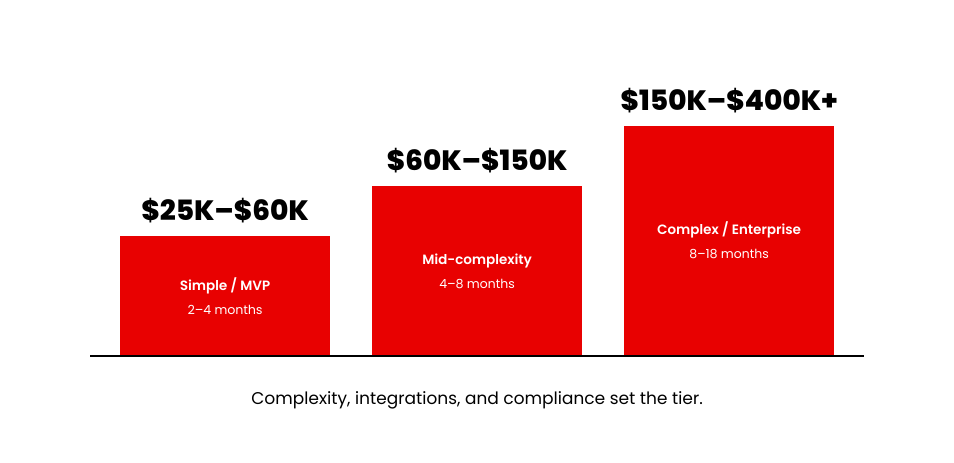
A budget becomes defensible when you separate platform fees from delivery cost. Apple may charge $99 for membership, but your build cost is still a function of screens, user roles, integrations, backend ownership, QA scope, and post-launch responsibility. That is why two teams can quote the same app 3x apart and both believe they are being reasonable.
Turn Your Feature List Into a Number
Answer a few questions about platform, features, and scope using our app development cost calculator to get a ballpark iPhone app estimate before you talk to anyone.
Calculate your iPhone app costWhat Apple Developer Program Actually Charges: $99, $299, D-U-N-S and the App Store Commission
If you only want to build and test on your own devices, Apple’s free path exists. If you want to publish publicly, the standard Apple Developer Program is $99 per year. The $299 Apple Developer Enterprise Program is for large organizations with internal-use app distribution needs, not for ordinary public launches.
Apple’s official program structure is straightforward once you separate development from distribution:
Free Apple account path: You can access Xcode, developer documentation, forums, and test apps directly on your own devices using Xcode.
Apple Developer Program: $99/year for individuals and organizations distributing apps publicly.
Apple Developer Enterprise Program: $299/year for private internal distribution to employees in qualifying organizations.
Organization enrollment: Companies and educational institutions typically need a D-U-N-S Number, which Apple notes is available for free in most jurisdictions.
Fee waivers: Eligible nonprofits, educational institutions, and government entities may qualify for a membership fee waiver.
App Store commission: Standard commission is 30% on paid apps and in-app purchases, with 15% available through the App Store Small Business Program for qualifying developers.
For solo builders, the answer is straightforward. You can learn, build, and test apps without paying Apple right away. However, that is different from launching a customer-facing product, managing App Store updates, or operating a business through Apple’s ecosystem.
The Five Variables That Move Your iPhone App Development Cost
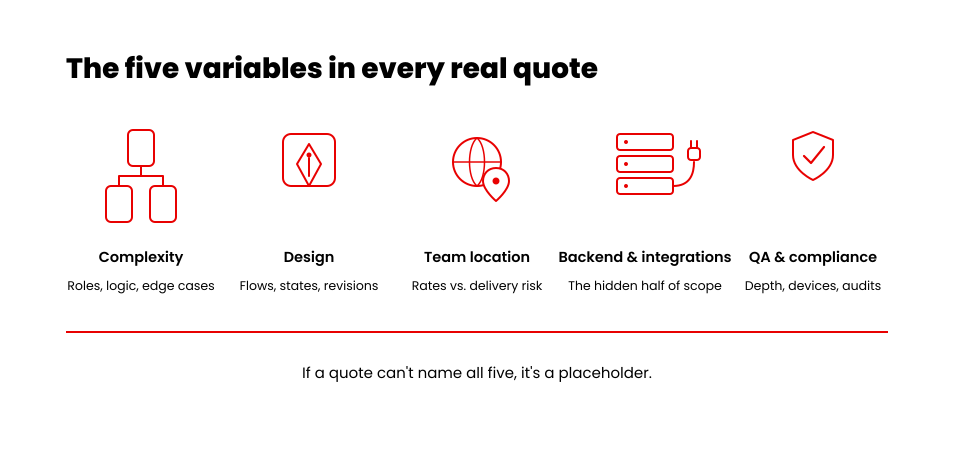
iPhone app development cost moves on five visible levers: complexity, design depth, team location, backend/integration load, and QA/compliance burden. If you cannot name those five in your quote, you do not yet have a quote; you have a placeholder.
Complexity
Complexity is still the primary cost driver. The number of screens matters, but the bigger cost accelerators are user roles, business logic, edge cases, moderation flows, offline behavior, and real-time data handling. A five-screen app with payments, identity, notifications, and admin logic can be more expensive than a ten-screen brochure-style product.
Design
Design cost is not “making it pretty.” It is flows, wireframes, interaction states, design systems, accessibility, handoff fidelity, and revision cycles. Founders often underestimate how much rework begins when the product is not fully thought through before code starts.
Team Location
Regional rates change budgets materially, but cheap hourly rates do not automatically produce a cheaper product. A lower-cost team with weak scoping, thin QA, or poor release discipline often creates a more expensive year two than a more expensive team that built the right foundation in year one.
Backend and Integrations
The price jumps when the app is not just a client. Payments, chat, geolocation, admin portals, CMS layers, file storage, analytics, search, CRM sync, EHR connectivity, and compliance logging all expand effort. Products that look simple in the App Store often hide most of their cost in backend design and operations.
QA and Compliance
QA is not optional polish. It is device coverage, regression protection, release safety, and performance confidence. In regulated categories, compliance adds cost because it adds documentation, controls, review, and risk management. If your app touches healthcare, financial transactions, or sensitive user data, you are not buying code alone, you are buying a more accountable delivery process.
What Each Project Stage Costs, and What You Have to Supply
A realistic iPhone app budget is not one lump sum. It breaks across discovery, design, engineering, QA, launch, and year-one support. Buyers make better decisions when they can see both the vendor work and the inputs they themselves must provide.
Below is a stage-by-stage breakdown using a $150,000 reference project:
| Stage | Approx. Budget Share | Approx. Cost on a $150K Project | What Happens Here | What You Must Supply |
|---|---|---|---|---|
| Discovery & Scoping | 5–10% | $7,500 – $15,000 | Requirements, architecture, scope boundaries, tech stack selection | Product goals, priority list, decision-maker access, initial PRD or feature list |
| UI/UX Design | 10–15% | $15,000 – $22,500 | Wireframes, flows, prototype, design system, revision loop | Brand assets, references, approval cadence, accessibility requirements |
| Frontend Development | 30–40% | $45,000 – $60,000 | Swift/SwiftUI coding, state management, screen builds, interactions | Finalized screens, acceptance criteria, feedback windows |
| Backend & API Development | 20–30% | $30,000 – $45,000 | Server logic, data model, auth, admin logic, integrations | API decisions, third-party credentials, ownership of services |
| QA & Testing | 10–15% | $15,000 – $22,500 | Functional, regression, device, performance, and release testing | Test accounts, scenarios, edge cases, success criteria |
| App Store Submission | 2–5% | $3,000 – $7,500 | Metadata, compliance review, TestFlight, release packaging | Apple account access, privacy disclosures, screenshots, policy answers |
| Post-Launch (Year 1) | 15–25% of build cost/year | $22,500 – $37,500 | Bug fixes, updates, compatibility, minor enhancements | Maintenance owner, backlog priorities, response SLAs |
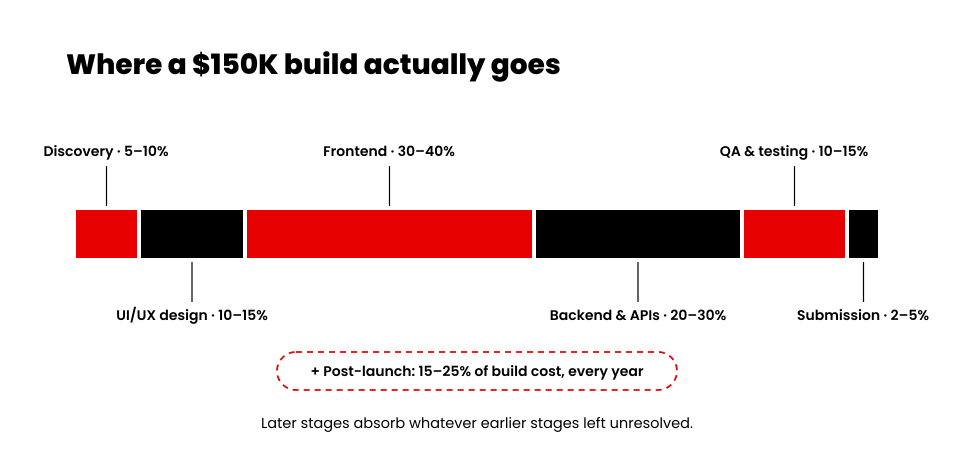
This is where iOS app development context matters. Buyers usually price vendor labor and forget buyer-side readiness. If the product team has not supplied a clear PRD, wireframes, brand assets, integration list, or approval authority, the timeline slips and the budget loses integrity.
The fastest way to save money is not to slash one stage blindly. It is to stop later stages from absorbing uncertainty that should have been resolved earlier.
iPhone App Development Cost by App Type and Industry
Industry shapes cost because industries shape risk. The most expensive apps are not always the prettiest ones, they are the ones carrying real-time logic, regulated data, or complicated operating flows.
| App Type / Industry | Core Complexity Drivers | Estimated Cost Range | Typical Timeline |
|---|---|---|---|
| On-demand (ride, food, delivery) | Real-time tracking, dual-sided UX, payments | $80,000 – $200,000 | 5–9 months |
| eCommerce & marketplace | Catalog, cart, payments, inventory sync | $60,000 – $180,000 | 4–8 months |
| Fintech & banking | PCI DSS, biometric auth, real-time transactions | $150,000 – $400,000+ | 8–14 months |
| Healthcare & fitness | HIPAA, EHR integrations, wearables | $120,000 – $350,000 | 7–12 months |
| SaaS / enterprise | Role-based access, dashboards, cloud infrastructure | $100,000 – $300,000 | 6–12 months |
| Gaming & AR/VR | 3D rendering, physics, ARKit, performance intensity | $150,000 – $500,000+ | 8–16 months |
These ranges only become useful when read against your actual product. A “healthcare app” can mean a light wellness tracker or a highly sensitive platform with records exchange and compliance governance. Same label, radically different budget.
What iOS Developers Charge, by Region
Regional rate differences are real, but they only help if you compare like with like. Hourly price without delivery quality, scope clarity, and release accountability is not budgeting, it is rate shopping.
A compact regional view looks like this:
| Region | Junior | Mid-level | Senior |
|---|---|---|---|
| USA / Canada | $80–$120/hr | $120–$180/hr | $150–$250/hr |
| Western Europe | $60–$90/hr | $90–$140/hr | $120–$180/hr |
| Eastern Europe | $35–$55/hr | $55–$80/hr | $75–$110/hr |
| India / Southeast Asia | $20–$35/hr | $35–$55/hr | $50–$80/hr |
| Latin America | $30–$50/hr | $50–$75/hr | $65–$95/hr |
The correct use of this table is not “pick the cheapest region.” It is “decide which parts of the product need senior ownership, which can be delegated, and how much delivery risk you can absorb.” If you want a deeper geography breakdown, see developer rates by country.
The Real Cost of Year One and Beyond
Post-launch cost is not an afterthought. If you ship a product and budget nothing for compatibility, hosting, monitoring, and controlled fixes, you did not really budget for launch — you budgeted for a screenshot.
| Year-One Line Item | Annual Cost | Who Owns It | Skippable? |
|---|---|---|---|
| Apple Developer Program renewal | $99/year | Product owner / account holder | No |
| Maintenance & updates | 15–25% of build cost/year | Dev partner or internal team | No |
| iOS version compatibility | 2–4 developer weeks per major iOS release | Engineering | No |
| Backend / cloud hosting | $500–$10,000+/month | Engineering / DevOps | No |
| Third-party API & SaaS tools | Usage-based / subscription | Product + engineering | Usually no |
| Security & compliance audits | $5,000–$25,000/year in regulated sectors | Security / compliance | No in regulated products |
| Crash monitoring & analytics | $200–$2,000/month | Engineering / product | Not if you care about quality |
| Certificate / provisioning upkeep | Time cost, recurring | Engineering / release owner | No |
This is also where teams forget operational friction. Certificates expire. Provisioning breaks installs. Major iOS releases arrive on Apple’s schedule, not yours. Hosting bills rise with user adoption. And if your app touches healthcare or payments, audits are not decorative line items, they are the price of remaining trustworthy.
If you are trying to benchmark year-one ownership against store behavior, Apple’s own annual app maintenance tooling is useful for visibility, but it does not eliminate the engineering work.
iOS vs Android Cost: Why Three Credible Sources Give Three Different Answers
iOS is not always cheaper than Android, and Android is not always cheaper than iOS. The contradiction usually comes from people comparing different things: development hours, hourly rates, fragmentation burden, or full dual-platform strategy.
Here is the practitioner view that resolves the confusion:
| Source Type | Their Claim | What They Are Actually Measuring | When It Is True |
|---|---|---|---|
| Platform-neutral market view | iOS and Android cost about the same | Similar feature scope on mature delivery teams | When the product is standard and comparison is top-line budget |
| Engineering-hours view | iOS can be cheaper | Less device fragmentation, tighter ecosystem, cleaner testing matrix | When comparing implementation effort only |
| Rate-card view | iOS can be more expensive | Strong native iOS specialists sometimes bill higher rates | When the team mix is senior-heavy or native-specialist-led |
The more important budget fact for buyers launching on both platforms is this: dual native development usually costs materially more than single-platform development, while a shared codebase can reduce the multiplier.
On AppVerticals’ Android cost guidance, launching on both platforms from day one typically lands around 1.7x to 2.2x the cost of an Android-only build, while shared-codebase delivery often lands closer to 1.2x to 1.6x of an Android-first build, depending on how much platform-specific behavior remains.
So the right question is not “Which platform is universally cheaper?” It is “What stack choice gets this product to market with acceptable risk, acceptable speed, and acceptable long-term maintenance?”
How to reduce iPhone App Development Cost without Cutting Product
The cheapest app is usually the one that does fewer things, more deliberately, in the right order. Cost reduction works when it removes wasted effort, not when it amputates capabilities you will need again three months later.
The highest-value cost controls are usually these:
- Scope the MVP like a real MVP. Separate launch-critical flows from “nice once we have traction.”
- Pay for discovery before you pay for engineering confusion. Discovery is cheaper than rewrite.
- Choose native only when the product benefits from native. If shared code gets you to market without performance or UX compromise, use it.
- Use managed infrastructure where it makes sense. Firebase, Supabase, Auth0, Stripe, and similar services can shorten early delivery.
- Keep the first release operationally narrow. One user role beats four. One integration beats five.
- Fix ownership early. Decide who owns backend, analytics, monitoring, content operations, and year-one maintenance.
- Prefer budget guardrails over false certainty. Time-and-materials with sprint caps is often more honest than fixed-price fiction on blurry scope.
The mistake founders make is trying to save money by stripping QA, architecture, or post-launch planning. That does not lower cost; it delays it, often into the most expensive part of the product lifecycle.
The Quote Normalization Sheet: Making Three Agency Quotes Comparable
If three agencies quote the “same” app at wildly different prices, they are usually not pricing the same thing. Normalize scope first. Compare price second.
Use this checklist before you judge any quote:
| Normalize This Item | Why It Changes Price | What to Pin Down |
|---|---|---|
| Screen count | More screens usually mean more states, more logic, more QA | Exact screens and edge states |
| User roles | Admin, provider, customer, guest, moderator all change complexity | Every role and permission layer |
| Integration list | Stripe, Maps, Twilio, EHR, CRMs all move cost | Named services, not “3rd-party APIs” |
| Backend ownership | Hidden backend work is a common quote gap | Who builds and maintains what |
| QA scope | Device matrix and regression depth change effort materially | Testing types and release criteria |
| Who supplies design | Missing design gets rebuilt as engineering churn | Final UI source of truth |
| Post-launch responsibility | Maintenance omission makes quotes look falsely cheap | Warranty, SLAs, update ownership |
| Contingency treatment | Change-request rules can distort headline price | How unknowns are billed |
A good quote does not just tell you the number. It tells you what assumptions made the number possible.
A bad quote often looks attractive because it leaves expensive things unnamed: admin scope, analytics, app review remediation, privacy disclosures, migration work, release support, or post-launch obligations.
What Budget Actually Makes Sense for Your Stage
The correct iPhone app budget depends less on ambition and more on stage. A pre-seed team should not fund an enterprise architecture for a hypothesis. A growth-stage company should not ship customer-facing core workflows on a prototype foundation.
| Business Stage | Sensible Budget | What It Should Buy You | Red Flag |
|---|---|---|---|
| Pre-seed / idea validation | $25,000 – $60,000 | Tightly scoped MVP, core flow, measurable user learning | Overbuilding roles, dashboards, or infrastructure before signal |
| Seed / early traction | $60,000 – $150,000 | Stronger UX, analytics, admin tooling, more reliable backend | Shipping growth features on a fragile base |
| Series A / scale-up | $150,000 – $300,000+ | Multi-role product, deeper integrations, stronger observability | Treating QA and security as optional |
| Enterprise / regulated rollout | $300,000 – $400,000+ | Compliance, auditability, complex workflows, stronger governance | Using consumer-app budgeting logic |
If you want to benchmark delivery outcomes beyond a single example, review the broader case studies library and compare your own product by scope, risk, and operating model, not by superficial category label.
Conclusion
iPhone app development cost is only confusing when platform fees, product scope, and delivery ownership are all mixed into one number. Once you separate Apple’s commercial fees from actual build cost, the budgeting picture gets much cleaner: the $99 membership matters, but your real spend will be driven by complexity, integrations, compliance, QA depth, and year-one ownership.
See What It Takes to Ship a Production-Ready iPhone App
Native Swift and SwiftUI builds covering architecture, UX, App Store submission, and post-launch maintenance, scoped to your feature list and launch timeline.