













 ChatGPT
 Perplexity
 Claude
 Google AI
SaaS MVP development means launching one paid workflow supported by user authentication, customer data separation, and subscription billing. Based on our product scoping at AppVerticals, a standard SaaS MVP typically costs $30,000-$70,000 and takes 10-16 weeks to develop, depending on the complexity of the workflow, integrations, and security requirements.
An MVP for SaaS should prove that customers will complete the core workflow and pay for continued access. Our MVP development services help founders define that workflow, validate its feasibility, and establish a release scope before development begins.
For version one, I recommend building the product’s defining workflow, using established providers for authentication and payments, and postponing features that do not directly support validation. Start with a single application, enforce tenant-level data isolation, and measure activation, retention, and paid conversion after launch.
This guide covers the release scope, technology choices, budget, timeline, security requirements, and decisions that determine what to build next.
Key Takeaways
|
What SaaS MVP development means
A SaaS MVP is the first functional version of a subscription-based software product designed to validate a core customer need and willingness to pay. It delivers one complete workflow that customers can use while the business collects feedback and measures demand.
Unlike a general MVP, a SaaS MVP must support multiple customer accounts with separate data, recurring subscription billing, self-service onboarding, and reliable uptime.
These requirements allow customers to sign up, access the product, and pay without assistance from a salesperson.
Our POC vs prototype vs MVP guide explains which validation approach fits your product’s stage.
SaaS MVP Scope: What to Build, Buy and Leave for Later
Effective MVP development for SaaS starts by identifying the core assumption the product must validate. Discovery turns that assumption into a locked scope for release one, with clear acceptance criteria.
| Product component | Version-one decision | Reason |
| Core workflow | Build | Delivers the product’s primary value |
| Sign-in and accounts | Buy: Auth0 or Firebase Auth | Reduces custom authentication work |
| Subscription billing | Buy: Stripe | Supports recurring payments and plan management |
| Customer data separation | Build | Prevents cross-customer data access |
| Onboarding | Build: Short guided flow | Helps customers reach first value |
| User roles | Build: User and admin | Covers essential permissions |
| Admin console | Build: Basic controls | Supports customer and account management |
| Product analytics | Buy: Mixpanel or GA4 | Measures activation and behavior |
| Integrations | Build: Two or three essential connections | Completes the core workflow |
| SSO | Wait | Add for enterprise requirements |
| Custom reports | Wait | Validate reporting demand first |
| Native mobile apps | Wait | Add for validated mobile workflows |
| AI capabilities | Wait | Require a specific validated use case |
For recurring payments, Stripe’s subscription documentation provides the implementation requirements for subscription lifecycles and billing events.
During our work on the Gifted Financial Services platform, we kept class bookings within the application while using Zoom or Google Meet for live sessions. We also replaced the proposed SMS alerts with email notifications and persistent in-app banners.
These decisions preserved the required customer experience while avoiding additional infrastructure and per-message costs.
I recommend resolving similar trade-offs during a product discovery workshop, before the team commits to development.
SaaS MVP Tech Stack: Defaults That Ship Fast
A practical SaaS MVP tech stack uses established technologies that support the first release and allow the product to expand without unnecessary architectural complexity.
For most web-based SaaS products, I recommend starting with a single deployable application and a relational database.
| Technology layer | MVP default | Change it when |
| Frontend | Next.js with React | Interface requirements demand another framework |
| Backend | Node.js | Python better serves data-heavy or AI workloads |
| Database | PostgreSQL | Data requirements justify another database |
| Hosting | AWS, single region | Geographic or compliance needs change |
| Authentication | Managed authentication provider | Specialized identity requirements emerge |
| Billing | Stripe | Payment geography or business rules require another provider |
| Monitoring | Sentry | Operational requirements justify additional tooling |
Technology selection should follow the product’s requirements, team capabilities, and anticipated dependencies.
Our guide to SaaS application development covers the reasoning behind these technology choices.
As our web application architecture guide explains, teams should split functionality into separate services when a measured requirement appears, such as independent scaling or deployment needs.
Planning the First Release of a SaaS Product?
Bring your idea to a free discovery call with our MVP strategists. You leave with a clear scope, timeline, cost estimate, and technology guidance.
Plan Your SaaS MVPMulti-Tenancy in a SaaS MVP: One Database, a Tenant ID on Every Record
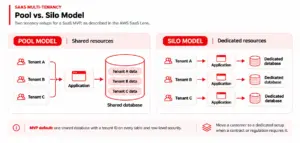
For a SaaS MVP, I recommend one shared database with tenant IDs on every tenant-owned table and enforced row-level security.
According to the AWS SaaS Lens, the pool model shares resources across customers, while the silo model provides dedicated resources for each customer.
Move customers to dedicated infrastructure when contracts or regulations require it.
As a SaaS development company, we implement row-level security, tenant-specific schemas, and data encryption to protect customer information.
SaaS MVP Development Cost and Timeline
A standard SaaS MVP with user and admin roles, subscription billing, a dashboard, and two or three integrations commonly costs $30,000-$70,000 and takes 10-16 weeks based on our scoping estimattes.
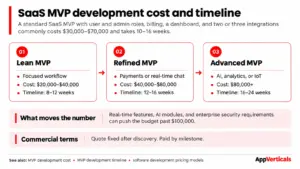
I recommend treating early estimates as planning ranges until discovery confirms the requirements and dependencies. At AppVerticals, we finalize the quote after discovery and tie payments to agreed milestones.
For a detailed financial breakdown, see our MVP development cost guide. Our MVP development timeline explains delivery phases, while the software development pricing models comparison covers commercial arrangements.
Security Basics a SaaS MVP Needs Before Its First Customer
A SaaS MVP must enforce tenant-level authorization, protect credentials and customer data, maintain recoverable backups, and record sensitive activity before accepting paying customers.
I recommend five launch checks:
- Verify tenant access on every request. Confirm that the authenticated user belongs to the customer account associated with the requested resource.
- Protect credentials. Store API keys, tokens, and passwords in managed secret storage outside the source code.
- Encrypt customer data. Protect information in transit and at rest using appropriate encryption controls.
- Test backup recovery. Restore a backup in a controlled environment and confirm that the recovered data is usable.
- Log sensitive actions. Record authentication events, permission changes, and important administrative activity.
Tenant authorization deserves particular attention. OWASP Top 10:2025 ranks Broken Access Control as A01, reflecting the importance of enforcing permissions on the server.
Our MVP delivery approach applies ISO 27001-aligned controls to security planning and implementation.
For additional controls, see our web application security best practices guide.
After Launch: The Numbers That Decide the Next Release
Track activation, retention, and trial-to-paid conversion from day one to evaluate your SaaS MVP’s performance.
These metrics reveal whether customers complete the core workflow, return to the product, and become paying subscribers.
Product-Market Fit Test: In First Round Review (2018), Rahul Vohra recommends asking users how they would feel if they could no longer use the product. Sean Ellis identified 40% answering “very disappointed” as a benchmark for product-market fit. Superhuman improved its score from 22% to 58%.
Use the results to decide whether to persevere, pivot, or scale.
Want a Number Before You Talk to Anyone?
Answer a few questions about your business, platforms, and features to receive a preliminary development estimate.
Estimate Your MVP CostSaaS MVP Development in Practice: One Platform, Four Texas Agencies
Our Visionze platform demonstrates how phased SaaS development helped four Home and Community Services agencies in Texas manage operations through one multi-tenant system. Each agency manages 20-60 consumers, with customer data isolated across the platform.
A team of four to five developers built the system using React.js, React Native, NestJS, MySQL, and AWS. Development prioritized essential workflows and state-mandated forms before expanding to additional agencies and document types. The result was an approximately 90% reduction in paper-based processes.
Choosing SaaS MVP Development Services
Choosing the right SaaS MVP development services requires a structured process that defines scope, validates requirements, and establishes clear delivery terms. I recommend working with an MVP development company that completes discovery with a locked scope, tests a prototype before coding, and provides a fixed quote with milestone-based payments.
The development partner should also demonstrate progress every two weeks and maintain the code in your repository from day one. These practices provide visibility into delivery, ownership of the product, and control over future development.