













 ChatGPT
 Perplexity
 Claude
 Google AI
By the time a CTO reaches me, they usually need a launch window they can defend to leadership, engineering, and the business. A minimum viable product, or MVP, is the smallest production-ready product that lets a team test one meaningful user workflow. Its development timeline covers far more than writing code.
Discovery, design, sprint planning, development, user acceptance testing, and launch readiness all consume calendar time. API integrations, authentication, analytics, CI/CD, security review, compliance, stakeholder approvals, and scope changes can extend the critical path. Across more than 50 digital product strategies, I have found that a credible schedule starts with a clear learning goal, explicit dependencies, and a decision-maker for each milestone.
A useful MVP schedule tells leadership what will be proven, what could block delivery, and which decision must happen next. In this guide, we break down the MVP development timeline, from early discovery and design to development, testing, and launch. You’ll learn what impacts delivery time, where projects typically slow down, and how to plan an MVP schedule that aligns with business goals.
Key Takeaways:
- MVP development timeline: Typically ranges from 6 to 24 weeks, depending on scope, complexity, integrations, compliance, and platform requirements.
- Scope matters more than feature count: Workflows, user roles, dependencies, security requirements, and integrations often have a bigger impact on delivery time.
- Clear ownership prevents delays: Defined goals, decision-makers, teams, and acceptance criteria help keep MVP schedules on track.
- Phases often overlap: Discovery, design, development, testing, and launch preparation run in parallel to improve delivery speed.
- Planning gaps cause delays: Scope creep, unclear requirements, delayed approvals, and integration issues commonly extend timelines.
- Successful MVPs focus on learning: Prioritize one core workflow with clear dependencies and measurable launch goals.
What is the timeline for MVP development?
With a stable core scope, an available cross-functional team, continuous quality assurance, accessible external systems, and timely approvals, a focused MVP can fit a six-to-eight-week planning scenario. A standard software-as-a-service product often needs 10–16 weeks, while a regulated or multi-role platform can require 16–24 weeks.
Treat these ranges as planning scenarios. A proof of concept, design-only prototype, hackathon build, and feature-complete release each require a separate estimate.
The scenarios assume:
- A product owner can approve scope and answer questions promptly.
- The team includes product, design, engineering, and quality-assurance capacity.
- The core workflow and launch criteria are agreed during discovery.
- Required API access, credentials, and test environments are available.
- Testing starts during development.
- Scope additions move to a later release unless they replace equivalent work.
Calendar time also differs from delivery effort. Parallel work can compress the calendar while the total effort remains the same, and an external approval can pause the critical path while engineering capacity remains available.
I advise CTOs to keep four measures separate:
| Measure | What it represents | Why it matters |
|---|---|---|
| Calendar duration | Time from kickoff to release | Used for launch and stakeholder planning |
| Delivery effort | Combined time contributed by the team | Used for staffing and budget decisions |
| Critical path | The longest chain of dependent tasks | Determines the earliest credible launch date |
| Contingency | Capacity reserved for known uncertainty | Protects the release from integration and validation surprises |
Timeline and budget usually move together because added roles, platforms, and integrations require more design, development, and testing. For the financial side of that decision, use our MVP cost breakdown alongside the schedule. Keep the two estimates distinct.
What determines an MVP development timeline?
A feature count gives me only a partial view of the schedule. I also need to know how many user roles, platforms, systems, approval steps, and failure conditions the team must handle.
A five-feature internal tool with one user role can be simpler than a three-feature fintech application that requires identity verification, transaction monitoring, audit logs, and security approval. The second product has fewer visible features and a much larger validation surface.
| Timeline factor | Questions I ask during scoping | Likely calendar effect |
|---|---|---|
| Core workflow | Can one user complete one valuable outcome end to end? | A focused workflow reduces design and testing volume |
| User roles | Which permissions and journeys differ by role? | Each role adds screens, authorization rules, and test cases |
| Platforms | Is the MVP web, iOS, Android, or cross-platform? | Multiple platforms expand implementation and device testing |
| Integrations | Which APIs are essential for launch? | External access, documentation, and sandbox quality create dependencies |
| Data migration | Must existing records be cleaned or transformed? | Mapping and reconciliation add preparation and validation |
| Security | What authentication, authorization, and audit controls are required? | Security requirements affect architecture and release review |
| Compliance | Which legal or industry controls apply? | Evidence collection and approval can extend launch readiness |
| Stakeholders | Who approves scope, design, security, and release? | Slow or conflicting feedback creates idle time and rework |
| AI behavior | How will outputs be evaluated and monitored? | Evaluation, guardrails, latency, and fallback handling add work |
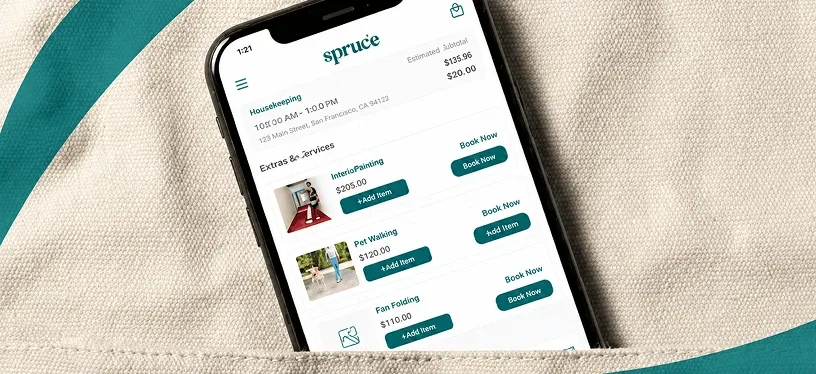
Our work on Get Spruce makes that system surface visible. Spruce already operated a resident mobile app and several web portals serving administrators, service providers, and property managers.
The expansion added a dedicated mobile app for service professionals and more detailed property-management workflows. It also introduced capacity management, dynamic pricing, reporting, role-based access, and scheduling across the platform.
The supplied project record identifies integrations with Braze, Braintree, Slack, Front, and Mixpanel. Each integration brought its own access, data, error-handling, and validation requirements.
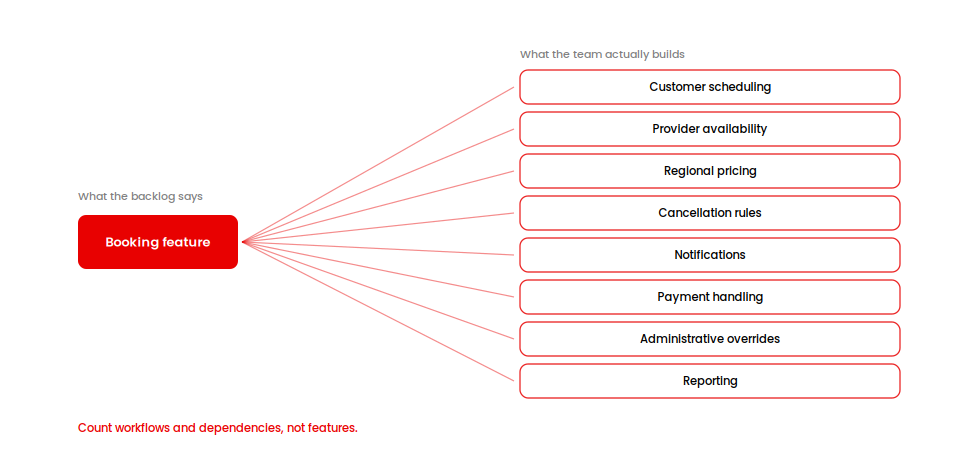
The planning lesson is concrete. A “booking feature” can include customer scheduling, provider availability, regional pricing, cancellation rules, notifications, payment handling, administrative overrides, and reporting. Count workflows and dependencies first.
MVP development phases and milestones
I plan MVP work as overlapping delivery lanes with explicit acceptance points. Discovery clarifies the product while technical setup begins, and quality assurance starts as soon as the first working feature reaches a staging environment.
A staging environment is a production-like system used for internal review before release. CI/CD, or continuous integration and continuous delivery, automatically builds, tests, and deploys approved code so the team can review working software frequently.
With the scope, delivery team, external access, and approvers available, I use the following phase allowances for planning. The phases overlap, so adding every row would overstate the total calendar duration.
| Phase | Typical planning allowance | Core work | Milestone or exit evidence |
|---|---|---|---|
| Discovery and scope | 1–3 weeks | User problem, core workflow, user stories, priorities, technical risks | Approved scope, launch criteria, dependency list |
| UX and product design | 1–4 weeks, often overlapping | User flow, wireframes, interface states, component selection | Approved core journey and essential error states |
| Technical foundation | Begins during discovery or design | Architecture, data model, authentication, environments, CI/CD | Working staging environment and agreed API contracts |
| Build and integration | 4–12+ weeks | Frontend, backend, administration, analytics, integrations | Core workflow runs end to end on staging |
| Validation and UAT | Continuous, with a focused release window | Functional, regression, device, security, and user acceptance testing | Critical defects resolved and product owner approval |
| Launch readiness | About 1–2 weeks | Monitoring, backups, rollback plan, support process, soft launch | Release approval and production smoke test |
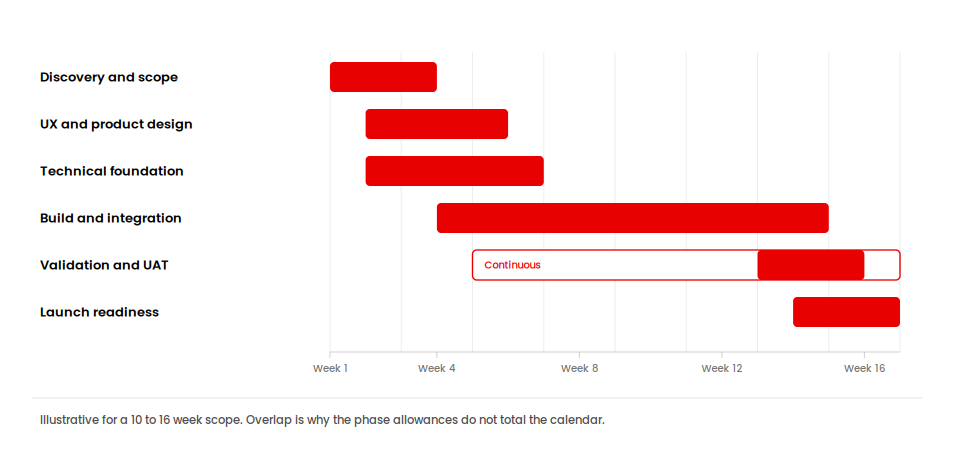
A frontend team can build against an agreed API contract while backend engineers implement the service. Designers can prepare secondary states while developers build the approved primary flow.
User acceptance testing, or UAT, is where business representatives confirm that the product supports the agreed real-world workflow. I ask teams to define UAT scenarios during discovery so every feature remains connected to a release condition.
A milestone needs observable evidence. “Development complete” leaves room for interpretation, while “a new user can register, complete the core transaction, receive confirmation, and see the transaction in the admin portal” gives product, engineering, and QA the same finish line. Evidence closes the phase.
Sample MVP timelines by product complexity
These scenario-based planning references assume an available cross-functional team, a stable core scope, prompt approvals, and testing throughout development. They exclude hiring lead time and unresolved access to third-party systems.
| Scenario | Planning range | Assumed scope | Primary calendar pressure |
|---|---|---|---|
| Focused workflow | 6–8 weeks | One role, three to five core capabilities, simple business logic, one essential integration | Scope discipline and rapid product feedback |
| Standard SaaS MVP | 10–16 weeks | User and admin roles, billing, dashboard, core workflow, two or three integrations | Permissions, billing states, and integration testing |
| Mobile app MVP | Scope-dependent | Core mobile journey, backend, authentication, analytics, and defined platform coverage | Device behavior, app-store preparation, and native capabilities |
| Integration-heavy MVP | Scope-dependent | Several external systems, data mapping, retries, error handling, and administrative controls | API access, sandbox quality, and partner response time |
| Regulated MVP | 16–24 weeks | Multiple roles, auditability, security controls, identity or compliance workflows | Control validation and release approval |
| AI-enabled MVP | Scope-dependent | One bounded AI workflow with evaluation criteria and fallback behavior | Data quality, model evaluation, latency, security, and monitoring |
A six-week MVP development timeline can work when the team is validating one narrow journey. It becomes fragile once the schedule includes several user roles, legacy integrations, custom infrastructure, or an unresolved security review. A three-month MVP development timeline is a useful planning frame for many standard SaaS products. The team still needs to reduce the release to one valuable workflow and protect that boundary through weekly reviews.
For a mobile app MVP, platform coverage must be decided before the estimate. A cross-platform application, separate native iOS and Android builds, and a web-plus-mobile product create different implementation and testing surfaces.
AI requires its own scoping discipline. Coding assistants can help engineers produce boilerplate and test scaffolding, while product validation, integration behavior, security review, and stakeholder decisions continue to consume calendar time.
What delays MVP delivery?
Schedule overruns often begin as small unresolved decisions. An unanswered API question during discovery becomes rework during development, while a delayed design approval can block several user stories.
I use this delay-risk checklist before sprint planning:
| Delay risk | Early warning sign | Schedule control |
|---|---|---|
| Scope creep | New features enter active sprints without trade-offs | Require each addition to replace similar effort or move to the next release |
| Approval latency | Several stakeholders provide separate or conflicting feedback | Name one accountable product owner and set a response window |
| Unclear acceptance criteria | Engineers and stakeholders describe “done” differently | Add observable completion conditions to each user story |
| Integration uncertainty | Production access or documentation remains unavailable | Test the riskiest API during discovery |
| Late QA | Full workflow testing begins near launch | Test each feature on staging within its development sprint |
| Design changes during build | Core screens remain open for revision | Approve the core flow and error states before implementation |
| Security review at release | Security receives the architecture after development | Involve security during discovery and threat review |
| Environment gaps | Staging differs materially from production | Automate configuration and deployments through CI/CD |
| Data migration uncertainty | Source data quality remains unknown | Profile a representative sample before final estimation |
| Shared team capacity | Critical contributors split time across products | Reserve named capacity and document backup ownership |
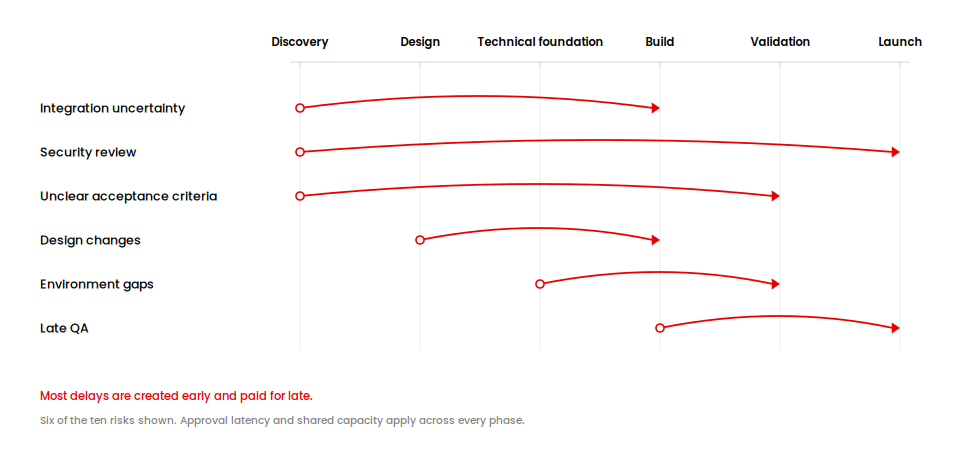
Weekly demonstrations provide an early-warning system. They let stakeholders see working software and correct misunderstandings while the affected code is still fresh. Small delays compound.
How CTOs can keep an MVP timeline on track
A CTO creates schedule reliability through decision design. The delivery team needs clear authority, response expectations, dependency ownership, and measurable release criteria.
I recommend six controls:
- Write the learning goal. State the assumption the MVP must test and the behavior that would provide useful evidence.
- Map one end-to-end workflow. Include the user action, system response, administrative handling, analytics event, and failure state.
- Set a scope gate. Approve the initial release backlog before the main build begins.
- Assign dependency owners. Give each integration, security review, legal review, data source, and platform account a named owner.
- Review working software weekly. Use a shared staging environment and capture decisions during the review.
- Define launch readiness early. Agree on acceptable defects, monitoring, rollback, support, security approval, and UAT evidence.
Backlog refinement means preparing and clarifying future work before it enters a sprint. Keep it focused on the approved release, with later ideas held in a separate backlog.
I also encourage a short executive decision calendar. Product may need same-day answers throughout the build, while security, legal, operations, or finance may need scheduled reviews with several days of preparation.
Place those reviews on the calendar during discovery. Approval risk should be visible before sprint commitments are made.
The CTO should receive a concise weekly view of:
- Current milestone and confidence level
- Working functionality demonstrated
- Decisions due before the next review
- External dependencies and owners
- Scope changes accepted or deferred
- Defects affecting the critical path
- Launch-readiness risks
The report should expose decisions that can move the critical path. Governance protects the date.
MVP versus prototype versus full product
A proof of concept tests technical feasibility. A prototype tests how a proposed experience should work, often through clickable screens. An MVP gives real users a functioning product so the team can observe behavior and validate a business assumption.
| Product stage | Primary question | Typical output | Production expectation |
|---|---|---|---|
| Proof of concept | Can the risky technical idea work? | Technical experiment | Usually disposable |
| Prototype | Can users understand and navigate the experience? | Clickable or simulated interface | No production operation required |
| MVP | Will users complete and value the core workflow? | Deployable product with analytics and support | Production-ready for a controlled audience |
| Full product | Can the product support broader adoption and operations? | Expanded workflows, controls, and scale capabilities | Designed for sustained operation |
Choosing the correct stage can remove unnecessary development. When technical feasibility remains uncertain, start with our POC vs. prototype vs. MVP decision guide.
Once the team selects an MVP, protect its learning goal from full-product expectations. Our guide to MVP versus full-product scope explains how those release standards differ. The boundary protects the learning goal.
When to involve an MVP development partner
External support becomes useful when the target date is approaching faster than the organization can assemble product, design, engineering, QA, and delivery capacity. It also helps when the MVP depends on architecture or integrations that the internal team has limited time to investigate.
I would assess a development partner against the schedule it can explain. Ask for:
- Assumptions behind the proposed range
- Named roles and committed availability
- Discovery outputs and scope-approval process
- Approach to API and integration risk
- Frequency of staging releases and demonstrations
- Testing ownership throughout development
- Security and launch-readiness activities
- Change-control process
- Code, documentation, and environment handoff
A credible response connects every phase to a deliverable and a decision. It also identifies what your organization must supply, including credentials, subject-matter experts, security feedback, legal approval, and product decisions.
For mobile products, the broader delivery model matters. Our mobile app development company overview explains how product strategy, design, engineering, and launch support fit together.
Your MVP development timeline becomes more credible as assumptions become explicit. Start with one testable workflow, map its dependencies, reserve the required team, and place approvals on the calendar. Write the assumptions down before committing.
A defensible plan has four parts: one core workflow, explicit dependencies, named decision owners, and observable release evidence. Put those on the calendar before making a launch commitment.
Build a defensible MVP schedule
Review the workflow, dependencies, team capacity, and approval risks behind your proposed release.
Discuss your MVP scope and delivery assumptions