














 ChatGPT
 Perplexity
 Claude
 Google AI
The three main software development pricing models are fixed price, where you pay one agreed amount for a defined scope; time and materials, where you pay for hours worked at agreed rates; and dedicated team, where you pay a monthly fee per engineer.
Fixed price suits projects with locked requirements, time and materials fits changing requirements, and dedicated teams work best for products with ongoing development needs.
Before signing with a web app development company, confirm which pricing model the quote follows and how changes to the scope affect costs.
This guide compares pricing, billing structures, change requests, and post-launch bug fixes to help you choose the right model for your project.
Key Takeaways
|
What Are Software Development Pricing Models?
Software development pricing models define how costs are calculated, while software development engagement models determine who manages the work. This guide focuses on pricing.
The three main models are:
- Fixed price: One agreed amount for a defined project scope.
- Time and materials: Billing based on actual hours worked at agreed rates.
- Dedicated team: Monthly billing for allocated engineering resources.
For more on team management and delivery responsibilities, read our guide to in-house vs outsourcing software development.
How Fixed Price, Time and Materials, and Dedicated Teams Work
Fixed price puts cost overrun risk on the vendor, time and materials shifts it to the client, and dedicated teams leave the client responsible for managing engineering capacity and costs.
Fixed Price: One Price for an Agreed Scope
A fixed-price contract establishes the scope, cost, and milestones before development begins, with the vendor absorbing cost overruns and any changes requiring a separately priced change order. This model suits projects with fixed requirements, budgets, and deadlines. At AppVerticals, our MVP offering includes Fixed Quote After Discovery and Milestone-Based Pricing, tying costs to agreed deliverables.
Key consideration: Martin Fowler explains that fixing the scope creates the main constraint, while keeping the price and deadline fixed with flexible feature selection allows greater adaptability.
Time and Materials: Pay for the Hours Worked
A time and materials contract bills actual development hours at agreed rates through monthly timesheets, allowing you to adjust priorities each sprint while carrying the risk of cost overruns. For example, 200 hours at $50 per hour costs $10,000, with additional hours increasing the bill.
Key consideration: FAR 16.601 identifies the lack of a financial incentive for contractor cost control and requires U.S. federal contracts to include a ceiling price that the contractor exceeds at its own risk. For commercial projects, request a similar spending cap, regular sprint reports, and written approval before exceeding the budget.
Turn These Ranges Into a Quote for Your Project
Share your requirements on a discovery call, and we’ll recommend a pricing model and send a quote built around your scope.
Dedicated Team: A Monthly Fee per Engineer
The dedicated team model provides full-time engineers billed monthly based on 160 working hours per engineer, giving you direct control over development priorities, workloads, and deliverables. Unlike a fixed-price project, this model allows you to adjust requirements and allocate resources as your product evolves, making it suitable for SaaS platforms and businesses with ongoing development roadmaps.
At AppVerticals, clients who hire dedicated developers receive a 10-business-day trial, a 30-day exit notice period, and rates fixed for the contract term. For details on team composition, pod pricing, and onboarding timelines, read our dedicated development team guide.
Time and Material vs Fixed Price vs Dedicated Team
| Factor | Fixed Price | Time and Materials | Dedicated Team |
| What you pay for | Agreed deliverables | Actual hours worked | Allocated engineering capacity |
| Budget certainty | High for agreed scope | Depends on spending controls | Predictable monthly rate |
| Scope flexibility | Requires change approval | Backlog can change | Priorities can change |
| Overrun risk | Vendor for original scope | Client bears extra hours | Client bears utilization risk |
| Your involvement | Milestone reviews | Regular sprint reviews | Ongoing priority management |
| Billing method | Agreed milestone payments | Hours x agreed rates | Monthly per engineer |
What Each Pricing Model Costs: Rates, Retainers and Fixed Quotes
Software development costs depend on scope, technical complexity, required specialists, and how engineering capacity is billed.
At AppVerticals, our published pricing provides the following planning ranges:
| Model | How the Bill Is Built | AppVerticals Planning Range |
| Time and materials | Actual engineering hours | $30–$85/hour |
| Dedicated developer | 160 hours per month | $4,800–$13,600/month |
| Basic web application | Fixed scope and milestones | $12,000–$40,000 |
| Mid-range web application | Fixed scope and milestones | $40,000–$100,000 |
| Enterprise web application | Discovery-based fixed quote | $100,000+ |
| Lean MVP | Fixed quote after discovery | $20,000–$40,000 |
| Refined MVP | Fixed quote after discovery | $40,000–$80,000 |
| Advanced MVP | Fixed quote after discovery | $80,000+ |
These figures are planning ranges, with final quotes determined after a discovery call based on the project’s scope and technical requirements.
For a detailed breakdown of how development costs are calculated, read our software development cost estimation guide.
How Change Requests and Bug Fixes Are Billed Under Each Model
Change requests and post-launch defects directly affect what a software project costs beyond its original estimate.
PMI’s 2018 Pulse of the Profession reported that 52% of projects experienced scope creep or uncontrolled changes. The finding reinforces why change approval and defect responsibility must be addressed before signing.
| Scenario | Fixed Price | Time and Materials | Dedicated Team |
| New feature request | Priced change order | Added to billable backlog | Managed through reprioritization |
| Existing feature modification | Change order if outside scope | Additional development hours | Uses allocated team hours |
| Bug within agreed scope | Reworked under acceptance terms | Depends on defect provisions | Addressed using team capacity |
| Bug discovered after launch | Covered within agreed warranty | Billed unless otherwise agreed | Handled within available capacity |
| Additional third-party integration | Separate scope and price | Billed engineering hours | Uses allocated development time |
A defect is functionality that fails to meet agreed acceptance criteria, while a change request introduces work outside the approved scope. Clearly defining both helps prevent billing disputes.
For fixed-price contracts, specify warranty coverage, exclusions, and response times, and consider a feature-swap clause allowing equivalent features to be exchanged without additional cost. For time and materials, clarify whether rework caused by the vendor’s failure to meet agreed requirements is billable.
For additional contract protections, see our pre-contract checklist.
Which Pricing Model Fits Your Web App Project
The right model follows the project’s level of requirement certainty, the frequency of expected changes, and your capacity to manage delivery.
| Your Situation | Recommended Model | What to Lock in the Contract |
| First release with locked scope and budget | Fixed price | Scope, milestones, acceptance criteria |
| SaaS product with changing requirements | Time and materials with cap | Rates, budget cap, sprint reports |
| Weekly releases across a long roadmap | Dedicated team | Trial, notice period, rate lock |
| Rescue of an unfamiliar codebase | Audit, then fixed-price phases | Audit findings, phase deliverables |
| Ongoing maintenance after launch | Monthly retainer | Response times, hours reports |
For further guidance on defining your first release, explore our MVP development services. If you’re evaluating an existing codebase, our code audit guide explains how to assess technical issues before committing to development costs.
Hybrid Pricing: Fixed Price for the First Release, Time and Materials After Launch
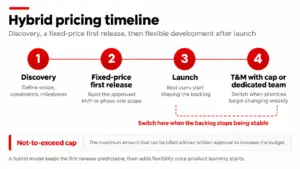
Hybrid pricing combines fixed-price development for the initial release with time and materials or a dedicated team for ongoing improvements, providing budget certainty while accommodating evolving product requirements.
A not to exceed contract establishes the maximum amount billable without approval for additional spending.
Software Development Pricing Models in Practice: Hip2Save
Our Hip2Save app rebuild demonstrates how separating defined development work from ongoing maintenance provides better cost control and billing transparency.
Hip2Save’s website was functioning, but its iOS and Android applications faced significant performance and reliability issues. Our team audited both applications, identified 36 defects, and separated critical bug fixes from architectural improvements, pricing each workstream independently before rebuilding both apps.
Following the rebuild, the engagement transitioned to an ongoing maintenance retainer with dedicated engineers and monthly hours reporting. Any work beyond maintenance requires a written change request specifying the estimated hours and budget before development begins.
The engagement achieved 99.4% crash-free sessions, and four years later, our team continues delivering updates and supporting both applications.
Although Hip2Save is a mobile app project, it demonstrates how software development pricing can combine scope-based billing for defined work with a retainer for ongoing maintenance.
Choosing a Web App Development Company by How It Prices
Before selecting a web app development company, evaluate how clearly it defines project costs, scope, and contractual responsibilities. Look for discovery before quoting, a documented scope, transparent development rates, and a spending cap for hourly work. The agreement should also specify how change requests are priced, what the warranty covers, and how post-launch defects are handled.
Explore our web application development services to discuss your project requirements and pricing options.
Comparing Quotes for a Web App?
Tell us what you’re building. We’ll scope it in a discovery call and provide a tailored quote or a rate card if a dedicated team fits better.
Get a Quote for Your Web App
Frequently Asked Questions
What Are the Disadvantages of Fixed-Price Contracts?
Fixed-price contracts limit flexibility because requirements, deliverables, and costs are agreed upon before development begins. Any changes outside the approved scope require additional pricing and approval, potentially increasing costs and delaying delivery. Incomplete requirements can also lead to disputes over what the original agreement covers, making clearly defined acceptance criteria and a documented change-request process essential.
What Happens to Unused Hours in a Time and Materials or Dedicated Team Contract?
Under time and materials, clients pay for actual hours worked, so unused hours are not billed. Dedicated team billing depends on the agreed contract terms and allocated engineering capacity. At AppVerticals, billing covers working hours only, while onboarding, holidays, and sick leave are unbilled. Clients should confirm whether unused hours can be carried forward or whether monthly commitments apply.
Should the Price Be Lower if Developers Use AI Coding Tools?
AI coding tools should reduce development costs when they demonstrably reduce the hours required to deliver the agreed scope without compromising quality. METR’s February 2026 update reported some evidence of productivity improvements but acknowledged limitations in measuring their impact. Under time and materials, efficiency gains should appear as fewer billable hours, while fixed-price buyers should assess the overall quote against deliverables, quality, and timelines.
Which Costs Sit Outside the Quote Under Every Pricing Model?
Development quotes can exclude hosting, cloud infrastructure, third-party API fees, software licenses, app store accounts, and post-warranty support unless explicitly included in the agreement. These expenses can increase the total cost of ownership regardless of the pricing model. Before signing, request a breakdown of included services, one-time charges, recurring costs, and maintenance fees to avoid unexpected expenses after launch.