











 ChatGPT
 Perplexity
 Claude
 Google AI
A product discovery workshop brings founders, product managers, designers, and technical stakeholders together to define the problem, understand target users, and establish the requirements for a minimum viable product (MVP).
At AppVerticals, discovery focuses on understanding business objectives, evaluating user needs, identifying technical considerations, and prioritizing the functionality required for the initial release.
These discussions help shape product requirements and the proposed scope of work, giving founders and development teams a clearer foundation for planning, design, and implementation.
How a Product Discovery Workshop Fits the Product Discovery Process
A product discovery workshop provides the starting point for the broader discovery process by identifying assumptions that require validation and questions that need further investigation.
The broader product discovery process includes user research, requirements refinement, design exploration, and technical investigation. These activities inform the initial scope and help teams identify potential risks before development begins. Our MVP development timeline explains how this early discovery work fits into the overall development process.
However, product discovery does not end when development starts. As explained in Product Talk’s continuous discovery framework, ongoing customer feedback and learning inform product decisions throughout development and after launch.
Why Discovery Comes Before Your MVP
Discovery comes before MVP development because a reasonable feature list can still lead to an expensive first release. AppVerticals’ work on One For All Pro demonstrates why discovery matters before development. The founders wanted to build a home-services marketplace, but important operational questions remained unanswered, including how providers would be paid, how commissions would be distributed, and what verification requirements should apply.
By defining these rules before designing the application, the team established the foundation for three connected applications: a customer app, a service provider app, and an admin panel. These decisions shaped the product’s workflows, payment structure, and technical requirements.
Discovery helps the team make three decisions:
- What must be validated first? Identify critical business assumptions that require evidence before influencing product decisions.
- What belongs in the MVP? Prioritize the functionality needed to deliver value and test the core proposition.
- What needs investigation? Identify unresolved workflows, dependencies, and technical constraints before implementation begins.
Who Joins a Product Discovery Workshop
The workshop needs people who understand the business, users, and delivery constraints.
A typical group includes:
- Founder or product owner: Explains the business opportunity, customer problem, revenue model, and desired outcome.
- Product manager: Leads the conversation, challenges assumptions, aligns priorities, and turns decisions into requirements.
- Business analyst: Documents workflows, functional requirements, dependencies, and exceptions that need consideration.
- UX designer: Examines how users accomplish tasks and identifies opportunities to simplify the experience.
- Technical lead: Evaluates feasibility, integrations, architecture, and constraints that affect delivery.
Attendance should reflect the decisions being made. Technical stakeholders contribute from the outset, ensuring feasibility informs product discussions rather than being evaluated only after scope decisions. Founders remain involved in decisions about scope, investment, and business priorities.
A Product Discovery Workshop Agenda, Day by Day
The agenda moves from business assumptions through MVP scope to feasibility.
Software product discovery workshops use techniques such as assumption mapping, user story mapping, and MoSCoW prioritization.
This three-day schedule is illustrative:
| Session | Goal | Output |
| Day 1 | Understand the business, users, and biggest assumptions | Problem statement, success criteria, assumption map |
| Day 2 | Understand user journeys, organize user stories, and prioritize MVP functionality | User journey map, user story map, prioritized MVP requirements |
| Day 3 | Assess feasibility and plan development | Architecture outline, preliminary estimate, roadmap |
Day 1: Business Goals, Users, and the Riskiest Assumption
Day 1 establishes who faces the problem, how often, and why solving it matters. We examine the business model, target audience, existing alternatives, and available customer evidence before discussing potential solutions.
During the One For All Pro engagement, the team needed to clarify how the marketplace would handle payments when a service provider visited a customer but did not secure the job. The project also required clear rules for distributing payments between the platform, provider companies, and individual service professionals.
These decisions established the marketplace’s operating rules before application design began.
Day 2: User Journeys, Feature Mapping, and MVP Scope
This stage begins with user journey mapping to understand how users interact with the product, identify friction points, and uncover opportunities to improve their experience.
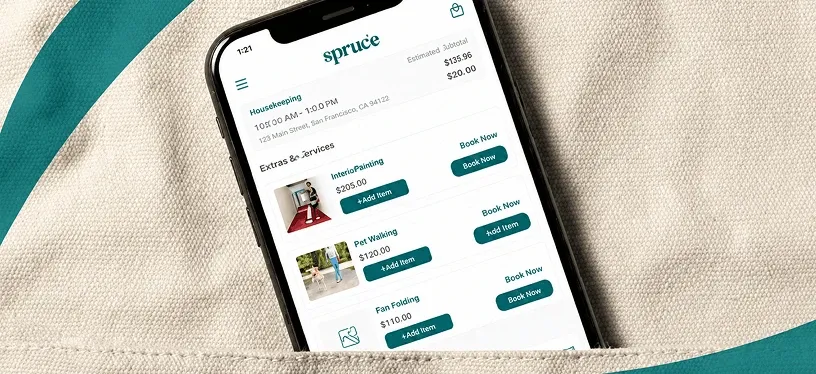
AppVerticals’ work with Spruce, a residential services platform, illustrates the importance of understanding different user workflows. The platform serves residents, property managers, service professionals, and operational teams, each with distinct responsibilities.
During the platform rebuild, AppVerticals examined the requirements of these user roles and identified gaps in scheduling, service management, pricing, and operational visibility. These findings informed the development of a dedicated service professional app, real-time capacity management, and improved property management tools.
User story mapping helps translate these workflows into prioritized product requirements, distinguishing essential MVP functionality from features suited to later releases.
Day 3: Architecture, Estimate, and Roadmap
This stage builds on technical considerations identified throughout discovery, evaluating whether the proposed MVP aligns with budget, infrastructure, security, integration requirements, and launch constraints.
AppVerticals’ work on the 5miles marketplace demonstrates why technical evaluation must inform product planning from the beginning. The project involved modernizing four existing platforms across web and mobile, each with its own technical constraints.
Before progressing with the redesign, the team reviewed the existing codebases and architecture to understand implementation limitations. They also evaluated marketplace categories using actual listing and sales data, reducing the category structure from 107 to 11.
For AI-powered MVPs, feasibility assessments also consider data availability, model accuracy, integration requirements, and operating costs. These factors help determine whether an AI feature is practical for the initial release.
Product Discovery Questions to Answer Before You Build
Product discovery questions test the business case, user journey, and delivery feasibility.
Cover three areas:
Business Questions
- What problem are we solving? Describe the customer problem without jumping straight to features.
- How will the product generate value? Establish the revenue model or operational benefit.
- What would make the MVP successful? Identify measurable outcomes such as completed bookings, active users, or paid transactions.
User Questions
- Who are the primary users? Identify distinct audiences and their responsibilities.
- How do they solve this problem today? Understand alternatives and existing frustrations.
- What is the shortest journey that delivers value? Define the core experience.
- Which assumptions about user behavior need testing? Distinguish customer evidence from internal expectations.
Technical Questions
- Which external systems must the product integrate with? Identify dependencies before estimating.
- What security or regulatory requirements apply? Understand constraints that influence architecture.
- Which technical uncertainties affect the timeline or budget? Identify what requires further investigation.
What You Walk Away With: Workshop Deliverables
Product discovery translates workshop discussions into documented requirements, decisions, and unresolved questions that guide the next stages of development.
Common discovery and planning deliverables include:
- MVP Scope Document
Defines users, primary workflows, requirements, and the boundaries of the first release. The founder can use it to approve what the team will build and check whether later changes are in scope.
- Prioritized Product Backlog
Documents the agreed features, their priority, and relevant dependencies. It provides a reference for development planning and evaluating changes to the approved MVP scope.
- Clickable Prototype
Where prototyping is included, an interactive representation allows stakeholders to review important user journeys before development. Our guide to POC vs prototype vs MVP explains how each serves a different purpose.
- Technical Architecture Outline
Shows the system components, integrations, and dependencies that influence technical effort. It helps explain the implementation complexity behind individual features.
- Development Estimate and Timeline
Sets out expected effort, milestones, cost considerations, and assumptions. A founder should be able to see which assumptions and dependencies influence the estimate.
- Risk and Assumptions Log
Lists major unknowns, their impact, and who will investigate them. A risk without an owner is likely to reappear during development.
With documented scope, founders can evaluate MVP development services against the same requirements rather than compare quotes built on different assumptions.
Confirm which outputs your engagement includes, and whether the team will deliver them during the sessions or after follow-up investigation.
Choosing a Partner to Run Your Discovery Workshop
Choose a discovery partner who challenges your assumptions and explains how product decisions affect scope and cost. If a team accepts your entire feature list without asking what the MVP needs to prove, question how thoroughly they have evaluated your requirements.
Ask how they prioritize features, investigate technical dependencies, and translate workshop decisions into estimates. Our guide to vet and choose an MVP partner covers additional considerations.
As an MVP development company, AppVerticals helps founders connect business objectives with practical product requirements.
Have an MVP idea? Explore AppVerticals’ MVP development services to see how we help founders define product requirements and plan development.
Frequently Asked Questions
What Is the Purpose of a Discovery Workshop?
A product discovery workshop aligns founders and development teams on the business problem, target users, product objectives, and initial requirements before development begins. It helps identify assumptions, prioritize essential functionality, and recognize technical dependencies that influence MVP scope. Through structured discussions, stakeholders clarify what the product needs to achieve and which features support those goals. The workshop also establishes a shared understanding of project priorities, reducing misunderstandings and providing a clearer foundation for requirements documentation, design, and development planning.
How Long Does a Product Discovery Workshop Take?
The duration of a product discovery workshop depends on the product’s complexity, the number of stakeholders involved, and the requirements that need clarification. A straightforward MVP with limited functionality generally requires less discovery effort than a marketplace involving multiple user roles, payment workflows, and third-party integrations. Discovery activities can also extend beyond workshop discussions to include research, requirements refinement, and technical investigation. The objective is to resolve important uncertainties and establish a clear product direction before moving into development planning.
What Is Product Discovery in Product Management?
Product discovery is the ongoing process of understanding user problems, identifying opportunities, testing assumptions, and deciding what a product team should build.
It involves activities such as user research, stakeholder discussions, prototyping, usability testing, and prioritization. Product managers evaluate potential solutions across four dimensions: customer value, usability, technical feasibility, and business viability.
These activities help teams make evidence-based product decisions, prioritize opportunities, and determine whether proposed solutions address meaningful user needs while supporting business objectives.
Do You Need a Discovery Workshop for a Small MVP?
A small MVP still benefits from product discovery because fewer features do not necessarily mean fewer risks. Even a simple application can involve complex user workflows, third-party integrations, or important business rules. A discovery workshop helps founders identify essential functionality, clarify technical requirements, and establish realistic priorities before development. The depth of discovery should reflect the product’s complexity and existing uncertainties. For smaller projects, focused discussions around the core user journey, business goals, and technical dependencies can provide sufficient direction.
How Is Product Discovery Different for AI-Powered MVPs?
Product discovery for AI-powered MVPs includes traditional product planning alongside additional considerations such as data availability, model performance, accuracy, and operating costs. Teams must determine whether AI meaningfully improves the user experience and whether the required technology can deliver reliable results. Discovery also examines integration requirements, privacy considerations, and situations requiring human oversight. Establishing measurable performance expectations early helps founders prioritize practical AI functionality, assess technical feasibility, and avoid investing in features that introduce complexity without delivering clear user or business value.