













 ChatGPT
 Perplexity
 Claude
 Google AI
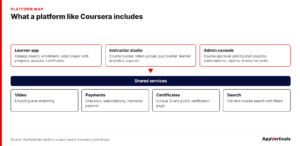
To build an online learning platform like Coursera, you need a learner app, an instructor studio, and an admin console on top of shared services for video, payments, certificates, and search. A phased custom MVP takes 3 to 4 months and costs $80,000 to $150,000, and a full product takes 6 to 10 months at $180,000 to $350,000. Teams that want a partner to scope it with them start with an education app development company that has shipped learning platforms. This guide covers the features each role needs, a working tech stack, the three build paths (SaaS, open source, or custom), six build steps, cost and timeline by phase, and what one of our multi-role builds taught us.
| “I price a learning platform by its video minutes, its payout rules, and its integrations first. Those three lines decide whether the budget holds after launch.”
Zaid Tirmizi, Technical Architecture and Costing Strategist at AppVerticals |
Key Takeaways
- A platform like Coursera has four parts: a learner app, an instructor studio, an admin console, and the services behind them for video, payments, certificates and search.
- You can build one three ways: a course-hosting SaaS such as Teachable or Thinkific, an open-source platform such as Open edX or Moodle, or a custom build.
- Build custom when you run a multi-instructor marketplace, sell to institutions or need control over pricing and learner data.
- A phased custom build runs 3 to 4 months and $80,000 to $150,000 for an MVP, and 6 to 10 months and $180,000 to $350,000 for a full product.
- Video delivery is a running cost you can price up front: at Mux list prices, 3,000 learners watching 100 minutes a month with 300 hours of video stored costs about $254 a month.
- Coursera closed its combination with Udemy on May 11, 2026, and now pairs hundreds of university and industry partners with an ecosystem of 95,000 content creators.
What it takes to build an online learning platform like Coursera
To build an online learning platform like Coursera, you need three apps for three audiences and a shared set of services behind them. An e-learning platform is software that lets people publish courses, sell or assign them, deliver lessons and quizzes, and track who finished what.
Coursera shows the scale this model reaches. Coursera’s Q1 2026 results report 205 million registered learners as of March 31, 2026, and more than 375 university and industry partners. Its combination with Udemy closed on May 11, 2026. The combined company now pairs its partner catalog with an ecosystem of 95,000 content creators, so one platform serves both models.
Before any online learning platform development starts, I ask clients to pick one of three models. A partner catalog hosts courses from vetted universities and companies. An open instructor marketplace lets anyone publish and sell. A single-provider academy sells or assigns one organization’s own courses. The model decides your approval workflow, your revenue split and how much of the admin console you need on day one.
Core features by user role
Each role needs a short list of must-have features at launch, and the rest can wait for later phases. The table below is the scope I start from in discovery.
| Role | Must-have at launch | Add later |
| Learner | Catalog search, enrollment, video player with progress, quizzes, certificates | Offline viewing, recommendations, AI tutor, discussion forums |
| Instructor | Course builder, video upload, quiz builder, learner analytics | Live cohorts, coupons, assignment grading at scale |
| Admin | Course approval, pricing, refunds, user management, reports | Enterprise seats, single sign-on, partner revenue dashboards |
| Payments and certificates | Checkout, subscriptions, instructor payouts, verified certificates | Multi-currency pricing, tax handling by region |
Learner and instructor features
Learners judge the platform in the first five minutes, so catalog search, one-click enrollment, and a video player that remembers progress come first. Quizzes and certificates give them a reason to finish, and mobile apps with offline viewing keep them learning on a commute.
Instructors need a course builder that handles video upload, lesson ordering, and a quiz builder without a support ticket. Learner analytics show them where students drop off, and a payout screen shows what they earned and when it arrives. In a marketplace, a weak instructor studio means fewer courses, and fewer courses mean fewer learners.
Admin, payments, and certificates
The admin console runs course approval, pricing, coupons, subscriptions, and refunds. For a marketplace, revenue share and instructor payouts need the most careful design, and I build them on Stripe Connect, which handles onboarding, identity checks, and payouts to sellers on a platform.
Verified certificates need a unique ID and a public verification page so an employer can check one. Institutions also ask for reports, enterprise seats, and single sign-on (SSO, one login shared with their own systems) before they sign, so I scope those in the second phase for any team selling to companies or universities.
Online learning platform tech stack
A working stack to build an online learning platform uses proven, well-documented tools at every layer, with video and payments bought as services. The table shows the choices I use on most learning builds.
| Layer | Common choices | Why |
| Web frontend | React or Next.js | Fast catalog pages that search engines can index |
| Mobile | React Native or Flutter | One codebase for iOS and Android |
| Backend | Node.js, Python or Laravel | Large hiring pool and mature libraries |
| Database | PostgreSQL | Reliable for enrollments, payments and grades |
| Search | Elasticsearch or OpenSearch | Full-text course search with filters |
| Video | Mux, or AWS MediaConvert with CloudFront | Encoding, adaptive streaming and per-minute pricing |
| Payments | Stripe Connect | Marketplace payouts to instructors |
| Content standards | SCORM, xAPI, LTI 1.3 | Imports packaged courses and connects to school systems |
Coursera itself started small. According to Coursera’s engineering team, its first code was PHP written by Stanford students, and in 2014, its engineers moved new services to Scala on the Play framework.
The lesson I take from that is simple. Start as one well-structured application, and split services out only as load and team size grow. Our guide to web application architecture explains when that split pays off.
(Alt text: Online learning platform development tech stack showing web and mobile apps, an API layer, PostgreSQL, a search index, a video pipeline and Stripe payouts)
See what each phase of your learning platform costs
Our cost guide breaks down MVP, full product, and enterprise budgets, plus the monthly running costs to plan for.
Read the education app cost guide
Three ways to build: SaaS, open source or custom
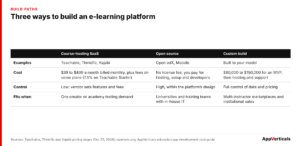
You can launch on a course-hosting SaaS, run an open-source platform or commission a custom build, and the right path depends on your model and how much control you need. Each path handles elearning platform development differently, as the table shows.
| Path | Examples | Upfront and ongoing cost | Control over data and pricing | Fits when |
| Course-hosting SaaS | Teachable, Thinkific, Kajabi | $39 to $499 a month billed monthly, plus fees on some plans (7.5% on Teachable Starter) | Low: vendor sets features and fees | One creator or academy testing demand |
| Open source | Open edX, Moodle | No license fee; you pay for hosting, setup and developers | High, within the platform’s design | Universities and training teams with in-house IT |
| Custom build | Custom education software | $80,000 to $150,000 for an MVP, then hosting and support | Full | Multi-instructor marketplaces and institutional sales |
SaaS gets one academy live in days, and its transaction fees and plan limits grow with you. Open edX is stewarded by Axim Collaborative, a nonprofit founded by Harvard and MIT, and Moodle is free to download under an open-source license. Both give you the code, and both still need engineers to host, upgrade, and extend them.
A Coursera clone script looks like a fourth option. It launches quickly, and it is hard to change once your model moves past the template. I weigh all of these with clients using our build vs. buy software framework.
How to create an online learning platform in 6 steps
Here is how to build an e-learning platform in six steps, from the first workshop to scale. Each step ends with a decision that the next one depends on.
- Run a discovery workshop. A product discovery workshop settles users, scope, and risks in a few days. You leave with a feature list, a phase plan, and an estimate.
- Pick the model and how you charge. Choose a partner catalog, a marketplace, or an academy. Then choose subscriptions, per-course sales, paid certificates, enterprise seats, or a mix.
- Scope the MVP. Keep it to catalog, video, payments, and certificates. Everything else goes on the phase two list.
- Build and integrate. Connect the video service, payments, SSO, and LTI as you build each feature. Integrations left to the end break schedules.
- Pilot with one cohort or partner. A real cohort finds the gaps that test scripts miss. Fix those before you open enrollment.
- Scale. Add native mobile apps, recommendations, and an AI tutor once usage data shows where learners need help.
Online learning platform development cost and timeline
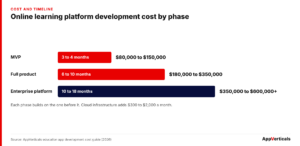
Online learning platform development costs $80,000 to $150,000 for an MVP and $180,000 to $350,000 for a full product, according to our education app development cost guide. The table breaks the budget down by phase.
| Phase | Scope | Timeline | Cost |
| MVP | Catalog, video, payments, certificates, basic admin | 3 to 4 months | $80,000 to $150,000 |
| Full product | Mobile apps, instructor payouts, analytics, SSO | 6 to 10 months | $180,000 to $350,000 |
| Enterprise platform | Multi-tenant institutions, LTI, AI features, compliance | 10 to 18 months | $350,000 to $600,000+ |
Running costs come next. Cloud infrastructure runs $300 to $2,000 a month in our guide, and video is the line I price separately because it grows with every learner.
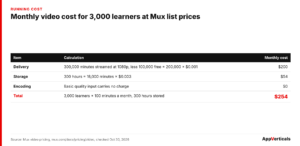
Here is a worked example at Mux’s list prices, checked on October 30, 2026. Picture 3,000 learners watching 100 minutes a month with 300 hours of video stored.
| Item | Calculation | Monthly cost |
| Delivery | 300,000 minutes streamed at 1080p, less 100,000 free = 200,000 × $0.001 | $200 |
| Storage | 300 hours = 18,000 minutes × $0.003 | $54 |
| Encoding | Basic quality input carries no charge | $0 |
| Total | $254 |
That is about $254 a month to build an online learning platform’s video layer at this size, and the math scales in a straight line as watch time grows.
Online learning platform development in practice: a multi-role tutoring platform
Our K-12 tutoring network build shows how a multi-role learning platform comes together in phases. The client, a US network placing tutors into K-12 districts, needed proof that each session happened, because its federal funding depended on attendance evidence.
We built four role-based experiences on one platform: a parent and student app, a tutor app, a district coordinator portal and a network admin portal. The stack was React Native, React, Node.js, PostgreSQL, AWS and Stripe Connect, the same layers in the table above.
A seven-person team delivered it in six months, with two districts running the platform from month three. We built in a fixed order: attendance check-in first, then scheduling, then matching, then payouts. Each layer depended on clean data from the one before it.
The network logged 38,000 sessions in its first term and onboarded 1,240 tutors across 14 districts. District attendance reports went from 9 days to 1. The full story is in our multi-role tutoring platform case study.
Choosing a partner to build your online learning platform
Choose a partner that has launched edtech products and can show video and payments work in production. Ask for learning platforms they shipped, how they handled instructor payouts, and their experience with FERPA (the US law that protects student education records) and accessibility standards such as WCAG 2.1 AA. Public universities with populations of 50,000 or more must meet WCAG 2.1 AA under ADA Title II by April 26, 2027. Our education app development team covers all three, and our educational app development work spans tutoring, LMS, and corporate training builds.
Compare SaaS and custom before you commit
Our buyer’s guide sets out the fee, control and ownership trade-offs of each path so you can test your model against them.
Read the SaaS vs custom software guide