













 ChatGPT
 Perplexity
 Claude
 Google AI
Build vs buy software is the decision between developing a custom application your team owns and licensing a ready-made product from a vendor. The right answer depends on one factor above all others, which is how much the software differentiates your business. You build what sets you apart, you buy what every company needs and you combine the two wherever a vendor gets you most of the way there. What has shifted in 2026 is the cost of building because AI-assisted development has made custom work faster and cheaper than the old rule of thumb assumes.
That shift is measurable. McKinsey found that software developers can complete coding tasks up to twice as fast with generative AI, which lowers the single biggest cost that used to make buying the safe default.
Key Takeaways
- Build vs buy software comes down to differentiation, so you build what makes you distinct, buy what everyone needs and combine the two everywhere else.
- Building gives you control, IP ownership and exact fit, while buying gives you speed and a lower entry price with the tradeoff of vendor lock-in.
- AI-assisted development has cut the time and cost of building well-defined software, which makes “buy by default” weaker advice than it was five years ago.
- Over a 3 to 5 year horizon, licensing renewals, integration and customization often push the real cost of buying much closer to the cost of building than the sticker price suggests.
- You should build when the software is a competitive differentiator or owns sensitive data and IP and buy when the need is a solved commodity.
- A hybrid build-on-buy approach lets you license the commodity core and build only the differentiating layer on top through APIs.
- The Differentiation-First framework scores each function on how differentiating and how commoditized it is, then routes it to build, buy or build-on-buy.
- Run a real total cost of ownership comparison before you decide because the cheapest option in year one is frequently the most expensive by year three.
What Does Build vs Buy Software Actually Mean?
Building software means designing and developing a custom application that your organization owns end to end, from the source code to the roadmap. Buying software means licensing an existing product, usually delivered as SaaS and paying to use functionality that a vendor built and maintains for many customers at once. The build-or-buy concept is the structured comparison of those two paths against your budget, timeline, control needs and risk tolerance.
The distinction matters because the two paths create very different ownership positions. When you build, you own the asset, the data model and every future decision about it. When you buy, you rent capability and accept the vendor’s decisions about pricing, features and direction.
In practice, most real decisions are not a clean choice between the two. A finance team might buy an accounting platform, build a custom pricing engine and connect the two through an integration layer. The useful question is which category each function belongs in and I will come back to that with a framework later in this guide.
Build vs Buy Software: Pros and Cons
The pros and cons of build vs buy software split cleanly along five dimensions: cost, speed, control, fit and long-term risk. Buying wins on speed and upfront cost. Building wins on control, fit and ownership. The table below is the summary I walk clients through before we go any deeper.
| Dimension | Build (custom software) | Buy (off-the-shelf or SaaS) |
|---|---|---|
| Upfront cost | Higher, paid as development investment | Lower, paid as subscription or license |
| Time to value | Slower, weeks to months to first release | Faster, often live in days |
| Control and roadmap | Full control over features and priorities | Vendor controls the roadmap |
| Fit to your process | Exact, built around how you work | Approximate, you adapt to the tool |
| Data and IP ownership | You own the code and the data model | Vendor holds the platform and terms |
| Long-term risk | Maintenance and staffing responsibility | Vendor lock-in and price changes |
The old reading of this table was simple. Buying looked cheaper and faster on the two dimensions executives feel first, so buying became the default and building became the exception you justified. That reading is now incomplete and the reason is cost, which is the next section.
What Is the Real 3 to 5 Year Cost of Building vs Buying?
The real cost of building versus buying only becomes clear over a 3 to 5 year total cost of ownership window. Buying looks cheaper on day one because the subscription is small next to a development budget. Across several years, license renewals, per-seat increases, integration work and paid customization accumulate and the gap narrows or reverses.
Building carries the opposite shape. The investment is front-loaded, then the ongoing cost settles into maintenance, hosting and enhancement. This is where a real total cost of ownership analysis earns its keep because it compares the full multi-year picture rather than the first invoice.
Building has real risk on the cost side too and I want to be honest about it. McKinsey and the University of Oxford found that large IT projects run 45 percent over budget on average, with software projects carrying the highest risk of overrun. That is a strong argument for tight scope and a delivery partner who has shipped this kind of work before and it is a cost the framework later in this guide is designed to contain.
The table below shows the shape of a typical 3 to 5 year comparison for a mid-market business application. Treat the ranges as directional and size them against your own scope.
| Cost Component | Build | Buy | Build on Buy (Hybrid) |
|---|---|---|---|
| Year 1 upfront | $60,000 to $250,000+ | $5,000 to $40,000 | $30,000 to $120,000 |
| Annual ongoing | 15% to 25% of build cost | Renewals plus seat growth | Platform fees plus custom layer upkeep |
| Integration and customization | Included in build | Often underestimated | Shared across both |
| Cost driver over time | Enhancement and staffing | License and seat inflation | Custom layer scope |
The mistake I see most often lives inside this table. A team buys a platform to save time, then spends two or three years paying for integrations, add-on modules, extra seats and workarounds that the tool was never shaped for. By the time they add it up, they have paid more than a focused build would have cost and they still do not own the result. This is exactly the tradeoff we lay out in our SaaS vs custom software buyer’s guide for teams weighing a packaged product against a custom one.
How the AI Prototype Economy Changes the Build vs Buy Math
AI-assisted development has lowered the cost and time of building software, which weakens the historical case for buying by default. For most of the last decade, buying won on the numbers that leaders feel first, which were speed and upfront spend. Both of those numbers have moved.
The evidence is direct. GitHub’s controlled research found that developers using an AI pair programmer completed a task 55% faster than those without one. McKinsey’s broader analysis puts the potential impact of generative AI at 20 to 45 percent of current annual software development spending. When the cost of producing custom code drops by a meaningful fraction, the break-even line between build and buy moves in favor of building.
I want to be precise about where the gains land because this is where I see teams over-read the headlines. In my work leading AI transformation at AppVerticals, the acceleration shows up most on well-defined, boilerplate-heavy work, which covers scaffolding, integrations, tests and standard CRUD features. On genuinely novel or complex logic, the gains shrink and McKinsey’s own study confirms that time savings fall on high-complexity tasks. AI compresses the routine 70% of a build and that alone changes the economics.
There is a second force at work, which is the wider prototype economy. Low-code and no-code tooling has matured to the point where 70% of new applications will use low-code or no-code technologies by 2026.
Combined with AI code generation, this means a working prototype that once took a quarter can now take a sprint, which makes the early choice between a proof of concept, a prototype, and an MVP the practical first step. When you can build something real and testable in days, the case for locking into a vendor early gets weaker. For teams exploring this route, our guide on low-code vs no-code web development breaks down where each approach fits.
None of this makes buying obsolete. It makes the decision more balanced and it rewards teams who actually run the analysis instead of defaulting.
When Should You Build Software?
You should build software when it is a competitive differentiator, when it owns sensitive data or intellectual property or when no product on the market fits the way your business actually works. These are the cases where control and ownership pay for themselves.
Build when the answer to any of the following is a clear yes:
- The software is your edge: If customers choose you partly because of how this system works, that logic belongs to you, not a vendor.
- The workflow is genuinely yours: When your process is a real source of margin or speed, forcing it into a generic tool erodes the advantage you already have.
- The data or IP is sensitive: Owning the codebase and data model gives you control over security, compliance and where information lives.
- Integration is the whole point: When the value comes from connecting systems that no single vendor covers, a custom layer is often the cleanest path.
The counterweight is honest capacity. Building means you own maintenance, security patching and a roadmap, so you need the team or a partner, to carry that over time. Custom software building is a commitment and the AI tooling that speeds the build does not remove the responsibility for running it.
When Should You Buy Software?
You should buy software when the need is a solved commodity, when speed matters more than fit or when the function sits far from what makes your business distinct. Payroll, email, ticketing and standard accounting are rarely worth building because mature products already do them well and cheaply.
Buying is the stronger call in these situations:
- The problem is universal: Thousands of companies need the same thing and a vendor has already refined it across all of them.
- Speed is the priority: You need the capability to live this month and the cost of waiting for a build outweighs the benefit of a perfect fit.
- The function is non-differentiating: No customer will ever choose you because of how your expense reports work.
The item to inspect carefully here is software licensing. The headline subscription is only part of the picture, so read the terms on seat growth, usage tiers, data export and renewal increases before you sign. Build vs buy software licensing decisions often turn on those clauses rather than the sticker price and they are the same clauses that create lock-in later. If part of your buy decision is whether to outsource the surrounding build work, our analysis of outsourcing SaaS development versus in-house covers the tradeoffs.
What About Vendor Lock-In, Licensing and IP Ownership?
Vendor lock-in is the risk that switching away from a purchased product becomes so expensive or disruptive that you effectively cannot leave. It is the hidden cost that a clean buy-vs-build analysis has to price in, alongside licensing terms and IP ownership. When you buy, the vendor holds the platform, the data format and the leverage at renewal.
Before you commit to a purchased product, pressure-test it against this checklist:
- Data portability: Can you export your full data in a usable format, on your schedule, without a fee?
- Integration openness: Does the product offer documented, stable APIs or does it wall your data off?
- Pricing exposure: How much can per-seat and usage pricing rise at renewal and is there a cap?
- Exit path: If you left in two years, what would the migration actually cost in time and money?
- IP boundaries: For any custom work built on the platform, who owns it, you or the vendor?
Building inverts most of these risks because you own the code, the data model and the exit. That ownership is not free, since you take on the maintenance and security burden instead. The right move is to name the risk you prefer to carry rather than to pretend either path is risk-free.
The Modern Compromise: Build on Buy
Build on buy is a hybrid approach where you license a commodity platform for the parts everyone needs and build a custom layer on top for the parts that differentiate you. It captures the speed and low entry cost of buying while protecting the ownership and fit that matter most. For a growing number of the projects I see, this is the practical answer.
The pattern works like this. You buy the mature core, which might be a CRM, a payments platform or an ERP. Then you build a proprietary layer on top through the vendor’s APIs, which holds the workflow, logic or customer experience that sets you apart. The commodity work stays with the vendor and your engineering effort goes only where it creates advantage.
The line to draw is the differentiation line. The vendor’s API should stop where your competitive logic begins and your proprietary code should own everything past that point. Draw the line too generously toward the vendor and you hand your advantage to a platform. Draw it too far toward custom and you rebuild commodity features that were never worth your time.
The Differentiation-First Build/Buy/Build-on-Buy Framework
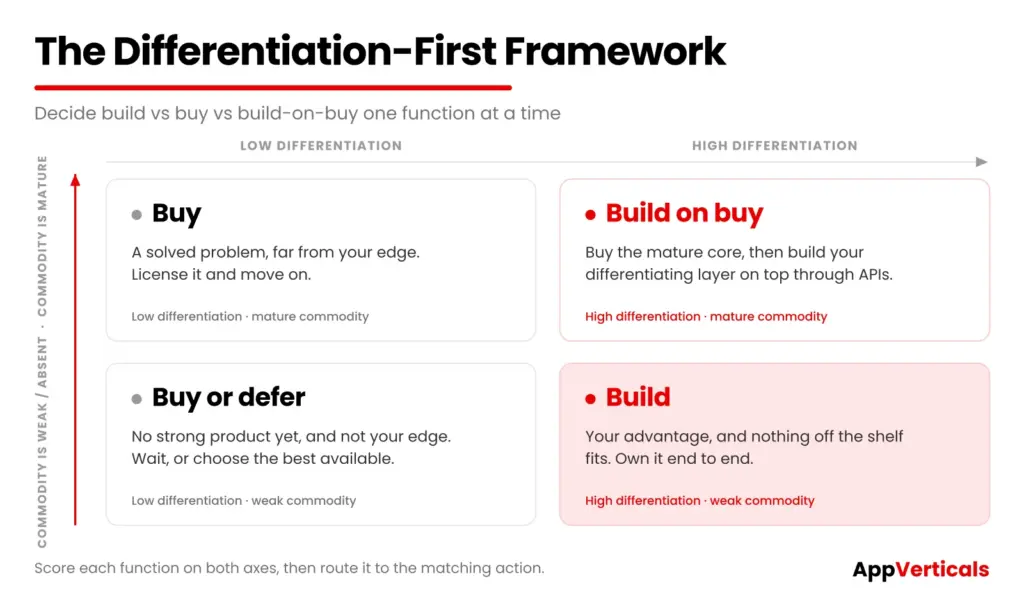
The Differentiation-First framework decides build vs buy at the level of individual functions. It scores each function on two axes, which are how differentiating it is to your business and how commoditized it already is in the market, then routes it to build, buy or build-on-buy. This is the build vs buy software analysis I run with every client before we scope anything.
Score each function, then place it in the matrix below.
| Low Differentiation | High Differentiation | |
|---|---|---|
| Commodity is mature | Buy A solved problem, far from your edge. License it and move on. |
Build on buy Buy the mature core, then build your differentiating layer on top through APIs. |
| Commodity is weak or absent | Buy or defer No strong product exists yet, but it is not your edge. Wait or pick the best available option. |
Build Your advantage is unique and nothing off the shelf fits. Own it end to end. |
The framework forces a better conversation than a project-wide vote. Instead of asking “should we build or buy this system,” you ask “which functions in this system deserve to be built,” and the answer is usually a mix. Most software acquisition decisions get easier once you stop treating the whole platform as one choice.
Then run a quick decision checklist across the functions you plan to build:
- Does this function differentiate us in a way a customer would notice?
- Would owning the code and data give us a real security, compliance or speed advantage?
- Do we have the team or a partner, to maintain it for the next three years?
- Has AI-assisted development made the build small enough to justify the ownership?
- Have we compared the full 3 to 5 year total cost of ownership, including license renewals, integration and maintenance beyond the first invoice?
If the answers point to build, you are building for the right reasons. If they point to buying, you are buying with your eyes open on licensing and lock-in.
See what your build would actually cost before you commit
Get a fast, scoped estimate for the functions you have decided to own, with no obligation.
Get Your Free EstimateFinal Thoughts
The strongest build vs buy software decisions come from teams who stop treating it as one choice and start deciding function by function. You buy the commodity work, you build the few things that set you apart and you use a hybrid layer wherever a vendor gets you most of the way there. That approach was always sound and AI-assisted development has now made the build side of it far more affordable than the old default assumed.
The real work is the analysis. Score your functions on differentiation, run a 3 to 5 year total cost of ownership comparison and read the licensing terms before you sign anything. Do that and the decision stops being a gamble and becomes a plan you can defend.
If you are weighing a build for the functions that matter most, that is the conversation worth having before the first sprint.
Ready to Build the Parts That Set You Apart?
We help teams decide what to build, scope it against real cost and ship custom software that reaches production.
Explore Our Custom Software Development Services
Still comparing packaged and custom options? Read our SaaS vs Custom Software buyer’s guide next.