














 ChatGPT
 Perplexity
 Claude
 Google AI
Flutter app development cost sits between $20,000 and $150,000 for most business apps, with the majority of funded builds landing between $30,000 and $80,000. That range is wide because the market genuinely is wide, and because the word “app” can honestly describe four different projects.
The question is almost never “what does Flutter cost.” It is closer to this: “I have two quotes, one is $38,000 and one is $115,000, and I cannot tell which one is lying to me.”
Usually neither of them is. They are pricing different projects that happen to share a name.
This piece breaks Flutter pricing into the numbers I actually quote to the clients looking for flutter app development services, explains what moves a build from one tier to the next, and gives you a way to read an estimate so that gap stops being a mystery.
Key Takeaways
- Most Flutter builds cost $30,000 to $80,000: A scoped MVP can start near $20,000, while enterprise platforms can exceed $150,000.
- Flutter can reduce development costs: A shared Flutter codebase can save 30% to 40% compared with separate native iOS and Android builds, with further savings in post-launch maintenance.
- Four factors drive most cost differences: Scope clarity, custom design requirements, team location, and the amount of backend infrastructure already available can create a major difference in quotes.
- Plan for ongoing costs: Budget around 20% to 30% of the initial build cost each year for maintenance, hosting, and third-party services.
- Compare itemised quotes: A quote that excludes QA, backend development, or post-launch support is not necessarily cheaper—it may simply be incomplete.
What Flutter App Development Costs in 2026
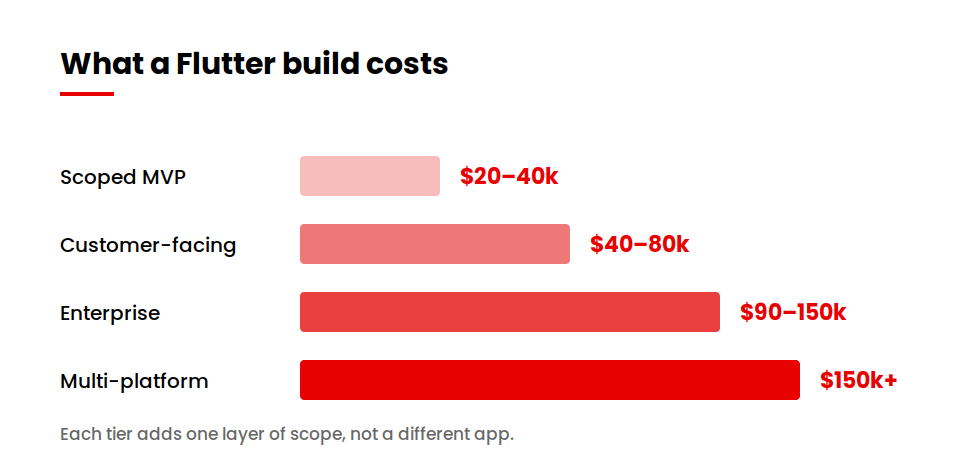
Flutter app development costs $20,000 to $150,000 for most commercial projects in 2026. A single-purpose internal tool or a scoped MVP starts around $20,000. A customer-facing app with accounts, payments and notifications typically runs $40,000 to $80,000. Enterprise platforms with role-based access, compliance requirements and legacy integrations begin at $90,000 and climb from there.
Here is how that breaks down by build tier.
| Build Tier | Cost Range | Timeline | What You Get |
|---|---|---|---|
| Scoped MVP or Internal Tool | $20,000 – $40,000 | 2 – 3 months | Core workflow, standard components, single platform focus, minimal custom design |
| Customer-Facing App | $40,000 – $80,000 | 3 – 5 months | Custom design, user accounts, payments, notifications, analytics |
| Complex or Enterprise App | $90,000 – $150,000 | 5 – 9 months | Role-based access, admin dashboards, third-party integrations, compliance work |
| Multi-Platform Platform | $150,000+ | 8 – 12+ months | Mobile plus web or desktop, real-time features, scalable backend architecture |
One number worth holding onto: the median Flutter project we scope comes in near $55,000. Most of the quotes that shock people are either well below that because something has been left out, or well above it because the scope quietly includes a backend rebuild.
Flutter App Development Cost by App Type and Business Stage
The tier table above is a starting point. Two other lenses usually get a founder closer to their real number.
Cost by what you are building
| App Type | Cost Range | Main Cost Driver |
|---|---|---|
| Internal Business Tool | $20,000 – $45,000 | Number of user roles and reporting depth |
| Marketplace or Booking App | $45,000 – $95,000 | Two-sided flows, payments, scheduling logic |
| eCommerce App | $50,000 – $110,000 | Catalogue size, payment methods, order management |
| Field Service or Logistics App | $55,000 – $120,000 | Offline handling, GPS, sync conflict resolution |
| Healthcare or Fintech App | $80,000 – $180,000 | Compliance, audit logging, encryption standards |
Offline handling is the one people underestimate most. An app that works when the signal drops needs conflict resolution, a local data store and a sync strategy, and that combination adds real weeks. We built a field service app where offline sync was the single largest line item in the estimate, ahead of the interface work.
Flutter app development cost by where your company is
| Stage | Typical Budget | What the Money Buys |
|---|---|---|
| Pre-Seed or Bootstrapped | $20,000 – $40,000 | Validation. One workflow, done properly. |
| Funded Startup | $40,000 – $100,000 | A product that can carry growth without a rewrite |
| Established SMB | $60,000 – $140,000 | Integration with systems you already run |
| Enterprise | $120,000+ | Security review, procurement, multi-stakeholder sign-off |
Enterprise budgets look inflated next to startup ones for the same feature list. Much of that difference is not engineering. It is security review cycles, procurement, and the cost of getting five stakeholders to agree on a scope.
If your answer to the budget question is “smaller than any of these,” start with MVP development and validate before you spend the rest.
What Actually Drives Flutter App Development Cost
Five things move the number, in roughly this order of impact.
Features and how complex each one is
Feature pricing is the part most estimates itemise, so it is the easiest to compare between vendors.
| Feature | Typical Cost to Build |
|---|---|
| Email and Password Login | $2,000 – $3,000 |
| Social Login (Google, Apple) | +$1,500 |
| Biometric or Multi-Factor Authentication | $2,000 – $5,000 |
| Push Notifications | $2,000 – $3,500 |
| Real-Time Chat | $8,000 – $15,000 |
| Single Payment Gateway | $3,000 – $5,000 |
| Subscription Billing | +$4,000 – $6,000 |
| Offline Mode with Sync | $8,000 – $18,000 |
| AI or Recommendation Features | $10,000 – $40,000 |
| Each Third-Party Integration | $1,000 – $5,000 |
Real-time chat is the classic budget surprise. It reads like one line on a feature list and prices like four, because presence, delivery receipts, message history and push handling are separate pieces of work.
How much custom design you want
Flutter ships with two complete design systems built in. Material Design covers the Android look, and Cupertino covers the iOS one. Using them costs almost nothing extra.
| Design Approach | Added Cost |
|---|---|
| Flutter Defaults, Light Theming | $0 – $3,000 |
| Branded Design System | $8,000 – $18,000 |
| Fully Custom UI with Animation | $18,000 – $35,000 |
Custom design is the most commonly over-bought line item in a first build. If you are validating an idea, the default components will not lose you a single user.
Which platforms you target
Flutter runs from one codebase, and that codebase can reach more than phones. Each additional target adds real work.
- Web support: +20 to 30 percent of the mobile cost
- Each desktop platform (Windows, macOS, Linux): $8,000 to $15,000
- Foldable device support: $5,000 to $10,000
- Optimised tablet layouts: +15 to 25 percent
Compliance, if it applies to you
HIPAA (the US health data rule), GDPR (the European privacy regulation) and PCI-DSS (the payment card standard) each add $10,000 to $40,000 depending on how much of your app touches regulated data. That covers audit logging, encryption standards, access controls and the documentation your auditor will ask for.
How much backend already exists
This is the driver almost nobody asks about before requesting a quote, and it moves the number more than anything except scope itself.
If you have a working API, a Flutter app is a front end. If you have a database but no API, someone has to build the layer in between. If you have neither, you are paying for a complete backend alongside the app, and that can be 40 percent of the total.
Flutter Developer Rates by Region and Team Structure
Where your team sits changes the same project’s price by a factor of four.
| Region | Mid-Level | Senior | Lead / Architect |
|---|---|---|---|
| US and Canada | $100 – $150/hr | $150 – $200/hr | $200 – $250/hr |
| Western Europe | $80 – $120/hr | $120 – $160/hr | $160 – $200/hr |
| Eastern Europe | $50 – $80/hr | $80 – $120/hr | $120 – $150/hr |
| South Asia and Southeast Asia | $30 – $50/hr | $50 – $80/hr | $80 – $120/hr |
Rate is not the same as cost. An experienced team at $110 an hour that ships in fourteen weeks costs less than a cheaper team at $55 an hour that takes thirty-two weeks and needs two rounds of rework. The rework never appears in the original quote, which is why the cheaper bid keeps winning.
A working Flutter team usually looks like this:
- One to three Flutter developers, carrying 60 to 80 percent of the hours
- One designer, active for 20 to 30 percent of the timeline
- One backend developer, 30 to 50 percent depending on what exists already
- One QA engineer, 15 to 25 percent
- One project manager, 10 to 15 percent throughout
Monthly burn runs roughly $10,000 to $18,000 for a small offshore team, $22,000 to $38,000 for a mixed team, and $45,000 or more for a senior team based in the US.
Flutter vs Native App Development Cost: Where the Saving Comes From
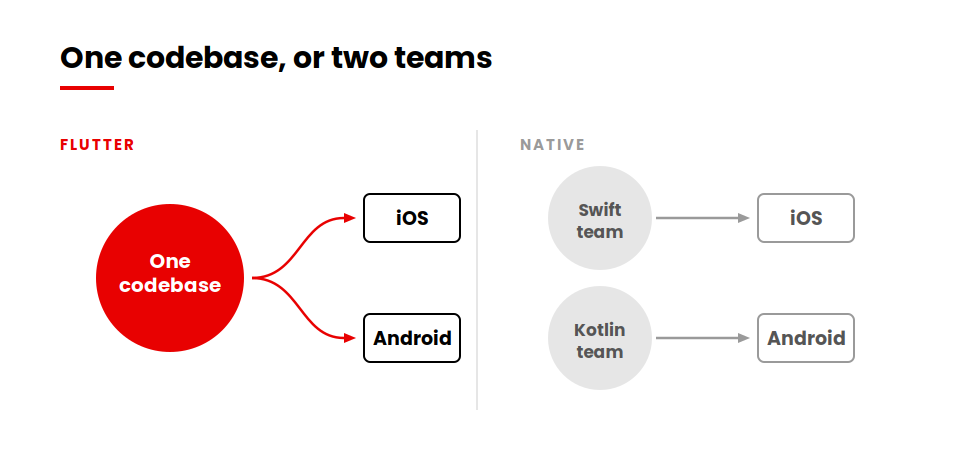
Flutter costs 30 to 40 percent less than building the same app twice in Swift and Kotlin. That figure gets repeated everywhere, so it is worth showing where it actually comes from.
The 30–40% figure is repeated so often that it deserves an external corroboration. Rihards Baumanis and Maksims Peļņa, Development Leads at Chili Labs, who have shipped both Flutter and native, put development cost at 30–40% less in their own ROI breakdown, and they name the same caveat this article does: hardware-intensive apps still justify native.
| Project Scope | Flutter | Native (iOS + Android) | Saving |
|---|---|---|---|
| Scoped MVP | $25,000 | $42,000 | 40% |
| Customer-Facing App | $60,000 | $98,000 | 39% |
| Complex Platform | $140,000 | $225,000 | 38% |
| Enterprise Build | $240,000 | $360,000 | 33% |
The saving comes from three places, and only one of them is the code.
Team size. A Flutter build needs 40 to 50 percent fewer developers, because you are not staffing two platform teams in parallel.
Time. Native takes 60 to 80 percent longer for the same feature set, since every screen is built twice.
Maintenance. This is the part that compounds. One codebase means one bug fix, one release, one regression test cycle.
A Number Worth Knowing
On Get Spruce, a React Native build serving 685,000 customers across five user roles, we measured 85 to 95 percent of native performance in production. Cross-platform performance stopped being the real objection some years ago. The trade-off now is about platform-specific capability, not speed.
When Flutter costs more than native
Being straight about this matters more than the saving does, because getting it wrong is expensive in both directions.
Flutter is the wrong call when your app depends on deep, platform-exclusive OS integration, when you are building something performance-critical like a 3D game or live video processing, or when you are shipping to one platform only and the second is not on the roadmap. It is also the wrong call when you already employ a strong native team, because you would be paying to retrain them.
In those cases a Flutter build ends up carrying platform-specific native code anyway, and you pay for the bridge on top of everything else.
Gautier, Flutter developer at Apparence (Apparence Kit, a Flutter-focused dev agency), author of “Flutter vs. React Native in 2025: Which One to Choose?” says, “For me, Flutter’s approach of owning its rendering pipeline often translates to more consistent visuals and performance.”
Still deciding between frameworks? Our breakdown of Flutter and React Native covers the trade-offs beyond cost.
Hidden and Ongoing Flutter App Development Costs
The build price is the beginning of the spend, not the total.
| Ongoing Cost | Typical Range |
|---|---|
| Maintenance and Updates | 15 – 20% of build cost per year |
| Apple Developer Program | $99/year |
| Google Play Developer Account | $25 one-time |
| Backend and Hosting | $50 – $5,000/month, scaling with users |
| Analytics and Monitoring | $0 – $500/month |
| Third-Party Services | $100 – $2,000/month |
| Security Review | $2,000 – $10,000/year |
Budget 20 to 30 percent of your build cost annually for all of it. On a $60,000 app that is $12,000 to $18,000 a year, or roughly $1,200 a month once you average it out.
Maintenance is not optional and it is not padding. Apple and Google both ship breaking changes on an annual cadence, and an app that goes eighteen months without an update will start failing store review requirements.
Why Flutter Quotes Range From $5,000 to $300,000
Search this topic and you will see that spread quoted everywhere, usually presented as though it were a fact of nature. It is not. Four things explain nearly all of it, and once you can see them you can place any quote you receive.
Cause one: scope is defined at different depths
“A booking app” can mean a single calendar and a confirmation email, or it can mean multi-resource scheduling, cancellation policies, deposits, waitlists and a provider dashboard. Both are booking apps. One is $22,000 and one is $95,000.
Vendors quoting the low end are usually not being dishonest. They are answering the question you asked, at the depth you asked it.
Cause two: design is priced as an assumption, not a decision
An estimate built on Flutter’s default components and one built on a custom design system can differ by $30,000 before a single feature changes. Most quotes do not say which they assumed.
Cause three: the team’s region is invisible in the total
A $38,000 quote and a $115,000 quote can describe the same 700 hours of work. One is priced at $54 an hour in South Asia, the other at $164 an hour in the US. Neither figure tells you that unless you divide it out.
Cause four: backend is either included or quietly excluded
This is the one that causes real damage. A quote that covers the Flutter app and assumes you are supplying working APIs will always look cheaper than one that includes building them. If your backend does not exist yet, the cheaper quote is not cheaper. It is a partial answer that will be completed later, by invoice.
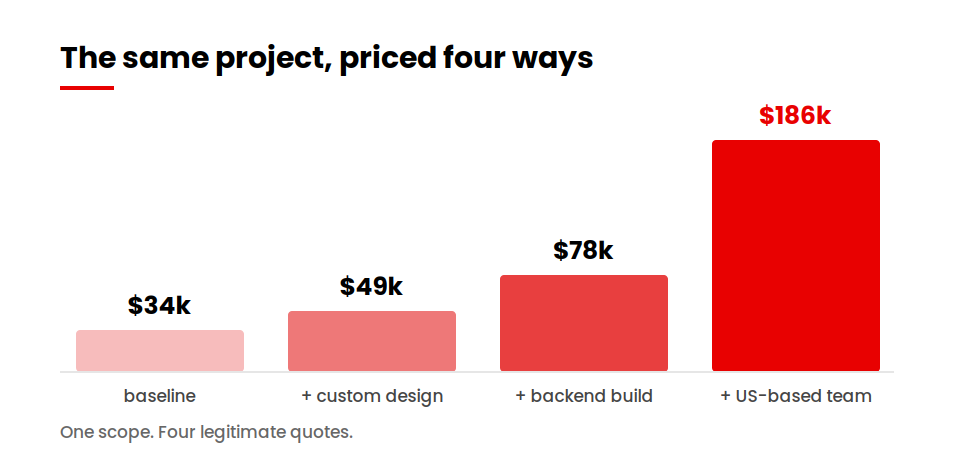
The same project, priced four ways
| Scenario | Price |
|---|---|
| Baseline | $34,000 — Customer app, default design, APIs already exist, South Asia team |
| Add Custom Branded Design | $49,000 |
| Add Backend Build From Scratch | $78,000 |
| Same Scope, US-Based Senior Team | $186,000 |
Every one of those numbers is a legitimate quote for a Flutter app. Nothing dishonest happened between the first row and the last.
Not sure which tier your app sits in?
Run your feature list through our estimator and get a band in under two minutes, along with which of these four drivers is moving your number.
Estimate my Flutter build →
How to Read a Flutter App Development Cost Quote
This is the difference between comparing two numbers and comparing two projects.
What a complete estimate itemises
A quote you can actually evaluate will break out all seven of these, with hours or a sub-total against each:
- Discovery and scoping: requirements, user flows, technical spec
- UI/UX design: and which of the three design approaches it assumes
- Flutter development: front-end build, by feature or by screen
- Backend work: explicitly stated as included, excluded, or existing
- Third-party integrations: named individually, priced individually
- QA and testing: as its own line, with device coverage stated
- Deployment and post-launch support: store submission plus a defined support window
The five absences that signal an underscored bid
When a client forwards me a competing quote, these are what I look for first. Any one of them means the number in front of you is not the number you will pay.
- No QA line. Testing is 15 to 25 percent of a build. A quote without it has either hidden it inside development hours or has not planned for it.
- Backend unstated. If the document does not say whether APIs are included, assume they are not.
- No device coverage named. “iOS and Android” is not a test plan. Which OS versions, which screen sizes, which devices?
- No post-launch window. A build with no defined support period means the first crash report starts a new commercial conversation.
- A single lump sum with no hours. You cannot compare a lump sum to anything. Ask for the hour breakdown before you compare it to a second quote.
We use the same seven-part structure internally, which is described in more detail in our guide to software development cost estimation.
Flutter budget qualifier
Get an estimate band in under two minutes
Question 1 of 5
Your estimate band
Estimate my Flutter buildA planning range, not a quote. Team location is not captured here and can move a number by 3× on its own.
Flutter App Development Cost in Practice: What We Build and What It Takes
Numbers in a table are easier to trust when you can see a real project behind them.
Dad Crafted Decor: when the app is the cheap part
Dad Crafted Decor refinishes kitchen cabinets. The problem they brought us was a sales problem rather than a software one. Customers could not picture a new finish on their own kitchen, so decisions stalled, and a stalled decision usually became no decision.
What we built lets a customer photograph their kitchen and see new textures and finishes applied to it. Behind that sits a custom detection model trained to find cabinets, drawers and fittings in a photograph and segment them, so a finish lands only where it belongs and not across the worktop.
The interesting part, for a cost conversation, is where the money went. The app layer was straightforward: take a photo, send it, show the result, let the customer compare options. The expensive part was the model, and specifically making it accurate on the photographs customers actually send.
The owner described the accuracy that mattered as accuracy on photos that are rarely clean. Kitchen photos taken on a phone have bad lighting, odd angles, clutter on the counter and half a fridge in frame. Training a model to segment cabinets reliably under those conditions is a different job from segmenting them in a showroom shot, and the distance between those two jobs was most of the budget.
That maps directly onto the feature table earlier in this article. AI features sit at $10,000 to $40,000 against $2,000 for a login, and the spread is not arbitrary. A login either works or it does not. A model has to work on the messy input your real customers produce, and that is where the hours go. If your app has a machine learning component, the Flutter layer is usually the cheapest thing you are buying.
You can see more of this work in our client case studies.
The Three-Year Cost of Owning a Flutter App
Build cost is the number everyone compares. Ownership cost is the number that decides whether the project was a good idea.
Here is a $60,000 Flutter app against the equivalent native build, over 36 months.
| Cost Category | Flutter | Native (iOS + Android) |
|---|---|---|
| Initial Build | $60,000 | $98,000 |
| Year 1 Maintenance (18%) | $10,800 | $17,640 |
| Year 2 Maintenance | $10,800 | $17,640 |
| Year 3 Maintenance | $10,800 | $17,640 |
| Hosting and Services (36 Mo) | $14,400 | $14,400 |
| Major OS Update Handling (x3) | $9,000 | $16,500 |
| THREE-YEAR TOTAL | $115,800 | $181,820 |
The gap widens over time rather than closing. At build it is 39 percent. At three years it is 36 percent in percentage terms but $66,000 in cash, and almost all of the growth in that gap comes from maintaining one codebase instead of two.
One cost this table does not show, because nobody can predict it reliably: Flutter major version upgrades. Google ships them on a regular cadence, and each one carries some migration work. Budget a few thousand dollars a year against it rather than being surprised.
How to Reduce Flutter App Development Cost without Cutting Scope
Four things actually work. The rest is usually false economy.
Ship an MVP first.
Building the core workflow properly and adding the rest after real usage data cuts initial spend by 40 to 60 percent, and it stops you paying to build features nobody opens.
Sort features with MoSCoW.
Must have, should have, could have, will not have. Putting every feature into one of those four buckets before you request quotes typically defers 25 to 35 percent of the initial build.
Use the package ecosystem.
pub.dev hosts tens of thousands of community-maintained Flutter packages covering authentication, state management, networking and payments. Building those from scratch is money spent for no advantage.
Start on a managed backend.
Firebase or Supabase can remove $10,000 to $30,000 of initial backend work, and you can migrate to custom infrastructure later once you know your actual load.
If your conclusion is that the scope should be smaller, MVP development is the right starting point.
Conclusion
The two quotes on your desk are probably both honest. They are describing different projects that happen to share a name.
Work out which of the four drivers each one has priced in, and the difference between them usually resolves into scope you either need or do not. That is a decision you can make. Comparing two totals is not.
If you want a number you can plan against, the fastest route is a scoped estimate rather than a range.
Get your Flutter build priced against real scope
We will break your requirements into the same tiers this article uses and show you what each one costs, itemised, before you commit to anything.
Explore our Flutter app development services →