














 ChatGPT
 Perplexity
 Claude
 Google AI
By the time a CTO brings up a mobile app redesign, task completion has usually slipped or technical debt has made routine changes harder to ship. A mobile app redesign is a structured change to an existing product’s interface, workflows, and supporting technology. The immediate decision is how far that change should reach and whether the current architecture can carry it safely.
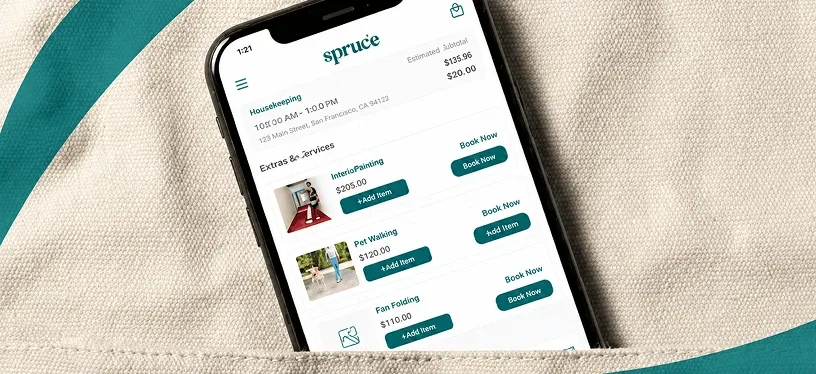
I scope that decision using user retention, crash-free sessions rate, API contracts, design-system coverage, WCAG 2.2, Apple Human Interface Guidelines, Material Design 3, and rollout controls. Spruce shows why those inputs belong together: its resident app, role-specific portals, architecture, capacity management, and pricing controls formed one operating system. Screen-level thinking would have missed the dependencies underneath it.
A redesign succeeds when the team can name the user problem, define the technical boundary, and reverse the release safely.
What mobile app redesign means
Scope changes the risk. I separate redesign work into distinct options because each creates a different engineering commitment, release burden, and change-management requirement.
A visual refresh updates typography, color, spacing, icons, and reusable components while preserving navigation and core workflows. It fits products whose usability remains sound while their brand identity or interface consistency has fallen behind.
A UX redesign changes how users find features, understand information, and complete important tasks. It can affect navigation, onboarding, checkout, booking, account management, and other flows with measurable friction.
A redesign with engineering remediation changes the experience while addressing technical constraints that prevent the new design from working reliably. That work can include API changes, state-management improvements, framework updates, performance fixes, and replacement of brittle interface code.
A rebuild replaces a substantial part of the product foundation. It becomes a serious candidate when the current architecture cannot support the intended product direction within an acceptable delivery and maintenance risk.
| Scope option | Typical change | Evidence that supports it | Main delivery concern |
|---|---|---|---|
| Visual refresh | Brand identity, typography, color, spacing, icons, components | Design-system audit, brand migration requirements, interface consistency findings | Visual drift between old and new components |
| UX redesign | Navigation, information architecture, screen sequence, content hierarchy | Funnel analysis, usability testing, support patterns, session evidence | User relearning and workflow disruption |
| Redesign with engineering remediation | UX changes plus targeted code, API, or performance work | Technical-debt review, crash analysis, API constraints, dependency mapping | Scope expanding after design begins |
| Rebuild evaluation | Application foundation and experience replaced together | Architecture audit, unsupported frameworks, high maintenance risk, blocked roadmap | Migration, feature parity, data integrity, and release continuity |
The boundary can also change by flow. An app may need new onboarding, a visual refresh across account screens, and engineering remediation around payments within the same program.
I advise teams to define scope at the workflow level before approving a product-wide label. “Redesign the app” is too broad to estimate or govern; “redesign onboarding and booking while preserving account management” creates a testable boundary.
A design system is the shared collection of components, usage rules, interface states, and interaction patterns that keeps design and production code aligned. It supports gradual migration because teams can replace old components as each approved flow moves through delivery.
Signs your app needs a redesign
Age alone gives me very little decision value. I look for patterns across user behavior, product reliability, delivery friction, platform alignment, and business change.
The strongest product signal is deterioration inside a high-value workflow. A fall in onboarding completion, booking completion, checkout conversion, or successful task completion tells the team where to investigate. It does not identify the cause by itself.
Review the sequence around the drop-off. Funnel events show where users leave, while usability sessions, support tickets, app-store reviews, and session recordings help explain why they leave.
User retention is moving below the product’s own baseline. Retention should be segmented by user type, acquisition source, app version, platform, and behavior. An aggregate trend can hide a release-specific failure or a problem affecting one important cohort.
Onboarding creates avoidable friction. Warning signs include abandoned setup, repeated permission denials, confusion around account creation, and failure to reach the product’s first meaningful action. Product analytics should show where the flow breaks, and direct research should explain the user’s hesitation.
Support repeatedly explains the interface. A recurring question about navigation, labels, permissions, or feature location is evidence that the product requires too much interpretation. Add those patterns to the redesign backlog with frequency, affected role, and workflow impact attached.
Interface states are incomplete. Loading, empty, error, success, offline, disabled, and permission-denied states tell users what is happening. Missing states also force developers to make isolated implementation decisions, which increases design debt and behavioral inconsistency.
Reliability is affecting the experience. Track the crash-free sessions rate against the product’s own historical baseline and release history. A concentration of failures around a specific screen may point to an engineering problem, a heavy interface state, an unstable integration, or a combination of those conditions.
Feature delivery keeps exposing technical debt. A small interface request that repeatedly triggers broad regression work deserves an architecture review. The team may be dealing with tightly coupled screens, duplicated components, outdated frameworks, weak test coverage, or undocumented dependencies.
The same diagnosis applies when the product includes AI-assisted features. My guide to AI technical debt explains how model dependencies, data quality, and accumulated implementation shortcuts can add another layer to redesign scope.
The interface lacks a governed design system. Buttons, forms, navigation, spacing, and feedback patterns may vary because teams built them at different stages. Component inconsistency raises usability risk and makes future changes harder to estimate.
The product no longer reflects the business. A new brand, operating model, market, subscription structure, or user role can leave the mobile product representing an older version of the company. This often requires a brand identity migration alongside workflow and content changes.
Accessibility gaps affect core tasks. A review against WCAG 2.2 should cover perceivable content, operable controls, understandable interactions, and compatibility with assistive technology. Certification claims require a separate, authorized assessment.
Platform patterns have drifted. Apple Human Interface Guidelines and Material Design 3 provide current conventions for their respective ecosystems. A platform review should focus on navigation, controls, feedback, touch behavior, typography, and accessibility while preserving the app’s brand.
Patterns carry more weight. Several problems concentrated in onboarding may support a targeted redesign, while friction across core workflows, reliability, and feature delivery may justify a broader program.
| Observed signal | Evidence to collect | Likely investigation path |
|---|---|---|
| Users abandon a key task | Funnel events, usability findings, session evidence | UX redesign of the affected flow |
| Interface looks inconsistent | Component inventory, production-screen audit | Visual refresh and design-system migration |
| Support repeats navigation guidance | Ticket categories, search behavior, interviews | Information architecture and content review |
| Crashes cluster around a workflow | Crash logs, release history, dependency trace | Engineering remediation before or alongside UX work |
| Small changes cause broad regressions | Test failures, dependency map, delivery history | Architecture and technical-debt assessment |
| Brand and product have diverged | Current brand standards, app inventory | Brand identity migration with controlled workflow changes |
| Accessibility issues block tasks | WCAG 2.2 review, assistive-technology testing | Accessibility remediation within redesign scope |
This recommendation has a limit. If users complete core tasks efficiently and the main constraint sits in framework maintenance or code quality, evaluate a refactor before changing the experience.
Redesign versus rebuild
Product and engineering need separate assessments before they can make this decision together. Product and design teams examine the user experience; engineering examines whether the current foundation can support the proposed change safely.
When user problems concentrate in labels, navigation, content hierarchy, and interface consistency, the existing architecture may remain viable. When the roadmap is blocked by brittle dependencies, unsupported technology, or pervasive state-management problems, design work needs a deeper engineering gate.
I ask engineering to document five areas before scope approval:
- The current architecture and its high-risk dependencies.
- The API contracts used by affected workflows.
- Framework, build-tool, and platform support constraints.
- Regression coverage for business-critical behavior.
- Data migration and feature-parity requirements.
An API contract defines how the mobile app and a backend service exchange requests, responses, errors, authentication, and data. A redesign can violate that contract when a new flow requires unavailable data, changes the sequence of operations, or adds a validation rule.
Contract review should happen while designers are shaping the flow. A polished prototype can otherwise depend on unavailable data, introduce excessive calls, or ignore a backend rule that users still have to satisfy.
That distinction matters. Some technical debt affects developer efficiency, while other debt creates direct production risk. Repeated code can slow delivery; an undocumented payment dependency can threaten transaction continuity.
I use the following decision gate to keep the discussion evidence-based:
| Decision factor | Redesign remains viable when… | Rebuild evaluation becomes stronger when… |
|---|---|---|
| Core workflows | Existing flows can be changed independently | Business logic is tightly coupled across most flows |
| API layer | Contracts can support the intended experience with contained changes | Required data and operations demand broad service replacement |
| Framework and tooling | Supported upgrades can be completed within the program | The foundation blocks releases, hiring, testing, or roadmap work |
| Regression coverage | Critical behavior can be protected with reliable tests | Current behavior cannot be verified safely |
| Data model | New flows fit the existing model or a controlled migration | The model conflicts with the product’s current operating needs |
| Release continuity | Old and new experiences can coexist during migration | Coexistence would create unacceptable operational complexity |
| Maintenance outlook | Remediation reduces recurring delivery friction | Patching preserves the same structural constraints |
Spruce shows why this assessment has to cover the wider product ecosystem. The existing system included a resident mobile app and web portals serving administrators, service providers, and property managers. Fragmented architecture, missing mobile workflows for service professionals, incomplete property-management functionality, and limited capacity and pricing controls created a system-wide scope.
The resulting work combined architecture redesign, a dedicated service-professional mobile app, property-management enhancements, capacity management, dynamic pricing configuration, reporting, and role-based controls. These parts had to remain integrated because booking and pricing decisions affected several roles.
The deployed platform gave service professionals mobile task management, property managers direct access to property information, and administrators operational reporting and pricing controls. Screen scope follows system scope.
App redesign process for CTOs
I advise CTOs to run product discovery and technical discovery together. Sequential handoffs create rework because design can make assumptions about data, performance, or permissions that engineering later has to reverse.
| Process stage | Primary activity | Required output | Decision owner |
|---|---|---|---|
| Current-state discovery | Map screens, workflows, analytics, support issues, and user roles | Prioritized problem statement | Product lead |
| Technical discovery | Review architecture, API contracts, dependencies, reliability, and technical debt | Feasible change boundary | Engineering lead |
| Scope selection | Choose affected flows and redesign depth | Approved scope and exclusions | Product and engineering leadership |
| Experience design | Build information architecture, wireframes, and prototypes | Validated workflow model | Design lead |
| System design | Define components, states, platform behavior, and brand migration | Design-system migration plan | Design lead |
| Engineering planning | Break work into releasable vertical slices | Delivery and dependency plan | Engineering lead |
| Validation | Run usability, accessibility, integration, and regression testing | Accepted release candidate | QA lead |
| Controlled launch | Release by cohort with monitoring and rollback controls | Verified production rollout | Release manager |
Map the current product as users experience it. Document successful paths, workarounds, role-specific behavior, abandoned flows, support escalations, and operational dependencies. Production behavior often differs from old specifications and design files.
Start with production reality. Include screens teams tend to overlook: permission prompts, loading states, empty states, expired sessions, offline behavior, validation errors, cancellation paths, and account recovery.
Create a baseline before changing the experience. Capture the product’s current task completion, user retention, crash-free sessions rate, support patterns, and relevant performance measures. Use the app’s own baseline and segment it by platform, release, role, and workflow.
Success criteria need direct relationships to the redesign. A navigation change can be evaluated through feature discovery and task completion; architecture remediation may focus on reliability and regression frequency.
Run the engineering feasibility review. Engineering should map affected API contracts, authentication, analytics, third-party services, feature flags, data models, and hidden dependencies. The output is a boundary showing what design can change safely, what requires backend work, and what needs architectural remediation.
The review should also identify platform-release constraints and supported build tooling. Current Apple Human Interface Guidelines and Material Design 3 can guide interface decisions, while platform requirements determine whether the app can be built, tested, and submitted through the intended release path.
For broader planning across architecture, platforms, testing, and release preparation, use the mobile app development guide alongside the redesign plan.
Prioritize workflows before screens. A workflow is the complete path a user follows to achieve an outcome. Designing isolated screens can conceal broken transitions, missing data, unclear responsibilities, and error states.
I prefer to rank workflows using business value, user friction, technical feasibility, reliability risk, and dependency reach. This creates a release order grounded in evidence without relying on an unsupported formula.
Validate structure with low-fidelity prototypes. Wireframes let teams test navigation, content hierarchy, labels, and task sequence before visual details absorb attention. Include existing users because their learned behavior creates different risks from those of new users.
Prototype testing should cover successful completion and recovery from errors. Error recovery often reveals where a redesigned flow lacks context, confirmation, or a safe way back.
Build or migrate the design system. Inventory components in design files and production code, then define which become shared components, which require modification, and which should be retired. Include component behavior, content rules, accessibility states, analytics events, and platform-specific variations.
Brand identity migration belongs in this plan. Map old and new colors, typography, icons, imagery, voice, and motion so teams can migrate deliberately across mobile, web, support content, and store listings.
Apply platform and accessibility criteria. Use Apple Human Interface Guidelines to review iOS behavior and Material Design 3 to review Android behavior. Shared branding can remain consistent while controls, navigation, feedback, and system integration respect each platform.
WCAG 2.2 should inform requirements for contrast, text resizing, focus behavior, control labels, error communication, input support, and target usability. Test with assistive technology and representative devices; a checklist review alone provides incomplete evidence.
Plan engineering in vertical slices. A vertical slice delivers an entire working workflow across interface, business logic, API behavior, analytics, and testing. It gives the team something complete to validate and release behind a feature flag.
This method exposes integration problems earlier. A batch of disconnected screens can look complete while the actual task remains unusable.
Define acceptance criteria before development. Each workflow should include functional behavior, interface states, API expectations, analytics events, accessibility checks, performance considerations, and regression coverage. Shared acceptance criteria reduce interpretation between product, design, engineering, and QA.
The Spruce redesign followed this system-wide logic because role-specific experiences shared bookings, properties, pricing, scheduling, and capacity data. Shared data made shared governance unavoidable.
Protect users during legacy redesign
A legacy app redesign changes a product that already has history. Users have learned where features live, which shortcuts work, and how to recover when the intended workflow falls short.
Habits are product dependencies. I ask teams to map the real workflow before moving controls or removing screens. Analytics can show common paths, while interviews, support tickets, and operational observation reveal workarounds that tracking may miss.
User muscle memory deserves explicit treatment. A frequently used control can be technically easy to relocate and operationally expensive to relearn, especially in products used throughout a workday.
Create a workflow-preservation register with these categories:
- Stable behavior: successful behavior that should remain familiar.
- Known friction: evidence-backed behavior selected for change.
- Workaround: unofficial behavior users rely on to finish a task.
- Hidden dependency: another system or role affected by the workflow.
- Migration support: communication, guidance, or temporary compatibility needed during change.
Role-based review is crucial. Administrators, field teams, customers, managers, and support staff may use the same feature for different purposes. A simplified customer flow can remove information an operational role needs.
Legacy redesigns also require feature-equivalence decisions. Document which capabilities carry forward, which change, which retire, and which need temporary support while users migrate.
Brand identity migration creates another layer of relearning. Preserve familiar task landmarks where possible, then use release communication, contextual guidance, updated support content, and clear store-listing materials to explain meaningful changes.
App Store Optimization covers the listing elements that influence discovery and conversion, including screenshots, descriptions, release notes, and positioning. A redesigned interface can create confusion when store assets continue to show the previous experience.
Plan rollout and regression controls
A redesign release should be observable and reversible. That requires controls in the product, test suite, deployment process, analytics, and support plan.
A feature flag is a server- or configuration-controlled switch that enables or disables a capability without requiring a new release. It can separate code deployment from user exposure and provide a faster response when monitoring identifies a problem.
A phased rollout exposes a release to controlled cohorts before expanding availability. Cohorts can be based on account type, internal users, geography, platform, app version, or another characteristic the product can monitor responsibly.
The cohort plan should identify:
- Who receives the redesigned flow.
- Which baseline the cohort will be compared against.
- Which metrics and support signals will be monitored.
- Who has authority to pause expansion.
- Which conditions activate rollback.
- How users and internal teams will be informed.
Regression testing confirms that behavior which previously worked still works after a change. Prioritize authentication, account recovery, payments, booking, data synchronization, notifications, permissions, and any workflow tied to contractual or operational obligations.
Automation helps with repeatable paths, while exploratory testing remains valuable around new interactions, unusual device states, accessibility behavior, and cross-system dependencies. Contract tests can also verify that an API continues to return the fields, error states, and behavior expected by the mobile client.
| Control | Purpose | Evidence before release | Owner |
|---|---|---|---|
| Feature flag | Control exposure to the redesigned experience | Enable, disable, and targeting behavior tested | Engineering lead |
| Release cohort | Limit initial user impact | Cohort definition and comparison baseline | Product lead |
| Regression suite | Protect existing business-critical behavior | Critical tests passing on supported platforms | QA lead |
| API contract tests | Detect integration-breaking changes | Required requests, responses, and errors verified | Engineering lead |
| Monitoring dashboard | Observe reliability and workflow behavior | Events, errors, and release segmentation confirmed | Product and engineering |
| Rollback plan | Restore a safe experience | Rollback path rehearsed and responsibilities assigned | Release manager |
| Support readiness | Identify user confusion quickly | Updated guidance and escalation path available | Client success or support |
Monitor user retention, task completion, crash-free sessions rate, API errors, latency, support volume, and qualitative feedback in the context of the released cohort. A single aggregate dashboard can conceal whether the redesigned experience caused the change.
Rollout decisions also need version awareness. Mobile users update at different times, so backend services and data contracts may need to support old and new clients concurrently.
Reversibility is a release requirement. Record the evidence reviewed, the person authorizing expansion, known issues, mitigation, and the next review point in a release decision log.
Mobile app redesign checklist
Use this checklist as a governance tool. Each stage has required evidence, an accountable owner, and an exit criterion that leadership can review before the program advances.
| Checklist stage | Required evidence | CTO owner | Exit criterion |
|---|---|---|---|
| User friction | Funnel, support, and usability evidence | Product lead | Prioritized problem statement |
| Architecture | API contract, dependency, and technical-debt review | Engineering lead | Feasible change boundary |
| Design system | Component audit and platform patterns | Design lead | Migration plan |
| Accessibility | WCAG 2.2 review | QA lead | Test plan approved |
| Validation | Regression and usability testing | QA lead | Release candidate accepted |
| Rollout | Cohorts, monitoring, and rollback | Release manager | Rollback path tested |
I would add several working checks beneath those formal gates:
- Baseline the affected workflows before redesign work begins.
- Record scope exclusions so adjacent requests do not enter delivery silently.
- Include loading, empty, error, offline, permission, and success states.
- Map analytics events to the redesigned flow.
- Review Apple Human Interface Guidelines and Material Design 3.
- Define feature-equivalence and migration decisions for legacy users.
- Validate API contracts before approving high-fidelity design.
- Connect each critical workflow to regression coverage.
- Prepare support guidance and App Store Optimization assets.
- Assign pause and rollback authority before the phased rollout.
Keep the checklist with the delivery plan. Update it when scope changes, dependencies emerge, or release evidence challenges an earlier assumption.
Ownership keeps the gate real. Without a named owner and exit criterion, the gate is advisory.
What drives mobile app redesign cost
Mobile app redesign cost depends on the amount of uncertainty and change the team has to absorb. An estimate needs explicit assumptions about scope, platforms, architecture, integrations, migration, validation, and release controls.
Boundaries drive the estimate. A small interface refresh and a system-wide redesign can share the same label while requiring different product, engineering, and QA commitments.
| Cost driver | Questions that affect scope | Typical cost effect |
|---|---|---|
| Redesign depth | Are visuals changing, or are navigation and workflows changing too? | Deeper behavioral change increases research, design, implementation, and validation work |
| Workflow and state coverage | How many critical flows and interface states are affected? | More paths increase design and test coverage |
| Platform strategy | Does the product require separate iOS and Android behavior? | Platform-specific behavior increases implementation and QA scope |
| Design-system maturity | Do reusable components exist in design and code? | Weak coverage adds component creation and migration work |
| Architecture condition | Can the current application support the proposed experience? | Technical remediation can become a major workstream |
| API and integration impact | Do flows require new data, service behavior, or third-party changes? | Contract changes increase coordination and regression risk |
| Legacy workflow migration | Which habits, roles, and workarounds need protection? | Migration planning adds research, communication, and compatibility work |
| Brand identity migration | How widely must new identity rules propagate? | Cross-channel migration adds asset, content, and governance work |
| Accessibility | Which WCAG 2.2 criteria and assistive-technology paths apply? | Broader validation adds design, engineering, and QA effort |
| Regression coverage | Which critical behaviors lack reliable tests? | Test creation adds upfront work and reduces release uncertainty |
| Rollout controls | Are feature flags, cohorts, monitoring, and rollback already available? | Missing controls add engineering and release-management scope |
| Store and support readiness | Which listings, screenshots, help content, and scripts must change? | Launch coordination expands beyond product delivery |
The largest estimation risk often appears at boundaries. A navigation change may require backend permissions, analytics updates, support documentation, and migration of saved user state.
Ask for an estimate that separates discovery, experience design, design-system work, engineering remediation, implementation, validation, and rollout. This gives leadership a clearer view of where uncertainty sits and which decisions can change the total.
The estimate should distinguish committed scope from conditional scope. API remediation, for example, may remain conditional until technical discovery confirms the contract gap. A credible estimate also explains exclusions. Data migration, backend replacement, analytics repair, accessibility testing, content rewriting, store assets, and post-release monitoring can easily disappear from early assumptions. I recommend requesting a dependency register beside the estimate. Each major assumption should have an owner, evidence source, and decision deadline. Unowned assumptions become budget risk.
Put a number to your app redesign scope
Tell us about your requirements and calculate the cost of your app redesign scope in no time.
estimate the cost of your redesign scopeConclusion
You now have the evidence categories, scope options, technical gates, owner checklist, and release controls needed to evaluate a mobile app redesign. Your next action is to assemble them into one evidence pack.
Include affected workflows, baseline metrics, recurring support issues, architecture diagrams, API contracts, design-system coverage, known dependencies, platform constraints, and the current regression suite. Ask product, design, engineering, QA, support, and release management to agree on the problem statement and feasible change boundary.
I would keep that boundary tied to evidence throughout delivery. Protect working behavior, expose hidden dependencies early, validate structure before implementation, and release through controls the team has already tested.
A redesign is ready for investment when the new experience and its supporting system can evolve together.
Ready to invest in your app redesign and transform user experience?
We have the best mobile app designers onboard who can assist redefining your user experience and deliver a user-centric app design.
Explore our mobile app design services