












 ChatGPT
 Perplexity
 Claude
 Google AI
Evaluating an AI development company means checking technical proof, data practices, delivery history, and contract terms before you sign anything. I have spent close to eighteen years advising founders, CTOs, and Fortune 500 leaders on this decision. That includes build-versus-buy calls and outsourcing strategy. Most failures trace back to one habit. Teams grade an AI vendor with a checklist built for ordinary software outsourcing.
Forrester’s June 2026 report found that roughly three-quarters of enterprise leaders say they are adopting agentic AI. Only a small minority have it running in real production. Deloitte’s Tech Trends 2026 research puts a number on that gap. Just 11 percent of organizations are actively running agentic systems in production today. This guide gives you the exact scorecard I use with clients, so you’ll know how to evaluate an AI development company before signing any contract. You’ll get the criteria, the red flags, and a contract checklist to use before you sign.
Key Takeaways:
- Evaluating an AI development company means checking technical proof, data practice, delivery record, team stability, and contract terms.
- Forrester found roughly three-quarters of enterprises adopting agentic AI. Deloitte found only 11 percent have it running in production. That gap separates real AI vendors from confident sales decks.
- Before you evaluate any vendor, confirm you actually need one. AppVerticals’ own build-vs-buy framework applies equally to the hiring decision and the technical one.
- A short list of red flags ends most bad vendor relationships before they start. Vague pricing, no production references, no answer on data handling.
- The AI Partner Readiness Score gives you an actual number for comparing vendors on your shortlist.
- The contract matters as much as the pitch. IP ownership, data handling on exit, and post-launch support need to be written into it.
- Pricing for AI development from roughly $8,000 to $300,000 or more, depending on the build type. Knowing which tier you are buying prevents most billing disputes.
What Does It Actually Mean to Evaluate an AI Development Company?
Evaluating an AI development company means testing their claims against evidence before you commit budget or data to them. That includes technical proof on a real, shipped system. It means a clear answer on data handling, plus contract terms that protect you if things go badly.
This is different from evaluating a general software vendor. An AI system keeps learning, drifting, and behaving differently as real usage grows. A contract that only covers delivery of working code misses the part that matters most. What happens after launch.
The rest of this guide gives you the exact process. What to check, what should stop the conversation, a scorecard, and what needs to be in writing.
| What to Check | What It Proves |
|---|---|
| Technical proof on a real, shipped system | The vendor has delivered similar solutions before, not just pitched the capability. |
| A clear answer on data handling | Your data will be handled, stored, and protected the way you expect. |
| Verifiable references | The vendor’s claims hold up when verified through real customer conversations. |
| Contract terms in writing | You are protected with clear expectations around scope, responsibilities, and outcomes if the engagement goes wrong. |
Why Evaluating an AI Vendor Is Not the Same as a Normal Software RFP
AI vendor evaluation needs criteria a standard software RFP never asks for. A standard RFP checks delivery track record, team seniority, and price. Those still matter for an ai development company. They miss the parts of an AI engagement that cause damage later.
This shift is happening because more engineering teams now use AI in software development to accelerate coding, testing, automation, and deployment workflows. That makes vendor evaluation more important, because the partner needs to understand not only how to build AI features but also how those features fit into modern software engineering practices.
A vendor evaluation for this category needs three things a normal RFP skips. Proof the vendor monitors model behavior after launch. A clear answer on where your training data goes. Evidence they have carried something similar all the way into production.
| Standard RFP Asks | AI Engagement Also Needs | Why It Matters After Launch |
|---|---|---|
| Delivery track record | Proof the vendor monitors model behavior after launch | Degrading accuracy appears as a slow increase in complaints, not an obvious system failure. |
| Team seniority | A clear answer on where your training data goes | Data risks and quality issues often appear only after real usage scales. |
| Price | Evidence they have taken a similar AI system into production | A successful demo does not predict reliability, performance, or cost at real-world scale. |
Before You Evaluate Anyone: Should You Hire an AI Development Company at All?
You should hire an AI development company once an honest build-vs-buy check points that way. Some teams already have the in-house skill to build the feature themselves. They just need a second opinion before committing.
Take a look at the five-gate build-vs-buy decision framework for this question:
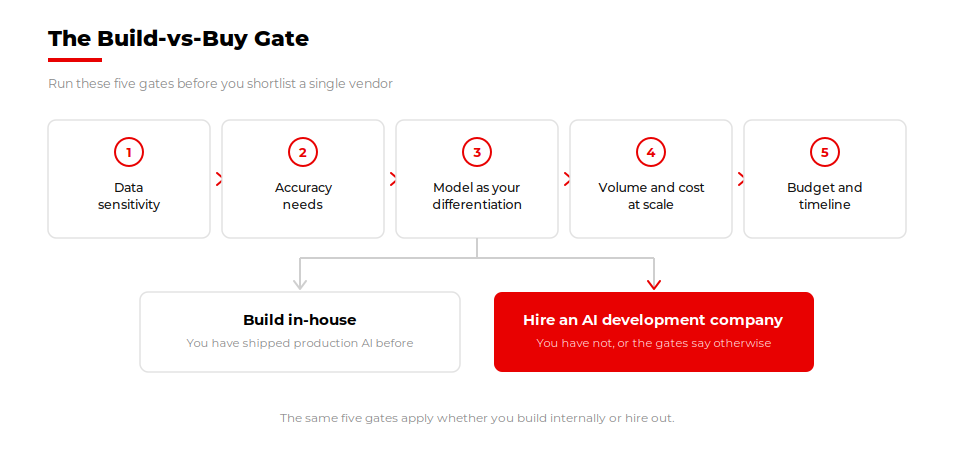
- Data sensitivity
- Accuracy needs
- Whether the model is your real differentiation
- Volume and cost at scale
- Budget and timeline
The same five gates apply whether you build internally or hire out.
If your team has never shipped a production AI feature, walk those gates with an outside team first. It is a low-cost step before a full engagement. A short discovery call can confirm whether you need a custom AI development company at all. A commercial API sometimes solves the problem on its own.
What Are the Red Flags When Hiring an AI Development Company?
Vague pricing, missing references, and unclear data handling are the clearest signals to walk away. A handful of red flags show up again and again in AI vendor conversations that later go wrong. Any one of these is a reason to pause. Two or more are a reason to leave.
| Red Flag | Why It Matters |
|---|---|
| Vague or bundled pricing | A vendor who cannot separate development, infrastructure, and support costs is not ready for a serious contract. |
| No production references | Anyone can build a convincing demo. A reliable AI development company should be able to show systems that have handled real users and production conditions. |
| No answer on data handling | If a vendor cannot clearly explain data access, storage, and usage, the real process may create security concerns later. |
| Junior team after the sales pitch | The senior team that defines the solution should remain involved in delivery. A post-signing handoff to unknown junior staff creates execution risks. |
| No monitoring or drift plan | Without post-launch monitoring, AI systems can lose accuracy over time while problems remain invisible until users report them. |
The AI Partner Readiness Score: Score Your Shortlist
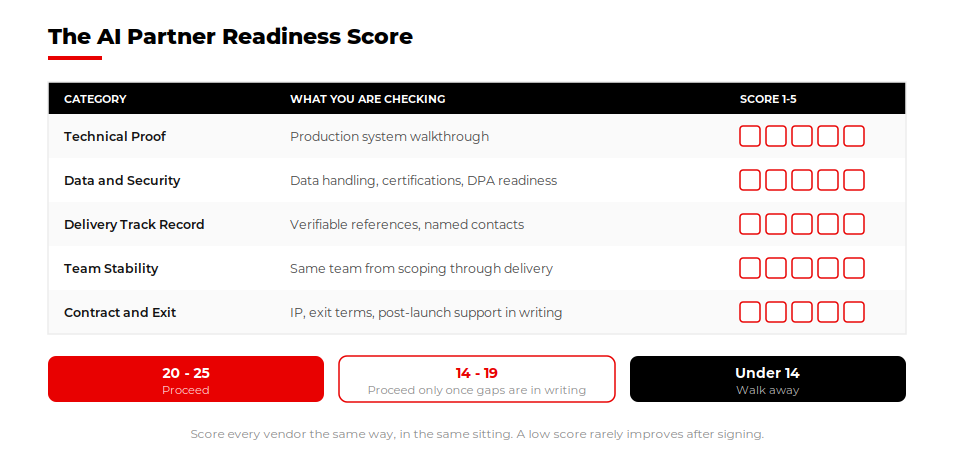
Score every vendor on your shortlist the same way, using the same five categories, in the same sitting. This turns impressions into a number you can defend to a finance team.
Technical Proof
Can the vendor walk you through a production system? Do they name specific tools and explain the reasoning, rather than reciting a list of buzzwords?
For an ai ml development company specifically, that proof looks like a model validated against real historical data.
Data and Security Discipline
Do they explain exactly where your data goes and hold relevant certifications, such as ISO 27001 or SOC 2? Do they hold these where the engagement calls for it? Will they sign a data processing agreement before any personal data changes hands?
Delivery Track Record
Can they provide two or three verifiable references in a comparable industry, with named contacts you can actually call? A vendor who deflects a reference check is telling you something.
Team Stability
Will the people who scope the project stay on it through delivery? Ask directly who is assigned and whether that team changes once the contract is signed.
This check matters the same way for an ai development company in usa and for an offshore team. Team stability predicts whether the sales-call team actually builds the system.
Contract and Exit Terms
Is IP ownership, data handling on exit, and post-launch support written into the proposal itself? Not just discussed on a call. The next section covers exactly what to look for.
| Category | What You Are Checking | Score (1-5) |
|---|---|---|
| Technical Proof | Production system walkthrough | ___ |
| Data and Security Discipline | Data handling, certifications, DPA readiness | ___ |
| Delivery Track Record | Verifiable references, named contacts | ___ |
| Team Stability | Same team from scoping through delivery | ___ |
| Contract and Exit Terms | IP, exit terms, post-launch support in writing | ___ |
Score bands: 20 to 25 means proceed. 14 to 19 means proceed only once the specific gaps are addressed in writing. Under 14 means walk away.
Score every vendor on your shortlist the same way, in the same sitting. A vendor that scores low rarely improves once the contract is signed.
See Production Work Before You Decide
Browse real projects to see what production-grade delivery actually looks like, the same test you just ran above.
View Case StudiesQuestions to Ask, and What to Get in Writing Before You Sign
Ask these five questions, then confirm the answers made it into the contract. A verbal answer protects nobody once the engagement starts.
- Who owns the model, the code, and any fine-tuned weights built specifically for us?
- What happens to our data and any trained model artifacts if we end the engagement?
- What is the response time and scope for monitoring and bug fixes after launch?
- Can we change model providers later without a penalty clause blocking us?
- What is the process and rate for scope changes that come up mid-project?
Every one of those answers should show up as a specific clause in the contract itself. Here is what each clause should actually say.
| Clause | What It Should Say | Red Flag If Missing |
|---|---|---|
| IP ownership | You own the model, code, and any fine-tuned weights built for you, in writing. | Vague language like “jointly owned,” or no IP clause at all. |
| Data handling on exit | What happens to your data and trained artifacts if you end the engagement, including a data processing agreement. | No exit clause, or data deletion left undefined. |
| Post-launch support | Named response times and scope for monitoring, retraining, and bug fixes after go-live. | Support offered only as a future upsell with no terms today. |
| Vendor lock-in language | The right to change model providers or bring work in-house without penalty. | Exclusivity clauses tying you to one vendor’s stack. |
| Change-order process | A defined process and rate for scope changes mid-project. | “We will figure it out as we go,” with no defined process. |
How Much Does It Cost to Hire an AI Development Company?
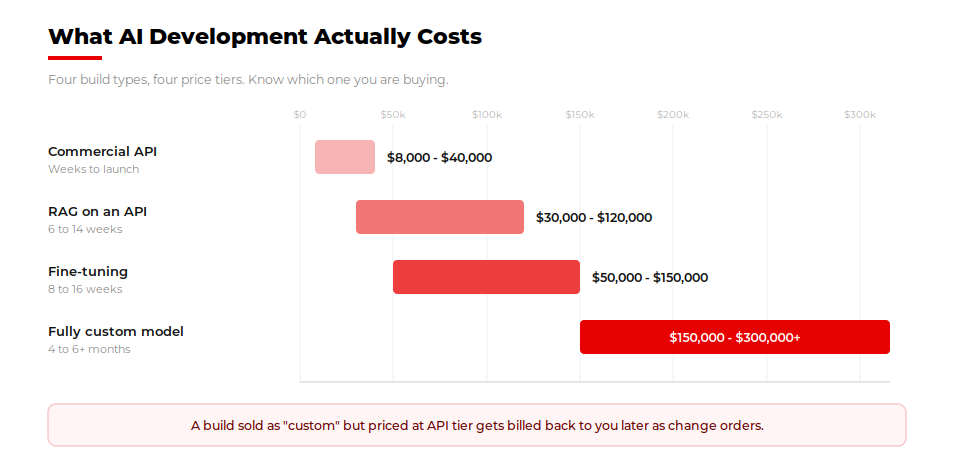
AI development pricing falls into four tiers, from $8,000 to $300,000 or more. Unclear pricing is one of the red flags above, and a concrete range is what turns unclear into checkable. Knowing which tier applies to your project makes a proposal easy to verify.
| Approach | Best For | Typical Range | Time to Launch |
|---|---|---|---|
| Commercial API | Fast validation, general AI tasks | $8,000 to $40,000 | Weeks |
| RAG on an API | Accuracy grounded in your own data | $30,000 to $120,000 | 6 to 14 weeks |
| Fine-tuning | Consistent tone, format, or domain behavior | $50,000 to $150,000 | 8 to 16 weeks |
| Fully custom model | Differentiation, IP ownership, full data control | $150,000 to $300,000+ | 4 to 6+ months |
A proposal priced well under the API tier for anything described as custom is a signal. Real build work is being sold at API pricing, and the gap gets billed later as change orders. A high price on a narrow feature is a sign you are paying for unneeded capability.
An AI chatbot development company sits in the API or RAG tiers most of the time. A well-grounded chat interface rarely needs a fully custom model.
AI Development Company vs. AI Agent Company vs. Generative AI Company
Ai development company is the broad umbrella term, and agent, generative, and custom are narrower specialties inside it. Vendors use all of these interchangeably in pitches, which makes proposals harder to compare directly.
| Term | What It Actually Covers | Ask For |
|---|---|---|
| AI development company | The broad category: vendors building AI features, models, or systems for businesses. Also marketed as an AI software development company or AI application development company. | A specific build type: API integration, RAG, fine-tuning, or a fully custom model. |
| AI agent development company | Vendors building autonomous AI agents that can take actions, use tools, and complete tasks with limited human input. | Their approach to tool-calling safety, permissions, monitoring, and human review for higher-risk actions. |
| Generative AI development company | Vendors focused on AI-generated outputs such as text, images, code, or other content creation workflows. | Whether outputs need grounding through retrieval or can rely on general model knowledge. |
| Custom AI development company | Vendors building bespoke AI systems, models, or workflows around proprietary business data. | Evidence that off-the-shelf solutions were tested and ruled out before investing in custom development. |
Some engagements involve an agent that takes real actions on its own. Our guide to AI agent integration covers the added review.
A narrower need changes what to ask for. A single feature bolted onto an existing product is really an ai app development company search. Integration experience is the real test there.
Final words
You now know how to evaluate an AI development company using clear criteria, practical red flags, and a contract checklist before signing anything. Score your shortlist honestly, and treat a low score as your answer, even if the pitch was polished.
For broader vendor criteria beyond AI specifically, our guide to in-house versus outsourcing software development covers the wider decision.
Want a Second Opinion on Your AI Vendor Shortlist?
Talk to our team before you sign. We will pressure-test your shortlist against the same criteria in this guide.
Talk to Our AI TeamKeep reading
If you are still deciding whether to build or buy at all, Custom AI Development vs. Using an API covers that decision first. If the engagement involves an autonomous agent, AI Agent Integration covers what to check technically. And for the full cost breakdown by build type, see what AI development actually costs.