














 ChatGPT
 Perplexity
 Claude
 Google AI
AI governance becomes difficult when AI moves from experimentation into real business workflows. By the time an organization starts formalizing governance, teams may already be using generative AI, embedded models, or agents to make decisions, handle data, or trigger actions in production. An AI governance policy gives those uses a clear set of rules for how AI systems are approved, deployed, monitored, changed, and retired. For a CTO, the challenge is not simply restricting AI use; it is creating enough control over data, models, vendors, and agents without slowing teams down unnecessarily.
This guide explains how to build an AI governance policy that works as an operating mechanism, not just a compliance document. It covers what the policy should define, how to assign decision rights and accountability, which controls should sit around different levels of AI risk, and what evidence organizations should retain to prove those controls are working.
Key Takeaways
- Policy is one governance layer: Pair the policy with a governance framework, enforceable controls, and evidence.
- Inventory AI use cases: Include internally built systems, third-party tools, embedded AI, APIs, and agents.
- Assign clear ownership: Define business and technical accountability along with approval and escalation authority.
- Operationalize risk classification: Use risk tiers to determine approvals, controls, testing, monitoring, and evidence requirements.
- Connect policy to controls: Define the owner, enforcement point, evidence, and exception process for every requirement.
- Govern the full AI lifecycle: Reassess systems when models, data, integrations, users, or autonomy levels change.
- Govern AI agents as delegated authority: Set permissions, action limits, human checkpoints, logging, and revocation mechanisms.
- Keep evidence reconstructable: Make it possible to determine what was approved, by whom, under which conditions, and what happened afterward.
- Start small and sequence the work: Begin with inventory, a risk matrix, approved-use rules, and one workable approval path.
What Is an AI Governance Policy
An AI governance policy is the formal statement of how your organization expects AI to be selected, built, purchased, used, and supervised. Its scope should cover internally developed models, third-party APIs, embedded AI features, generative AI tools, and agents acting across business systems.
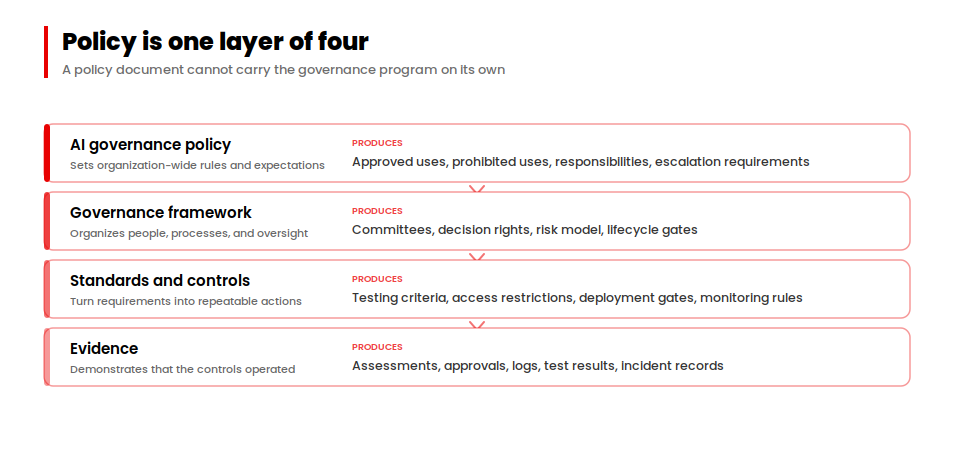
A policy document cannot carry the entire governance program. Teams also need a framework for decision-making, standards that define mandatory implementation details, controls embedded in workflows, and records showing that those controls operated.
| Component | Purpose | Practical output |
|---|---|---|
| AI governance policy | Establishes organization-wide rules and expectations | Approved uses, prohibited uses, responsibilities, escalation requirements |
| AI governance framework | Organizes people, processes, and oversight | Committees, decision rights, risk model, lifecycle gates |
| Standards and controls | Translate requirements into repeatable actions | Testing criteria, access restrictions, deployment gates, monitoring rules |
| Evidence | Demonstrates decisions and control operation | Assessments, approvals, logs, test results, incident records |
A useful AI governance policy document covers the following areas. Each section should point to an owner or supporting process.
- Purpose, objectives, and risk appetite
- Scope, definitions, and covered users
- AI system inventory requirements
- Approved and prohibited uses
- Data classification and handling rules
- Roles, decision rights, and escalation paths
- Risk classification and approval requirements
- Model, vendor, application, and agent controls
- Testing, deployment, monitoring, and change management
- Incident reporting, exceptions, and policy review
An AI governance policy template can accelerate drafting, yet its generic clauses still need owners, enforcement mechanisms, and evidence requirements tailored to your organization. Templates remain starting points.
Why Policy-Only AI Governance Fails at Scale
Policy-only AI governance fails when a rule cannot change a system decision. “Use AI responsibly” gives engineers, procurement teams, and business users no test they can apply during design or approval.
The same gap appears when responsibility is distributed across several functions without a final decision owner. Security may assess access and data exposure, legal may evaluate obligations, product may own the use case, and engineering may operate the system. Someone still needs explicit authority to approve, reject, pause, or retire it.
Scale exposes every gap. AI can enter through an employee subscription, a software update that adds an embedded assistant, a vendor API, an internal model, or an agent connected to operational tools.
Operational governance needs four outcomes. Together, they make ownership and control visible.
- Every material AI use case appears in an inventory.
- Each use case has a named business and technical owner.
- Its risk tier determines approvals, controls, and evidence.
- Production behavior is monitored through change and retirement.
Lifecycle coverage matters because AI behavior can change with its data, prompts, models, tools, and usage patterns. Production ownership must be explicit.
Start With Scope, Inventory, and Risk Appetite
I start policy design by defining what the organization means by an AI system. A narrow definition focused on standalone chatbots will miss AI embedded in customer platforms, developer tools, analytics products, workflow automation, and purchased software.
The scope clause should cover employees, contractors, vendors, and other parties using AI on the organization’s behalf. It should also specify which business units, legal entities, systems, data classes, and geographic operations fall under the policy.
Inventory at component level. Each AI system record should contain enough information to classify risk and assign accountability.
- System and use-case name
- Business purpose
- Business owner and technical owner
- Model or AI service provider
- Internal, third-party, or hybrid delivery model
- Data categories and data sources
- Affected users or populations
- Output and decision type
- Human review requirements
- Connected tools and systems
- Risk tier and approval status
- Production version and last review date
- Monitoring, incident, and retirement status
One product can contain several components with different consequences. A low-impact content assistant, a customer-facing recommendation model, and an automated action that changes an operational record should have separate inventory entries or linked component records.
Our DCD project shows why this distinction matters. Our team built an AI-powered cabinet customization ecosystem with Gemini integration, kitchen reimagination, automated quote generation, role-based access, and real-time notifications.
The project record reports that the system reduces decision uncertainty and speeds up customization approvals. From a governance-design perspective, visual reimagination and automated quote generation warrant separate component records because their outputs influence different decisions.
The supplied record covers product scope and outcomes only. I am applying a governance lens to show how I would classify its components.
Risk appetite completes the foundation by defining the level of uncertainty and potential harm the organization will accept for different data, users, decisions, and degrees of automation. Risk appetite sets the boundary.
Assign Decision Rights and Accountable Owners
A mid-market organization rarely needs a large permanent AI ethics board for every use case. It does need named authority that can make timely decisions and escalate higher-risk cases.
I recommend separating business accountability from technical operation. The business owner accepts responsibility for the use case and its impact, while the technical owner maintains the system, controls, documentation, and monitoring.
| Role | Core responsibility | Typical decision |
|---|---|---|
| Executive sponsor | Sets risk appetite and resolves major escalations | Approves restricted use or material exceptions |
| Policy owner | Maintains policy, standards, and review cadence | Publishes policy updates |
| Business owner | Owns purpose, impact, and acceptable use | Requests approval and accepts residual business risk |
| Technical owner | Owns architecture, testing, release, and monitoring | Confirms technical readiness |
| Security and privacy reviewers | Assess access, data, vendors, and abuse exposure | Approve controls within their authority |
| Governance committee or delegate | Reviews high-risk and cross-functional cases | Approves, rejects, limits, or pauses deployment |
| Users and operators | Follow approved procedures and report incidents | Escalate unexpected behavior |
One owner must decide. The policy should state who can approve each risk tier, grant an exception, accept residual risk, suspend an AI system, and authorize production changes.
It should also name a deputy so approvals continue when the primary owner is unavailable. Each decision record needs a responsible person, an escalation destination, and a deadline appropriate to the use case.
Build Risk Tiers Into Approval and Control Requirements
Risk tiers help a CTO concentrate governance effort where AI can create the greatest harm. Classification should consider data sensitivity, affected people, decision impact, autonomy, reversibility, scale, and the organization’s ability to detect errors.
The following matrix is illustrative. Organizations should adapt its definitions and approval authorities to their risk appetite, contractual duties, industry, and applicable law.
| Risk tier | Example use case | Approval | Required controls | Evidence |
|---|---|---|---|---|
| Low | Internal drafting assistant | Product owner | Approved tools; data restrictions | Tool register; attestation |
| Moderate | Customer-support copilot | CTO delegate | Testing; human review; monitoring | Test record; release approval |
| High | Eligibility recommendation | Governance committee | Impact assessment; escalation; monitoring | Assessment; decision log |
| Restricted | Autonomous financial action | Executive approval | Explicit authority; kill switch; audit logs | Approval; runtime logs |
Classification must change control. Each tier should trigger a predefined package of approvals, testing, monitoring, and evidence.
The policy also needs a route for ambiguous cases. I would assign the higher plausible tier until the owner provides enough evidence to support a lower classification.
Classification should be reviewed when a system gains new data, users, integrations, decision authority, or autonomy. A support copilot can move into a higher tier when it gains permission to issue refunds, modify accounts, or send unsupervised customer communications.
Translate Policy Statements Into Enforceable Controls
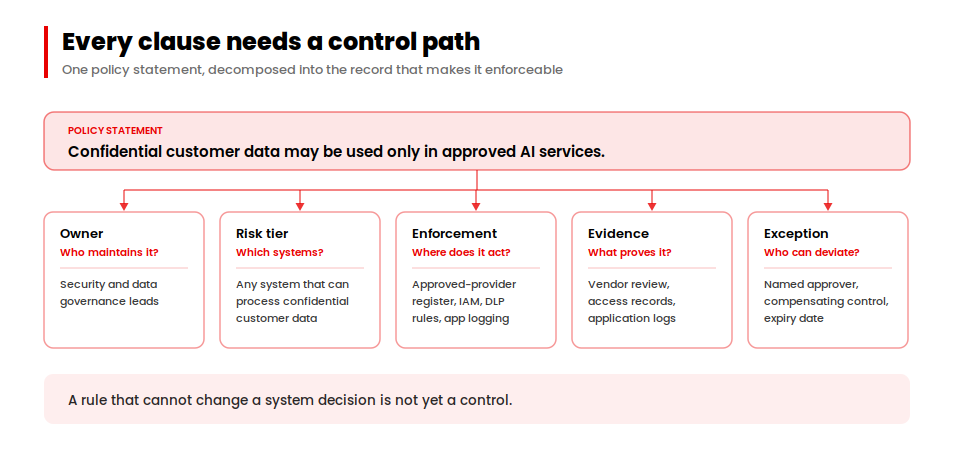
Every important policy statement should connect to an owner, an enforcement point, and a record. Every clause needs a control path.
Consider a policy rule that permits confidential customer data only in approved AI services. Its control mapping could include an approved-provider register, identity-based access, data loss prevention rules, vendor review, application logging, and an exception workflow.
The implementation record should contain five fields. Together, they show how the policy operates.
- Owner: Who maintains and verifies the control?
- Risk tier: Which systems must use it?
- Enforcement: Where does the control act?
- Evidence: What record proves the action occurred?
- Exception: Who can authorize a deviation, for how long, and under which conditions?
Technical enforcement can occur in several places. Identity and access management can restrict users, application code can block sensitive fields, continuous integration and delivery pipelines can require approval before release, and runtime gateways can limit model or agent behavior.
Manual controls still have a role, especially during early implementation. They should produce consistent evidence and have a clear path toward automation when use-case volume grows.
A concise mapping record might read: “High-risk customer recommendations require documented testing, business-owner approval, human review before action, production monitoring, and quarterly control review.” Each requirement should point to a system, workflow, or accountable reviewer.
Govern AI Across Development, Deployment, and Change
AI governance and policy design should follow the system lifecycle. A one-time intake review will miss model upgrades, prompt changes, new data sources, third-party updates, and shifts in how users rely on outputs.
During design, capture the purpose, users, data, anticipated impact, prohibited behavior, and human oversight model. Assign the initial risk tier before architecture decisions become expensive to reverse.
During development and validation, test the risks relevant to the use case. These can include output accuracy, harmful content, bias, prompt injection, sensitive-data exposure, tool misuse, and failure under unusual inputs.
During deployment, approval gates should verify that required tests passed, documentation exists, monitoring is active, and rollback procedures work. Governance should operate inside development and release workflows.
During operation, owners should monitor system performance, misuse signals, incidents, complaints, and control failures. Monitoring depth should follow the risk tier and the organization’s ability to intervene.
During change and retirement, the owner should assess updates before release, preserve required records, remove access and credentials, and confirm how retained data will be handled. Change needs its own gate.
ISO/IEC 42001 supports this management-system view through a continual-improvement approach. Its scope covers organizations that develop, provide, or use AI-based products and services.
Add AI Agent Governance Before Delegating Actions
AI agents can choose tools, retrieve information, generate plans, and take actions across connected systems. Their ability to act makes authority design central to AI agent policy governance.
Start with an explicit authority envelope. This is a machine-readable and human-readable definition of the resources an agent can access, the actions it can take, the transaction limits it must observe, and the conditions that require approval.
An agent control set should cover the following areas. Each permission should map to an owner and revocation path.
- Identity and least-privilege access
- Approved tools and destinations
- Read, write, approve, and execute permissions
- Data retrieval and retention boundaries
- Transaction or action limits
- Human approval checkpoints
- Runtime logging and traceability
- Timeout, revocation, and kill-switch mechanisms
- Escalation for uncertainty, conflict, or policy violations
- Testing for prompt injection and tool misuse
Human oversight must specify an intervention condition. The policy should identify which action is paused, who reviews it, what information they receive, and how approval is recorded.
Authority must be revocable. Teams should be able to withdraw an agent’s credentials, tool access, active tasks, and delegated authority without waiting for a complete application deployment.
Maintain Evidence, Monitoring, and Exception Records
Governance evidence should make a decision reconstructable. A reviewer should be able to see what system was assessed, which version was approved, who made the decision, which evidence they considered, and which conditions applied.
Evidence must be reconstructable. A lifecycle evidence register can link the AI inventory to the following records:
- Risk and impact assessments
- Model, vendor, and data documentation
- Test plans and results
- Release and change approvals
- Human oversight records
- Monitoring reports and alerts
- Incident and remediation records
- Exception approvals and expiration dates
- Retirement decisions
The decision log or audit trail should record approvals, rejections, conditions, exceptions, and escalations. Runtime logs serve a different purpose by recording system events, agent actions, tool calls, and operational behavior.
Exceptions need an owner, reason, scope, compensating controls, approval date, and expiration date. The review workflow should alert owners before an exception expires.
Monitoring requirements should define action thresholds and response owners. A dashboard without a response rule leaves accountability unresolved.
A Mid-Market CTO Implementation Sequence
I would sequence a mid-market program around usable artifacts. Sequence beats breadth.
| Phase | Primary work | Exit condition |
|---|---|---|
| 1. Establish visibility | Define scope, assign policy owner, inventory AI systems and tools | Material AI use cases have owners and inventory records |
| 2. Classify and prioritize | Approve risk criteria, classify systems, identify prohibited or restricted uses | Every inventoried system has a provisional risk tier |
| 3. Establish decision gates | Define approval authorities, control packages, exceptions, and escalation | New and changed systems follow a documented workflow |
| 4. Integrate delivery controls | Add testing, deployment approvals, access restrictions, monitoring, and logs | Priority controls operate in delivery and production |
| 5. Improve assurance | Review evidence, incidents, vendors, agent permissions, and policy effectiveness | Governance has a recurring review and improvement cycle |
Implementation cost depends on AI inventory size, existing security controls, system integrations, evidence requirements, and the number of high-risk use cases. The following table is a qualitative planning aid; scoped discovery is required for pricing.
| Implementation area | Main cost drivers | Relative budget pressure |
|---|---|---|
| Policy and ownership design | Stakeholder count, existing policies, approval complexity | Focused |
| Inventory and risk classification | Number of tools, vendors, products, and business units | Moderate |
| Workflow implementation | Ticketing, procurement, deployment, and exception integrations | Moderate to high |
| Technical enforcement | Gateways, access controls, testing, logging, and agent restrictions | High for complex environments |
| Monitoring and assurance | Production telemetry, review frequency, audit requirements | Ongoing |
For a constrained team, begin with an inventory, risk matrix, approved-use rules, and one approval path. Start with visibility and authority.
When to Get AI Governance Implementation Support
External implementation support becomes useful when policy drafting is moving faster than control delivery. Other readiness signals include unclear ownership, an incomplete AI inventory, inconsistent vendor reviews, high-risk use cases, and agents gaining access to business systems.
I would also consider support when governance work is consuming senior engineering time without producing repeatable workflows. A focused engagement should leave the organization with an assessed operating model, named decisions, control mappings, implementation priorities, and artifacts the internal team can maintain.
Evaluation should cover advisory and technical capability. Ask how the implementation team will connect policy clauses to architecture, delivery pipelines, runtime monitoring, agent permissions, evidence, and exception handling.
External support adds little when the AI inventory is small, use cases remain low risk, and internal owners can implement the required controls. Support should remove bottlenecks.
Conclusion
AI governance becomes effective when it moves beyond policy language and into the systems and workflows where AI is actually used. A policy can define what is allowed, but it cannot manage AI risk on its own. Organizations also need clear decision rights, risk-based approval gates, enforceable controls, lifecycle monitoring, and evidence that shows those controls operated.
For a CTO, the goal is not to create a governance process that slows every AI initiative. It is to make the path to responsible deployment predictable. Every material AI system should have a named owner, a risk tier, defined controls, an approval path, and a way to monitor and intervene when conditions change.
The practical starting point is straightforward: build an inventory, assign accountability, classify risk, and connect each requirement to an actual control and evidence record. From there, governance can be integrated into development, deployment, vendor management, runtime operations, and AI agent permissions.
Build an AI governance operating model
Get an assessment of your policy, decision rights, risk tiers, controls, evidence requirements, and implementation priorities.
Explore AI governance services
Prefer a narrower starting point? Begin with a review of the gaps between your current policy statements and operating controls.
I would start with one concrete action: list every AI system, assign an owner, and give it a provisional risk tier. That inventory will show where policy language still lacks an approval, control, or evidence record.