











 ChatGPT
 Perplexity
 Claude
 Google AI
Custom AI development means building specialized AI models, agents or systems tailored to your proprietary data, business logic and compliance needs, instead of relying solely on a general-purpose API like OpenAI or Anthropic. For most use cases, you start with a commercial API, add retrieval-augmented generation (RAG) to ground it in your data and only move to fine-tuning or a custom model when the API hits a wall on accuracy, cost at scale, data control or differentiation. 88% of organizations report regularly using AI, according to McKinsey, which shifts the real question from whether to adopt AI to whether you should build a custom system or buy one off the shelf. Custom AI development typically runs from around $40,000 for a focused build to well past $150,000 for an enterprise system, so the decision is as much financial as it is technical.
This guide explains what custom AI development involves, walks through a build-vs-buy framework, covers real costs and ROI and shows exactly when building your own pays off and when it does not.
Key Takeaways
- Custom AI development is the practice of building AI models, agents or systems around your own data, workflows and compliance needs rather than relying on an off-the-shelf tool alone.
- The smart default is to start on a commercial API, add RAG to ground it in your data and graduate to fine-tuning or a custom model only when accuracy, scale, control or differentiation forces the move.
- Build-vs-buy is a cost and risk decision, not a prestige one and the wrong call is what turns custom AI into an expensive science project.
- Costs range from roughly $8,000 to $40,000 for an API-based start, up to $150,000 or more for a fully custom enterprise system and ongoing inference plus maintenance is the line most teams forget to budget.
- Custom AI is worth it when the value created or cost saved clears the build-and-run cost within a sensible payback window and it is not worth it for generic tasks an API already handles well.
- Data readiness, integration depth and evaluation drive most of the timeline and most of the risk, not model selection.
- Roughly 42% of companies abandoned most of their AI initiatives in 2025, so an honest “when not to build” filter protects your budget more than any model choice.
- The fastest path to value is a phased one: prove a narrow use case on the cheapest viable approach, then scale the investment once it earns the right to grow.
What Is Custom AI Development? (and How It Differs From AI, ML and Generative AI)
Custom AI development is the process of building AI models, agents or systems tailored to a specific business, its proprietary data, workflows and compliance requirements, rather than using a general-purpose tool exactly as it ships. In practice, that can mean fine-tuning an existing model on your data, building retrieval systems that ground a model in your knowledge base or training a model from scratch when nothing on the market fits.
The point of going custom is accuracy, control and differentiation that a generic API cannot provide on its own. When I scope a project with a client, “custom” is rarely the whole model. More often it is a deliberate combination of off-the-shelf components and a small amount of genuinely bespoke work placed exactly where it changes the outcome.
It helps to separate three terms that often get used interchangeably:
- AI development: AI development is the broad practice of building systems that perform tasks normally requiring human intelligence. It is the umbrella over everything else here.
- Machine learning (ML): ML is a subset of AI where models learn patterns from data to make predictions or classifications, think fraud scoring, demand forecasting or recommendation engines.
- Generative AI: Generative AI is a newer subset that creates content such as text, images and code, usually powered by large language models (LLMs).
Custom AI development can draw on all three. A mature build chooses the right technique for the problem instead of defaulting to the trendiest one. Plenty of valuable systems I have shipped lean on classical ML, not a frontier LLM because that was the cheaper and more reliable way to hit the target.
How Does Custom AI Development Work? (the Process, Step by Step)
The build itself follows a fairly consistent path. The order matters because most failures I see trace back to teams skipping or rushing the early steps.
- Frame the business problem: Define the outcome you want in measurable terms before naming any technology. “Reduce first-response time on Tier 1 tickets by 30%” is a usable target. “Add AI” is not.
- Assess the data: Identify what data the system needs, where it lives, how clean it is and who owns it. This is where timelines get made or broken.
- Choose the approach: Decide between a commercial API, RAG on an API, fine-tuning or a fully custom model. This is the build-vs-buy decision and the framework below exists to make it deliberate.
- Build and integrate: Develop the model or pipeline and connect it to the systems it has to work with, such as your CRM, ERP, databases and internal workflows.
- Evaluate against the target: Test accuracy, latency, cost per request and failure behavior against the metric you set in step one, not against a demo prompt.
- Deploy with guardrails: Ship into production with monitoring, access controls, human review where the stakes justify it and a clear rollback plan.
- Monitor and improve: Watch real-world performance, retrain or refine as data and conditions change and keep an eye on inference cost as usage grows.
Notice that only one of these seven steps is about choosing a model. The work that actually decides whether a custom AI project succeeds sits in framing, data, integration and evaluation.
Custom AI vs. Using an API: The Build-vs-Buy Decision Framework
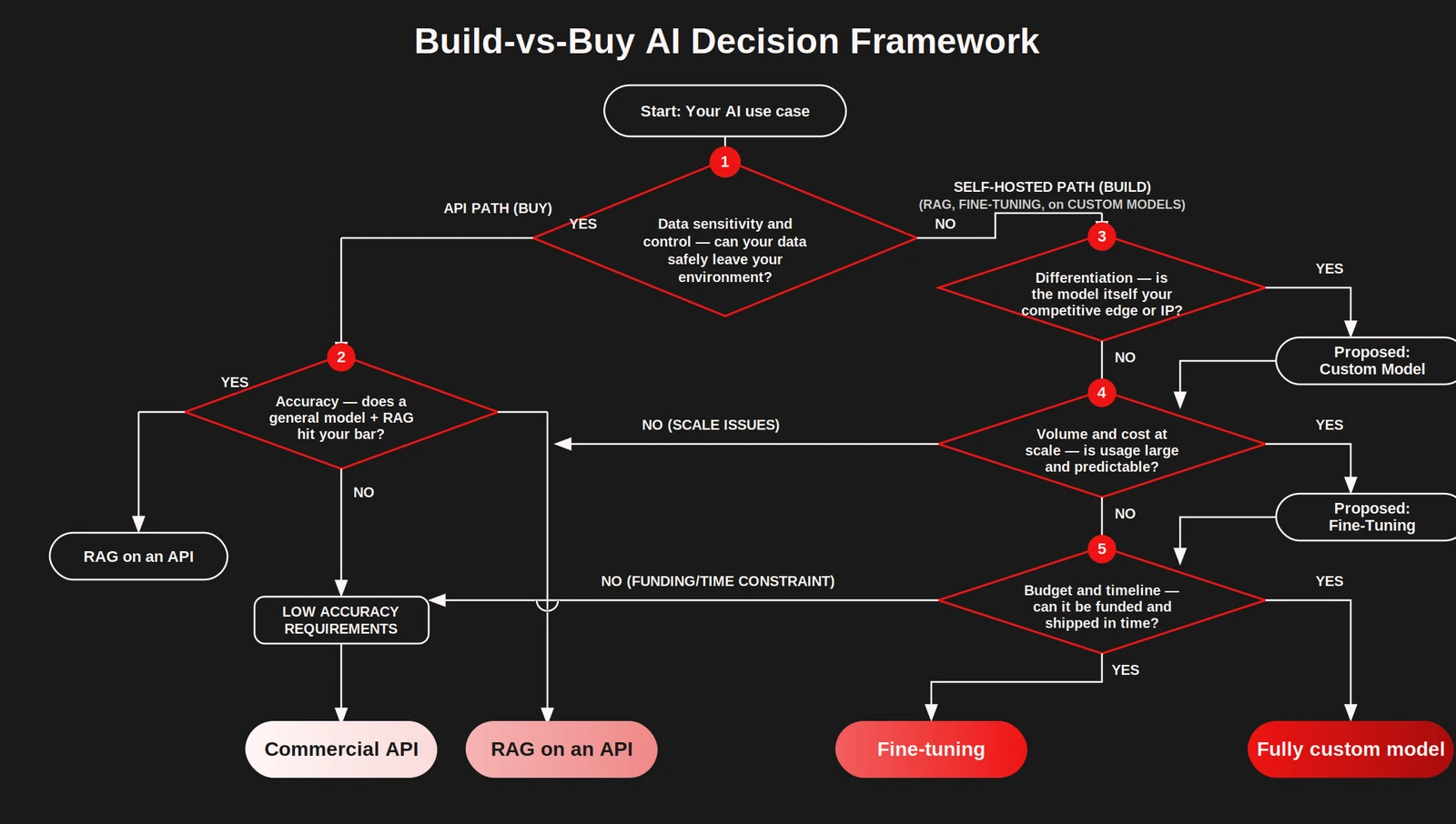
This is the decision the title promises, so I will take clear positions instead of hiding behind “it depends.” Over many engagements, I have boiled the choice down to a sequence I call the Build-vs-Buy AI Decision Framework. Run your use case through these five gates in order and the right approach usually reveals itself.
Gate 1: (Data sensitivity and control)
Can your data legally and safely leave your environment to be processed by a third-party API? If strict compliance, residency or confidentiality rules say no, a pure commercial API is off the table and you move toward self-hosted RAG, fine-tuning or a custom model.
Gate 2: (Accuracy needs)
Will a strong general model, grounded in your data through RAG, get you to acceptable accuracy? If yes, stop there. If grounding alone cannot deliver the consistency, format or domain behavior you need, fine-tuning becomes the candidate.
Gate 3: (Differentiation)
Is the model itself your competitive edge or core intellectual property? If the model is the product, a custom build can be justified. If the model is plumbing behind your product, buy it and spend your effort elsewhere.
Gate 4: (Volume and cost at scale)
At very high request volumes, per-call API pricing can quietly grow past the amortized cost of a fine-tuned or owned model. If your usage is large and predictable, the economics start favoring a build.
Gate 5: (Budget and timeline)
Reconcile everything above with what you can fund and how fast you need to ship. The technically ideal approach is the wrong one if it cannot be financed or delivered in time to matter.
The framework routes you to one of four destinations: a commercial API, RAG on an API, fine-tuning or a fully custom model. Most teams who walk these gates honestly land on API or RAG. A smaller, well-justified group lands on fine-tuning or fully custom. Both outcomes are correct, the failure is choosing custom because it sounds impressive rather than because the gates pointed there.
Here is how that plays out in practice. A logistics client recently came to us certain they needed a custom model to answer operational questions from their internal documentation. We walked the gates together:
- Data sensitivity: Their data could stay within a private cloud, so Gate 1 did not force a full custom build. It only ruled out sending raw documents to a public endpoint.
- Accuracy: Their accuracy need was real but solvable with grounding, so Gate 2 pointed at RAG rather than fine-tuning.
- Differentiation: The model was not their competitive edge, so Gate 3 said buy, not build.
- Volume: Their usage was moderate, so Gate 4 did not change the math.
The result was a self-hosted RAG system on a commercial model, delivered in weeks instead of months, at a fraction of the custom price they had budgeted. Same problem, very different bill, because the gates were honest.
The framework is not there to push you toward a build or away from one. It is there to make the decision explicit, so the approach you choose can be defended to your finance team and revisited later as your needs change.
Want the gates applied to your specific use case?
We can walk your use case through this framework and tell you which approach actually fits, before you commit a dollar to a build.
Talk through your use case with our AI teamThe Four Approaches: API, RAG, Fine-Tuning or Fully Custom (and When to Use Each)
Each gate above resolves into one of four delivery approaches. Here is how they compare on the dimensions that actually drive the decision.
| Approach | Best for | Upfront cost | Data control | Time to launch |
|---|---|---|---|---|
| Commercial API | Fast start, general tasks | $8K to $40K | Low (data leaves) | Weeks |
| RAG on an API | Your-data accuracy, current facts | $30K to $120K | Medium to High | 6 to 14 weeks |
| Fine-tuning | Consistent behavior, format or domain | $50K to $150K | High | 8 to 16 weeks |
| Fully custom model | Differentiation, IP, full control | $150K to $300K+ | Full | 4 to 6+ months |
Working benchmarks from our own AI delivery work. Treat them as ranges, not quotes.
A few practical notes on each:
- Commercial API:
The right starting point for most teams. You get frontier capability immediately and validate the use case cheaply before committing real money. The trade-off is limited control and data leaving your boundary.
- RAG on an API:
This is where most “custom” projects should actually live. Retrieval grounds a general model in your documents, records and current facts, which fixes the majority of accuracy complaints without training anything. When clients describe wanting RAG-grounded systems, this is usually the sweet spot.
- Fine-tuning:
Worth it when you need consistent tone, structured output or domain behavior that prompting and retrieval cannot reliably produce. It raises cost and data requirements, so it should follow evidence that RAG was not enough.
- Fully custom model:
Reserved for cases where the model is your moat, your data is too sensitive to leave or your volume and control needs justify owning the whole stack. This is also where most agentic builds get serious, since production AI agents often need tighter control over behavior and tooling than a generic API allows.
Table is the heart of the decision. If you remember one thing, remember that you can move up this ladder over time. Starting on an API does not lock you out of a custom build later and it usually makes the eventual build smarter because you have real usage data to design against.
It is also worth saying that these four approaches are not mutually exclusive. The systems I am proudest of tend to be hybrids. A production assistant might use a commercial API for general reasoning, a RAG layer for grounding in company data, a small fine-tuned component for one stubborn formatting requirement and classical ML for a scoring step where an LLM would be overkill. The framework gets you to a primary approach. Good engineering then mixes in the others exactly where each earns its place. The mistake is treating “custom versus API” as a single binary switch when the real answer is almost always a thoughtful blend weighted toward the cheapest option that meets the bar.
How Much Does Custom AI Development Cost? (MVP vs. Enterprise + Ongoing)
Cost is the question every CTO asks first and it deserves a straight answer rather than a shrug.
A focused custom build typically runs $40,000 to $150,000, while a fully custom enterprise system runs $150,000 or more. Starting on a commercial API is far cheaper, often in the $8,000 to $40,000 range to validate a use case. RAG-grounded systems tend to sit in the middle. These figures line up with the broader custom AI development cost ranges we publish from our delivery data.
The biggest cost drivers are predictable:
- Approach: API, RAG, fine-tuning or fully custom, in roughly ascending order of cost.
- Data readiness: Clean, accessible, well-owned data is cheap to work with. Fragmented data is where budgets quietly double.
- Integration depth: Connecting to one system is straightforward. Orchestrating across CRM, ERP and internal tools is where real engineering time goes.
- Ongoing inference and maintenance: This is the line teams forget. A model in production keeps costing money through API or compute usage, monitoring and periodic retraining.
It also helps to separate an MVP from an enterprise build because they are different financial decisions. An MVP exists to answer one question cheaply: does this use case create value when real users touch it? That is usually an API or RAG build in the lower cost bands, designed to be measured. An enterprise build is what you fund after the MVP earns it, with the integration depth, governance and reliability that production at scale demands. Trying to skip the MVP and build the enterprise system first is how teams turn a $40,000 question into a $200,000 mistake.
One more line that surprises people: budget for life after launch. A custom AI system is not a one-time purchase. Plan for ongoing inference or compute cost, monitoring, periodic retraining and a support arrangement to handle drift and edge cases. As a rough rule, I tell clients to expect ongoing run-and-maintain cost to be a meaningful annual fraction of the build cost, not a rounding error. The teams that budget for it stay in production. The teams that do not quietly let the system rot.
Is Custom AI Worth It? Measuring ROI and Payback
Custom AI is worth it when it solves a high-value problem that off-the-shelf tools cannot and when the value it creates or the cost it saves exceeds the build-and-run cost within a reasonable payback period. It pays off fastest where accuracy, proprietary data or differentiation directly drive revenue or savings.
The honest market backdrop matters here. In McKinsey’s 2025 State of AI survey, 88% of organizations reported regularly using AI, yet only around 39% could point to any enterprise-level impact on EBIT and most of those put the figure below 5%. The takeaway is not that AI fails to pay off. It is that value comes from disciplined, well-scoped builds, not from adopting AI broadly and hoping.
Here is a simple payback model I use, with illustrative numbers so you can see the shape of it.
Worked example (illustrative):
- A support team handles 8,000 tickets per month.
- A RAG-grounded assistant reliably resolves or deflects 40% of them, which is 3,200 tickets, the kind of build thoroughly covered in our AI chatbot development services guide.
- At an estimated $5 of agent time per ticket, that is $16,000 saved per month or about $192,000 per year.
- The build costs $90,000 and ongoing inference plus maintenance runs about $3,000 per month or $36,000 per year.
- Year-one net value is roughly $192,000 minus $36,000 minus $90,000, which is about $66,000, with payback landing around seven months.
Change the assumptions and the answer changes, which is exactly the point. The formula is always the same: value created or cost saved per month, set against build cost plus run cost, equals your payback period. If that math does not clear within a window your finance team accepts, the build is not worth it yet. You can pressure-test the inputs against broader AI adoption statistics before you commit.
In my experience, the returns land fastest in a few recognizable places. High-volume, repetitive work where a person currently acts as the connective tissue between systems is the clearest win because the time saved is large and easy to measure. Tasks where accuracy or speed directly affects revenue, such as lead qualification or fraud screening, tend to pay back quickly when they work. The slowest returns come from broad, vague mandates like “make the company more efficient with AI,” because there is no single number to move and therefore no clean payback to point at. When a use case resists a simple payback calculation, that is usually a sign the scope is too wide, not that the math is too hard.
Data, Integration, Accuracy and Security: What a Build Actually Requires
A custom AI project is only partly a modeling effort. The rest is the unglamorous work that determines whether it survives contact with production.
Data
You need data that is relevant, reasonably clean, accessible and owned by someone accountable. Fine-tuning and custom models need more of it and at higher quality. RAG is more forgiving but it still depends on a well-maintained knowledge source. If your data is scattered across five systems with no consistent schema, fix that before you build, not during.
Integration
The model rarely works alone. It has to read from and write to your existing stack, including CRMs, ERPs, databases and workflow tools. In my experience, integration is where timelines and budgets are most often underestimated because no two companies have the same combination of systems.
Accuracy
Accuracy is set by your evaluation method, not by the model’s reputation. Define what “good enough” means for your use case, measure against real inputs and keep a human in the loop wherever a wrong answer is expensive. Grounding through RAG usually moves accuracy more than swapping models.
Security and Compliance
Decide early what data can leave your environment, what has to stay and what regulations apply. Access controls, audit logging and a clear policy on human review are deployment requirements, not afterthoughts. For regulated industries, these constraints often push the approach toward self-hosted or custom builds, which is a legitimate reason to spend more.
When NOT to Build Custom AI
This is the section competitors leave out and it is the most valuable thing I can tell you. People often ask me when I advise a client not to build custom AI and what it costs them if they build it anyway.
The cost of building anyway is not hypothetical. The bill shows up as months of engineering time, a six-figure spend and a system that is harder to maintain than the off-the-shelf option it replaced. Worse, it occupies the team that could have shipped three smaller wins in the same period.
The market data backs this up. Gartner predicts that over 40% of agentic AI projects will be canceled by the end of 2027, citing escalating costs, unclear business value and inadequate risk controls. On the broader picture, S&P Global Market Intelligence found that the share of companies abandoning most of their AI initiatives jumped from 17% to 42% in a single year, with the average organization scrapping 46% of its proof-of-concept projects before they reached production.
Almost none of those failures are model failures. They are scoping failures, data failures and the simple mistake of building custom when buying would have worked. The contrarian position is the responsible one: the goal is to solve the problem, not to own the most impressive model.
Two patterns come up again and again. The first is the prestige build. A team wants to say they trained their own model, so they commit to fine-tuning before testing whether grounding alone would have worked. Months later they have a model that performs about as well as the API plus RAG they skipped, except now they own the maintenance, the retraining and the inference bill forever.
The second is the premature build, where a team commits a large budget to a custom system before validating that the use case has value at all. When the use case turns out to be marginal and many do, the sunk cost is total. In both cases, the fix was the same and it was free: start cheap, prove value and only spend up when the gates and the numbers both point that way.
If you take nothing else from this section, take this. The most expensive AI decision is not choosing the wrong model. It is building a custom system you did not need to build.
How to Choose a Custom AI Development Company
If your use case does justify a build, the partner you pick matters as much as the approach. A few things I would look for if I were on the buying side:
- They recommend the cheapest approach that works: A good partner will sometimes talk you out of a custom build. That is a signal of integrity, not weakness.
- They lead with your business outcome: The first conversation should be about the problem and the metric, not about which model they want to sell you.
- They are honest about data and integration: If a vendor promises a custom AI system that plugs in and just works with no data preparation, walk away.
- They show production experience, not demos: Anyone can build a convincing prototype. Ask to hear about systems that reached production and what it took to keep them there.
- They plan for life after launch: Monitoring, retraining, cost management and support should be part of the proposal, not a surprise later.
This is exactly how we approach AI development services at AppVerticals. We ship both off-the-shelf and custom, which means our recommendation is driven by your use case rather than by the one thing we know how to sell.
Final Thoughts
The real decision is not custom AI versus an API. It is matching the approach to the problem, the data and the budget. Most teams should start on an API, add RAG to ground it in their data and graduate to fine-tuning or a custom model only when accuracy, scale, control or differentiation demands it. Get that sequence right and custom AI pays for itself. Get it wrong and it becomes an expensive science project.
If you want a straight build-vs-buy recommendation for your specific use case, with a real cost, timeline and ROI estimate, talk to a team that ships both.
Get a build-vs-buy recommendation
We’ll assess your product, data, and scalability needs and recommend the most cost-effective AI approach for your use case.
Keep reading: what a custom AI build actually costs and how to put AI agents into your workflows.