













 ChatGPT
 Perplexity
 Claude
 Google AI
Doctor appointment booking app development means building the system a clinic uses to publish its availability, let patients claim a slot, and keep that slot in sync with the practice management system and the EHR behind it.
I have scoped a lot of these. The conversation almost always opens with a feature list, and the feature list is almost always the least interesting part.
What decides whether one of these apps works is a set of choices nobody puts in the brief: whether patients can move their own appointments, how you stop two people taking one slot, and what happens when the schedule changes in the EHR rather than in your app.
This guide covers the features, the integration work, HIPAA, what it costs, how long it takes, and the one architectural decision I would make first.
The most expensive mistake I see is building a booking app that cannot release a slot. If a patient has to phone the clinic to cancel, most will just not turn up, and the slot dies with them.
Key Takeaways
- A doctor appointment booking app costs roughly $45,000 to $140,000 for a clinic-scale build, and $140,000 to $250,000 once it syncs both ways with an EHR.
- Letting patients cancel and rebook themselves is the decision that moves the numbers most. In a 2025 study, direct booking produced a 8% no-show rate against 5.9% for phone bookings.
- The same study found the opposite result at a hospital using a request-and-triage form, where online bookings ran 3% against 11.2%. The booking model drives the outcome, not the fact that it is online.
- The hardest engineering is slot locking and capacity, and it rarely appears on a feature list.
- Two-way EHR integration usually costs more than the booking app itself.
- Reminders help and then flatten out. A meta-analysis of 26 studies found reminded patients were 23% more likely to attend.
What a Doctor Appointment Booking App Has to Do
Strip it back and the job is small. Show real availability, take a booking, and hold it.
Then let that booking be moved or released, and tell the clinical system what happened.
Everything else is a feature on top of those five.
They get complicated because availability is not a simple calendar. A provider has appointment types of different lengths, rooms and equipment that can only be used once at a time, buffers between patients, and rules about who may book what.
Most failed booking projects I have seen failed at that layer, long before anyone reached telemedicine app development or the AI triage behind modern medical diagnosis apps.
Direct Booking or Request-and-Triage: The Decision That Sets Your No-Show Rate
There are two ways to build the booking flow, and they produce measurably different results.
Direct booking. The patient sees live slots, picks one, and owns it. They can cancel or move it themselves, at any hour, without speaking to anyone.
Request and triage. The patient submits a request. Staff review it, decide urgency, and assign a slot. Changes go through the same queue.
The evidence here is unusually clean. A 2025 study in *Frontiers in Digital Health* tracked 98,067 appointments across an ophthalmology practice and a university hospital over twenty months.
In the practice, which used direct booking, online appointments had a no-show rate of 1.8% against 5.9% for phone bookings. Unused slots fell from 22.7% to 10.3%, and slots never booked at all fell from 8.6% to 1.6%.
In the hospital, which used a request form with internal triage, online appointments performed worse than offline ones, at 14.3% against 11.2%.
Same channel. Opposite outcome.
The authors are direct about why. Practice patients typically cancelled or rebooked 24 to 48 hours ahead, giving staff time to refill the slot. Hospital patients could not, because every change went back through triage.
The rule I take from this: Being online does nothing on its own. What lowers no-shows is handing the patient control of their own appointment. If your build ships without self-service cancellation, you have built a request form with a nicer interface.
Dr. Michael Reich, the study’s senior author, is an ophthalmologist at Augenärzte am Städel in Frankfurt and at the Eye Center of the Medical Center–University of Freiburg. His team concluded that the benefit depends on the setting and on how much autonomy the system gives the patient. There is a real exception. Some care needs triage: complex referrals, specialist sequencing, anything where the wrong slot is a clinical risk. If that is your situation, build the triage queue properly and put your effort into reminders instead.
Why Reminders Alone Will Not Fix Your No-Show Rate
Reminders work. They also stop working sooner than people expect.
A systematic review of 26 studies published in *BMJ Open* found that patients who received a digital reminder were 23% more likely to attend. In the Frontiers study, SMS reminders measurably reduced no-show risk in the hospital setting. But a study of ten American clinics found centralized telephone reminders moved the no-show rate from 16.3% to 15.8%. That is a rounding error.
The pattern is consistent. A reminder acts on an appointment that already exists, so it cannot change how hard that appointment was to book, how easy it is to move, or how long the patient waited for it. A systematic review of 105 studies in *Health Policy* put the average no-show rate across specialties at 23%, and found longer waits between booking and appointment among the strongest predictors of a missed visit.
Build reminders properly, with two-way responses so a cancellation actually frees the slot. Then accept that the booking pathway does the heavier work.
Core Features of a Doctor Appointment Booking App
This is the part most feature lists get right, so I will keep it short and flag the ones that carry hidden work.
- Provider availability rules — appointment types, durations, buffers, room and equipment constraints
- Patient-facing slot search — by provider, specialty, location, and soonest available
- Self-service cancel and reschedule — the feature from the section above
- Two-way SMS and push reminders — a reply must actually release the slot
- Waitlist and auto-fill — offers a freed slot to the next patient automatically
- Intake forms — collected before the visit, not in the waiting room
- Payments and copay collection — card on file changes attendance behaviour
- Provider and admin dashboard — the schedule as staff actually work it
- Patient record and visit history
Two are more work than they look. Waitlist auto-fill is a real-time matching problem, and intake forms touch protected health information the moment a patient types into them.
If video visits are in scope, the telemedicine app features breakdown covers that side, and healthcare app development covers where booking sits among the other modules.
The Hard Part: Slot Locking, Capacity and Double-Booking
Here is the problem that eats timelines.
Two patients open the same slot at the same moment. Both tap book. Without the right handling, both succeed, and a receptionist finds out on the morning of the appointment.
The fix is a short-lived lock. When a patient opens a slot you reserve it for a few minutes, then release it automatically if they abandon. The lock has to survive a crash, a lost connection, and a patient who leaves the screen open for an hour.
Capacity is harder. A clinic’s real capacity is doctors, rooms, equipment and support staff, all of which can block each other, and a slot is only bookable when every resource it needs is free.
Elizabeth W. Woodcock’s 2022 scoping review in the *Journal of Medical Internet Research* on automated patient self-scheduling found that organizational and workflow barriers, rather than technology, are what usually stop these systems working.
That matches what I see. The code is tractable, and getting a clinic to agree on its own booking rules is the slow part.
Budget real discovery time for those rules. Every clinic thinks theirs are simple until you write them down.
EHR and Practice Management Integration
A booking app that does not write back into the clinical system creates a second source of truth, and the clinic will trust the old one.
Three levels, roughly:
Read-only. Your app pulls availability and displays it. Staff still enter the booking. Cheapest, and it keeps a manual step.
One-way write. Your app pushes confirmed bookings into the EHR or practice management system. Most clinic builds land here.
Two-way sync. Changes in either system reflect in the other. Most of the value sits here, and most of the cost.
Integration usually costs more than the booking app itself, especially with larger vendors where certification and sandbox access add weeks before anyone writes code. We covered EHR integration cost and timelines separately.
If patient communication and follow-up are also in scope, that overlaps with healthcare CRM territory and is worth scoping at the same time.
HIPAA and What It Adds to the Build
The moment your app knows that a named person has an appointment with a named doctor, you are handling protected health information.
That brings requirements: encryption in transit and at rest, access controls with real roles, audit logging of every record view, a signed agreement with every vendor that touches the data, and a breach process you can actually run.
Practically, it affects your build in four places. Your hosting has to support a signed business associate agreement, and your logging has to capture reads as well as writes.
Your SMS reminders cannot contain clinical detail, and your test environments cannot hold real patient data.
None of this is exotic. It does add time, and the teams that get caught out are the ones who treat it as a security review at the end. Our guide to HIPAA-compliant app development sets out what the controls cost and where the effort lands.
Doctor Appointment Booking App Development Cost
Here is what these builds actually run, by scope.
| Scope | What you get | Cost | Timeline |
|---|---|---|---|
| Single-clinic MVP | Slot search, booking, self-service cancel, SMS reminders, admin dashboard. No EHR write-back. | $45,000 – $80,000 | 3–4 months |
| Multi-provider clinic | Above plus capacity rules, waitlist auto-fill, intake forms, payments, one-way EHR write | $80,000 – $140,000 | 4–6 months |
| Group or multi-location | Above plus two-way EHR sync, multi-site availability, role-based admin, reporting | $140,000 – $250,000 | 6–9 months |
| Patient-facing platform | Multi-clinic marketplace, provider onboarding, telehealth, billing | $250,000+ | 9 months+ |
These sit inside our published healthcare app development cost range of $30,000 to $500,000 and higher, which covers the wider category.
Three things move a quote more than anything else. How many outside systems you connect to, since each is its own piece of work with its own testing. Whether you need two-way sync, which is the largest single step in this table.
And how complicated your availability rules are. A single-specialty clinic with one room type is a different build from a group practice with shared imaging equipment.
What would your version cost?
Run your scope through our cost calculator for a range you can put in front of a partner meeting, or talk it through with someone who has priced these builds before.
Estimate the cost of your scopeDevelopment Timeline, Phase by Phase
| Phase | Duration | What happens |
|---|---|---|
| Discovery and booking rules | 2–4 weeks | Documenting availability, appointment types, resource constraints |
| Design | 3–4 weeks | Patient booking flow and staff dashboard |
| Core build | 8–12 weeks | Booking engine, slot locking, notifications, admin |
| Integration | 4–10 weeks, overlapping | EHR and practice management connection, sandbox access, certification |
| HIPAA review and testing | 2–4 weeks | Controls, audit logging, penetration testing |
| Pilot and rollout | 3–6 weeks | One clinic or one specialty first, then widen |
Integration is the phase that slips, and it slips on access rather than engineering. Request vendor sandbox credentials during discovery, not when you are ready to build against them.
Pilot with one clinic. Booking rules that looked complete on paper show their gaps in the first fortnight of real use, and fixing them across one site is far cheaper than across nine.
Build, Buy, or Configure: Three Routes Compared
| Route | What you get | Cost | Best when |
|---|---|---|---|
| Buy a scheduling product | Fast, supported, standard flows | Per-provider subscription | Your workflows are close to standard and you have no product ambition |
| Configure a platform | A commercial scheduling tool extended and integrated to fit | Licence plus $30,000 – $90,000 of engineering | You want speed, but the standard flows miss your specialty |
| Build | Full control of the booking logic, the data, and the patient experience | See the cost table above | Booking is part of your product, or no product handles your availability model |
I talk more clients out of building than into it. If you run one clinic with standard appointment types, a commercial product configured properly will serve you better for a fraction of the cost.
Building earns its money in three situations: your availability rules break standard products, the booking experience is part of what you sell, or you need the appointment data in your own systems. That work sits in our healthcare app development services.
What We Learned Building Booking at Scale
The clearest lesson I have on capacity came from outside healthcare.
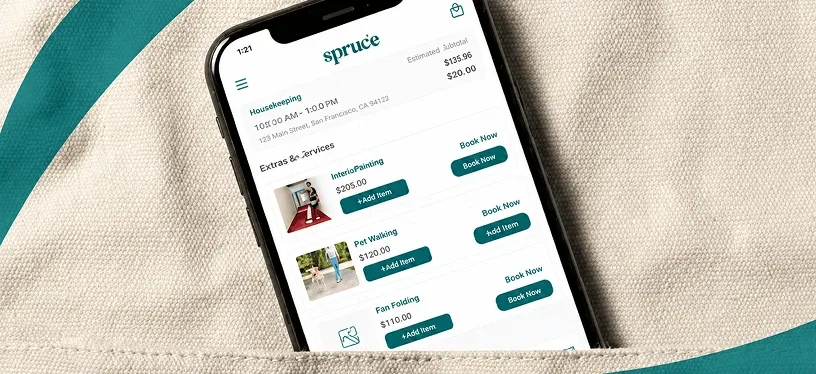
Spruce runs home and property services across the United States. Residents, property managers and short-term rental operators all book cleaning and chore visits through the same platform, and service professionals work those bookings in the field.
Their legacy system had no capacity management. Bookings went in faster than the workforce could absorb, which meant overbooking, uneven workloads, and service pros stacked against each other.
We rebuilt the platform across every role and added a capacity management module that balanced workload against actual available resources, a mobile app so service pros could manage tasks and availability in real time, and a pricing configurator that adjusted by region and property.
The platform now runs 6,477 properties and more than 685,000 customers, with 67 service providers and 7,581 property management companies on it.
Change the words and that is a clinic. A slot is only real if the person and the room are both free, and fixing that needed a module of its own rather than a setting.
We have seen the same shape in wellness, on a platform where treatment rooms had to be cleaned and reset between clients, so two bookings that looked compatible on a calendar were not compatible in the building.
How to Scope This Without Overbuilding
Five things I would settle before anyone writes code.
- Decide the booking model first. Direct booking or request-and-triage. It changes the product, the integration and the outcome.
- Write down your availability rules. All of them, including the ones staff hold in their heads. This is the single best predictor of whether the estimate holds.
- Count your integrations and price them one by one. Never price one and assume the rest are free.
- Decide what happens to a freed slot. If the answer is “nothing”, cancellation is not saving you anything.
- Pick the pilot clinic before you start. It changes what you build first.
The version that works is usually smaller than the one people arrive with. Slot search, real self-service cancellation, working reminders and one solid integration will beat a feature-rich app that staff quietly stop using.
Conclusion
Most of the value in a doctor appointment booking app comes from two decisions: whether patients control their own appointments, and whether your schedule stays true to the clinical system behind it.
Get those right and a modest build will fill slots and cut no-shows. Get them wrong and staff will quietly keep the old process running alongside the new one.
If you are weighing a build against a commercial product, write down your availability rules and see whether anything on the market handles them. That answers the question faster than any demo will.
Build a booking system your clinic will actually use
Booking engines, EHR integration, and HIPAA-ready builds for clinics, groups and health-tech teams. See how we scope it, what it costs, and how long it takes.
Explore our healthcare app development services →