













 ChatGPT
 Perplexity
 Claude
 Google AI
Custom AI model development is the process of building or training an AI model around your own data instead of using a general-purpose model as it is. That can mean fine-tuning an existing foundation model, training a domain-specific model largely on your own data, or, in rare cases, building something from scratch. This is the part of the work people usually get wrong first: they treat it as one project with one price tag.
A fine-tune, a domain-specific model, and a from-scratch build are three different projects with three different budgets, timelines, and failure points. MIT’s Project NANDA found that 95 percent of enterprise generative AI pilots show no measurable return on investment, and most of those failures start with an unclear picture of which build type a team actually needs.
Key Takeaways
- Custom AI model development splits into three build types: fine-tuning, a domain-specific model, and a from-scratch build, each with its own cost and timeline.
- MIT’s Project NANDA found that 95 percent of enterprise generative AI pilots produce no measurable P&L impact, which makes a readiness check essential before committing to any build type.
- Fine-tuning an existing foundation model typically costs $15,000 to $50,000. A domain-specific build typically costs $60,000 to $180,000. A from-scratch build starts around $250,000 and can exceed $1,000,000.
- Data readiness and post-launch evaluation are the two stages most often left out of the original budget.
- Menlo Ventures found that the enterprise build-versus-buy mix shifted from about 47 percent built and 53 percent bought in 2024 to about 24 percent built and 76 percent bought in 2025.
- A model that is not monitored, evaluated, and retrained on a schedule will drift, regardless of build type.
What Custom AI Model Development Actually Means (And What It Does Not)
Custom AI model development is the practice of building or adapting an AI model so it performs a specific task using your own data, instead of relying on a general-purpose model exactly as a vendor ships it.
Most of what falls under custom AI model development today is custom generative AI model development: adapting a large language model rather than training a traditional classifier from raw tabular data. The traditional case still exists, for tasks like fraud detection or demand forecasting, but this guide focuses on the generative AI case, because that is where AppVerticals does most of its model-build work.
Some teams still mean something narrower and older when they say “build our own AI model”: training a traditional machine learning model on structured, tabular data for tasks like churn prediction or demand forecasting. That is a real and useful category of artificial intelligence work, and it uses a different toolchain, a different team, and a different cost structure than the generative AI case this guide covers. If that is what your project actually needs, the advice below does not transfer directly.
Custom AI model development is a narrower question than custom AI development overall. Custom AI development covers whether to build AI capability at all, and whether to use an API, an agent, or a model. In more advanced implementations, custom models can also power multi agent AI systems, where multiple specialized AI agents work together, each handling a specific task while coordinating toward a shared goal.
This guide starts one step later, once you have already made that call or are close to it, and covers what actually happens once the model itself needs to be custom.
Signs You Are Actually Ready to Build One
Most companies are not ready for a custom build yet, and that is a normal place to be. McKinsey’s 2025 State of AI survey of nearly 2,000 organizations found that close to two-thirds have not yet begun scaling AI across the enterprise, with only about one-third reporting real production scale in any function. If your organization is still in that group, a custom AI model development project is usually premature.
A few honest checks before committing:
- You have already tried an off-the-shelf API or a retrieval-augmented setup, and it falls short on accuracy, speed, or cost at your volume.
- You have proprietary data that a general-purpose model has never seen, and that data gives you a real advantage.
- The task is narrow enough to define success clearly. A support-ticket classifier is a good fit for a first custom build. A general-purpose assistant usually is not.
- You have a budget for the stages that come after training: evaluation, monitoring, and retraining, alongside the initial build.
If none of these apply yet, start with an API and revisit this later. Custom AI Development vs. Using an API walks through that sequencing in more depth.
The Three Ways to Build a Custom Model: Fine-Tuning, Domain-Specific, or From-Scratch
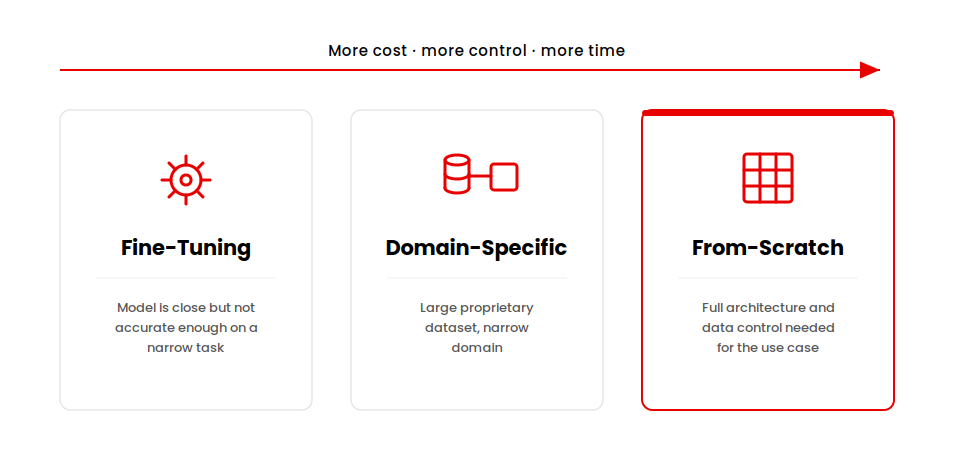
There are three ways to build a custom model, and each is a different project, with a different budget, timeline, and failure point.
Fine-tuning an existing foundation model
You take a foundation model, such as one from OpenAI or Anthropic, and continue training it on your own examples so it adapts to your task, without changing the base architecture. This is the fastest and cheapest of the three build types, and the right starting point for most companies that reach this stage. A common example is fine-tuning a model to write in a specific brand voice, follow a fixed output format, or handle a narrow set of support categories consistently.
A domain-specific custom model
You train a model largely on your own proprietary data for a narrow task, often building on an open-weight base model through platforms such as Hugging Face rather than starting pretraining from zero. This sits between fine-tuning and a full from-scratch build, and it is where most custom AI model development platforms marketed to enterprises actually operate. A common example is a model trained mostly on a company’s own technical documentation, contracts, or transaction history, handling a task general models get wrong because they were never trained on that kind of data at scale.
A from-scratch build
You define your own model architecture, assemble and clean your own training data at scale, and train from randomly initialized weights. This is the build type most people picture when they hear “custom AI model,” and it is also the one fewest companies actually need. Stanford HAI’s AI Index estimated GPT-4’s training compute at roughly $78 million and Gemini Ultra’s at roughly $191 million, and the report’s most recent edition notes that frontier labs including OpenAI, Anthropic, and Google have since stopped disclosing training details publicly. A business-scale from-scratch build is nowhere near that figure, but it remains the most expensive and slowest of the three options by a wide margin. This build type applies to teams building a genuinely new kind of model. A new use case for an existing architecture usually does not require it.
The signal for which one you need usually comes down to how far an off-the-shelf model and retrieval-augmented generation, or RAG, have already gotten you, and whether the remaining gap is about accuracy, latency, cost, or data ownership.
Custom AI Model Development, Stage by Stage
The custom AI model development process runs through six stages. The stages that get skipped most often are data preparation and post-launch evaluation. The training run itself rarely gets skipped.
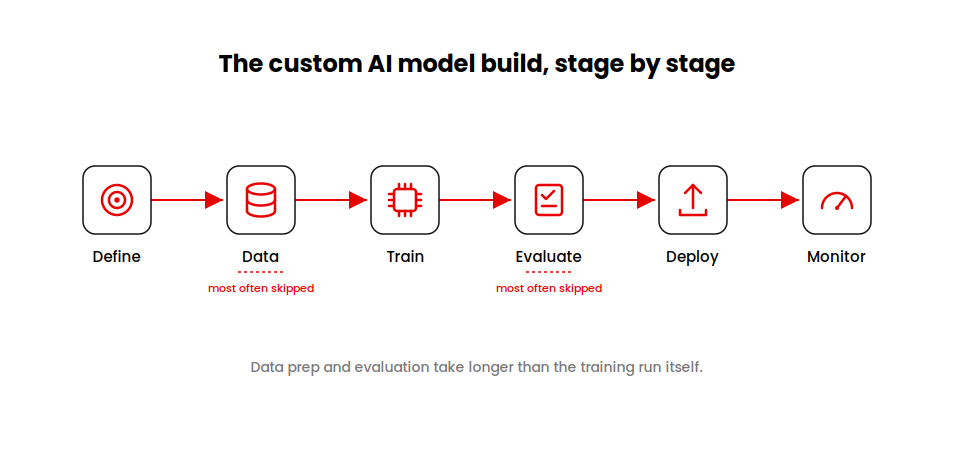
- Define the problem and the metric. Decide what counts as a correct answer before any data work starts.
- Collect and clean the data. This stage runs through the data pipeline work of collecting, labeling, and cleaning examples, and it typically takes longer than training itself.
- Train. Run the actual fine-tuning job or training run on a rented GPU compute, tracked through MLOps tooling for versioning and reproducibility.
- Evaluate. Test against real examples, not only a held-out slice of the training set, and set a bar the model has to clear before anyone calls it done. This model evaluation stage determines whether the build is actually ready to ship.
- Deploy. Once deployed, these models often become part of broader software systems, influencing how teams build, test, maintain, and improve applications. Understanding the role of AI in software development helps organizations integrate AI capabilities into the software lifecycle more effectively.
- Monitor and retrain. Watch for model drift as real usage starts to look different from the training data, and set a retraining schedule before drift becomes visible to users.
What Custom AI Model Development Actually Costs
Real numbers, broken down by build type.
| Build Type | Typical Cost | Typical Timeline | Best Signal |
|---|---|---|---|
| Fine-tuning | $15,000 to $50,000 | 3 to 6 weeks | Off-the-shelf model is close but not accurate enough on a narrow task |
| Domain-specific custom model | $60,000 to $180,000 | 2 to 4 months | Large proprietary dataset, narrow domain, fine-tuning alone plateaus |
| From-scratch build | $250,000 to $1,000,000+ | 6 months or more | Full architecture and data control needed for competitive or regulatory reasons |
These figures cover the build itself: data preparation, training, and initial evaluation. They do not cover ongoing inference cost, monitoring tooling, or retraining, which are separate, recurring line items covered in the next section. For the full cost breakdown of an AI feature beyond the model itself, see what AI app development actually costs.
Not Sure Which Build Type Fits?
A short scoping call will tell you whether you need a fine-tune, a domain-specific model, or something bigger.
Talk to Our AI Team
What Drives the Price Up or Down
A few factors move the price more than anything else.
Data volume and quality. Clean, labeled, representative data is the single biggest cost driver in most model builds, ahead of model size or compute. Data that needs to be fixed mid-project costs more to repair than it would have cost to prepare properly at the start.
Model size and architecture choice. A domain-specific build on a smaller open-weight base model is cheaper to train and to run than a build on a very large base model, and it is often more accurate for a narrow task.
Compute and inference pricing trends. Epoch AI’s 2025 analysis found that the price to reach a fixed level of AI performance fell between 9 times and 900 times per year, depending on the benchmark. That mainly affects inference cost, what you pay per request once the model is live, rather than the one-time training cost. Falling API prices do not automatically make a custom build itself cheaper.
Team composition. A fine-tune can often run with one ML engineer working part time. A from-scratch build needs a dedicated data engineer, an ML engineer, and ongoing MLOps support, and that headcount is usually the largest line item in a from-scratch budget, ahead of compute itself.
Latency and deployment target. A model that needs to respond in under a second, running on-device or at the edge, costs more to optimize than one that can run asynchronously in the cloud with a few seconds of headroom.
Enterprise complexity. Enterprise custom AI model development services typically add compliance review, data governance sign-off, and AI integration on top of the model build itself. Connecting AI models with existing enterprise software, APIs, and workflows often requires additional engineering, which extends both cost and timeline for larger organizations.
How Long It Actually Takes
Fine-tuning is fast. Most fine-tuning projects go from data collection to a working model in three to six weeks, assuming the data is already reasonably clean.
A domain-specific custom model usually takes two to four months. Most of that time goes to data collection, cleaning, and the first few rounds of evaluation. Training itself is comparatively fast.
A from-scratch build takes six months or more, often closer to a year for anything close to production quality, and that estimate assumes the team is already in place on day one. Hiring a data science team from scratch adds months before the build timeline even starts.
Across all three build types, the training run itself is rarely the long pole. Data preparation and evaluation are.
The Mistake I See Most Often
The mistake I see most often is teams budgeting for the training run and skipping the budget for what comes before and after it.
Data readiness gets underestimated almost every time. Teams assume they have enough clean, labeled data because they have a lot of data, and those are two different things. Cleaning and labeling data properly can take longer than training the model itself, and it rarely gets its own line item in the original budget.
Evaluation and monitoring get skipped even more often. A model that scores well on a held-out test set can still behave differently once real users send it real, messy input. Without a monitoring setup and a retraining schedule, model drift shows up as a slow decline in accuracy that nobody notices until a customer complains.
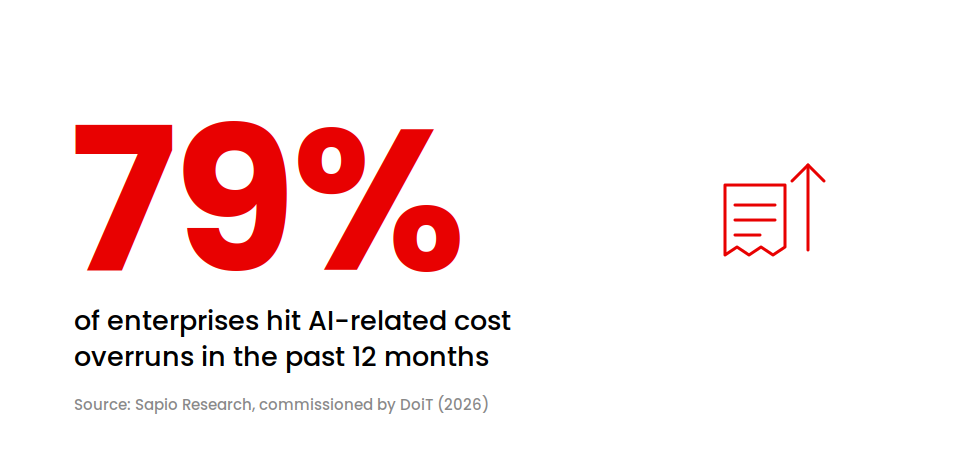
This is a budgeting and planning problem. Planning for it before the project starts fixes most of it. A survey of 500 finance leaders conducted by Sapio Research and commissioned by DoiT found that 79 percent of enterprises experienced AI-related cost overruns in the past 12 months, and only 15 percent could calculate AI return on investment without significant bottlenecks. Underscoped data and evaluation work is a common cause of that kind of overrun.
Building In-House vs. Working With a Custom AI Model Development Company
Building in-house and working with a custom AI model development company are both legitimate paths, and the market has been moving toward the second option.
Menlo Ventures’ 2025 State of Generative AI in the Enterprise report found that the enterprise build-versus-buy mix shifted from roughly 47 percent built and 53 percent bought in 2024 to about 24 percent built and 76 percent bought in 2025. Fewer companies are training and maintaining models fully in-house than a year ago. The specialized skill set required is expensive to hire and hard to retain, which pushes many teams toward a partner.
MIT’s Project NANDA research, covered by Fortune, backs this up from a different angle: purchasing AI tools from specialized vendors and building partnerships succeeded about 67 percent of the time, against roughly one-third of that rate for internal-only builds. A hybrid approach, an internal owner working with an external custom AI model development company, outperforms either extreme on its own.
Getting this choice wrong is not free. A company that builds in-house without the right team in place often ends up paying twice: once for the initial internal attempt, and again for the external custom AI model development company brought in afterward to fix or rebuild it.
If you are about to purchase custom AI model development services, a few things separate a real custom AI model development company from a reseller of the same off-the-shelf API you could call directly:
- They show you evaluation results on your data. Benchmark scores on public datasets do not tell you how a model performs on your specific task.
- They tell you honestly when fine-tuning solves the problem and a from-scratch build does not, even though the larger build type is the bigger line item for them to sell.
- They own the production-hardening stage too: monitoring, guardrails, and drift detection.
Whether you build this capability in-house or bring in a custom AI model development company, the same evaluation questions apply. Ask each provider for a specific, checkable example of a model they have shipped.
Where This Leaves You
Knowing which of the three build types fits your problem gives you most of what you need to set a realistic budget and timeline. Fine-tuning, a domain-specific model, and a from-scratch build are priced and scheduled differently, and matching the build type to the actual gap in your current setup is the decision that determines the rest. If you are still not sure which one fits, that is a normal place to be, and it is a short conversation to sort out.
Ready to Scope Your Build
Bring us the build type and the data you have. We will map out the cost, the timeline, and the first step.
Start With AppVerticals
Keep Reading
Still deciding whether to build at all? Custom AI Development vs. Using an API covers that decision first.