















 ChatGPT
 Perplexity
 Claude
 Google AI
Artificial intelligence is transforming how enterprises operate, but deploying AI successfully is far more difficult than adopting the technology itself. While many organizations launch AI projects with ambitious goals, turning those initiatives into measurable business outcomes is far more difficult.
According to industry research, a significant percentage of enterprise AI projects never move beyond the pilot phase or fail to generate the expected return on investment because the underlying business, technology, and operational foundations are not in place.
This guide covers the biggest AI implementation challenges organizations face, why they prevent AI projects from succeeding, and practical ways to overcome them. You’ll also learn how generative AI and agentic AI are introducing new implementation challenges, explore real-world examples of enterprise AI failures, and follow a framework for building AI initiatives that can scale successfully.
What Are AI Implementation Challenges?
AI implementation challenges are the technical, operational, and organizational obstacles that prevent businesses from successfully deploying, adopting, and scaling artificial intelligence solutions. While building an AI model is important, achieving long-term success depends on much more than the technology itself. Organizations must ensure their data is reliable, their infrastructure can support AI workloads, their teams have the right skills, and governance policies are in place to manage risk and compliance.
These challenges can appear at any stage of an AI initiative. Some organizations struggle to prepare and organize the data needed to train or power AI systems. Others discover that their existing applications and legacy infrastructure cannot integrate with modern AI tools. Even after deployment, poor user adoption, unrealistic expectations, and the lack of a clear business strategy can prevent AI from delivering measurable value.
Why Do Most Enterprise AI Projects Fail to Scale?
Most enterprise AI projects do not fail because the technology is ineffective. They fail because organizations try to scale AI without building the business, technical, and operational foundations required to support it. A pilot may work in a controlled environment, but expanding AI across teams, systems, and workflows introduces new challenges that many companies are unprepared for.
Lack of a Clear Business Strategy
Many organizations adopt AI because competitors are doing it or because leadership expects quick results. Without a clearly defined business problem, measurable objectives, and success metrics, AI initiatives often lose direction and struggle to demonstrate value.
Poor Data Quality and Accessibility
AI models are only as good as the data they rely on. Inconsistent, incomplete, or siloed data leads to inaccurate predictions and unreliable outputs. As AI adoption grows, poor data governance becomes a major barrier to scaling.
Legacy Systems and Integration Challenges
Many enterprises still depend on legacy applications that were never designed to support AI. Integrating modern AI tools with outdated infrastructure can increase costs, slow deployment, and limit the ability to scale solutions across the organization. Understanding how AI is transforming the software development lifecycle can help teams plan better integrations, from AI-assisted coding and testing to building intelligent applications that support business workflows.
This is where AI integration services become valuable. They help organizations connect AI models, automation tools, and intelligent features with existing applications, databases, and business workflows without replacing their entire technology stack.
Skills and Resource Gaps
Building and maintaining enterprise AI requires expertise in data engineering, machine learning, cloud infrastructure, security, and governance. Many organizations lack these capabilities internally, making it difficult to move projects from proof of concept to production.
Weak Governance and Risk Management
As AI becomes part of critical business processes, organizations need clear policies for security, compliance, data privacy, and model oversight. Without governance, AI systems can introduce legal, ethical, and operational risks that slow adoption and reduce stakeholder confidence.
Resistance to Organizational Change
AI implementation is not just a technology initiative. Employees need training, leadership must communicate the value of AI, and workflows often need to be redesigned. Without effective change management, user adoption remains low, preventing AI from delivering meaningful business outcomes.
The Biggest AI Implementation Challenges Enterprises Face

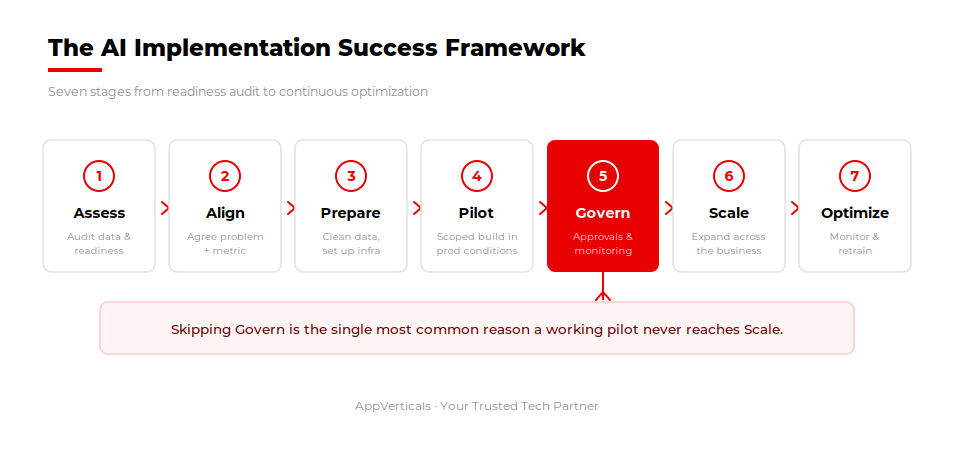
Data quality and readiness. AI systems are only as reliable as the data feeding them. Incomplete records, inconsistent formats, and siloed systems across departments are consistently the top technical obstacle enterprises report.
Integration with legacy systems. Many enterprises run on infrastructure built years or decades before AI was part of the plan. Connecting modern AI tools to those systems without disrupting daily operations takes real engineering work, not a plug in.
Talent gaps. Data science, machine learning engineering, and AI governance are still scarce skill sets. Many teams try to bolt AI initiatives onto staff who already have full time responsibilities elsewhere.
Unclear business objectives. Teams often start with the technology and work backward to a use case, instead of starting with a business problem and asking whether AI is the right tool to solve it.
Governance and risk. Who approves a model before it goes live. Who is accountable if it makes a wrong call. Without clear answers, legal and security teams slow projects down, and rightly so.
Change management and adoption. A model that works perfectly but that employees do not trust or understand will not deliver value. Adoption is a people problem as much as a technical one.
Cost and unclear ROI. Inference costs, infrastructure spend, and ongoing monitoring add up. Without a defined way to measure return, AI investment becomes difficult to justify past the first budget cycle.
How to Overcome AI Implementation Challenges
| Challenge | Practical Solution |
|---|---|
| Poor data quality | Run a data readiness assessment before any AI project starts. Fix quality issues at the source rather than patching them downstream. |
| Legacy system integration | Use API layers and middleware to connect AI tools without a full infrastructure overhaul. Prioritize systems that already expose clean data. |
| Talent shortages | Pair a small internal team with an experienced implementation partner. Build internal skills gradually through hands-on project work. |
| Unclear objectives | Define the business metric the project needs to move before writing a single line of code. |
| Governance gaps | Set up an AI governance committee early, with clear approval steps for any model going into production. |
| Low adoption | Involve end users in design and testing from the start. Train teams on what changes in their daily workflow and why. |
| Unclear ROI | Track cost per outcome, not just cost per model. Tie every AI initiative to a measurable business result. |
How to Build an AI Implementation Roadmap That Scales
A structured framework reduces the guesswork that causes most enterprise AI projects to stall. At AppVerticals, we use a seven stage approach we call the AI Implementation Success Framework.
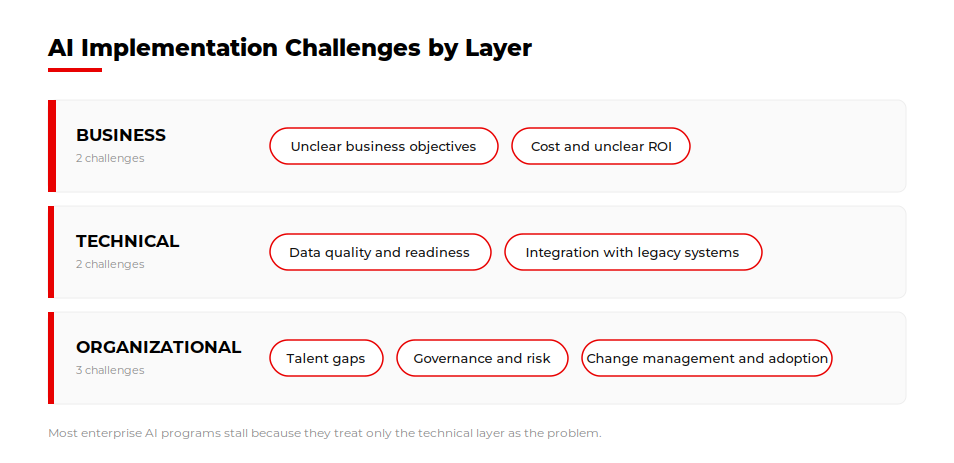
- Assess. Audit current data quality, systems, and AI readiness across the organization before committing to any use case.
- Align. Get business and technical leadership agreeing on the specific problem AI needs to solve and the metric that defines success.
- Prepare. Clean and structure the data, set up the required infrastructure, and put governance guardrails in place before development starts.
- Pilot. Build a small, scoped version of the solution using data and conditions that match production as closely as possible.
- Govern. Establish approval processes, monitoring plans, and accountability before the pilot moves anywhere close to full deployment.
- Scale. Expand the solution across the business function or organization, with the infrastructure and support model built to handle full production load.
- Optimize. Monitor performance continuously, retrain models as data shifts, and refine the system based on real usage patterns.
Skipping the Govern stage is the single most common reason a working pilot never reaches Scale.
Generative AI and Agentic AI Implementation Challenges
Generative AI introduces problems that traditional predictive AI did not have to deal with at the same scale. Outputs can be inaccurate or fabricated, sometimes called hallucinations. Prompts themselves can become a security risk if handled carelessly. Intellectual property questions around training data and outputs remain unsettled in many industries. Inference costs also climb quickly once usage scales across an organization.
Agentic AI raises the stakes further. These are systems that take multi step actions on their own, often without a human reviewing each decision. That autonomy creates three specific risks enterprises need to plan for.
These challenges are becoming increasingly important as organizations move toward agentic AI software development, where AI agents are used to plan, execute, test, and manage complex software workflows with greater autonomy.
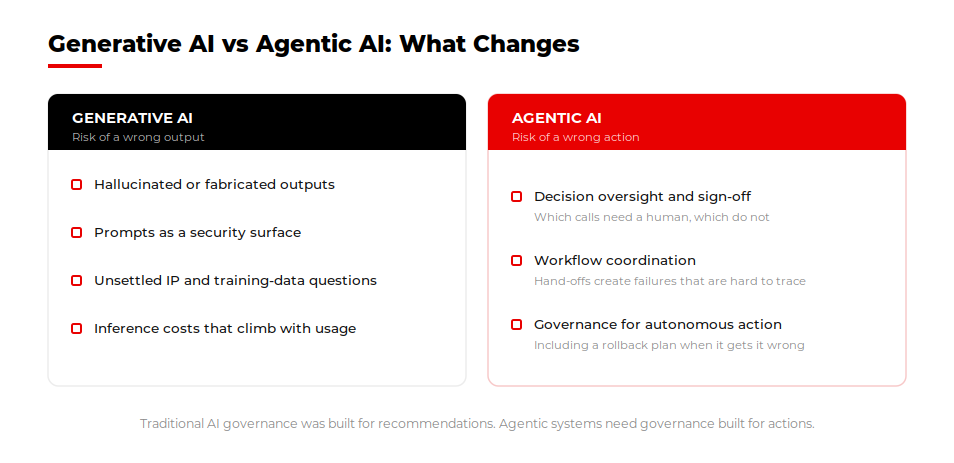
Decision oversight. When an agent can take action rather than just recommend one, someone needs to define exactly which decisions require human sign off and which do not.
Workflow coordination. An agent that hands off tasks to other systems or other agents can create failure points that are hard to trace back to their source.These challenges become even more complex with multi agent AI systems, where multiple specialized AI agents coordinate tasks, share information, and make decisions across connected workflows. Organizations need clear communication protocols, monitoring, and governance frameworks to ensure these systems operate reliably.
Governance for autonomous action. Traditional AI governance was built around models that generate recommendations. Agentic systems need governance built around actions, including rollback plans when an agent gets something wrong.
Looking two to three years ahead, we expect generative AI to move from a content and drafting tool toward a standard layer inside core business workflows, and agentic AI to shift from narrow, single task pilots toward coordinated systems that handle multi step processes with defined human checkpoints. Enterprises that build governance for this now will scale faster than those trying to retrofit it later.
How to Measure AI Implementation Success
A useful AI implementation program tracks more than model accuracy. Watch these categories:
- Business impact metrics. Revenue influenced, cost saved, or time reduced per process.
- Adoption metrics. Percentage of eligible employees actively using the tool, and how that changes over time.
- Quality metrics. Accuracy, error rate, and the frequency of human corrections needed.
- Operational metrics. Uptime, response time, and cost per transaction or per query.
- Risk metrics. Number of governance exceptions, flagged outputs, and incidents requiring escalation.
Tie each metric to a business owner, not just a technical one. A model can hit every technical benchmark and still fail if nobody on the business side is accountable for what it produces.
AI Implementation Best Practices for Long Term Success
Start with a business problem, not a technology. Choose a first use case with a clear, measurable outcome and a realistic path to production. Involve legal, security, and compliance from day one instead of at the end. Invest in data quality before investing in more advanced models. Build change management into the project plan, not as an afterthought. Treat monitoring and retraining as ongoing operational work, not a one time launch task.
5 Biggest AI Implementation Failures
Zillow Offers. Zillow used an algorithm to price and buy homes at scale. When the housing market shifted faster than the model could adapt, the company overpaid for thousands of properties. It shut the business down in November 2021, wrote down over 300 million dollars in inventory, and cut roughly a quarter of its workforce. The lesson is that a model trained on historical patterns needs constant recalibration when the underlying market changes.
IBM Watson for Oncology at MD Anderson. MD Anderson Cancer Center spent roughly 62 million dollars over several years trying to build a Watson powered treatment advisor. The project never made it into patient care and was shelved after the system could not integrate with the hospital’s updated records platform. The lesson is that integration with existing systems has to be solved early, not treated as a detail to figure out later.
Amazon’s AI recruiting tool. Amazon built a resume screening tool trained on a decade of past hiring data. Because the tech industry has historically skewed male, the model learned to favor male candidates and downgrade resumes containing words like “women’s.” The company scrapped the project once it could not guarantee the bias was fully removed. The lesson is that training data carries the biases of the past, and fixing surface symptoms does not fix the underlying pattern.
Air Canada’s chatbot. A customer support chatbot gave a passenger incorrect information about the airline’s bereavement fare policy. When the airline refused to honor what the bot promised, a Canadian tribunal ruled against Air Canada in February 2024, finding the airline responsible for its chatbot’s statements just as it would be for any other customer facing communication. The lesson is that an AI system speaking on behalf of a company carries the same accountability as a human representative.
McDonald’s drive through voice ordering. McDonald’s tested an IBM built voice ordering system across more than 100 restaurants for three years. Viral videos showed the system misunderstanding orders, adding dozens of unwanted items, and failing to process simple corrections. McDonald’s ended the partnership in June 2024. The lesson is that a system needs a reliable way to confirm what it heard before committing to an action, especially in noisy, real world conditions.
Final Thoughts
AI implementation challenges are predictable, and every one of them has a known solution. The organizations that succeed are not the ones with the most advanced model. They are the ones that treat data readiness, governance, and change management as part of the project from day one instead of problems to solve after launch.
Before investing further in AI, take an honest look at your organization’s readiness across data, systems, talent, and governance. A structured implementation approach, built on a clear roadmap rather than a string of disconnected pilots, is what turns AI from an experiment into a measurable business outcome.
Planning Your Next AI Initiative?
See how our AI development services help enterprises overcome implementation challenges and deploy AI solutions built for long term success.
Explore AI Development Services