














 ChatGPT
 Perplexity
 Claude
 Google AI
The benefits of mobile apps for business break down into ten repeatable wins. Each one carries its own price tag. These wins include sharper brand recognition, direct customer communication through push notifications, and stronger loyalty and repeat purchases. A mobile app also delivers richer customer data than a website alone provides.
Knowing the dollar cost of each benefit matters just as much as knowing the benefit itself. That cost detail is what stalls most build decisions at the budget stage. A push notification system sits in the $5,000 to $50,000 build tier. A points-based loyalty program with redemption logic lands between $50,000 and $120,000. AI-driven personalization, the kind that recommends products from browsing history, tends to push a build into six figures.
This guide pairs ten benefits businesses ask about most with the cost tier required to realize each one. It also raises one question worth asking before committing a budget. Is a benefit worth building for, or worth testing first?
Key Takeaways
- Every benefit on this list has a build price. Push notifications start near $5,000. AI-driven personalization starts near $120,000.
- Three tiers cover all ten benefits: simple at $5K to $50K, medium at $50K to $120K, and complex or AI at $120K to $500K+.
- Timelines track the tier. Simple runs 4 to 10 weeks, medium runs 3 to 5 months, complex runs 4 to 8 months.
- Fund two or three benefits and scope the build around those. Chasing all ten at once is how budgets break.
- Personalization is the most common early overcommitment. Ship the category-filter version first and confirm behavior changes before paying for a full recommendation engine.
- A mobile-optimized website delivers several of these benefits for a fraction of the cost. Rule that out before scoping a native build.
What Do These 10 Mobile App Benefits Actually Cost to Build?
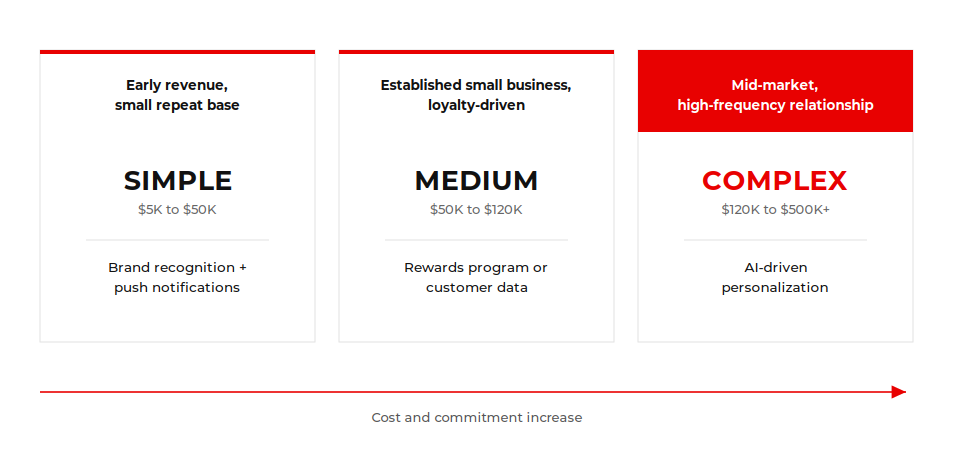
Each mobile app benefit falls into one of three cost tiers.
Simple builds start around $5000. Complex, AI-driven builds pass six figures. The table below maps all ten benefits to their tier.
| Benefit | What it requires | Cost tier | Timeline |
|---|---|---|---|
| Brand recognition | Branded UI, push infrastructure | Simple ($5K–$50K) | 6–10 weeks |
| Push notifications | Notification service, segmentation | Simple ($5K–$50K) | 4–8 weeks |
| Higher engagement | Native UI, offline caching | Simple–Medium ($20K–$70K) | 8–12 weeks |
| Personalized offers | Behavioral tracking, recommendation engine | Complex/AI ($120K–$500K+) | 4–8 months |
| Loyalty program | Points ledger, redemption, payment integration | Medium ($50K–$120K) | 3–5 months |
| Customer data insights | Analytics SDK, dashboard, data pipeline | Medium ($50K–$120K) | 3–4 months |
| Faster customer service | In-app messaging, support-ticket integration | Simple–Medium ($20K–$80K) | 6–10 weeks |
| Competitive edge | Varies: AR, voice, chatbot features | Medium–Complex ($50K–$300K) | Varies |
| Offline access | Local data sync, offline-first architecture | Medium ($50K–$120K) | 3–5 months |
| Revenue lift | In-app payments, checkout flow | Medium ($50K–$120K) | 3–5 months |
They are a good starting point if you’re curious, however, it’s important to map each of them against your scope to get a closer cost estimate.
What Are the Real Benefits of a Mobile App for a Business?
The benefits of mobile apps for business are not limited to customer engagement; they can also support loyalty, data collection, service, and revenue.
This growing focus on mobile experiences reflects a broader market trend. Businesses across industries are increasing mobile investments as app adoption, consumer expectations, and digital engagement continue to rise. The latest global mobile app development market statistics show how this ecosystem is expanding and why companies continue prioritizing mobile platforms.
Every benefit below solves a different business problem. Some require a simple build. Others require months of engineering. Our mobile app development team scopes each tier differently. The right benefit depends on your budget.
Stronger Brand Recognition
A mobile app puts your brand on a customer’s home screen every day.
That kind of repeat visibility is hard to buy through ads alone. A branded app icon, a consistent color scheme, and a short onboarding flow are enough to start. Most businesses see this benefit from a simple build.
Direct Communication Through Push Notifications
Push notifications let a business reach a customer without an email or a text message.
A basic notification setup uses a service like Firebase Cloud Messaging. It handles delivery across iOS, Android, and web from one system. Segmentation, so different customers receive different messages, adds modest scope on top of that base.
Higher Engagement Than a Mobile Website Delivers
A native app removes the friction a mobile browser adds to every visit.
No address bar, no page reload, and an icon a customer taps directly. Offline caching lets core screens load even on a weak connection. Businesses unsure whether that gap is worth the build cost should compare an app against a mobile-optimized website before committing.
Personalized Offers and Recommendations
Personalization uses a customer’s own behavior to decide what they see next.
A basic version filters by category. A full recommendation engine, the kind that learns from browsing history, needs real behavioral data and ongoing tuning. Budget accordingly before promising this benefit to a stakeholder.
A Loyalty or Rewards Program Customers Actually Use
A loyalty program turns a repeat customer into tracked, provable revenue.
Salesforce reports that 63 percent of high-performing marketers already use a loyalty program platform. Adoption is projected to keep climbing. A points ledger, redemption logic, and a payment integration are the core pieces. None of them are simple additions to an existing build.
Customer Data and Behavioral Insights
That data is one of the often-overlooked benefits of mobile apps, giving businesses a clearer view of screen-by-screen navigation, session length, and drop-off points.
Screen-by-screen navigation, session length, and drop-off points all become visible. That data needs an analytics SDK, a dashboard, and a pipeline to move it somewhere useful. Without that infrastructure, the data exists but nobody can act on it.
Better, Faster Customer Service
In-app messaging puts customer support one tap away instead of a phone call.
A support ticket integration connects that chat to whatever system your team already uses. This benefit rarely needs a full rebuild. Most businesses add it to an app that already exists for another benefit on this list.
A Competitive Edge in a Crowded Market
A feature a competitor has not shipped yet is a real, if temporary, edge.
Augmented reality try-on, voice search, and an in-app chatbot are common choices. Cost varies widely because the feature itself drives the number. Scope this benefit last, after the core app is already justified.
Offline Access and Reliability
An app that works without signal keeps a customer inside your product instead of losing them.
Local data sync and an offline-first architecture are what make this possible. Field service, travel, and retail businesses feel this benefit the most. A weak connection should never mean a blank screen.
Revenue Lift From App-Only Purchase Behavior
App users tend to buy more often than website visitors once an app is worth opening.
In-app payments and a streamlined checkout flow are the core requirement. This benefit is the hardest to promise up front, since it depends on which other benefits ship alongside it. Treat it as a compounding return that builds with the other benefits.
What Does a Business App Cost to Get Wrong?

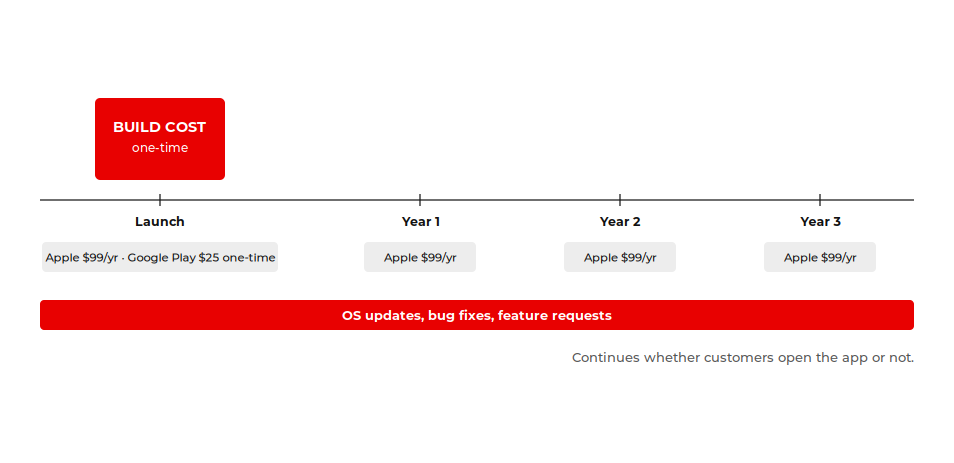
A mobile app that ships without a validated benefit can turn the cost of mobile app development into a recurring expense with no return.
The Apple Developer Program costs 99 dollars a year. Google’s Play Console registration costs 25 dollars once. Neither fee is large on its own. What adds up is the ongoing engineering time. OS compatibility updates, bug fixes, and feature requests continue whether customers open the app or not.
An app store listing stays live whether or not anyone opens it. Every benefit on this list needs a customer willing to open the app more than once. Validate that willingness before committing to the complex tier.
Should You Build a Mobile App Now or Test the Benefit First?
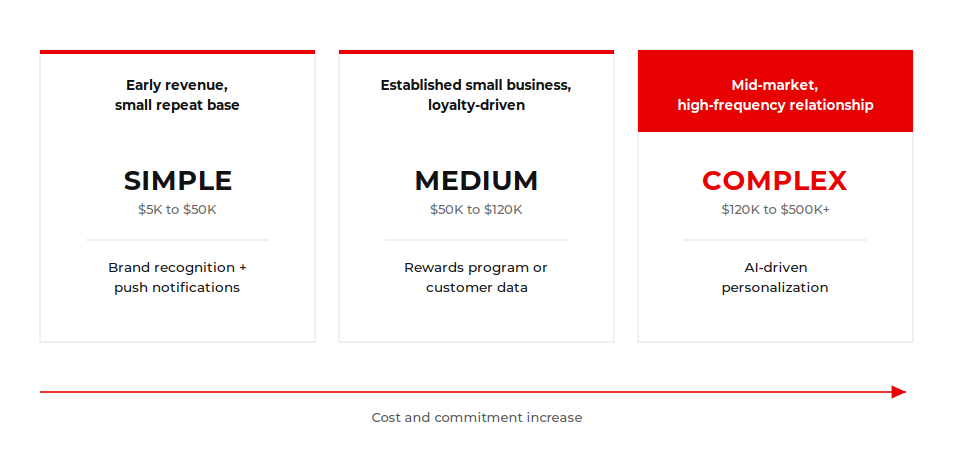
Match your company’s stage to one or two benefits before scoping a full build. Once you have identified the benefits worth funding, an experienced mobile app development partner can translate them into a prioritized feature set, realistic budget and phased delivery roadmap.
An early-revenue business with a small, repeat customer base fits the simple tier best. Brand recognition and push notifications are the two benefits to start with.
An established small business with a loyalty-driven customer base should consider the benefits of mobile apps for small businesses before looking at the medium tier. A rewards program or customer data collection fits well here.
A mid-market business with a proven, high-frequency customer relationship can justify the complex tier. AI-driven personalization fits here.
Before committing to any tier, review the mobile app development process and make sure the scope, timeline, and expected benefit are clear.
Not Sure Which Benefit Fits Your Budget?
Get a scoped range for your build before you commit to a tier.
Use the App Cost CalculatorConclusion
The ten benefits above carry very different price tags to earn. I put the business case on two or three of them instead of all ten at once. Before scoping a native build, confirm one thing first. Can a mobile-optimized website deliver the same benefit already? A website often delivers that same benefit for a fraction of the cost. That single comparison can change your entire budget.
See the Full Mobile App Cost Breakdown
Before you scope a build, see the complete cost guide behind these numbers.
See the Full Mobile App Cost Breakdown →Keep reading: Native vs Cross Platform App Development to understand how your build type changes the cost of the same benefit.