












 ChatGPT
 Perplexity
 Claude
 Google AI
Taking a vibe coded app from prototype to production means keeping the screens and workflows that work, fixing security and backend weaknesses, and rebuilding components that cannot safely support real users or transactions.
Whether you built your prototype using Lovable, Bolt, v0, Replit, Cursor, or Claude Code, you need to understand what is ready for launch before investing further.
Before hiring an MVP development company, I recommend evaluating each component for reuse, repair, or replacement.
In this guide, I’ll explain how to make those decisions, what each AI builder leaves you with, the estimated costs and timelines, and what investors examine during technical due diligence.
Key Takeaways
|
What Prototype to Production Means for a Vibe-Coded MVP
For a vibe-coded MVP, moving from prototype to production means preparing AI-generated software to handle real users, secure transactions, and ongoing operations.
Andrej Karpathy introduced the term vibe coding in February 2025. Software developer Simon Willison later defined it as:
| “building software with an LLM without reviewing the code it writes.” |
While AI tools accelerate early development, production introduces additional requirements for reliability, security, and maintainability.
| Stage | Who uses it | What it needs |
| Prototype | Founders, stakeholders, early testers | Demonstration flows, sample data, concept validation |
| MVP | Real users and pilot customers | Functional workflows, secure data handling, reliable backend |
| Production | Active customers and operations teams | Monitoring, backups, access controls, tested releases, operational support |
For a more detailed comparison, see our POC vs prototype vs MVP guide.
Why Vibe-Coded Prototypes Break Before Launch
Vibe coding to production becomes challenging when applications encounter concurrent users, interrupted transactions, unexpected inputs, and operational failures.
Common weaknesses in AI-generated applications include incomplete workflows, inconsistent code structures, and insufficient error handling. These weaknesses create AI technical debt and increase maintenance costs as the product grows.
The risks of inadequate controls are also visible in AI development tools. In July 2025, Replit’s agent reportedly deleted production data during testing. CEO Amjad Masad told Fortune the incident was:
“Unacceptable and should never be possible.”
Replit subsequently introduced additional database separation safeguards.
Security Gaps Are the First Fix
Security remains a major concern when moving AI-generated applications into production. Veracode’s October 2026 report found that AI-generated code passed security tests only 62% of the time.
The disputed CVE-2025-48757 highlighted database access-control concerns in Lovable-generated applications. This aligns with the OWASP Top 10:2025, which ranks Broken Access Control as its leading risk.
Prioritize server-side authorization, secure credential management, and dependency checks before launch.
For a deeper look at vibe coding security, read our guide to AI-generated code security risks.
Audit the Prototype Before You Change Anything
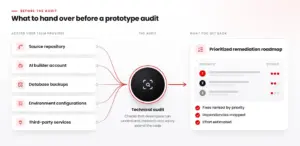
Before starting a technical audit, gather access to the source repository, AI builder account, database backups, environment configurations, and third-party services.
As Simon Willison puts it:
“I won’t commit any code to my repository if I couldn’t explain exactly what it does to somebody else.”
I use this principle to assess whether developers can understand, maintain, and safely extend the existing code. The final deliverable is a prioritized remediation roadmap with dependencies and estimated effort.
For more details, explore our code audit guide.
Keep, Fix or Rebuild: A Component-by-Component Decision Table
The decision to keep, fix, or rebuild depends on whether each component meets the product’s functional, security, and maintainability requirements.
I use the following checks to establish an initial recommendation.
| Component | Keep when | Fix when | Rebuild when |
| UI and screens | Matches validated designs | Missing loading or error states | Business logic mixed into UI |
| User flows | Users completed flows during testing | Navigation, retries, or empty states fail | Flows depend entirely on demo data |
| Sign-in and roles | Platform authentication enforces server-side authorization | Roles are checked only in UI | Custom authentication lacks reliable role controls |
| Data model | Supports relationships and migrations | Needs constraints, indexes, or access policies | Cannot support tenants, history, or relationships |
| Business logic | Runs server-side with tests | Duplicated or untested logic | Browser controls pricing, limits, or permissions |
| Payments and webhooks | Hosted checkout and verified webhooks | Missing idempotency or retry handling | Client controls prices or stores card data |
| Integrations | Official SDKs and server-side credentials | Exposed keys or weak error handling | Integration is mocked or incomplete |
| File storage | Private buckets and signed URLs | Publicly accessible sensitive files | Files depend on local disk or database |
| Hosting and CI/CD | Meets scaling and compliance requirements | Shared environments or missing deployment pipeline | Cannot migrate from builder-specific infrastructure |
| Monitoring and analytics | Reliable events and alerts exist | Incomplete error tracking or visibility | No observability infrastructure exists |
What Lovable, Bolt, v0, Replit, Cursor and Claude Code Leave You With
The handoff requirements for a vibe coded app depend on the builder’s code structure, hosting model, database services, and repository integration.
Here is what I would review when transferring a project to a development team.
| Builder | What you get | Where the code lives | What to check at handoff |
| Lovable | React app with Lovable Cloud or integrated backend services | Lovable project with two-way Git sync | Moving from Lovable to production requires reviewing database policies, secrets, migrations, and deployment requirements. |
| Bolt | JavaScript-based app, Bolt Cloud hosting, Bolt Database or Supabase | Bolt project with GitHub integration | Review database permissions, credentials, deployment dependencies, and infrastructure portability |
| v0 | Next.js, React, TypeScript, Tailwind CSS, and shadcn/ui | v0 project with GitHub integration | Identify Vercel dependencies, environment variables, and server-side services |
| Replit | Full-stack app with checkpoints and database support | Replit workspace with version control integration | Verify environment separation, backup recovery, production permissions, and deployment configuration |
| Cursor | AI-assisted changes to your selected application stack | Your existing project and repository | Review generated modules, dependencies, testing coverage, and architecture consistency |
| Claude Code | Agent-assisted implementation across your chosen stack | Your repository and development environment | Inspect code changes, permissions, automated tests, and release controls |
The capabilities above are described in the vendors’ official documentation: Lovable Git sync, Bolt, v0, Replit checkpoints, Cursor, and Claude Code.
Source code access alone does not guarantee a complete handoff. The team also needs control over production accounts, databases, storage, credentials, and deployment processes.
For more on AI-assisted development workflows, see our guide to vibe coding for mobile app development. For Apple-specific workflows, refer to building an iOS app with Claude Code.
Prototype to Production Timeline and Cost, Stage by Stage
The timeline and cost of taking an AI prototype to production depend on the condition of the existing application and how much engineering work can be preserved.
For an AI prototype to production engagement, AppVerticals uses preliminary scoping ranges to compare recovery options before defining the final project scope.
| Stage | What happens | Estimated timeline | Estimated cost |
| 1. Audit | First-pass technical review and component decisions | 1-2 weeks | $3,000-$8,000 |
| 2a. Stabilize | Access control and backend hardening | 2-5 weeks | $8,000-$20,000 |
| 2b. Security cleanup | Dependency review and supply-chain remediation | 1-3 weeks | $3,000-$10,000 |
| 3a. Targeted rebuild | Replace flagged components while preserving reusable work | 4-10 weeks | $20,000-$60,000 |
| 3b. Full rebuild | Replace the existing application foundation | 3-6+ months | $40,000-$150,000+ |
| 4. Test and launch | Critical-path testing, monitoring, staged deployment | Defined after discovery | Defined after discovery |
Stabilization and security cleanup can run concurrently, while targeted rebuilding and full rebuilding represent alternative approaches. Testing begins during development and continues through deployment.
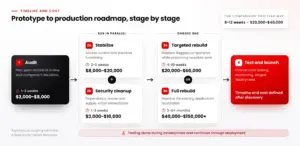
For comparison, a new lean MVP is estimated at $20,000-$40,000 over 8-12 weeks.
These are AppVerticals scoping estimates. A fixed quote follows discovery, once the technical requirements and implementation scope are confirmed.
What Investors Check in a Vibe-Coded MVP
Technical due diligence evaluates whether an application is secure, maintainable, and capable of supporting future development.
Reviewers examine the data model, backup and recovery processes, dependency licenses, test coverage, deployment documentation, and evidence of intellectual property ownership. They also assess whether another engineering team can maintain the application independently.
AppVerticals estimates comprehensive technical due diligence audits at $15,000-$40,000+ over 3-6 weeks, depending on scope.
Prototype to Production in Practice: Rescuing a Half-Built Freight Platform
AppVerticals helped Lulo Freight recover a partially developed freight management platform after a previous development partner left critical functionality incomplete.
The existing application had unfinished pricing logic, carrier workflows, and payment functionality. Our team assessed the architecture, established a shared data foundation, and prioritized load management and operational workflows.
According to our Lulo Freight case study, the completed platform delivered:
- 60% faster quote decisions
- 45% higher fleet utilization
- 70% less manual freight coordination
Although Lulo Freight was not an AI-generated prototype, the project demonstrates how a structured technical assessment can recover valuable development work.
Choosing an MVP Development Company for a Vibe-Coded Rebuild
Choose an MVP development agency with experience in your builder’s technology stack, transparent scoping practices, and established testing and deployment processes.
The team should provide clear deliverables, a fixed quote after discovery, and a post-launch support plan.
Explore AppVerticals’ MVP development services to plan the next stage of your application.
Have a Vibe-Coded Prototype That Needs to Go Live?
We’ll audit what you’ve built, identify what to keep, fix, or rebuild, and provide a fixed quote and timeline for your production MVP.