














 ChatGPT
 Perplexity
 Claude
 Google AI
In 2020, fewer than 25% of new applications were built with low-code or no-code tools. By 2026, Gartner expects that figure to reach 75%, a 3x shift in six years. Whatever you decide for your own product, building this way has already moved from the exception to the default. The rest of this guide is about whether it should be your default.
You have an app idea. You’ve been quoted $80,000 to build it. Then someone at a dinner mentions Bubble, or Webflow, or “just vibe-code it,” and says you can do the whole thing for a couple hundred dollars a month. Now you don’t know who to believe, the quote feels steep, the shortcut feels too good to be true, and you can’t tell which is right.
That confusion is the single most common starting point we see. So this guide does two things at once. First, it lays out what the market data actually says about low-code and no-code. Second, and more importantly, it translates each number into a decision you can actually make: Is this right for my business, at this stage, with my budget?
Key Takeaways
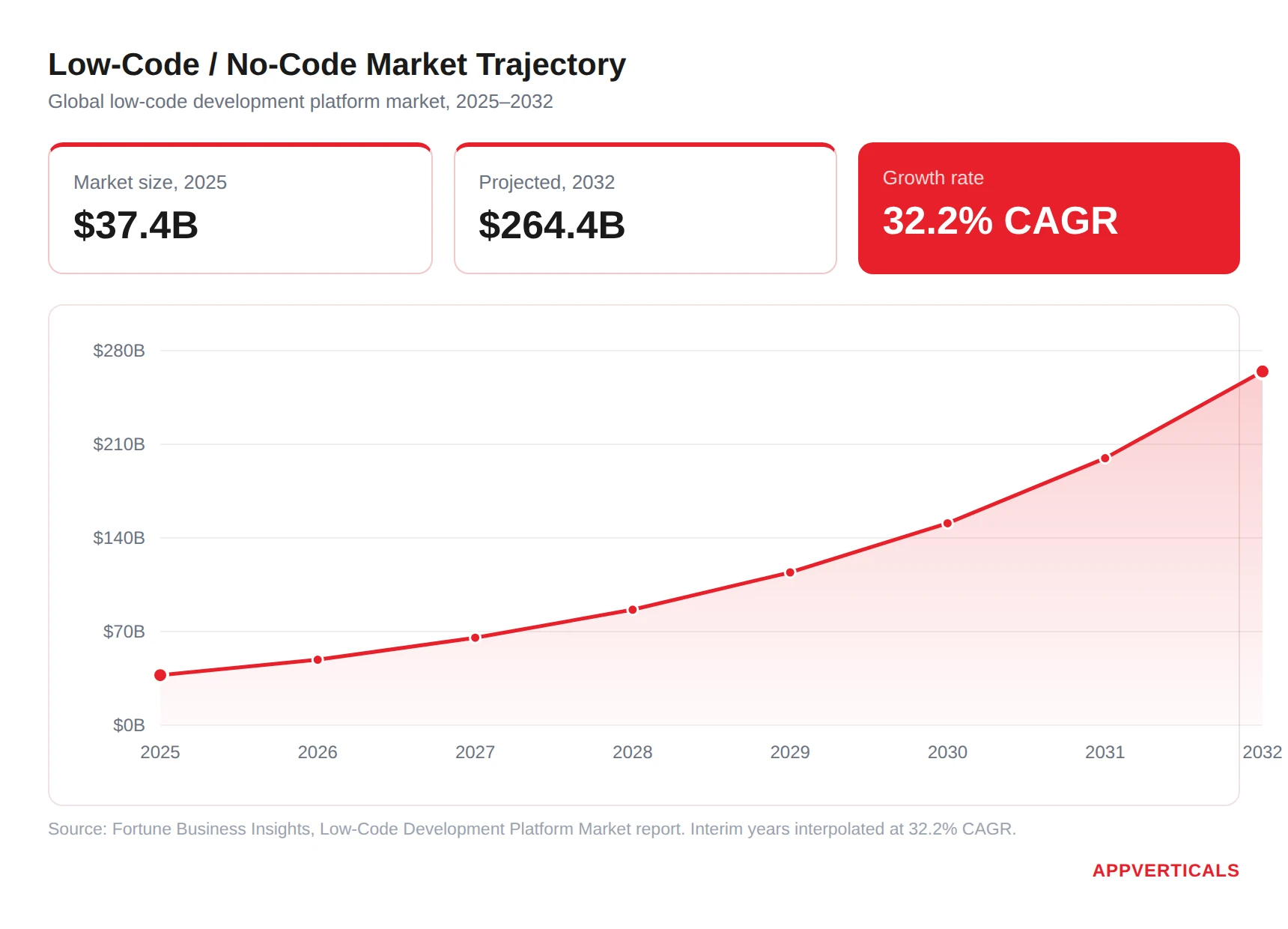
- Market size: The low-code development platform market stood at ~$37.4 billion in 2025, and is projected to hit $264.4 billion by 2032 at a 32.2% CAGR, though estimates vary widely by analyst, this is one of the higher-growth projections.
- Adoption: Gartner projects 70% of new applications would use low-code/no-code by the end of 2025 (up from <25% in 2020), rising to 75% by 2026.
- Speed: Low-code can cut development time by up to 90%; GitHub reports developers completing tasks 55% faster with AI assistance in its own study.
- The honest catch: 40–48% of AI-generated code has been found to contain security vulnerabilities, and a rigorous trial found experienced developers were 19% slower with early-2025 AI tools.
- Main risks founders cite: scalability, vendor lock-in, customization ceilings, and security, explored honestly below.
The State of the Market (Why This Matters Now)
Let’s start with the number everyone quotes. The global low-code development platform market was valued at roughly $37.4 billion in 2025 and is projected to reach $264.4 billion by 2032, growing at a 32.2% compound annual rate.
The bigger story isn’t the dollar figure, it’s the adoption curve. Gartner has repeatedly forecast that 70% of new applications built by organizations would use low-code or no-code technology by 2025, up from less than 25% in 2020, and that this rises to roughly 75% by 2026. That’s one of the fastest enterprise-technology adoption curves on record.
Two more shifts matter for you specifically. Gartner also projects that citizen developers will outnumber professional developers by roughly 4 to 1 at large enterprises, and that about half of all new low-code customers now come from business buyers outside the IT department.
What this means for you: these aren’t fringe tools anymore. The low-code/no-code development has become the default starting point for a large share of new software, which means the operators in your industry are very likely already using them. The question is no longer “is this legitimate?” It’s “where does it fit, and where does it break?”
What Exactly Is the Difference? (No-Code vs. Low-Code vs. Vibe Coding)
These three terms get lumped together constantly, and the differences genuinely matter, in 2026 there are now three approaches in play, not two.
Approach What it is Who it’s for Examples No-Code Zero programming. Pure visual, drag-and-drop. Non-technical founders, solopreneurs, ops teams Bubble, Webflow, Adalo, Glide, Airtable Low-Code Visual-first, but you can drop in custom code. Small dev teams, technical operators Retool, OutSystems, Mendix, WeWeb, Microsoft Power Platform Vibe Coding You describe what you want in plain English; AI writes the actual code. Anyone — but genuinely risky without technical oversight Cursor, Lovable, Bolt, Replit That third row is the 2025–2026 wildcard. The term “vibe coding” was coined by Andrej Karpathy, former Tesla AI director and OpenAI founding engineer, in a February 2025 post on X, describing a way of building where you “fully give in to the vibes, and forget that the code even exists.” It caught on so fast that Collins Dictionary named it Word of the Year for 2025.
The honest one-line summary, which we’ll spend the rest of this article backing up with data: no-code is the fastest to start but hits walls earliest; low-code scales further but needs someone technical; vibe coding is incredibly fast and produces real, portable code, but carries security and maintainability risks that are very well documented by now.The Real Cost Comparison
This is where founders most need a straight answer. Treat these as planning ranges, not quotes, real costs depend on complexity, region, and how much you change your mind mid-build.
Build type Simple app Medium complexity Complex / enterprise Custom development (US/UK) $40K–$80K $80K–$200K $200K–$1M+ Custom development (offshore) $10K–$30K $30K–$80K $80K–$300K No-code platform (DIY) $500–$3K/yr $3K–$12K/yr $12K–$50K/yr No-code agency build $4K–$15K $15K–$50K $50K–$150K Low-code (enterprise tier) $20K–$75K $75K–$250K $250K–$1M+ At the validation stage, the cost case for no-code is hard to argue with, and the reason isn’t just the build price, it’s what you don’t spend. Tara Reed built her art-recommendation startup Kollecto on Bubble with no code at all, and reported keeping operational costs under $600/month for the first six months while validating the idea, eventually generating around $30K in early revenue and getting into 500 Startups, all before writing a line of code. Marlow’s founder, Mary, reported launching her coaching platform on Bubble for roughly $79/month plus about $200/month in supporting tools like Zapier and Mailchimp.
The hidden-cost truth worth underlining: platform subscriptions compound: An app that costs $29/month at launch can cost $500+/month at scale once you hit workload-based pricing (Bubble) or per-seat pricing traps. The discipline that separates founders who win with no-code from those who get burned: model your three-year cost at 10x your current usage, not your month-one bill.What this means for you: for MVP validation and early traction, the math favors no-code decisively. The math changes at scale where custom software development usually pays off, and the entire point of reading a guide like this is to know that in advance so the change doesn’t ambush you.Speed, Productivity & ROI: And the Honest Counterpoint
The speed numbers are real and they’re the strongest argument for these tools:
- Low-code/no-code can reduce development time by up to 90%.
- In GitHub’s own study of ~4,800 developers, those using Copilot completed tasks 55% faster.
- A Forrester Total Economic Impact study commissioned by Microsoft modeled a 206% ROI over three years for a composite organization using Power Apps (a later, broader Power Platform TEI modeled 224%).
There’s an important counterpoint, though, because faster feels and faster is not always the same thing. In a rigorous randomized controlled trial by METR, 16 experienced open-source developers worked through 246 real tasks. They predicted AI tools would make them 24% faster. They believed afterward they’d been about 20% faster. In reality, they were 19% slower when allowed to use early-2025 AI tools, METR has since said it’s re-running the study on newer tools.
Two honest readings of that, taken together: the productivity gains are most reliable for simple, repetitive, well-scoped work (the exact sweet spot these tools were built for), and the “speed” of AI-assisted building can be partly perceptual, real on greenfield prototypes, much shakier on mature, complex systems.
What this means for you: if you have limited runway, three months to a launchable MVP versus nine is the difference between finding product-market fit and running out of cash. That’s a genuine reason to start fast. Just don’t assume the same speed multiplier holds once your product is real, complex, and carrying users.Adoption by Industry: Is Your Sector Already Using It?
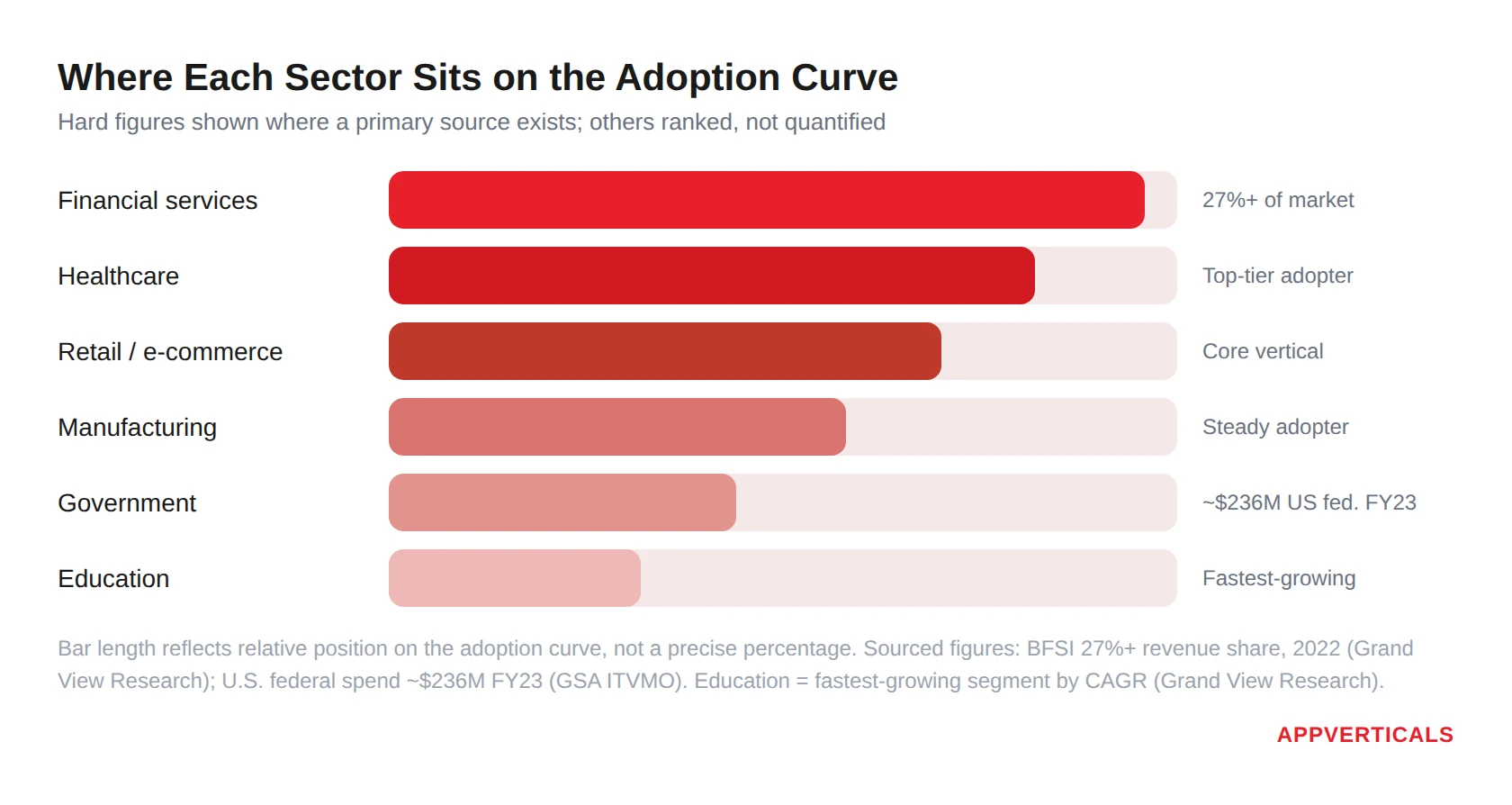
Adoption is uneven, and knowing where your sector sits tells you how much validation, and how many ready-made integrations and templates, already exist around you. The reliable signal here isn’t a precise “X% of your industry uses it” number (those float around a lot and rarely trace to a real source); it’s which sectors the analyst firms and the actual spending data consistently put at the front of the line. On that, the sources agree.
Grand View Research found that banking, financial services, and insurance (BFSI) was the single largest slice of the low-code market with over 27% of revenue in 2022, driven by client onboarding, back-office automation, and self-service tools.
MarketsandMarkets independently reaches the same conclusion: BFSI is the heaviest user and is projected to grow at the fastest rate, because these firms generate enormous volumes of data and constantly ship new products.
Here’s how the sectors line up, with what each is actually using these tools for:
Sector What the evidence shows Financial services (BFSI) The largest market segment, 27% of low-code revenue in 2022, and forecast to grow fastest. Used for client onboarding, loan origination, KYC, and customer portals. Healthcare Consistently ranked a top adopter; one health system reported building 80 clinical use cases in 12 months on low-code. Common uses include scheduling, reporting dashboards, and patient-intake forms within HIPAA constraints. Retail / e-commerce A core vertical across analyst segmentation; used for storefronts, inventory, point-of-sale, and marketing automation. Manufacturing A consistently named adopter, using low-code for process automation, quality-control apps, and IoT/operations dashboards. Government / public sector Slower adoption due to procurement and security rules, but growing: U.S. federal low-code/no-code spend reached ~$236M in FY2023 and has roughly doubled in four years. The Department of Defense alone accounted for ~$76M. Education Smaller today but one of the fastest-growing segments by CAGR (24%+). Emerging as a key vertical for low-code adoption in administration, learning tools, and student management systems. The Honest Risks with Low-Code/No-Code Development (What Nobody Tells You)
None of what follows is an argument against no-code, it’s the set of things to plan around so you use it deliberately instead of blindly.
Risk Who it affects most How to de-risk Scalability Consumer apps expecting fast user growth Load-test early at 10x your current usage; know your ceiling before users find it. Vendor lock-in Long-term products on a single platform Favor platforms that export clean code; write down an exit plan before committing. Pricing Apps with per-user or workload-based fees at scale Model the 3-year cost at 10x users, not the month-one bill. Customization ceiling Products where the software is the advantage If your edge is in the software, plan to move core logic to custom code eventually. Security Anything handling payments, health, or personal data Verify SOC 2 / HIPAA / GDPR before building; have an engineer review before launch. Risk 1: Scalability
No-code apps can slow noticeably at scale, and the manual processes propping up an MVP are often what break first. Kollecto is the textbook case: Tara Reed wrote that the model “began to fall apart” at around 1,500 monthly active users, not because Bubble itself collapsed, but because the human-in-the-loop steps behind it couldn’t scale.
Load-test early; find your ceiling before your users do.
Risk 2: Vendor lock-in
Rebuilding a maturing no-code app on custom infrastructure is a real, budgeted project, not a quick weekend fix. Platforms that export clean code (Webflow and others) reduce this risk; platforms that don’t, increase it.
Before you commit, model the worst case: what’s your exit plan if this platform doubles its price or shuts down in three years?
Risk 3: The pricing trap
Per-user pricing is fine for an internal tool and potentially catastrophic for a consumer app at scale; workload-based pricing can balloon unpredictably. Model costs at 10x your current users before choosing a platform.
Risk 4: Customization ceilings
If your competitive advantage is the software, a novel algorithm, a real-time system, deep custom logic, you will likely outgrow no-code eventually. If the software merely supports your business (a booking tool for a service company, an internal dashboard), no-code is usually enough indefinitely.
Risk 5: Security (the 2026 headline risk)
This is where vibe coding has produced well-documented failures:
- In a May 2025 study, 170 of 1,645 sampled Lovable-built apps (about 1 in 10) were leaking user data through the same class of misconfiguration, missing database row-level security, later assigned.
- An October 2025 scan by Escape.tech of ~5,600 vibe-coded apps found over 2,000 high-impact vulnerabilities, 400+ exposed secrets (API keys, tokens), and 175 instances of exposed personal data.
- One documented case, Moltbook, exposed roughly 1.5 million API keys due to missing row-level security; a separate February 2026 Lovable-built EdTech app exposed roughly 18,000 users, including thousands of student accounts.
- Across studies, roughly 40–48% of AI-generated code has been found to contain security flaws.
No-code and low-code platforms also vary enormously in formal compliance (SOC 2, HIPAA, GDPR). Therefore, it is important to verify the platform’s compliance posture before you build a single screen that touches sensitive data.
WHAT THE EXPERTS SAY: Tim Buckley, RFID executive with 15+ years in the field, on whether compliance kills low-code: he reported “no issues with DoD and government protocols so far” with their no-code/low-code stack, citing single sign-on, multi-factor authentication, and audit logging, with controls built so that formal certification is “an audit rather than a re-architecture.”The takeaway for founders: compliance is achievable on these platforms, if you choose and configure them deliberately. The failures above were almost all misconfiguration, not platform impossibility.
Real-World Proof: What Has Actually Been Built
Serious businesses build this way every day. A few concrete, sourced examples:
Kollecto by Tara Reed: non-technical founder, built the MVP and the art-matching logic on Bubble; ~$30K early revenue, into 500 Startups, all no-code, and then hit a scaling wall around 1,500 MAU.
Teal by David Fano: the “digital career companion” raised $5 million (investors including Flybridge) while building on a no-code stack with Bubble, specifically so the whole team, not just engineers, could iterate on the product.
Marlow by Mary Fox: built on Bubble for ~$79/month, pivoted from direct-to-consumer to organizational coaching based on user feedback after roughly 10 iteration cycles, proving the “narrow scope, quick launch, real users, then iterate” playbook.
Y Combinator, Winter 2025: YC CEO Garry Tan revealed that for about 25% of the batch, ~95% of the code was AI-generated. Crucial nuance YC stressed: these were highly technical founders who chose AI, not non-technical people outsourcing to a black box, and ~80% of the batch were building AI products.
What this means for you: the question stopped being whether serious businesses build this way. It’s whether it fits your business model, timeline, and complexity, and what your migration plan is when it works.
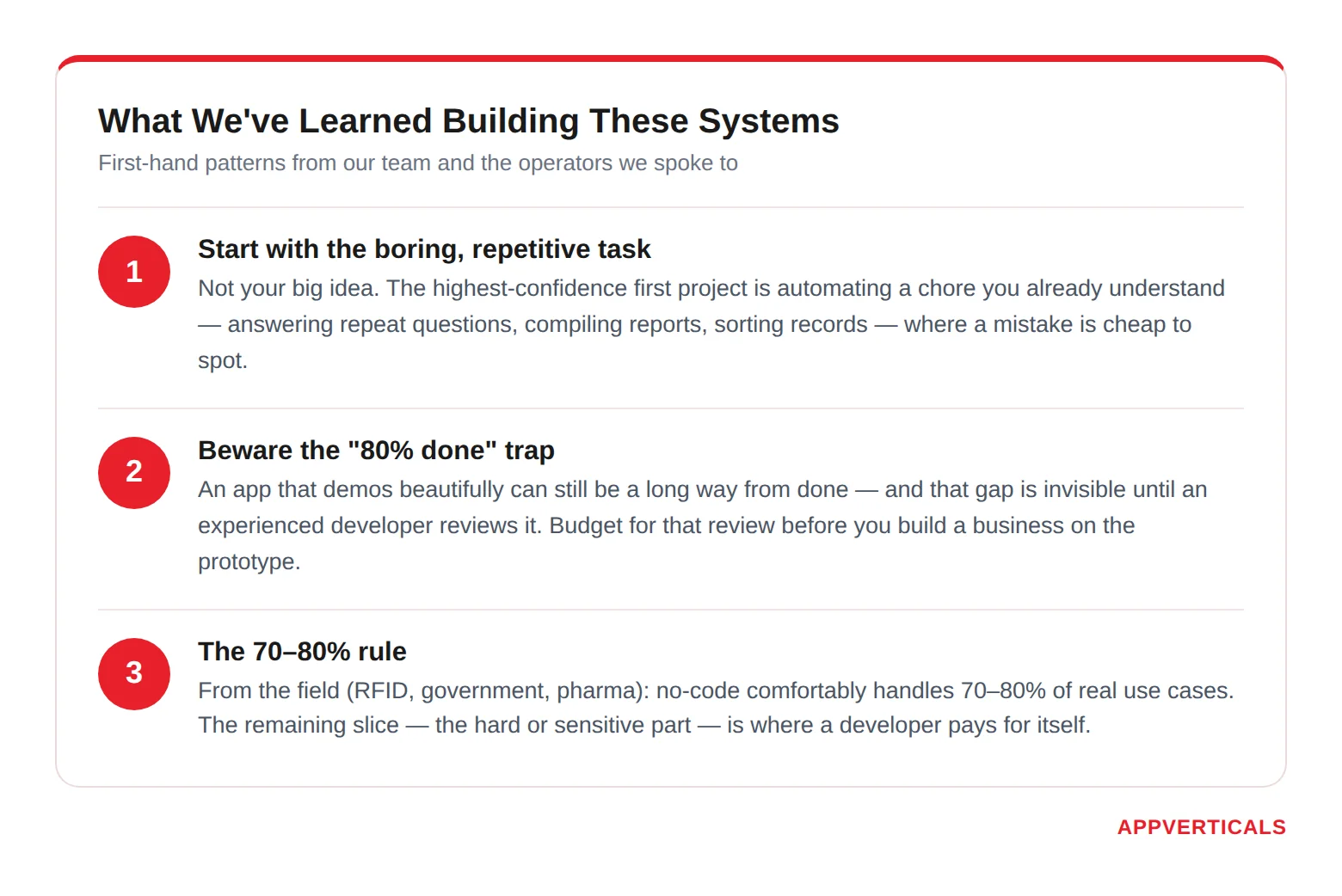
What We’ve Learned Building These Systems Firsthand
Here’s what actually plays out when founders and business owners bring these tools to us, patterns you can apply before you spend anything.
- The best first project is almost never your big idea, it’s the boring, repetitive task eating your team’s time. Our team has built several internal systems using low-code and no-code tools, and the lesson lines up exactly with the market data: these tools pay off most when they automate repetitive work, not when they try to be your flagship product. A few of the things we’ve automated this way:
- An internal help assistant that answers staff questions instantly by pulling from our own documentation, so people stop interrupting each other for the same answers, and we can see which documents are missing or unclear.
- A financial summary tool that gathers spending and expense data on a schedule and emails leadership a plain-English read on profit, burn rate, and where the money is going, work that used to mean someone manually assembling a spreadsheet.
- An intake-and-sorting system that automatically captures incoming records and files them into the right place, so nothing gets lost and no one has to sort entries by hand.
Notice what these have in common: none is a product we sell. They’re internal chores, answering repeat questions, compiling reports, sorting records that used to swallow hours. If you’re a founder or business owner, this is the highest-confidence place to start: point these tools at a repetitive task you already understand, where a mistake is cheap and easy to spot. That’s the use case the adoption data rewards, and it’s where you’ll feel the value fastest.
- The “80% done” trap, the most expensive misunderstanding we see. This one is worth slowing down on, because it costs founders real money and time. A pattern we run into often: someone arrives with an app they built (or had built) using a no-code tool or AI “vibe coding,” convinced it’s about 80% finished and just needs us to “wrap it up.”
When our team looks under the hood, the work is disorganized and hard to follow, and the genuinely time-consuming part is the review needed before anyone can safely build on top of it. Founders are understandably frustrated: the app looks finished, so it’s fair to ask why it isn’t.
Here’s the honest version, and the thing to internalize before you start: an app that demos beautifully can still be a long way from done, and that gap is mostly invisible until an experienced developer inspects it. It’s the same reason the security failures we discussed earlier kept slipping through: everything works in the obvious path, and the problems only show up when someone goes looking.
If you build a prototype this way (a smart move for testing an idea), budget time and money for a proper review before you treat it as the foundation of a real business. Plan for that step and it’s a minor line item; discover it after launch and it’s a crisis.
- From the field: even serious, regulated industries are using these tools, selectively. We also spoke with Tim Buckley, an executive with 15+ years in RFID (the tracking technology behind things like cold-chain and pharmaceutical logistics), about where these tools fit in demanding, hardware-heavy enterprise work. A few things he told us that should reassure, and guide, a cautious founder:
Customers rarely ask for low-code by name. As he put it, “it is typically something we present as a viable solution to save costs”, and more clients are warming to it as awareness grows.
On where the line sits, he was specific: “no-code applications will adequately handle 70–80% of the RFID use cases across all verticals,” with only the most demanding, high-volume, complex projects needing fully custom development.
His team deliberately runs a hybrid setup, their own proven tools handling the specialized parts, combined with no-code platforms for the rest, because, in his words, “an important part is knowing how the system works.”
And on compliance, which scares off a lot of founders in regulated spaces, he reported “no issues with DoD and government protocols so far,” with the right security controls (single sign-on, multi-factor authentication, audit logging) and certification treated as a checkbox rather than a rebuild.
That 70–80% figure, coming from someone deploying this in security-sensitive government and pharma settings, is the most useful rule of thumb: these tools comfortably handle the majority of what most businesses need, and the remaining slice, the genuinely hard or sensitive part, is where bringing in a developer pays for itself.
The 2026 Wildcard: Vibe Coding and What It Actually Changes
Vibe coding is recent enough that a lot of advice predates it entirely. Here’s the current picture for any founder trying to make sense of the term:
The term went from a February 2025 tweet to Collins’ Word of the Year in nine months.
AI coding adoption is near-universal among developers: 84% use or plan to use AI tools (Stack Overflow 2025), and 51% use them daily.
GitHub reports its Copilot assistant now generates ~46% of the code written by developers using it, and Gartner projects AI will generate ~60% of all code by the end of the period.
The honest take for founders: Vibe coding gives you no-code-like speed but outputs actual code, so you avoid platform lock-in. That’s its real advantage over no-code. But the security risk is not theoretical (see the Lovable, Moltbook, and Escape.tech data above), and the METR trial shows AI doesn’t reliably speed up experienced developers on complex, mature work.The emerging smart path is hybrid: no-code or vibe coding for the front-end MVP, then custom development for the backend and security-critical components when it matters. This is essentially what YC’s “highly technical founders using AI” are doing, and what Tim Buckley described doing with RFID.
Bottom line: vibe coding isn’t replacing no-code or custom development, it’s a third option sitting alongside them, strongest in technical hands and dangerous in unprepared ones.
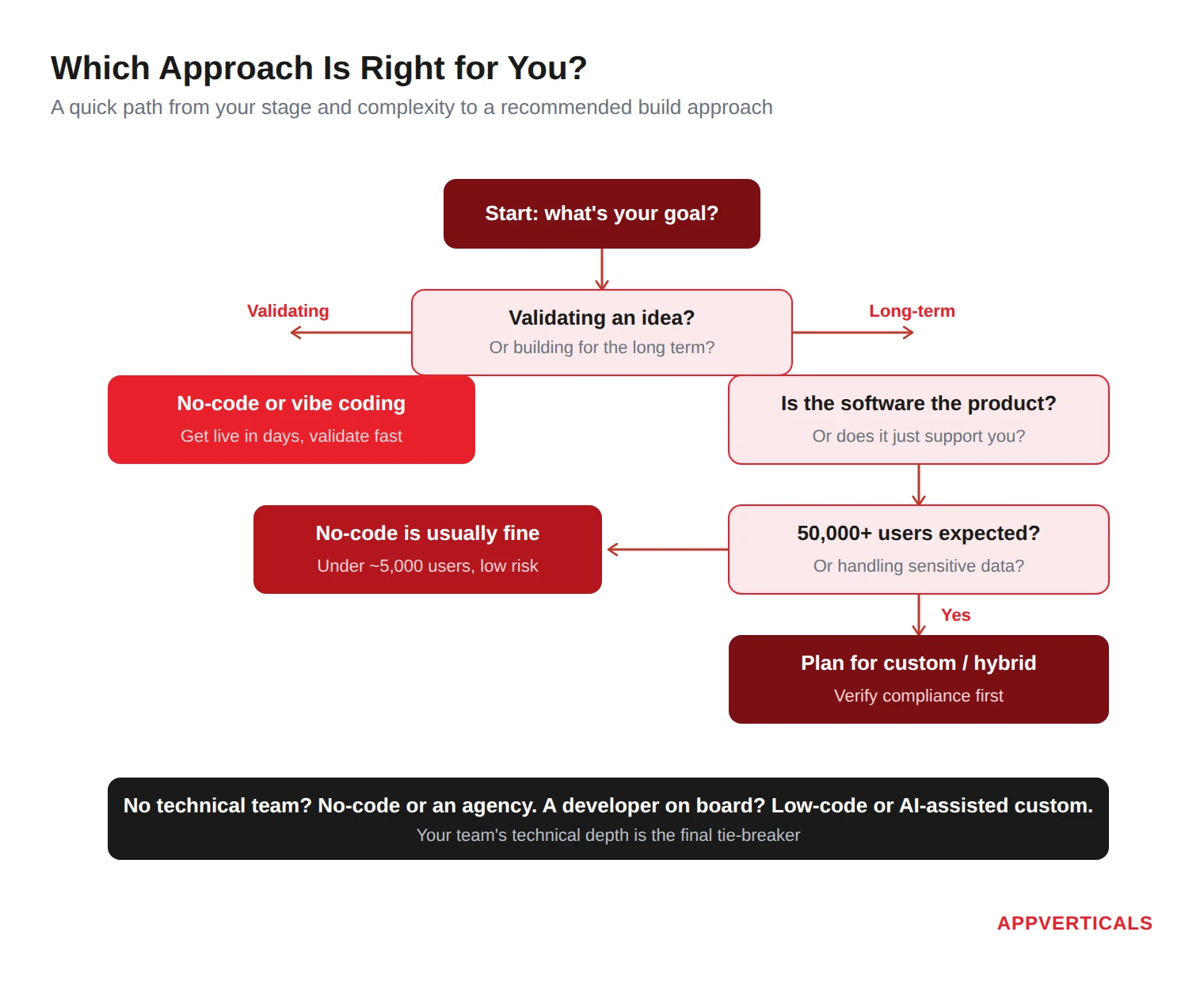
The Decision Framework: Which Approach Is Right for You?
Five questions. Answer them honestly and you’ll know which category to explore.
- Are you validating an idea, or building a long-term product?
- Validating → no-code or vibe coding; get live in days.
- Long-term → think hard about scale before committing to any one platform.
- Is your competitive advantage in the software, or supported by it?
- Supported by it (a booking app for your service business) → no-code is usually fine, possibly forever.
- The software is the product (a novel algorithm, real-time engine) → you’ll likely need custom code eventually.
- How many users do you expect in Year 2?
- Under ~5,000 → no-code handles most use cases.
- ~5,000–50,000 → low-code or hybrid; test performance early.
- 50,000+ → plan a migration path; no-code may become a ceiling.
- Do you handle sensitive data (payments, health, legal, financial)?
- Yes → verify SOC 2 / HIPAA / GDPR compliance before building anything.
- No → standard platform security is usually sufficient.
- Do you have technical resources on your team?
- None → no-code or a no-code agency (avoid low-code; it needs maintenance).
- Some → low-code or vibe coding with oversight.
- A developer on the team → low-code or AI-assisted custom development (the 2026 optimal).
This framework tells you which category fits.
Choosing the right platform, or knowing when to bring in engineers to review a vibe-coded build before it reaches users, is the next decision.
Conclusion
The market trajectory is not ambiguous: low-code, no-code, and now AI-assisted “vibe” development are all growing fast and are already the default starting point for a large share of new software. But the right tool depends entirely on your stage, your complexity, and your goals.
The smartest founders in 2026 aren’t arguing “no-code vs. custom.” They’re asking two sharper questions: What’s the fastest, cheapest way to validate this idea? And what’s my migration plan when it works? Get those two right, plan for the ceilings before you hit them, and the statistics in this article stop being background noise and start working as a map.
Zain is an enterprise strategist specializing in digital transformation and technology investment decisions. With nearly 18 years of experience advising startups, enterprises, and public sector organizations on technology strategy, he currently serves as Chief Strategy Officer at AppVerticals, guiding legacy modernization, build versus buy decisions, and outsourcing strategy for organizations from Fortune 500 companies to early stage startups.