













 ChatGPT
 Perplexity
 Claude
 Google AI
Trucking dispatch software assigns loads to trucks and drivers, tracks each load live, and moves the rate confirmation, proof of delivery, and invoice through one system. Carriers, freight brokers, third-party logistics providers (3PLs), and owner-operators use it to replace the whiteboard, the spreadsheet, and the phone calls that hold a dispatch desk together.
I have led requirements gathering, stack evaluation, and cost estimation on more than 30 software projects. When a fleet owner asks me about truck dispatch software, the real decision is whether to subscribe to an existing product or build one.
This guide covers what dispatch software does, the features small fleets and growing carriers need, the ELD, HOS, and IFTA rules it has to respect, published 2026 prices, and when a custom build pays off. It closes with a five-step build plan and a freight platform we rebuilt at AppVerticals.
“Subscribe while your dispatch work looks like everyone else’s. Build when the software becomes part of how you earn money.”
Key Takeaways
- Dispatch software runs each load from intake to invoice. A TMS adds planning and accounting, and an ELD records driving hours.
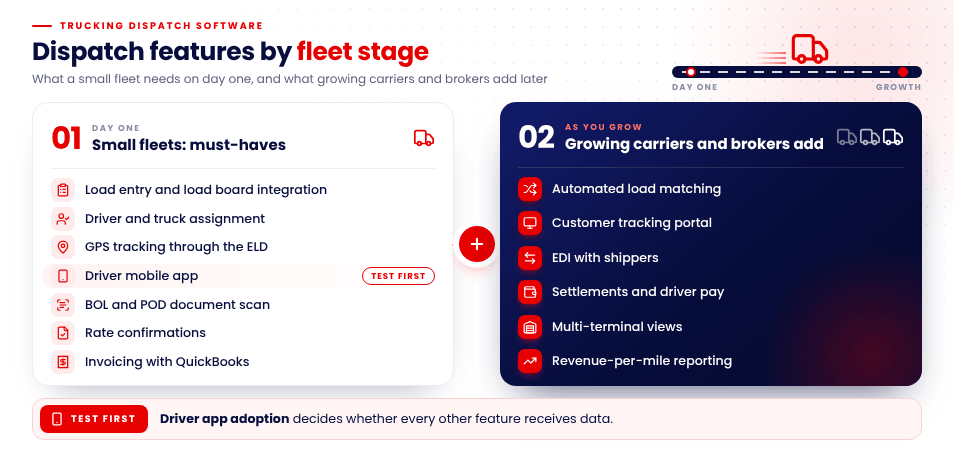
- Small fleets need load entry, load board integration, assignment, GPS tracking through the ELD, a driver app with document scan, and QuickBooks invoicing.
- Growing carriers and brokers add automated load matching, customer tracking portals, EDI with shippers, settlements, and revenue-per-mile reporting.
- Dispatch should show each driver’s remaining hours of service before a load is assigned, using the FMCSA 11-hour and 14-hour limits.
- Published 2026 prices start at $25 a month for a flat small-fleet plan, and DAT One load board plans cost $59 to $339 a month on top.
- AppVerticals prices a fleet platform with dispatch, routing, and ELD integration at $80,000 to $150,000.
- Build custom for specialized freight, deep shipper or ERP integrations, fees that grow faster than revenue, or a plan to sell dispatch software to carriers.
What Trucking Dispatch Software Does
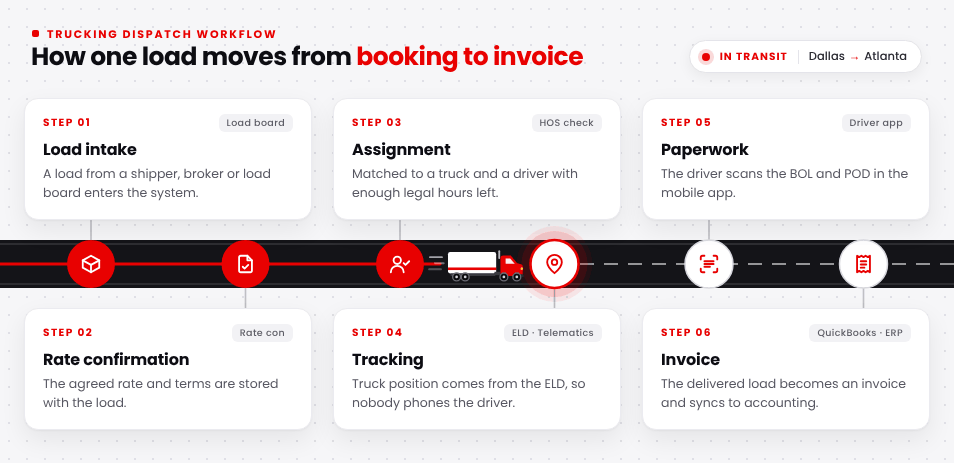
Trucking dispatch software moves each load through six steps, from the moment a load is booked to the moment the invoice goes out.
This is the workflow I map with every fleet before we talk about features or price:
- Load intake: the dispatcher enters a load from a shipper, a broker, or a load board.
- Rate confirmation: the agreed rate and terms are stored with the load.
- Assignment: the dispatcher matches the load to a truck and a driver with enough legal hours left.
- Tracking: truck position comes from the electronic logging device (ELD) or telematics unit, so nobody phones the driver for updates.
- Paperwork: the driver scans the bill of lading (BOL) and the proof of delivery (POD) in a mobile app.
- Invoice: the delivered load becomes an invoice and syncs to the accounting system.
Buyers mix up three product categories, so we separate them early in every scoping call. A good truck dispatch software setup uses all three, each for its own job.
| Product | What it does | Example products |
|---|---|---|
| Dispatch software | Creates and assigns loads, tracks them, and moves documents and billing. | Dispatch modules in TruckingOffice and Truckbase |
| Transportation management system (TMS) | Adds planning, rating, carrier management, accounting, and reporting around dispatch. | TruckingOffice and Truckbase, both sold as trucking TMS products |
| ELD and telematics | Records hours of service, engine data, and GPS position from the truck. | Motive, Samsara |
| Load board | Marketplace where carriers find loads and brokers post them. | DAT One, Truckstop |
Dispatch is the daily operating layer inside a TMS. Our guide to the logistics management system shows how a TMS fits inside a wider logistics platform.
Three groups buy dispatch software:
- Asset-based carriers that own trucks and employ drivers.
- Freight brokers and 3PLs that move loads on other carriers’ trucks.
- Owner-operators who dispatch themselves or pay an outside dispatcher.
Most of these buyers are small. FMCSA counted 2,132,868 active motor carriers in its September 25, 2026, registration snapshot, and the American Trucking Associations reports that over 99 percent of trucking companies operate 100 trucks or fewer. That explains why small-fleet plans start at low monthly prices.
Key Features of Trucking Dispatch Software
The core features of trucking dispatch software are load entry, load board integration, driver and truck assignment, GPS tracking, a driver mobile app, document capture, invoicing, and reporting.
Every vendor of dispatch management software organizes features differently, so I sort them by fleet stage: what a small fleet needs on day one and what growing carriers and brokers add later.
Must-Have Features for Small Fleets
Dispatch software for trucking at the small-fleet stage has to handle seven jobs without workarounds.
| Feature | What it does on the dispatch desk |
|---|---|
| Load entry and load board integration | Creates loads by hand or pulls them from DAT and Truckstop |
| Driver and truck assignment | Matches each load to an available truck, trailer, and driver |
| GPS tracking through the ELD | Shows truck position from the ELD already installed in the cab |
| Driver mobile app | Sends load details to the driver and collects status updates |
| Document scan | Captures the BOL and POD with the phone camera |
| Rate confirmations | Stores the agreed rate, accessorials, and terms with the load |
| Invoicing with QuickBooks | Turns a delivered load into an invoice and syncs it to QuickBooks Online |
Test the driver app before you sign anything. If drivers abandon it at a truck stop with a weak signal, the dispatcher goes back to phone calls, and the rest of the system stops receiving data.
What Growing Carriers and Brokers Add
Freight dispatch software for larger carriers, brokers, and 3PLs adds automation and customer-facing tools in addition to the basics.
- Automated load matching: suggests a truck and driver for each load based on location, equipment, and remaining hours.
- Customer tracking portal: lets shippers check load status without calling dispatch.
- EDI with shippers: exchanges tenders, status updates, and invoices through electronic data interchange (EDI), a standard format that large shippers use for business documents.
- Settlements and driver pay: calculates pay per mile, per load, or as a percentage of revenue, with deductions.
- Multi-terminal views: lets each terminal dispatch its own trucks while managers see the whole network.
- Revenue-per-mile reporting: shows which lanes, customers, and trucks make money.
Brokers also need carrier onboarding and rate management, which we cover in our list of freight management system features.
Revenue-per-mile reporting is where margin shows up. ATRI’s July 2026 operational cost report puts the average cost to run a truck in 2025 at $2.336 per mile, up 3.4 percent and the highest in the report’s history. A carrier that cannot see revenue per mile by lane cannot see which loads are losing money.
ELD, HOS, and IFTA Compliance in Dispatch Software
Dispatch software has to respect three sets of rules: the FMCSA ELD rule, the hours-of-service (HOS) limits, and IFTA fuel tax reporting.
ELD Rule
The FMCSA ELD rule requires most drivers who keep records of duty status to log them on a certified, registered ELD. Exceptions include short-haul drivers on timecards, drivers who keep logs 8 days or fewer in any 30-day period, and vehicles made before model year 2000.
FMCSA also removes noncompliant devices from its registered list. It revoked devices in May, June, July, and August 2026, and carriers get up to 60 days to replace a revoked ELD. I add an alert to dispatch that flags any truck whose device loses registration.
Hours of Service
The HOS rules for property-carrying drivers set four limits that dispatch has to check:
| Rule | Limit |
|---|---|
| Driving limit | 11 hours of driving after 10 consecutive hours off duty |
| On-duty window | No driving after the 14th consecutive hour after coming on duty |
| Break | 30 minutes after 8 cumulative hours of driving |
| Weekly limit | 60 hours in 7 days or 70 hours in 8 days, reset by 34 consecutive hours off duty |
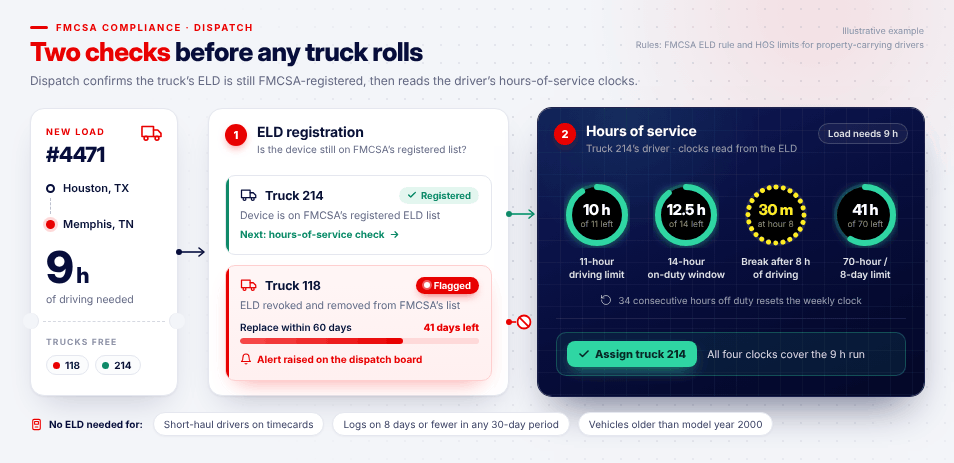
Dispatch should show each driver’s remaining hours before a load is assigned. I put that check on the assignment screen, so the dispatcher sees a warning before a load goes to a driver who cannot legally finish it.
Keep those rules configurable. FMCSA plans two HOS pilot programs for 2027: a flexible sleeper berth split and a pause of up to three hours in the 14-hour window.
IFTA
The International Fuel Tax Agreement (IFTA) lets interstate carriers file one quarterly fuel tax return for the member US states and Canadian provinces. It covers vehicles over 26,000 pounds gross vehicle weight, and returns are due on April 30, July 31, October 31, and January 31. Dispatch software helps when it records miles by state from GPS data and fuel purchases from fuel cards.
How Much Trucking Dispatch Software Costs
Trucking dispatch software costs from $25 a month on a flat small-fleet plan, subscription quotes start at a $290 monthly minimum on annual contracts, and a custom build starts at $80,000.
I checked these prices on each vendor’s own pricing page in October 2026. They illustrate pricing models and are listed in no particular order.
| Option | Pricing model | Published price example | Who it suits |
|---|---|---|---|
| Flat monthly plan | One price per fleet-size tier, no per-user fees, monthly billing | TruckingOffice: $25 to $90 a month (Basic), $35 to $130 a month (Pro) | Owner-operators and small fleets with standard freight |
| Per-truck or quoted subscription | Per truck, per driver, per load, flat annual rate, or custom quote | Truckbase: minimum $290 a month, billed annually | Growing fleets that want pricing matched to how they run |
| Custom build | One-time build plus hosting and maintenance | AppVerticals: $80,000 to $150,000 for fleet management with dispatch, routing, and ELD integration | Fleets and brokers whose freight or business model sits outside SaaS |
The load board is a separate line. DAT One carrier plans cost $59 to $339 a month, and you pay that under every option. Budget your ELD service separately as well.
Dispatch software for small trucking companies stays cheap because one product serves thousands of fleets. The math changes as per-truck fees, add-ons, and integrations stack up.
3-Year Cost Comparison for a 20-Truck Fleet
Here is the comparison I run for a sample fleet of 20 trucks hauling full-truckload freight, using the published prices above. ELD costs are left out because they apply to every option.
| Cost line (36 months) | Flat plan (TruckingOffice Pro, Fleet tier) | Quoted subscription (Truckbase minimum) | Custom build (AppVerticals range) |
|---|---|---|---|
| Software | $130 x 36 = $4,680 | $290 x 36 = $10,440 or more | $80,000 to $150,000 |
| Maintenance and support | Part of the subscription | Part of the subscription | $72,000 to $360,000 ($2,000 to $10,000 a month) |
| DAT One Office load board ($339 a month) | $12,204 | $12,204 | $12,204 |
| 3-year total | $16,884 | $22,644 or more | $164,204 to $522,204 |
On these numbers, a 20-truck fleet with standard freight should subscribe. A custom build earns its cost through what subscriptions cannot do, which the next section covers. The maintenance range comes from our custom logistics software vs off-the-shelf guide, and the logistics app development cost guide breaks the build budget down further.
Want a Number for Your Own Fleet?
Truck count, freight type, and integrations change every line of this table. Use our calculator to estimate scope, timeline, and budget for your dispatch build.
Estimate Your App CostWhen to Build Custom Trucking Dispatch Software
Build custom trucking dispatch software when your freight, your integrations, or your business model sit outside what subscription products handle.
Subscription dispatch software for trucking companies is designed around standard full-truckload and less-than-truckload freight. I recommend a custom build in four situations:
- Your operation does not fit SaaS. Intermodal and drayage work tracks containers, chassis, and port appointments. Oil and gas hauling tracks well sites and run tickets. Dump truck work bills by the ton or by the hour.
- You need deep integrations. Shipper EDI, your ERP, or an existing TMS needs two-way data flows that generic connectors handle poorly.
- Per-truck fees grow faster than revenue. A fee on every truck rises with each truck you add, even when lanes and margins stay flat.
- You plan to sell dispatch software to carriers. When the software is the product, you need to own the code, the data, and the roadmap.
There is also a middle path I call build-on-buy. You keep a TMS for accounting and compliance and build the missing workflow on top of it through the TMS API. The custom scope stays small, and the spend goes to the part of your operation that earns money.
For the general trade-offs, read our comparison of custom logistics software vs off-the-shelf. Our logistics software development team scopes full builds and build-on-buy extensions.
How We Rebuilt a Freight Platform for Lulo Freight
Lulo Freight, a Texas-based logistics technology company, fits the fourth situation. Its platform gives shippers instant pricing and gives carriers a way to fill idle truck capacity, so the carrier tools are part of what Lulo sells.
A previous development partner had left the platform partly built. Pricing logic was incomplete, the load board was not a usable carrier workflow, and the tools for managing loads, assigning drivers, and handling fleet activity were missing or unfinished.
We kept what worked and built the carrier side first, because the marketplace depends on carrier supply. The finished platform has nine modules, including Load Board, Load Management, Driver and Fleet Management, Shipment Tracking, and Payments and Billing. It runs on React Native for iOS and Android, Laravel for the API layer, and Firebase for real-time tracking and alerts.
The Lulo Freight case study reports 60% faster quote decisions, 45% higher fleet utilization, and 70% less manual freight coordination. Lulo needed to own that workflow end to end, and ownership is the test I apply to every build decision.
How to Build Trucking Dispatch Software in 5 Steps
A custom build moves through five steps: discovery, an MVP, integrations, a pilot with a few trucks, and a full rollout.
| Step | What happens | Deliverable |
|---|---|---|
| 1. Discovery | Map loads, exceptions, users, and systems in a product discovery workshop. | Scoped backlog and estimate |
| 2. MVP | Build the load board connection, assignment screen, and driver app. | Working dispatch for one terminal |
| 3. Integrations | Connect the ELD provider, load boards, and QuickBooks or your ERP. | Live data from existing systems |
| 4. Pilot | Run real loads with a few trucks on your hardest lanes. | Pilot results against your baseline |
| 5. Rollout | Move the remaining trucks, terminals, and customers onto the system. | Full production use |
I run the pilot on lanes where cell coverage drops, because that is where a driver app either proves itself or gets abandoned. Each step ends with a deliverable you can review before you fund the next one.
Choosing a Partner to Build Your Dispatch Software
Choose a partner with shipped logistics projects, hands-on work with ELD and telematics APIs, and a record of offline-ready driver apps.
- Logistics projects: Ask for a published freight or fleet case study and the modules it covered.
- ELD and telematics APIs: Ask which provider APIs the team has used, such as Samsara and Motive, for hours of service and vehicle location.
- Offline-ready driver apps: Ask how the app saves a POD scan when the signal drops mid-upload. Our offline driver app breakdown explains what a good answer covers.
- Estimate transparency: Ask for an estimate tied to named modules and integrations.
AppVerticals is a logistics app development company with published freight and field dispatch builds, including Lulo Freight and a field service rebuild with its own dispatch console. Every estimate I write lists the systems, devices, and offline rules behind the number.
Subscribe or Build: Decide on Fit First
Subscribe to trucking dispatch software when your freight and growth look standard, and build when the dispatch workflow is how you compete.
Start with a subscription, since it costs little to try. If your dispatchers keep working around it, write down every workaround you see. That list becomes the scope of a custom build or a build-on-buy extension, and it gives any estimate a solid starting point.
AppVerticals provides end-to-end logistics app development covering discovery, driver apps, dispatch consoles, integrations, and post-launch support.
Need Dispatch Software That Fits How Your Fleet Runs?
Your freight type, ELD provider, load boards, and accounting system should shape the software. Share them with our team, and we will scope a custom dispatch platform or a build-on-buy extension with a clear estimate.
Explore Our Logistics App Services