














 ChatGPT
 Perplexity
 Claude
 Google AI
Software development outsourcing is the practice of contracting a third-party vendor to design, build or maintain software instead of hiring an in-house engineering team. US companies use it to reach specialized talent, avoid three to six month hiring cycles and scale a team to match the actual workload rather than carrying fixed payroll. The engagement can cover an entire product or a single function such as QA, UI/UX or maintenance and the vendor either owns delivery outright or works under your direction.
The category is still growing. The global IT services outsourcing market was valued at $744.6 billion in 2024 and is projected to reach $1.22 trillion by 2030, according to Grand View Research.
After eighteen years of advising companies on these deals, I can tell you the outcome is decided in the contract. The teams that get burned almost never get burned by the engineering. They get burned by what they failed to put in writing.
Key Takeaways
- The most expensive mistakes trace to the contract: unassigned IP, vague acceptance terms and no exit clause.
- Offshore and nearshore rates typically run 40 to 70 percent below US in-house cost but rate is a weak predictor of total cost.
- Software development outsourcing means hiring an external vendor to build or maintain software, either end to end or for a specific function.
- The three engagement models that matter are staff augmentation, dedicated team and full-cycle project delivery and they differ mainly in who manages the work.
- A fair contract puts source-code ownership, milestone-based payment and a transition plan in writing before the first sprint.
- Outsourcing is fully legal in the US, with narrow exceptions for certain federal, defense and regulated-data work.
- The single best filter for any vendor is whether they will commit their pricing, IP terms and exit terms to paper without being pushed.
What Is Software Development Outsourcing?
Software development outsourcing is a contractual arrangement where an external partner delivers engineering work that a company would otherwise staff internally. That work spans product discovery, architecture, coding, QA, UI/UX design and long-term maintenance. Depending on the model you choose, the vendor either takes full ownership of delivery or supplies engineers who work under your management.
The reason US buyers reach for it comes down to two hard numbers. The median annual wage for a US software developer is $133,080 as of May 2024, per the Bureau of Labor Statistics and that figure excludes recruiting, benefits, equipment and management overhead. On top of the cost, hiring a senior engineer in a competitive US market routinely takes months. Outsourcing addresses both at once by opening access to a global talent pool you can scale up or down without a permanent payroll commitment.
Where this matters most is when a company treats outsourcing as an execution decision rather than a control decision. You are handing part of your product to people outside your building. That is a governance choice and the companies that treat it that way tend to write better contracts and get better outcomes.
The 4 Types of Outsourcing and the 3 Engagement Models
There are two separate choices buried inside “let’s outsource this,” and confusing them is where a lot of bad scoping starts. The first choice is location. The second is the engagement model, meaning how the relationship is structured and who manages the work day to day.
The four location-based types of outsourcing are:
- Onshore: a vendor in your own country. Highest cost, easiest communication and legal alignment.
- Nearshore: a vendor in a nearby country with overlapping business hours, for example, a US company working with a team in Latin America.
- Offshore: a vendor on another continent, usually chosen for the widest cost reduction and talent access.
- Hybrid or multi-shore: a deliberate mix, often a senior lead in or near your time zone with execution offshore.
Location sets your cost and your communication overhead. The engagement model sets your control and your risk. Here is how the three models compare.
| Engagement Model | How It Works | Who Manages the Work | Best For | Typical Pricing |
|---|---|---|---|---|
| Staff Augmentation | The vendor provides engineers who plug into your existing team | You manage the team and project | Teams with a clear roadmap and their own project management capacity | Monthly rate per engineer (time and materials) |
| Dedicated Team | The vendor builds a cross-functional team that works exclusively on your product | Shared management with a vendor-side lead | Long-term product development with evolving requirements | Monthly team retainer |
| Full-Cycle Project | The vendor handles delivery end-to-end based on an agreed scope and requirements | The vendor manages the project | Well-defined builds with a fixed outcome and timeline | Fixed price or milestone-based payments |
The practical rule I give clients is simple. If you have the in-house discipline to run a backlog and review work, staff augmentation gives you the most control for the least money. If you do not, a dedicated team or full-cycle delivery buys you the vendor’s project management and you pay for that in the rate. The mismatch to avoid is buying staff augmentation and then expecting the vendor to manage a project you have not defined.
For a longer treatment of when in-house wins, see our guide on in-house versus outsourcing software development.
Benefits of Outsourcing Software Development and the Risks Most Teams Underprice
The benefits of outsourcing software development are real and well documented: lower cost of delivery, faster access to specialized skills, the ability to scale a team to the work and freeing your internal people to focus on core product. Those are the reasons the market keeps growing and they are legitimate.
The risk side is where teams underinvest because the risks show up later than the benefits. A rate quote looks great in month one. The problems surface in month four, when the codebase you cannot read is late, the requirements got interpreted three different ways and no one wrote down who owns the source code.
The cost of getting this wrong is well documented. McKinsey and the University of Oxford studied large IT projects and found they ran 45 percent over budget and delivered 56 percent less value than predicted on average. Software projects carried the highest overrun risk of all. What failed those projects was governance and scoping, not the technology and a good contract is where you control both.
The risks worth pricing before you sign are these:
- Communication and time-zone drift: Ambiguous requirements get interpreted differently across a distance and clarification cycles stretch from minutes to days.
- Quality variance: A low hourly rate means nothing if the work needs to be redone. The total cost of ownership includes rework.
- IP and security exposure: Without explicit terms, ownership of the code you paid for can be genuinely unclear and regulated data adds compliance obligations.
- Vendor lock-in: If the code lives in the vendor’s environment and only their team understands it, leaving becomes expensive by design.
None of these are reasons to avoid outsourcing. They are reasons to evaluate the vendor and the contract properly, which is the rest of this guide. If your product is a SaaS platform where architecture decisions compound, the risk math is slightly different and we cover it in our guide on outsourcing SaaS development.
How Much Does Software Development Outsourcing Cost in 2026?
Software development outsourcing costs are driven far more by region and engagement model than by any single hourly figure. The clearest way to think about it is against your in-house baseline. A US in-house developer costs $133,080 in median base salary alone before overhead, so the question is how far each region moves you off that number.
Typical senior developer rate ranges reported across 2025 to 2026 industry rate guides look like this. Treat them as market ranges because specialization and seniority move them significantly.
| Region | Typical Senior Hourly Range | Time-Zone Overlap with US |
|---|---|---|
| North America (US, Canada) | $100 to $200+ | Full |
| Western Europe | $45 to $100 | Partial |
| Latin America (Nearshore) | $30 to $65 | High (4 to 8 hours) |
| Eastern Europe | $35 to $75 | Low to moderate |
| South and Southeast Asia | $18 to $50 | Minimal |
To make the gap concrete, run a single senior developer over three years.
An in-house US developer at the median $133,080 base salary costs about $399,000 in salary alone over three years. Add benefits at roughly 31 percent of total compensation (about $124,000, per the Bureau of Labor Statistics) and another $30,000 or so for recruiting, equipment, tooling and training, and the real three-year cost lands near $553,000.
The same 2,000 hours a year outsourced at a $40 blended rate runs about $240,000 over three years, with the vendor’s infrastructure included. Even after vendor-management time and the occasional rework cycle, that is a 50 to 55 percent lower total cost, with the added flexibility to scale the hours down when the roadmap slows.
But the headline number hides the real variable. That $240,000 assumes the work gets done once. A cheaper engineer who takes three times as long, or a fixed-price contract that treats every change as a billable variation, closes the gap fast. The three-year math only holds if the contract controls rework and scope, which is exactly what the rest of this guide is about.
Across these regions, offshore and nearshore delivery generally lands 40 to 70 percent below US in-house cost. The pricing model then shapes how that rate turns into a bill. Fixed-price suits a locked scope but punishes change. Time and materials suits an evolving roadmap but needs sprint-level scope discipline to stay predictable. A dedicated team retainer sits in between and rewards a longer relationship.
Get a real number for your project.
Answer a few questions about your project scope and get a tailored cost estimate, recommended engagement model, and a clearer view of your development investment.
Outsourcing vs In-House: A Quick Decision Check
Outsourcing wins when the work is time-bound, needs skills you do not have in-house or would force you to expand fixed payroll for a temporary need. In-house wins when the software is your core competitive IP, when it demands deep and permanent business context or when regulatory control over process and data has to stay inside your walls.
Most companies land on a hybrid answer. They keep architecture ownership and product direction in-house and outsource execution or they use a dedicated external team during an intensive build and scale it down to internal maintenance afterward. This is a build-versus-buy judgment about where control genuinely matters and it is worth making deliberately rather than by default. Our full breakdown lives in the in-house versus outsourcing guide.
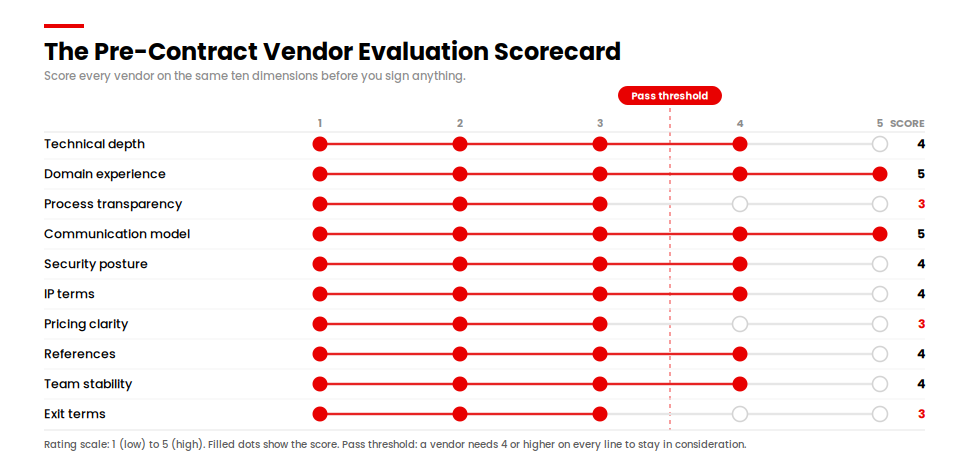
The Pre-Contract Evaluation Scorecard: 10 Things to Verify Before You Sign
The best vendors and the risky ones look nearly identical in a sales deck. They separate the moment you score them against specific, evidence-backed criteria instead of impressions. This is the scorecard I walk clients through before any contract goes out. Score each vendor 1 to 5 on every line and ask for the evidence listed. A vendor who cannot produce the evidence is telling you something.
| # | Criterion | What “Good” Looks Like | Evidence to Request |
|---|---|---|---|
| 1 | Technical depth | Named senior engineers with relevant stack experience | Anonymized CVs of the actual team |
| 2 | Domain experience | Shipped work in your industry or a close analog | Two case studies with outcomes |
| 3 | Process transparency | A defined sprint cadence and reporting rhythm | A sample sprint report or demo recording |
| 4 | Communication model | Overlapping hours and a named point of contact | The proposed meeting cadence in writing |
| 5 | Security posture | Documented controls and compliance where relevant | Security policy and SOC 2 or HIPAA evidence if required |
| 6 | IP terms | Full assignment of source code and work product to you | A redlined IP-assignment clause before kickoff |
| 7 | Pricing clarity | A transparent model with predictable change handling | A written change-order process |
| 8 | References | Reachable clients, including a past engagement | Two contactable references you actually call |
| 9 | Team stability | Low turnover and continuity of key roles | Attrition rate and key-person commitment |
| 10 | Exit terms | Defined handover of code, documentation and access | Transition clause included in the contract before signing |
The two lines people skip are 6 and 10, IP and exit. They feel like paperwork during a friendly sales process. They are the two that cost the most when a relationship ends, which every relationship eventually does.
6 Contract Clauses That Protect You
Six clauses do most of the protecting in a software development outsourcing contract. If a vendor resists putting these in writing, treat the resistance as data.
- IP and source-code ownership: The contract must assign all source code, designs and documentation to you, with everything transferring on payment. This is the clause that decides whether you own what you paid for.
- Milestone-based payment with acceptance: Payment should tie to delivered, accepted work against written acceptance criteria, so you pay for approved output rather than elapsed time. At AppVerticals, milestones are reworked before billing if they are not delivered as agreed and you pay only for approved work, which is the standard I would look for in any vendor.
- Service levels and support: Response times, defect handling and post-launch support obligations belong in the contract.
- Data protection and confidentiality: An NDA plus explicit security obligations and named compliance standards such as HIPAA or PCI-DSS where your data requires them.
- Exit and transition: A defined handover of code, credentials, documentation and knowledge, so leaving is a process rather than a hostage negotiation.
- Warranty and defect rework: A period during which the vendor fixes defects in delivered work at no additional charge.
The clean version of this is worth stating plainly. You own the code, you pay for accepted work and you can leave with everything you need. A vendor comfortable with those three commitments is showing you how they operate.
Red Flags That Predict a Failed Engagement
Some warning signs reliably precede a bad outsourcing engagement and they are visible before you sign. Watch for these:
- A confident fixed price quoted before any real discovery. It means the scope is guessed and every gap becomes a change order.
- Reluctance to assign IP in writing or vague language about “shared” ownership of code you are paying to build.
- A polished sales team and an unnamed delivery team. The people who pitched are not the people who build.
- No written acceptance criteria. Without them, “done” is whatever the vendor says it is.
- Pressure toward a large upfront payment with no milestone structure behind it.
- Code that lives only in the vendor’s environment, with no repository you control from day one.
- References that are hard to reach or a portfolio of logos with no contactable clients behind them.
Any one of these is a conversation. Two or more is a pattern. The vendor’s willingness to fix them when you raise them tells you more than the flag itself did.
Closing: The Contract Is the Product Decision
The vendors on your shortlist will look almost identical until you put them under the scorecard. Pricing transparency, IP assignment and exit terms reveal more about how an engagement will actually go than any portfolio ever will. If a vendor will not put milestone billing and full code ownership in writing, that is your answer and it is worth keeping the search open.
At AppVerticals, that is exactly how we structure our own engagements: milestone-based payments with rework before billing and full transfer of source code, designs and documentation to you at the end of the project. If you are weighing quotes right now, it is worth seeing how a transparent, milestone-billed engagement compares with what you are holding.
Get Your Project Roadmap
Talk to our experts and receive a detailed scope, the right technology recommendations, and a clear development plan, while maintaining full ownership of your product.
Start with our custom software development services overview to see how engagements are structured or read the in-house versus outsourcing guide if you are still weighing the decision.