













 ChatGPT
 Perplexity
 Claude
 Google AI
Property management software development means building a platform that runs leasing, rent collection, maintenance and owner accounting, connected to the payment, accounting and listing tools a company already uses. Property managers who have outgrown subscription tools and proptech founders build custom, and a basic build costs $40,000 to $80,000 at AppVerticals, while advanced platforms start at $500,000. In this guide I cover the core and custom features, the integrations to plan, the compliance rules that apply, a 3-year cost comparison for a 1,000-unit portfolio, the signs that custom pays off and the five steps to build it.
| Per-unit fees grow with every door you add. A custom platform pays off when that growth outpaces your revenue. |
Key Takeaways
- A property management system covers leasing, rent, maintenance and owner accounting. A real estate CRM and accounting software each cover one part.
- Seven core features make a system usable. Tenant and technician apps, multi-entity accounting and AI triage justify a custom build.
- Plan six integrations: accounting, payments, tenant screening, listings, e-signature and your current PMS.
- FCRA, Fair Housing, PCI DSS and Nacha rules shape the design from the first sprint.
- At 1,000 units, a custom MVP costs $58,000 to $140,000 over 3 years against $36,000 to $180,000 for subscription list prices.
- Build when per-unit fees outgrow revenue or the portfolio does not fit a standard tool.
What property management software does
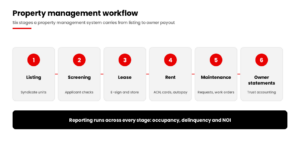
Property management software runs the full rental workflow, from the listing and tenant screening to the lease, monthly rent, maintenance work orders and owner statements.
Each stage hands data to the next. A screened applicant becomes a lease, the lease sets the rent schedule, rent payments post to the ledger, and the ledger feeds the statement each owner receives. When those handoffs live in one system, staff stop re-keying data between spreadsheets and accounting files.
Residential and multifamily managers use it to run unit turns and renewals. Commercial managers use it for lease terms and common area charges. HOA and community association managers use it for dues, violations and board reporting. The table below separates it from the two tools teams confuse it with.
| Tool | What it does | Example products |
| Property management software | Runs leasing, rent, maintenance and owner accounting in one system | AppFolio, Buildium, Yardi |
| Real estate CRM | Tracks leads, showings and agent pipelines before a lease exists | Follow Up Boss, Salesforce |
| Accounting software | Keeps the general ledger, payables and tax reporting | QuickBooks Online |
Key features of property management software
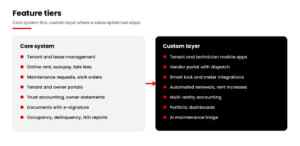
Property management software features fall into seven core capabilities that every system needs and seven custom capabilities that justify a build, and I plan property management software development on that split. The core set covers tenants, rent, maintenance, accounting and reporting. The custom set covers mobile apps, dispatch, devices, automation and AI.
Core features every property management system needs
A property management system needs seven core features before it handles a single live lease.
| Feature | What it must do |
| Tenant and lease management | Stores tenant records, lease terms, renewals and move-in and move-out dates. |
| Online rent collection | Takes ACH and card payments, with autopay and automatic late fees. |
| Maintenance requests and work orders | Logs tenant requests, assigns vendors and tracks each job to completion. |
| Tenant and owner portals | Gives tenants payment and request history and gives owners statements and reports. |
| Trust accounting and owner statements | Keeps tenant funds and owner funds in separate ledgers and produces monthly statements. |
| Document storage with e-signature | Holds leases, notices and inspection files and collects signatures online. |
| Reporting | Tracks occupancy, delinquency and net operating income (NOI), which is rental income less operating costs, by property. |
Features that justify a custom build
Seven features push a team past what a subscription tool offers, and each one maps to a gap in a standard system.
| Feature | What it adds |
| Tenant and technician mobile apps | Property management app development gives tenants a native app for payments and requests, and gives technicians a job list with photos, parts and on-site sign-off. |
| Vendor portal with work order dispatch | Routes jobs to approved vendors and records quotes, invoices and completion. |
| Smart lock and meter integrations | Connects door access and utility meters to unit status and move-in workflows. |
| Automated renewals and rent increases | Sends renewal offers and applies rent increases by lease rule and local limits. |
| Multi-entity accounting | Keeps separate books for each owner entity, with a consolidated view. |
| Portfolio dashboards | Shows occupancy, delinquency and NOI across every property in one view. |
| AI maintenance triage and lease data extraction | Sorts requests by urgency and trade and pulls dates and clauses from lease files, a daily example of AI in real estate. |
Property management software integrations
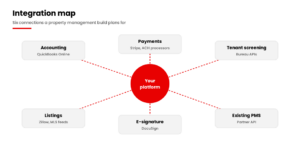
A build connects to six types of outside system: accounting, payments, tenant screening, listing syndication, e-signature and the property management system you already run. Before scoping, I confirm the API or partner program of each provider, because access terms decide what an integration can do.
| Integration type | Example providers | What it connects |
| Accounting | QuickBooks Online | Posts rent, fees and vendor bills to the general ledger. |
| Payments | Stripe, ACH processors | Collects rent by card and bank transfer and returns payment status. |
| Tenant screening | Screening bureaus with an API or partner program | Orders credit and background reports and returns results to the applicant record. |
| Listing syndication | Zillow Rental Manager, MLS integration feeds | Publishes vacant units and syncs inquiries. |
| E-signature | DocuSign | Sends leases and addenda for signature and files the signed copy. |
| Smart locks and IoT | Vendors with open device APIs | Issues access codes at move-in and reads meter data. |
| Existing PMS | AppFolio and Yardi, through their partner APIs | Reads and writes units, tenants and ledgers. |
Build-on-buy means extending the system you already own through its API instead of replacing it. A custom portal or dispatch module reads units and ledgers from the current system and writes results back, which leaves accounting where it is. This system integration work is the lower-risk first step for a portfolio that is satisfied with its ledger and needs better tenant and technician tools.
Security and compliance for US property management software
Four federal rules shape the design of a US property management platform, and state law adds a fifth layer for deposits and trust accounts.
| Rule | Plain-language meaning | What the software must do |
| FCRA | The Fair Credit Reporting Act governs screening reports from consumer reporting agencies. | Send an adverse action notice when a report leads to a denial or a higher deposit, and log the notice. |
| Fair Housing Act | Bars discrimination by race, color, national origin, religion, sex, familial status and disability. | Apply the same screening criteria to every applicant and record the basis for each decision. |
| PCI DSS | Sets security requirements for card data. | Use the processor’s hosted payment fields so card numbers never touch your servers and your PCI scope shrinks. |
| Nacha rules | Govern ACH bank transfers. Fraud-monitoring requirements now cover all non-consumer originators and their service providers, effective June 22, 2026. | Store each tenant’s debit authorization, handle return codes and run risk-based fraud monitoring. |
| State rules | Set deposit caps, interest and trust account handling. | Configure deposit rules and trust ledgers for each state in the portfolio. |
How much property management software development costs
Property management software development costs $40,000 to $80,000 for a basic build and $500,000 or more for an advanced platform, while subscriptions charge per unit every month. The table compares the three ways to pay.
| Option | Pricing model | Published price examples | Suits |
| Per-unit subscriptions | Monthly fee per unit | AppFolio from $1.49 per unit (Core) to $5.00 (Max). Yardi Breeze from $1 per unit. Buildium by plan tier. | Portfolios that fit a standard workflow |
| Subscription plus API add-ons | Subscription fee plus a scoped build | Current subscription plus a fixed build price set after discovery | Teams satisfied with their ledger that need custom portals or apps |
| Custom MVP | One-time build plus maintenance | $40,000 to $80,000 | Operators replacing spreadsheets with a core system |
| Custom mid-tier | One-time build, priced after discovery | $80,000 to $500,000 | Multi-entity portfolios with deeper integrations |
| Custom enterprise | One-time build, priced after discovery | $500,000 or more | Large portfolios and proptech products |
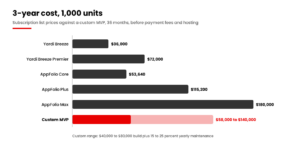
Property management software cost on a subscription grows with every unit you add, and the plan you pick changes the rate. The 3-year comparison below uses a 1,000-unit portfolio, 36 months at each vendor’s starting list price, and a custom MVP at the $40,000 to $80,000 build range plus annual maintenance at 15 to 25 percent of the build price, which is my planning assumption. Payment processing fees and hosting are excluded on both sides.
| Option (1,000 units, 36 months) | Basis | 3-year total |
| Yardi Breeze | $1 per unit per month | $36,000 [NEEDS DATA SOURCE: confirm on the Yardi Breeze pricing page] |
| Yardi Breeze Premier | $2 per unit per month | $72,000 [NEEDS DATA SOURCE: confirm on the Yardi Breeze pricing page] |
| AppFolio Core | $1.49 per unit per month | $53,640 |
| AppFolio Plus | $3.20 per unit per month | $115,200 |
| AppFolio Max | $5.00 per unit per month | $180,000 |
| Custom MVP | $40,000 to $80,000 build plus 15 to 25 percent yearly maintenance | $58,000 to $140,000 |
At 1,000 units the MVP range overlaps the middle of the subscription range, so features and control decide the choice once the prices meet. Use the app development cost calculator to price your own scope.
Four cost drivers move the number: tenant and technician apps, the count of integrations, accounting depth and data migration. My software development cost estimation method scores each driver before I quote a range.
When to build custom property management software
Build custom property management software when per-unit fees grow faster than your revenue, your portfolio does not fit a standard tool, your integrations need depth or you plan to sell the software as a product.
- Fees outgrow revenue. A per-unit fee is a fixed cost on every door, so a portfolio that adds units faster than rent grows sees margin shrink. At 1,000 units the AppFolio Max list price reaches $180,000 over 3 years.
- The portfolio does not fit. Student housing, co-living, mixed-use buildings and short-term plus long-term rentals need rules that standard tools force into workarounds.
- Integrations need depth. Links to your ERP, your bank or your owner reporting stack need two-way data flow that a standard connector does not give.
- You plan a product. Proptech founders who sell property management software need their own code, roadmap and multi-tenant architecture.
For the general comparison, read our guide to build vs buy software. For the build side, our custom real estate software development practice scopes platforms in this category.
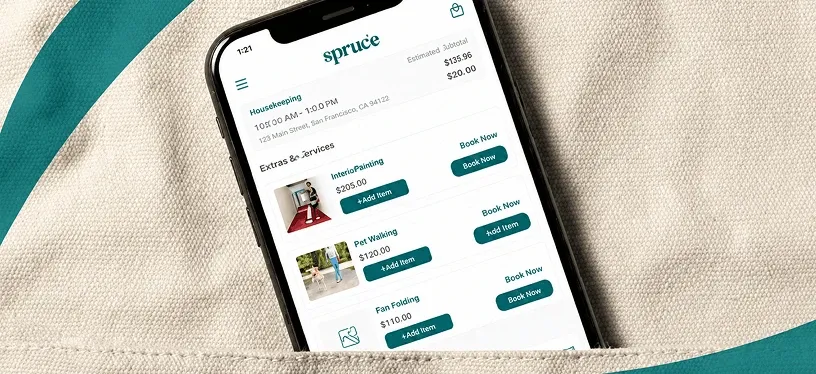
I saw a role-by-role approach work on a platform with a similar shape. Spruce, a US property services platform that connects residents, property managers and service professionals, had no mobile app for its service pros and no real-time view of provider capacity, so overbooking was a regular occurrence. We rebuilt it for the five roles that use it, added a service pro mobile app and a capacity module that distributes bookings against real availability, and the platform now supports more than 685,000 customers.
How to build property management software in 5 steps
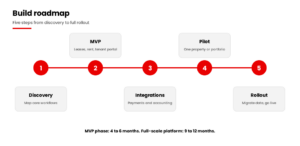
Rental property management software development follows five steps, from mapping workflows to a full rollout on migrated data.
- Map the leasing, rent and maintenance workflows with the staff who run them, and list the integrations each one needs.
- Build leases, rent collection, maintenance and the tenant portal first.
- Payment and accounting integrations. Connect the processor and the ledger, then test ACH returns and owner statements against real figures.
- Run one property or one portfolio on the new system and fix what staff report.
- Data migration and rollout. Move tenants, leases and ledgers from the old system and retire it. Our legacy software modernization practice handles migrations off older systems.
Choosing a partner for property management software development
A property management software development service should show real estate or proptech projects, payment and accounting API work, data migration from Yardi or AppFolio and completed security reviews. Ask for the integration list from a past build and the contract terms on code ownership.
A real estate app development company with those references can quote a range after discovery and name the compliance rules your platform must meet.
Our build vs buy guide sets out the cost, control and timeline trade-offs, so you can test your portfolio against them before you scope a build.Decide whether to build or keep paying per unit