













 ChatGPT
 Perplexity
 Claude
 Google AI
A product operating model is how a company organizes its teams and funding around customer outcomes. It rests on a few core parts: empowered teams, continuous discovery, reliable delivery, and outcome-based funding. This guide covers what changes, who owns what, and how to tell which model your team runs today. I have scoped more than 50 digital products in 12 years as a product strategist.
| The model decides whether a launch succeeds more reliably than the tech stack does. |
Gartner found that 85 percent of organizations have adopted or plan to adopt a product-centric delivery model.
Key Takeaways
- Focus on Customer Outcomes:
A product operating model aligns teams, priorities, and funding around delivering measurable customer and business outcomes instead of completing one-time projects. - Rethink How Teams Are Funded:
The biggest organizational shift is moving from fixed project budgets to persistent funding that supports long-term product ownership and continuous improvement. - Core Principles Stay the Same:
While leading frameworks define the product operating model differently, they consistently emphasize strategy, empowered teams, discovery, delivery, and outcome-based funding. - Avoid Traditional Project Thinking:
A fixed feature list created before validating customer needs is a strong indicator of project-based thinking rather than a modern product operating model. - Adopt the Model Where It Fits:
Small teams can successfully implement a product operating model, but organizations should recognize its limitations and adapt it to their size, maturity, and business goals.
What Is a Product Operating Model, Really?
A product operating model sets up how a company funds a team, defines its accountability, and measures its output. It replaces the traditional project model, where a team gets a fixed scope, budget, and deadline. Under a product operating model, a team owns a problem area over time.
Marty Cagan popularized the product operating model term in his book TRANSFORMED. He wrote it with his partners at the Silicon Valley Product Group. SVPG’s own material refers to the older way of working as the feature-team model. In that setup, a team simply executes a roadmap set by stakeholders.
The real question a product operating model answers is who decides what gets built next. It also asks how the team proves the decision worked.
This distinction sounds abstract until you watch it play out in a real team. A project team asks whether it hit the date. A product team asks whether the work actually helped the customer. Those two questions lead to different decisions almost every week.
A product operating model, in short:
- Funds a persistent team that stays together across releases.
- Gives the team a problem to own over time.
- Measures success by the results the team produces.
Product Operating Model vs. Project-Based Model: What Actually Changes
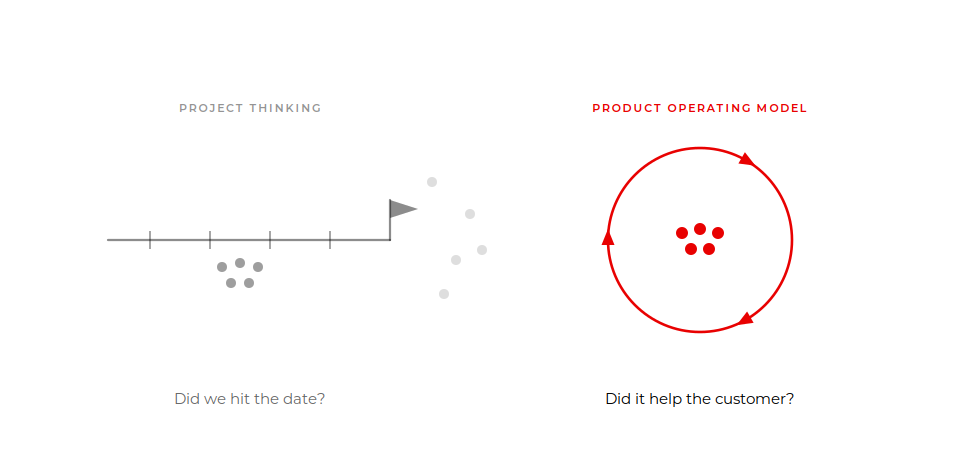
A product operating model changes funding, team structure, and success metrics compared to a project-based model. The table below lays out the five biggest differences.
| Dimension | Project-Based Model | Product Operating Model |
|---|---|---|
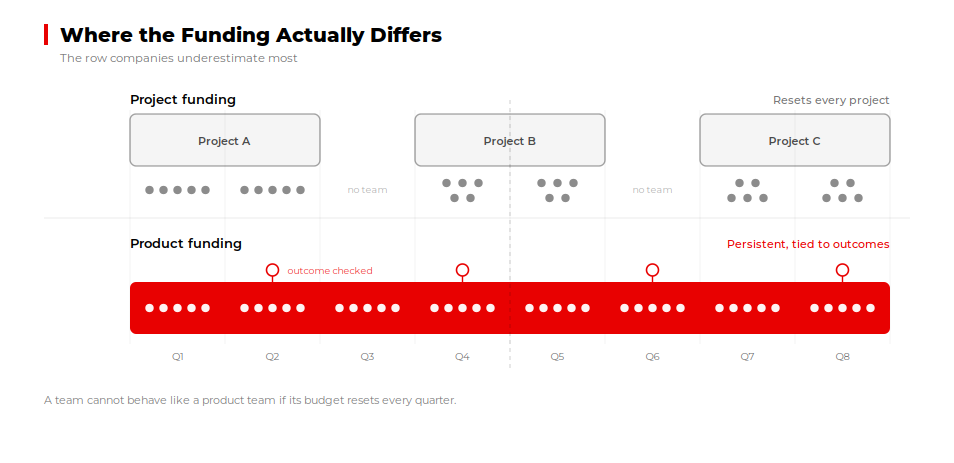
| Funding | Approved once, tied to a fixed budget for a single release | Ongoing, tied to a persistent team and its outcomes |
| Team structure | Temporary team, assembled and disbanded per project | Persistent team, stays with the same product area |
| Success metric | On-time and on-budget delivery | Customer and business outcomes, such as adoption or revenue |
| Decision-making | A sponsor sets scope before work starts | The team sets scope, informed by discovery |
| Scope | Fixed at the start, changes need approval | Expected to change as the team learns |
On Gartner’s Peer Community, a CIO described this funding shift as a move to persistent investment tied to value realized.
This funding row is the one companies underestimate. A team cannot behave like a product team if its budget resets every quarter. That project-by-project mindset is what many associate with the traditional IT model.
What a Product Operating Model Is Actually Made Of
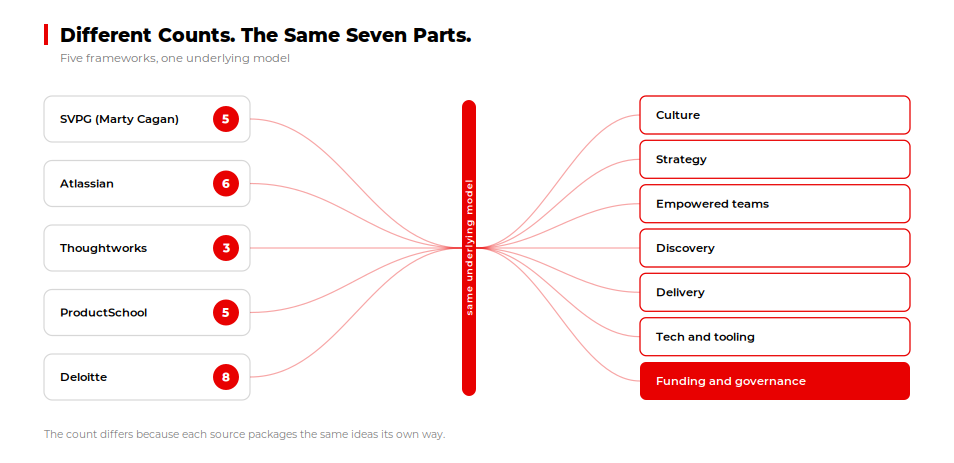
A product operating model is made of a small set of parts that repeat across every framework. Five well-known frameworks describe this model, and they do not agree on the count. Among the most influential is the Marty Cagan product operating model, also known as the SVPG product operating model.
| Source | Count | Label |
|---|---|---|
| SVPG (Marty Cagan) | 5 | Culture, strategy, teams, discovery, and delivery |
| Atlassian | 6 | Interconnected components spanning vision, strategy, and customer focus |
| Thoughtworks | 3 | Three key areas every product operating model covers |
| ProductSchool | 5 | Five components for a customer-centric product operating model |
| Deloitte | 8 | Eight pillars for scaling a product-based delivery model |
Line these five frameworks up, and the same seven parts keep showing up under different names. The count differs because each source packages the same ideas its own way.
Modern product teams also need to understand how they use AI in software development as part of their technology and tooling strategy. AI-assisted coding, testing, and automation can help teams deliver faster, but only when paired with strong ownership and engineering practices.
Product culture, product strategy, product discovery, and product delivery all depend on each other in practice. Weaken one, and the other three struggle to hold up. This is well documented in SVPG’s product model concepts material.
| Part | What It Covers |
|---|---|
| Culture | Whether teams are trusted to make decisions, not just execute them |
| Strategy | A clear product vision that every team can trace its work back to |
| Empowered teams | Cross-functional teams with a product manager, a designer, and engineers |
| Discovery | How teams test ideas with real users before committing engineering time |
| Delivery | How teams ship reliably once an idea is validated |
| Tech and tooling | The platforms and architecture that let teams move independently |
| Funding and governance | How money and decision rights flow to product teams |
A product management operating model puts more focus on the product manager than on the rest of the cross-functional team. Even with that emphasis, the seven parts remain unchanged.
Product-model teams get judged on outcomes, such as adoption or revenue. Output, like the number of features shipped, matters far less on its own.
A product team pairs a product manager, a product designer, and a small group of engineers. This cross-functional team owns a product area from discovery through delivery.
Empowered product teams treat discovery and delivery as two halves of the same ongoing job. Neither half is optional in the product operating model Marty Cagan describes.
Why Software Companies Are Ditching Project Thinking Now
A CIO.com report cites Gartner data showing that 55 percent of organizations are moving from project delivery to product delivery.
Customer expectations now shift faster than a fixed project plan can track. A digital transformation built around annual project budgets struggles to respond mid-cycle.
This shift also changes what companies expect from an outside development partner during scoping. A partner still pitching a fixed spec and a fixed date is answering last decade’s question.
How Companies Move From Project Thinking to Product Thinking
Companies move from project thinking to product thinking in a specific order. The sequence below reflects how real teams have made this shift.
- Shift ownership from delivery to outcomes. Name one team, and hold it accountable for a result.
- Change how the team is funded. Move from one-project budgets to ongoing, capacity-based funding.
- Change what gets measured. Track adoption and the value the team actually delivered.
- Start with one team. Prove the model there before scaling it company-wide.
The Signs You Are Still Running Products Like Projects
(Alt text: Checklist card with five rows showing signs of project thinking, final row in solid black to flag the most critical sign.)
A few clear signs show a team is still running products like projects. Check your own team against this list.
- A team gets a fixed feature list before anyone tests the underlying problem.
- A launch date gets set before any discovery work starts.
- Success gets measured by whether the team shipped on time.
- The team disbands or moves to a new project right after launch.
- No one on the team can explain who decided this was worth building.
Not Sure Which Stage You Are In?
This guide walks through what to build first once you know the real problem
→ See the Decision GuideWhat Changes When You Scope a New Product This Way
Scoping a product this way starts with a problem statement someone can validate. It does not start with a finished feature list.
In my scoping calls, I ask for the outcome a team wants before I ask about any feature. That single change in order affects the whole plan that follows.
This is the same thinking behind how we approach MVP scoping: define the smallest testable version of the outcome itself.
It also changes when a build-versus-buy question comes up. A team scoped around an outcome asks a different question first. It checks whether a feature is core to that outcome. Only then does it ask what the feature costs to build.
For more on that decision, see our guide to build vs. buy software.
When a company brings in an outside team under this model, the brief changes shape. AppVerticals’ own MVP development work starts from the outcome a client needs. The team works with the client to define the spec, rather than receiving a finished version on day one.
Can a Startup or Mid-Market Team Run This Model Without a 40-Person Product Org?
A small team can run a product operating model without a 40-person product organization. The core ideas scale down; the ceremony around them does not have to.
Align Technology, a medical device company, offers a more realistic product operating model example than Spotify or Amazon. The company started with one product-centric rollout, then planned three more the next year.
A five-to-fifteen-person team can apply the same core parts covered earlier. That means one clear owner, a real funding line, and a metric tied to the customer instead of the calendar.
The mistake smaller teams make is trying to install every pillar at once. Start with one product area, prove the funding and metric shift, then expand.
Where the Product Operating Model Breaks Down (The Honest Limits)
(Alt text: Warning-style checklist card showing two honest limits of the product operating model, low team maturity and funding or culture clashes, with a final black row noting not every team needs the full model yet.)
A product operating model breaks down when a team lacks the maturity to run discovery well. Handing a team ownership without the skill to use it creates a new kind of stall.
Gartner’s own survey found that 55 percent of respondents named a top adoption challenge. It was project-based funding and a culture clash between business and IT.
Thoughtworks makes a related point in its product operating model guidance. Too much standardization can slow innovation down, even inside a well-run product team.
Not every team needs the full model on day one. A team with one clear product and a stable customer base only needs a subset of these parts.
Ready to Scope Your Own MVP?
This guide walks through defining the smallest testable version of an outcome.
→ Read the MVP GuideKeep Reading
If you are scoping your next build, these go deeper on the pieces that matter most: how an MVP compares to a full product build, why a mid-size team might still buy instead of build, and how SaaS and custom software compare at this stage.