
















 ChatGPT
 Perplexity
 Claude
 Google AI
When an AI-driven decision is challenged, can your team reconstruct exactly what happened? That question is becoming increasingly important as organizations move AI systems from experimentation into production. A meaningful investigation requires more than application logs; teams need to trace the full decision chain; who initiated the request, what data the system retrieved, which prompt and model version were active, what controls were applied, what action was generated, and where human intervention influenced the outcome.
This guide explains how to design and implement an AI audit trail that makes those decisions traceable, reviewable, and defensible. An AI audit trail is the connected runtime evidence that allows engineering, compliance, security, and operations teams to investigate incidents, support governance reviews, and demonstrate accountability against emerging requirements such as the EU AI Act. The NIST AI Risk Management Framework also emphasizes documentation, monitoring, accountability, and lifecycle risk management as essential practices for trustworthy AI.
The focus is not on collecting unlimited volumes of AI logs. A million disconnected events can still leave an auditor unable to explain one sensitive decision. A well-designed audit trail preserves the evidence needed to follow a decision from an authorized request to the system inputs, controls, outputs, and real-world impact. In this guide, we cover the core components, implementation considerations, and best practices for building AI audit trails that support responsible AI operations.
What Is an AI Audit Trail?
An AI audit trail is a chronological, queryable record of the events and evidence behind an AI-assisted decision or action. It usually connects identity, purpose, input data, retrieval sources, model and prompt versions, policies, outputs, tool calls, human review, and downstream outcomes.
A complete AI audit trail should also preserve enough context to explain the system’s state at that moment. Current model behavior cannot reliably explain an older decision after prompts, retrieval indexes, policies, or configurations have changed.
AI Audit Trail vs. Logs, Documentation, and Data Lineage
I treat these records as complementary layers. Each answers a different question during an investigation or audit.
| Evidence layer | What it captures | Primary question answered |
|---|---|---|
| Application logs | Errors, requests, latency, authentication, and infrastructure events | Did the system operate correctly? |
| AI documentation | Intended use, controls, ownership, testing, and model limitations | How was the system designed to operate? |
| Data lineage | Where data originated and how it changed | Which data reached the workflow? |
| AI audit trail | Linked runtime evidence across the entire decision | How did this specific outcome occur? |
A prompt-and-response transcript provides only two points in the chain. Audit trail logging for AI should also show authorization decisions, retrieved sources, policy state, tool activity, review, and the resolved external effect.
What a Complete AI Audit Trail Should Capture
I recommend matching logging depth to the workflow’s risk, data sensitivity, and ability to affect people or systems. Higher-impact decisions need richer evidence and stronger retrieval controls.
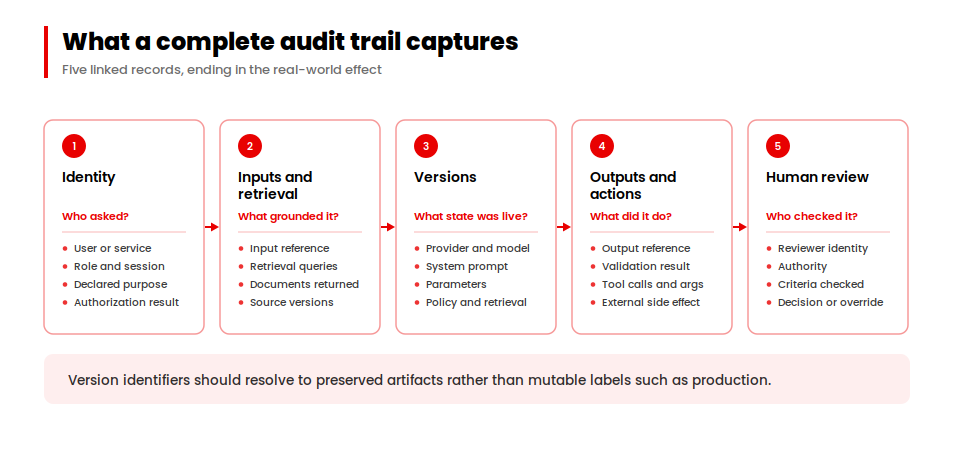
Identity, Purpose, and Authorization
Record the authenticated user or service account, role, session, declared purpose, permissions, and authorization result. This reveals cases where an answer was technically accurate while the requester lacked permission to receive it.
On CPCG, a healthcare operations platform, our team built role-based access, activity reporting, and an audit module for quality-assurance monitoring of remote support sessions. That delivery reinforced a principle I apply to AI systems: decision traceability starts with knowing who entered the workflow, what they were allowed to do, and which actions followed.
Inputs, Retrieval Context, and Source Provenance
Capture input references or protected snapshots, retrieval queries, documents returned, permission-filtered documents, source versions, and relevant data transformations. For retrieval-augmented generation, or RAG, this evidence shows which approved sources grounded an LLM response.
Raw prompt retention can create privacy and security exposure. Depending on the use case, teams may store encrypted content, redacted content, hashes, or secure references to a controlled source snapshot.
Model, Prompt, and Configuration Versions
An audit trail for AI models should identify the exact provider, model version, system prompt, workflow version, parameters, policy rules, and retrieval configuration. Version identifiers should resolve to preserved artifacts rather than mutable labels such as “production.”
I also record deployment changes separately. This connects a decision to the release, evaluation results, approval state, and rollback history active at inference time.
Outputs, Tool Calls, and External Side Effects
Store the output or a protected reference to it, confidence signals where meaningful, validation results, and refusal status. For an AI agent, capture each tool name, arguments, authorization result, response, error, retry, and handoff.
The record should finish with the external side effect: the field updated, message sent, transaction proposed, ticket created, or request rejected. That outcome is what turns an activity trace into a decision record.
Human Review, Overrides, and Escalation
Record the reviewer’s identity, authority, review criteria, decision, timestamp, edits, override reason, and escalation path. A generic “human approved” flag gives very little evidence about the control that operated.
For sensitive workflows, the reviewer should document what was checked and which supporting evidence was considered. Rejections and overrides deserve the same traceability as approvals.
AI Agent Audit Trails: Tracing Multi-Step Decisions
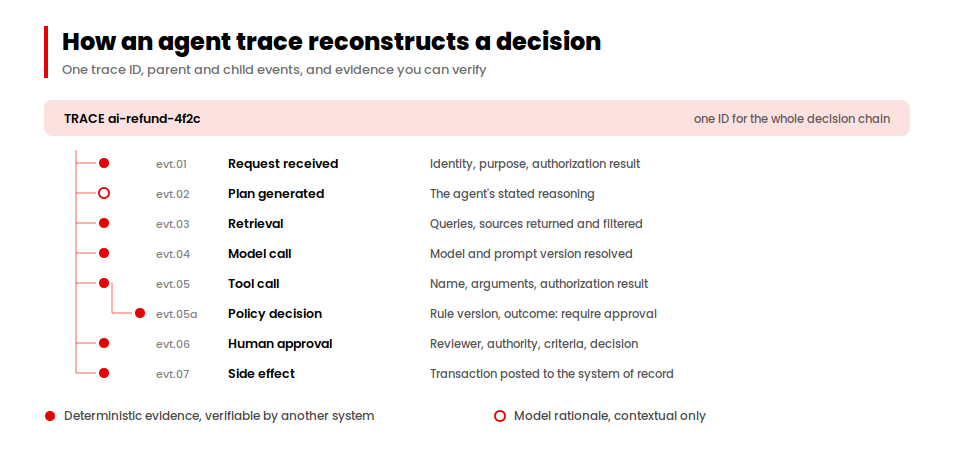
An AI agent audit trail needs parent-child links across planning, retrieval, model calls, tools, approvals, and actions. Give the overall run a trace ID, then assign event IDs to every step so investigators can rebuild the sequence without relying on a generated summary.
Record the agent’s stated rationale as contextual evidence while preserving deterministic facts separately. Tool requests, API responses, policy decisions, database changes, and approval events carry stronger evidentiary value because another system can verify them.
This distinction matters when an agent acts across several systems. The audit trail should reveal permission boundaries, failed attempts, retries, delegated sub-agents, intervention points, and whether a rollback restored the previous state.
How to Create an Audit Trail for AI Decisions
I build auditability into the workflow before production deployment. Retrofitting evidence after an incident usually leaves gaps because inputs, configurations, and temporary tool responses may already be gone.
Define the Auditable Event and Decision Boundary
Start with the business event that someone may need to explain. Examples include approving a refund, ranking an applicant, recommending a treatment, or updating a customer record.
Define where the decision begins, who can initiate it, which systems it can touch, and what counts as the final outcome. This boundary determines the required evidence.
Standardize Event IDs and Link Related Records
Assign one trace ID to the decision chain and a unique event ID to each component action. Include parent event IDs so retrievals, LLM calls, tool executions, and human approvals retain their sequence.
Use a versioned schema with UTC timestamps and consistent event types. Schema changes should preserve backward compatibility or include documented migration rules.
Protect Integrity, Retention, and Retrieval
Use append-only storage, restricted service identities, encryption, integrity hashes, and monitored administrative access. Hash chaining, digital signatures, or write-once-read-many storage can provide stronger tamper evidence where the risk requires it.
Retention should follow applicable legal, contractual, privacy, and operational requirements. Logging everything forever increases storage cost and can turn the evidence repository into a concentrated source of sensitive data.
Test Reconstruction Before an Audit Request
Select a sample decision and ask an independent reviewer to reconstruct it using stored evidence. The reviewer should identify the requester, sources, model state, policies, outputs, actions, and human decisions without help from the original developer.
Measure retrieval time, missing links, unreadable exports, and access-control failures. Repeat the test after schema changes, model releases, and workflow integrations.
Implementation cost depends on the evidence burden rather than a universal per-event figure:
| Cost area | What increases effort | Cost-control decision |
|---|---|---|
| Event capture | More models, tools, agents, and connected systems | Limit fields according to workflow risk |
| Sensitive payloads | Prompts or outputs containing regulated data | Use redaction, hashing, or secure references |
| Integrity controls | Signatures, hash chains, and write-once storage | Match controls to evidentiary requirements |
| Retention | High event volume and long retention periods | Apply approved retention classes |
| Retrieval | Cross-system joins and audit export formats | Standardize IDs and schemas early |
| Testing | Frequent releases and control changes | Automate reconstruction checks where practical |
Need Help Designing an AI Governance Framework?
Move from experimental AI use cases to production-ready systems with clear controls, monitoring, and accountability built into every workflow.
EU AI Act Audit Trail Requirements: What Article 12 Covers
Article 12 of the EU AI Act addresses record-keeping for high-risk AI systems. Its central requirement is that those systems technically support automatic event recording over their lifetime, with logs capable of supporting risk identification, post-market monitoring, and operational oversight.
The obligation’s application depends on the system’s classification, the organization’s role, jurisdiction, and other applicable law. An audit trail also forms only one part of AI Act readiness. This section provides educational guidance; qualified counsel should assess a specific deployment.
AI Audit Trail Readiness Checklist
When evaluating AI audit trail tools or a custom implementation, I ask teams to prove that evidence can be retrieved and connected. A feature list provides limited assurance until a sample decision survives reconstruction.
| Control | Evidence location | Typical owner | Retrieval test |
|---|---|---|---|
| Requester identity | Identity or audit store | Security | Find the authenticated actor |
| Purpose and authorization | Policy decision record | Governance | Show the permission evaluated |
| Input reference | Evidence repository | Data owner | Retrieve the decision-time input |
| Retrieval provenance | RAG trace store | AI engineering | List returned and filtered sources |
| Model version | Model registry | ML engineering | Resolve the exact model artifact |
| Prompt and workflow version | Version control or prompt registry | AI engineering | Reproduce the active instruction |
| Policy state | Policy registry | Governance | Identify the rule version applied |
| Tool calls and responses | Agent trace store | Platform engineering | Rebuild the action sequence |
| Human review and override | Workflow system | Process owner | Show criteria, decision, and authority |
| Outcome and side effect | System of record | Operations | Confirm the final external change |
| Integrity and access history | Security evidence store | Security | Detect alteration or privileged access |
| Retention and export | Archive or evidence platform | Legal and compliance | Produce a scoped evidence package |
If several rows require manual reconstruction across unlinked systems, I would treat the organization as partially ready. The next step is to define an evidence architecture, ownership model, and repeatable reconstruction test before expanding AI autonomy.
A useful AI audit trail is ultimately a testable evidence chain. If your team can retrieve one consequential decision and explain every material step, you have a foundation for stronger governance; if the chain breaks, you have a clear implementation backlog.
Conclusion
As AI systems become more autonomous and more deeply connected to business operations, organizations need more than model monitoring or application logs. They need evidence that explains how a decision was reached, what data influenced it, which controls operated, and what actions followed.
A well-designed AI audit trail creates that accountability layer. It connects identity, inputs, retrieval sources, model versions, policies, tool activity, human intervention, and outcomes into a traceable record that can withstand investigation and governance review.
The goal is not to capture every possible event. It is to preserve the right evidence so teams can reconstruct high-impact decisions quickly, protect sensitive information, meet regulatory expectations, and improve trust in AI systems. Organizations that build auditability into AI workflows from the start will be better positioned to scale AI responsibly while maintaining control.
Build AI Systems With Governance and Traceability Built In
From AI strategy to production deployment, our team helps organizations design secure, scalable AI solutions with the controls needed for responsible adoption.