












 ChatGPT
 Perplexity
 Claude
 Google AI
An application modernization strategy is the roadmap enterprises use to upgrade, restructure, or replace legacy applications so they run on current infrastructure, meet security and compliance requirements, and keep pace with business change. It starts with a full portfolio assessment, moves into selecting a modernization approach for each application (rehost, refactor, rebuild, replace, or retire), and ends with a phased execution plan tied to budget and business priorities.
No single approach fits an entire application portfolio. A payroll system that still works fine but runs on aging hardware might only need rehosting. A customer-facing platform that can’t support new features might need a full rebuild. A modernization strategy is what ties these individual decisions into one coordinated plan instead of a string of disconnected projects.
In this guide, you’ll learn how to evaluate legacy applications, compare the common application modernization strategies, build a modernization roadmap, estimate costs, choose the right technologies, and measure business impact.
What Is Application Modernization?
Application modernization is the process of updating the technology, architecture, or infrastructure of an existing application so it meets current performance, security, and scalability standards, without rebuilding the entire system from zero. It’s different from a routine software update because it touches the underlying platform, the codebase, or the architecture itself, not just features or a UI refresh.
Modernization spans a spectrum of effort. On the light end, it can mean moving an application from an on-premises data center to the cloud with minimal code changes. On the heavy end, it can mean breaking apart a monolithic application into microservices and rewriting core logic. Most enterprises use several of these approaches at once, matching the level of effort to what each application actually needs.
Application Modernization vs. Application Migration
Application migration and application modernization are closely related, but they solve different problems. Migration focuses on moving an application from one environment to another, while modernization changes the application itself so it can better support current and future business needs.
| Dimension | Application Migration | Application Modernization |
|---|---|---|
| What changes | The application’s hosting environment, such as moving from on-premises to the cloud or between cloud providers. | The application’s architecture, codebase, platform, or supporting technologies. |
| Scope | Primarily infrastructure focused. | Can include infrastructure, code, databases, integrations, and user experience. |
| Goal | Relocate the application with minimal disruption. | Improve performance, scalability, maintainability, and long-term value. |
| Effort level | Usually lower, especially for lift-and-shift migrations. | Varies depending on the approach, from replatforming to a complete rebuild. |
| Business outcome | Reduced infrastructure overhead and greater deployment flexibility. | Faster innovation, lower technical debt, and applications that are easier to maintain and expand. |
In practice, legacy migration is often step one of a broader modernization strategy. For example, a business may first move an application to the cloud to retire aging infrastructure. Once the application is running in its new environment, the team can gradually refactor services, modernize databases, or adopt containers and automated deployment pipelines. Breaking the work into phases reduces risk while allowing the business to realize value earlier.
Why Modernize Legacy Applications?
Organizations modernize legacy applications when aging systems begin limiting business growth, increasing operational risk, and slowing innovation. As technical debt accumulates and legacy technologies reach end of support, organizations face rising maintenance costs, security concerns, and growing difficulty adapting to changing business requirements. Modernization enables organizations to reduce these risks before they affect business continuity, customer experience, and long-term competitiveness.
The most common reasons enterprises modernize include:
- Growing technical debt: Years of patches, workarounds, and outdated dependencies make applications increasingly difficult to maintain and enhance.
- End-of-support technologies: Legacy frameworks, operating systems, and databases eventually lose vendor support, leaving organizations without security updates or critical patches.
- Security and compliance risks: Unsupported software and aging infrastructure increase exposure to cyber threats and make it harder to meet evolving regulatory requirements.
- Limited flexibility: Legacy architectures often make it difficult to respond quickly to changing business priorities, customer demands, or market opportunities.
- Integration challenges: Older applications frequently struggle to connect with cloud services, APIs, analytics platforms, and AI-powered tools, creating operational silos.
- Talent shortages: As legacy technologies become less common, finding developers with the required expertise becomes increasingly difficult and expensive.
- Escalating maintenance costs: Organizations often spend a growing share of their IT budget maintaining aging systems instead of investing in innovation.
These challenges explain why application modernization has become a strategic priority across industries. According to Red Hat’s latest State of Enterprise Open Source report, application modernization ranked alongside DevOps and application development as one of the top IT priorities for enterprise and government IT leaders, trailing only containerization.
Application Modernization Assessments
A modernization strategy should begin with an assessment, not a migration plan. Before deciding whether to rehost, refactor, replatform, or rebuild an application, organizations need to understand which systems deserve investment and which don’t.
A typical application modernization assessment evaluates each application from two perspectives:
- Business value: How important is the application to business operations, revenue, customer experience, or competitive advantage?
- Technical health: How maintainable is the application based on factors such as code quality, security, architecture, infrastructure, dependencies, and documentation?
Looking at both factors together helps organizations prioritize modernization efforts instead of relying on assumptions or application age alone.
At AppVerticals, we use a framework called the Modernization Priority Matrix to translate those findings into a practical roadmap. Each application is placed into one of four categories based on its business value and technical health.
| Business Value | High Technical Health | Low Technical Health |
|---|---|---|
| High Business Value | Maintain and optimize: Continue improving the application while monitoring its performance and reliability. | Modernize first: Prioritize these applications for refactoring, replatforming, or rebuilding because they are critical to the business but technically holding it back. |
| Low Business Value | Rehost or maintain: Keep the application running with minimal investment and review it periodically. | Retire or replace: Plan to decommission the application or replace it with a SaaS solution if it no longer justifies ongoing maintenance. |
Using this type of assessment prevents organizations from treating every legacy application the same. Some older systems continue to deliver strong business value with little technical risk, while others consume significant resources without supporting strategic goals. A structured assessment highlights where modernization will have the greatest business impact and where maintaining or retiring an application is the better decision.
For a broader view of why enterprises are prioritizing modernization today, take a look at our legacy software modernization statistics.
Common Application Modernization Strategies
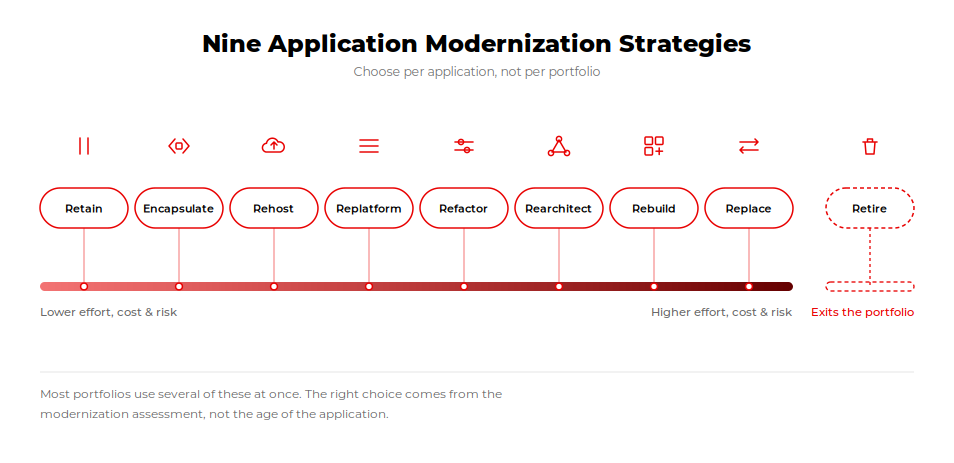
The 7 Rs are rehost, replatform, refactor, rearchitect, rebuild, replace, and retire: seven application modernization paths that range from a simple lift-and-shift migration to complete application replacement or decommissioning. Each approach addresses a different combination of technical complexity, business value, cost, and risk.
After assessing your application portfolio, the next decision is choosing the right modernization approach. There isn’t a single strategy that works for every application. Some systems only need a change in infrastructure, others require significant architectural changes or complete replacement, and some don’t need to move at all. The strategies below give you a full set of options to choose from based on an application’s business value, technical health, and long-term role in the organization.
| Strategy | When It’s the Right Choice |
|---|---|
| Retain | Leave the application as it is for now. Best for systems that work fine, aren’t a current priority, or where the cost of change outweighs the benefit. |
| Encapsulate | Wrap the application’s existing data and functions behind a modern API, without rewriting the underlying code. Best when other systems need to access legacy functionality but a full rebuild isn’t justified yet. |
| Rehost | Move the application to a new environment, such as the cloud, with little or no code changes. Best when the goal is to migrate quickly and reduce infrastructure costs. |
| Replatform | Make targeted improvements that allow the application to take advantage of the new platform without changing its core architecture. |
| Refactor | Improve the existing codebase to make it easier to maintain, scale, and enhance while preserving the application’s functionality. |
| Rearchitect | Redesign the application’s architecture, such as breaking a monolithic application into microservices, to improve scalability and flexibility. |
| Rebuild | Develop the application from the ground up when the current architecture can no longer support business requirements. |
| Replace | Move to a commercial SaaS solution when maintaining a custom application is no longer practical or cost-effective, distinct from retiring it outright since the underlying business function still needs to be served. |
| Retire | Decommission applications that no longer provide meaningful business value, eliminating unnecessary maintenance and security risks. |
Large organizations rarely rely on just one of these approaches. A portfolio may include applications that are simply rehosted, others that are refactored over time, and a few that are rebuilt or retired altogether. The right choice depends on the findings from the modernization assessment, not on the age of the application or a one-size-fits-all strategy.
How to Build an Effective Application Modernization Strategy
An effective application modernization strategy starts with understanding your application portfolio, not choosing a technology. Before investing in cloud migration, code changes, or new platforms, organizations need to identify which applications deliver the most business value and what each one requires to support future growth.
Google’s CIO Guide to Application Modernization recommends approaching modernization as a business transformation initiative, prioritizing applications based on business value, technical complexity, and long-term strategic objectives rather than modernizing every system at once.
Most successful modernization initiatives follow these steps:
- Assess your application portfolio. Create an inventory of every application, including its purpose, dependencies, infrastructure, and business owner.
- Evaluate business value and technical health. Assess how critical each application is to the business alongside factors such as architecture, code quality, security, maintainability, and performance.
- Choose the right modernization approach. Based on the assessment, determine whether the application should be rehosted, replatformed, refactored, rearchitected, rebuilt, replaced, or retired.
- Prioritize the roadmap. Modernize applications in an order that balances business impact, technical risk, and application dependencies instead of tackling every system at once.
- Plan budgets, timelines, and governance. Break the initiative into manageable phases, assign ownership, establish success metrics, and prepare rollback plans for critical applications.
- Execute incrementally. Deliver modernization in phases, validating each stage before moving to the next. This reduces risk, minimizes disruption, and allows teams to adapt as the project progresses.
Following a structured process helps organizations focus their resources where modernization will have the greatest business impact while reducing unnecessary risk throughout the transformation.
Planning Your Modernization Roadmap?
Learn more about our legacy software modernization approach, including the process, technologies, and solutions we use to help organizations modernize their applications.
Explore Legacy Software Modernization Services →Application Modernization Cost and Timeline by Strategy
The cost and duration of an application modernization project depend largely on the approach you choose. A simple rehosting project can often be completed in a matter of weeks, while rebuilding a business-critical application may take several months.
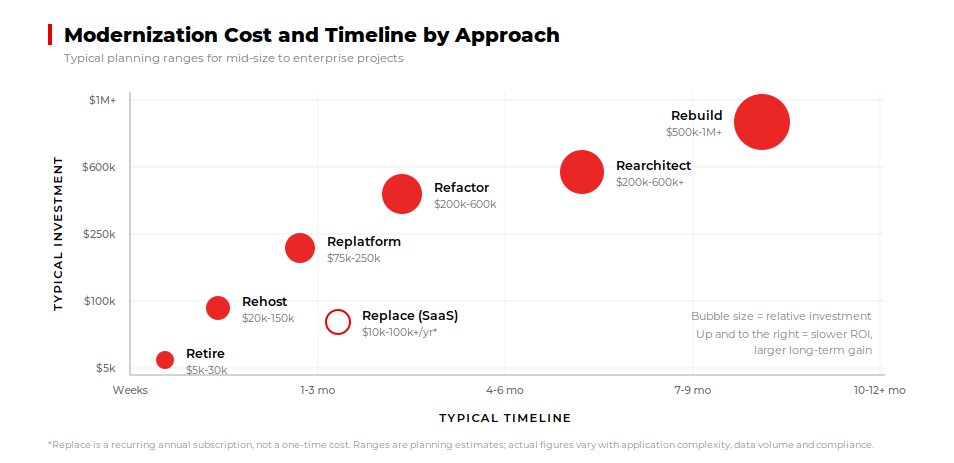
Factors such as application complexity, data migration, integrations, compliance requirements, and testing also influence the overall investment. The table below provides general planning estimates for each modernization strategy:
| Approach | Typical Cost Range | Typical Timeline | Relative ROI Speed |
|---|---|---|---|
| Rehost | $20,000–$150,000 | Weeks to 2 months | Fast, but limited long-term gain |
| Replatform | $75,000–$250,000 | 1–3 months | Fast |
| Refactor | $200,000–$600,000 | 2–5 months | Moderate |
| Rearchitect | $200,000–$600,000+ | 4–9 months | Slower, but larger long-term gain |
| Rebuild | $500,000–$1,000,000+ | 6–12+ months | Slowest, highest long-term gain |
| Replace (SaaS) | $10,000–$100,000+ per year (subscription, not one-time) | 1–4 months | Fast |
| Retire | $5,000–$30,000 | Weeks | Immediate cost avoidance |
Cost and timeline vary significantly by which of the 7 Rs an application needs. The ranges reflect what we typically see across mid-size to enterprise application modernization projects; actual figures depend on application complexity, data volume, and compliance requirements. For a deeper breakdown, see our full guide on legacy software modernization cost.
Key Technologies for Application Modernization
Application modernization relies on a combination of technologies that improve scalability, deployment, security, and operational efficiency. While the technology stack varies by organization, most modernization initiatives are built on a common set of tools and platforms.
What’s changed heading into 2026 is how much of the modernization process itself is now AI-assisted, not just AI-adjacent. Instead of being limited to AI-powered features within applications, organizations are now using AI to assess legacy systems, generate code, identify dependencies, plan migrations, and streamline testing. These changes are part of a broader shift toward AI in software development, where engineering teams use AI tools across coding, testing, debugging, and application maintenance workflows.
| Modernization Stage | AI Use Case | Example |
|---|---|---|
| Discovery | Automated code and dependency analysis | AI tools scan legacy codebases to map dependencies, dead code, and undocumented business logic before a human reviews it. |
| Migration | Automated infrastructure mapping | AI-assisted tools translate on-prem configurations into infrastructure-as-code templates for the target cloud environment. |
| Refactoring | AI-assisted code transformation | Large language models help translate legacy language syntax (such as older Java or COBOL patterns) into modern equivalents, with engineers reviewing every change. |
| Testing | Automated test generation | AI generates regression test cases from existing application behavior, closing coverage gaps in undocumented legacy systems. |
AI shortens the discovery and testing phases the most, since those stages depend heavily on understanding code that often has little to no documentation. It does not remove the need for engineers to validate business logic and compliance-sensitive changes by hand.
Application Modernization Benefits
Modernizing legacy applications delivers measurable business value beyond replacing outdated technology. By adopting modern architectures, cloud platforms, and automated development practices, organizations can improve operational efficiency, accelerate software delivery, reduce long-term costs, and build a technology foundation that supports future growth.
Some of the most common benefits include:
- Lower operating costs: Modern infrastructure, automation, and reduced technical debt lower long-term maintenance and infrastructure expenses.
- Faster software delivery: Modern architectures and CI/CD pipelines enable teams to release new features, updates, and fixes more quickly.
- Improved application performance: Modernized applications typically provide faster response times, greater reliability, and higher availability.
- Greater scalability: Cloud-native platforms allow applications to scale efficiently as workloads and business demands change.
- Stronger security posture: Modern platforms include built-in security capabilities, receive regular security updates, and simplify compliance with industry standards.
- Higher developer productivity: Modern tools, cleaner architectures, and automated workflows allow engineering teams to spend more time building new capabilities instead of maintaining legacy systems.
- Better customer experiences: Faster, more reliable applications improve usability, responsiveness, and overall customer satisfaction.
- Future-ready technology foundation: Modernized applications are easier to integrate with cloud services, data platforms, automation tools, and AI capabilities, making future digital initiatives faster and less complex.
While outcomes vary by organization, the objective remains the same: build applications that are easier to maintain, scale, and adapt as business needs evolve.
See How We Modernized a Legacy Platform for 685,000+ Customers
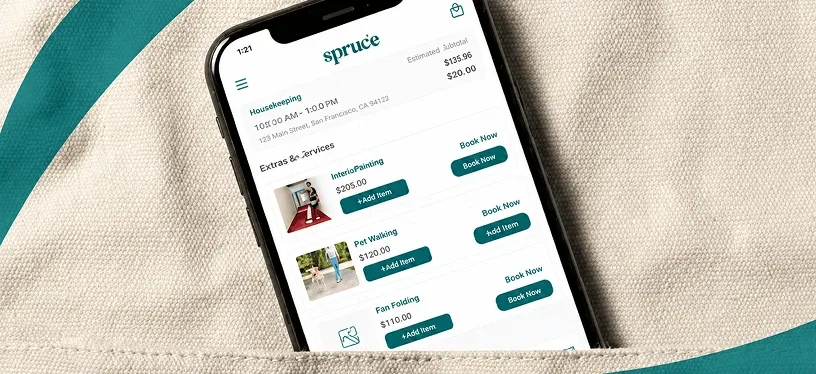
As Spruce scaled across U.S. markets, AppVerticals rebuilt its legacy platform with modern architecture, role-based apps, automation, and scalable pricing. The new system now supports 685,000+ customers, 6,477 properties, and 7,581 property management companies.
Read Full Case StudyHow to Build a Business Case for Application Modernization
A successful business case for application modernization focuses on business outcomes, not technical upgrades. While engineering teams may emphasize architecture, code quality, or cloud adoption, leadership wants to understand how modernization will reduce costs, improve efficiency, lower risk, and support future growth.
To build a compelling case, include the following:
- Quantify the current challenges: Identify how legacy applications affect the business through rising maintenance costs, security risks, operational inefficiencies, slower product releases, or frequent outages.
- Prioritize investments: Show which applications should be modernized first and explain why. Focusing on high-value, high-impact systems helps demonstrate that resources will be used where they deliver the greatest return.
- Define measurable business outcomes: Connect each phase of the modernization initiative to metrics such as lower infrastructure costs, improved application performance, faster release cycles, fewer production incidents, or increased developer productivity.
- Present a phased roadmap: Breaking the initiative into smaller milestones reduces implementation risk, delivers value sooner, and gives stakeholders confidence that progress can be measured throughout the project.
Decision-makers are more likely to approve modernization initiatives when they can clearly see the business value, expected outcomes, and a practical roadmap for achieving them. A well-supported business case turns modernization from a technical proposal into a strategic investment.
How Do You Measure the ROI of Application Modernization?
The return on investment (ROI) of application modernization extends beyond infrastructure savings. While reducing operational costs is important, organizations should also measure improvements in software delivery, system reliability, and business performance to understand the full impact of their modernization efforts.
Some of the most meaningful KPIs include:
- Operational efficiency: Compare infrastructure and maintenance costs before and after modernization, along with reductions in manual support work and production incidents.
- Development productivity: Measure improvements in deployment frequency, release cycle time, lead time for changes, and the time engineers spend maintaining legacy systems versus building new features.
- Application performance and reliability: Track uptime, response times, system availability, and the number of critical defects or outages after modernization.
- Business outcomes: Monitor metrics such as customer satisfaction, customer retention, feature adoption, and time to market for new products or capabilities.
The strongest ROI assessments combine technical, operational, and business metrics rather than focusing on cost savings alone. This provides a more complete view of how modernization is improving both the technology landscape and the organization’s ability to deliver value over time.
Final Thoughts
If there’s one takeaway from this guide, it’s this: every legacy application deserves a different decision. Some should be modernized, some migrated, and some retired altogether. The challenge isn’t choosing the newest technology. It’s knowing where to invest first and which approach will deliver the greatest value for your business.
That’s why the most successful modernization initiatives start with an assessment. Once you understand the current state of your application portfolio, the path forward becomes much easier to plan.
Get a Modernization Priority Assessment
Discover the fastest, most cost-effective path to modernizing your application portfolio.
Request Your Free Assessment →