Zohra is a technical project manager specializing in enterprise platform architecture and systems integration. With 11 years of experience spanning software engineering and technical project management, she now leads Odoo, Sitecore, AWS, and Microsoft Dynamics...
In 2026, Odoo ERP powers over 16 million users globally and 170,000+ active enterprises, making it a statistically validated growth engine reshaping the mid-market ERP landscape. For CEOs, CFOs, CTOs, and digital transformation leaders, the question is no longer whether Odoo ERP is viable, but how fast it’s growing, its market share, and its long-term stability.
After a number of Odoo consulting and implementation projects, I’ve learned that successful ERP adoption is not just about software; it’s about operational ROI, scalability, and measurable business growth.
I have compiled this report with the most relevant Odoo ERP market statistics, adoption trends, financial metrics, and industry data for 2026, helping decision-makers interpret the numbers behind the platform’s rise. Without any further ado, let’s dig in.
16+ million users globally and over 170,000 active enterprise customers make Odoo one of the fastest-growing ERP platforms worldwide.
120,000+ new customers annually, growing at ~20–25% CAGR, outperforming SME-focused ERP offerings from SAP, Oracle, and Microsoft Dynamics.
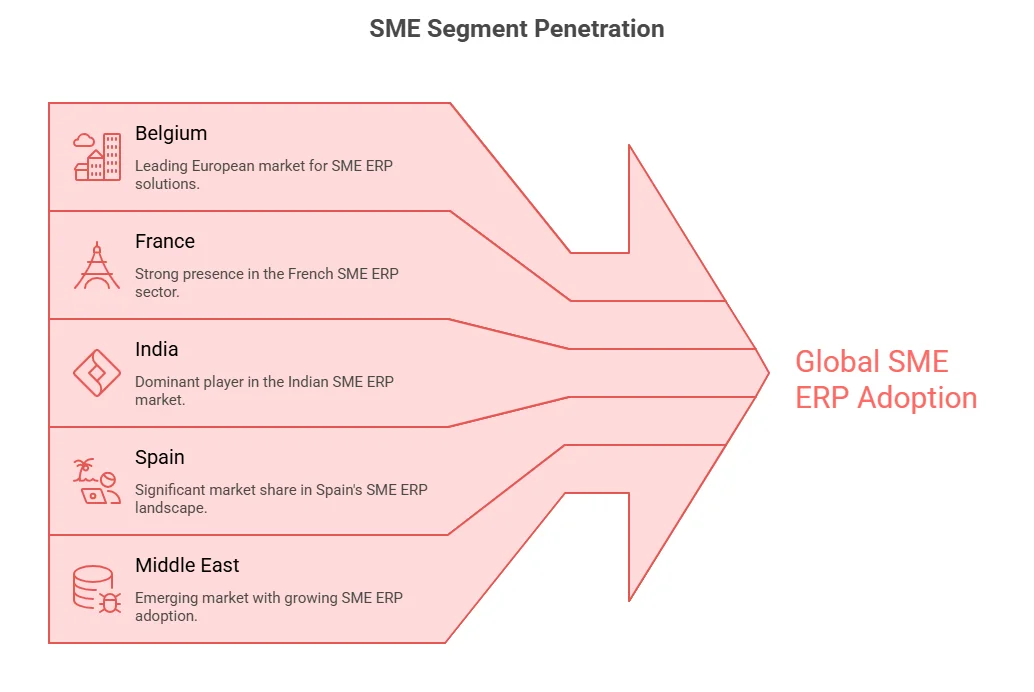
Odoo holds 5.77% global ERP market share, and 12–15% of SME ERP adoption, with the strongest presence in Belgium, France, India, Spain, UAE, and Saudi Arabia.
According to StartUpBusiness, Revenue is scaling rapidly like a SaaS platform: €650M in 2025, projected to be €800M+ in 2026, targeting €1B by 2027, with 42% annual recurring revenue (ARR).
Implementation speed is a major adoption driver: 2–4 months for 10–25 users, 6–12 months for 100+ users, compared to 12–24 months for SAP.
Cost advantage is substantial: As per Bresdel, Odoo Enterprise TCO for 50 users: $315K–387K, up to 65% lower than legacy vendors, thanks to flat per-user pricing and no per-module fees.
Adoption spans industries with measurable ROI: 25–35% production lead-time reduction in manufacturing, 15% inventory accuracy improvement in retail, 20–30% faster billing cycles in professional services, and 40–60% faster setup in hospitality & real estate.
Cloud & AI adoption is high: 60% of core apps are AI-enabled, 35% automated invoice OCR adoption, 20–30% reduction in stock-outs with predictive demand planning.
Odoo supports 10,000+ concurrent users, millions of daily transactions, and multi-company, multi-currency reporting, proving its scalability for mid-market enterprises.
Despite adoption success, ERP failure risk persists: 75% of projects miss objectives, 74% exceed budget, and 61% run over schedule, usually due to data migration, integration, or governance issues, not the platform itself.
For organizations seeking expert guidance on Odoo implementation, AppVerticals delivers proven strategies, customizations, and integrations that maximize ERP ROI.
How Many Users Does Odoo ERP Have Globally in 2026?
Odoo ERP has over 16 million users worldwide in 2026, with 120,000+ new customers added annually.
Odoo is positioning itself as the dominant modular ERP for mid-market businesses (10–500 employees).
How Much Revenue Is Odoo ERP Generating and How Fast Is It Growing?
Odoo generated about €650M in revenue in 2025, is projected to exceed €800M in 2026, and is targeting €1B by 2027, reflecting strong ARR growth and SaaS-like scaling.
Observation: Odoo is scaling like a SaaS company, not a traditional enterprise vendor.
How Is Odoo ERP Being Adopted Across Industries in 2026?
Odoo ERP shows broad adoption across sectors, driving lead‑time reductions in manufacturing, faster checkout and inventory gains in retail, optimized services billing, and quicker setup in hospitality and real estate.
For mid-market companies, Odoo ERP adoption is often justified within the first fiscal year.
How Has the Odoo ERP Partner Ecosystem Grown in 2026?
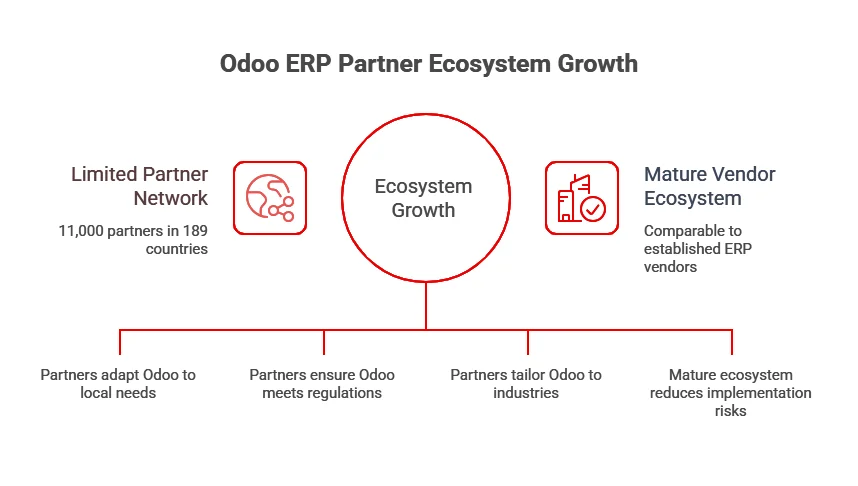
Odoo’s global partner network exceeds 11,000 certified partners in 189 countries, supporting localization, industry‑specific implementation, and broader ecosystem maturity.
Ecosystem growth supports:
Localization
Compliance adaptation
Industry-specific implementation
Lower deployment risk
Vendor ecosystem maturity is now comparable to established ERP vendors.
How is Odoo ERP Leveraging Cloud and AI in 2026?
Odoo ERP leverages cloud deployment and AI to automate processes, improve forecasting, and scale efficiently, making it a proactive platform for SMEs.
Expert Opinion: I see Odoo continuing to grow in the SME market, with more AI features and ecosystem expansion in the coming years. – Omar Farh, Odoo Developer
This indicates that Odoo ERP is no longer “just open-source,” it is AI-augmented and cloud-native.
Expert Opinion: The “composable ERP” trend – Businesses are moving away from monolithic systems toward modular platforms. Odoo’s app-based architecture fits perfectly with this shift, letting companies build their tech stack incrementally rather than committing to massive upfront investments. Economic pressures are accelerating the shift – With the current economic climate, CFOs are scrutinizing every software expense. Companies are actively looking to consolidate their tech stack, and Odoo can replace 5-10 different SaaS subscriptions at a fraction of the cost. The SMB market maturation – Mid-market companies that outgrew QuickBooks but aren’t ready for SAP now have viable options. Odoo has really matured in recent years – better UX, more robust features, stronger partner ecosystem. It’s no longer just for small shops. Developer community momentum – There’s a growing pool of Odoo developers and implementation partners globally, particularly in regions like India, Europe, and Latin America. This makes implementation more accessible and competitive pricing-wise. – Jihad Mahfouz, Full Stack Developer
Where Is Odoo ERP Experiencing the Most Geographic Growth in 2026?
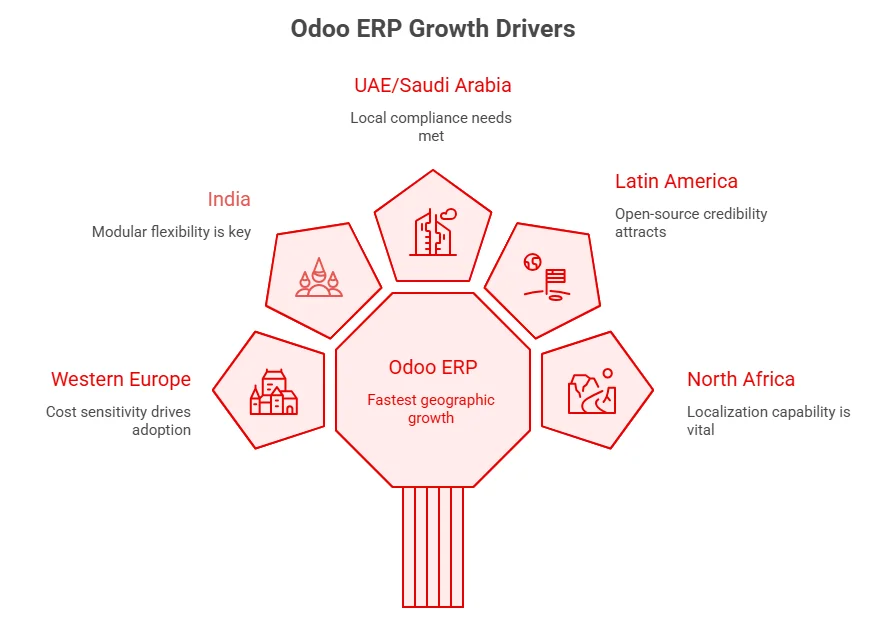
Odoo ERP is growing fastest in regions like Western Europe, India, the UAE & Saudi Arabia, Latin America, and North Africa, driven by cost sensitivity, modular flexibility, and local compliance needs.
Emerging markets show the fastest acceleration due to:
Cost sensitivity
Modular flexibility
Open-source credibility
Localization capability
How Does Odoo ERP Compare Competitively in the Market in 2026?
Odoo competes strongly on cost, speed, modularity, and flexibility versus legacy vendors like SAP, Oracle, and NetSuite, making it especially appealing for mid‑market and SME deployments
Category
Odoo
SAP
Oracle
NetSuite
User Experience
Highly intuitive and user-friendly
Complex and requires training
Moderately user-friendly
Fairly easy with some learning curve
Cost Structure
Budget-friendly and scalable
Premium-priced solution
High-cost enterprise pricing
Mid-to-upper pricing range
Flexibility & Customization
Extremely adaptable with extensive customization options
Limited flexibility
Moderate customization capabilities
Restricted customization compared to others
Ideal For
Organizations of all sizes, from startups to large enterprises
Large-scale corporations
Multinational firms with complex HR and operations needs
Growing mid-market companies seeking a cloud-based ERP
How Scalable Is Odoo ERP in 2026?
Performance metrics:
10,000+ concurrent users supported
Millions of daily transactions are possible
Multi-company, multi-currency environments
Consolidated reporting across global entities
Scalability is no longer a barrier for mid-market enterprises.
What Challenges and Market Constraints Does Odoo ERP Face?
Despite strong statistics, Odoo ERP has limitations:
Steeper learning curve vs accounting-only systems
Customization maintenance overhead
Not ideal for extremely regulated industries
Large enterprise (10,000+ users) complexity may require additional architecture
However, adoption trends show these constraints are not slowing mid-market growth.
Why Do Some Odoo ERP Implementations Fail?
Despite its rapid adoption, a significant number of Odoo ERP implementations run into serious issues that can undermine expected ROI and delay go-live dates.
Up to 75% of ERP projects fail to achieve original objectives, with only about 23% considered fully successful, while 74% exceed budget and over 61% take longer than planned. This high failure rate reflects integration, scope, and planning issues that plague many Odoo deployments.
One of the most common implementation failure causes remains poor data migration. Migrating data from legacy systems to Odoo often results in incomplete maps, corrupt records, and lost history when not properly audited and cleansed beforehand, increasing the likelihood of post-go-live disruptions.
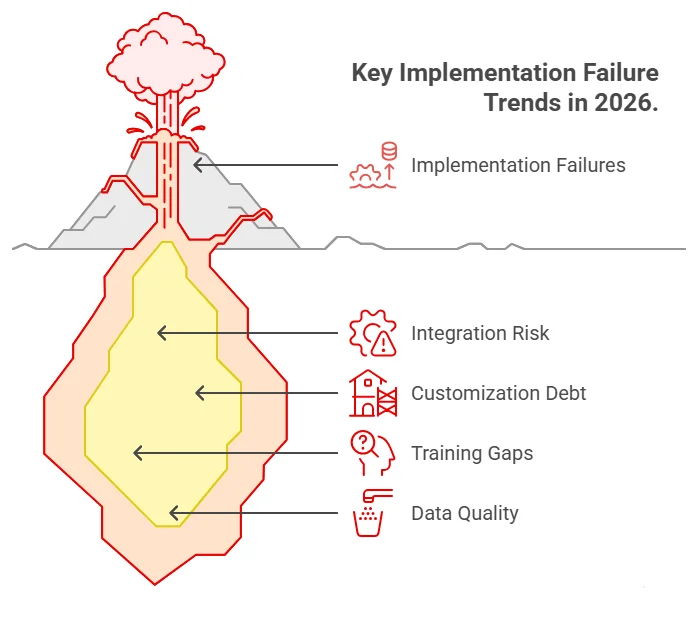
Key Implementation Failure Trends to Watch in 2026
Integration risk remains a top threat: as ERP ecosystems expand, projects require more real-time data syncs and API connections between Odoo and legacy or third-party systems, failures in which account for a large share of overruns in cost, time, and scope.
Customization debt is increasing: firms trying to replicate legacy processes instead of re-engineering workflows in Odoo risk prolonged upgrade cycles and escalating maintenance bills.
Training and adoption gaps continue to derail otherwise functional implementations, especially in self-implemented or under-managed projects.
Data quality and migration complexity remain core risk vectors, emphasizing the need for phased dry runs and extensive cleansing prior to go-live.
Failure Red Flags Every Buyer Should Monitor in 2026
To avoid becoming another statistic, stakeholders should watch for:
No detailed scope or KPI documentation before project kickoff
Frequent scope changes during build without change control
Low user participation in testing (lack of UAT)
No dedicated change management plan
Integration delays that push go-live phases outward
These are consistent risk patterns across multiple Odoo implementation mistake analyses, reinforcing that failure is rarely due to the ERP itself, but due to project governance failures.
Odoo Looks Simple—Until You Implement It
Don’t become part of the 75% ERP failure statistic. AppVerticals delivers risk-controlled Odoo implementations built for measurable ROI.
Trend 5: Shift from On-Premise to SaaS: Cloud-first deployments are now the majority.
Expert Opinion: Odoo has emerged as one of the fastest-growing ERP platforms in recent years, driven by its ability to deliver a comprehensive and flexible solution at a competitive cost. It positions itself effectively between complex, high-cost legacy systems and lightweight tools with limited functionality, making it particularly attractive for growing businesses. With continued expansion in cloud capabilities and automation features, Odoo appears well-positioned to strengthen its global market presence in the coming years.
– Amr Abuzeid, Sr. Odoo Functional Consultant
Final Analysis: What the Statistics Signal
The 2026 data confirms Odoo ERP has transformed from a niche open-source option to a high-growth, globally adopted, financially robust ERP platform. Key stats highlight:
User Base & Market Growth: 16+ million users, 170,000+ enterprise customers, 120,000+ new clients annually, and CAGR ~20–25%.
Revenue & Financial Strength: €650M in 2025, projected €800M+ in 2026, ARR at 42%, targeting €1B by 2027. Valuation exceeds $5B, signaling stability and reinvestment capacity.
Market Positioning: 5.77% global ERP market share, 12–15% SME segment adoption, competing against 250+ ERP vendors. Dominates modular, cloud-first, AI-embedded ERP adoption for mid-market enterprises.
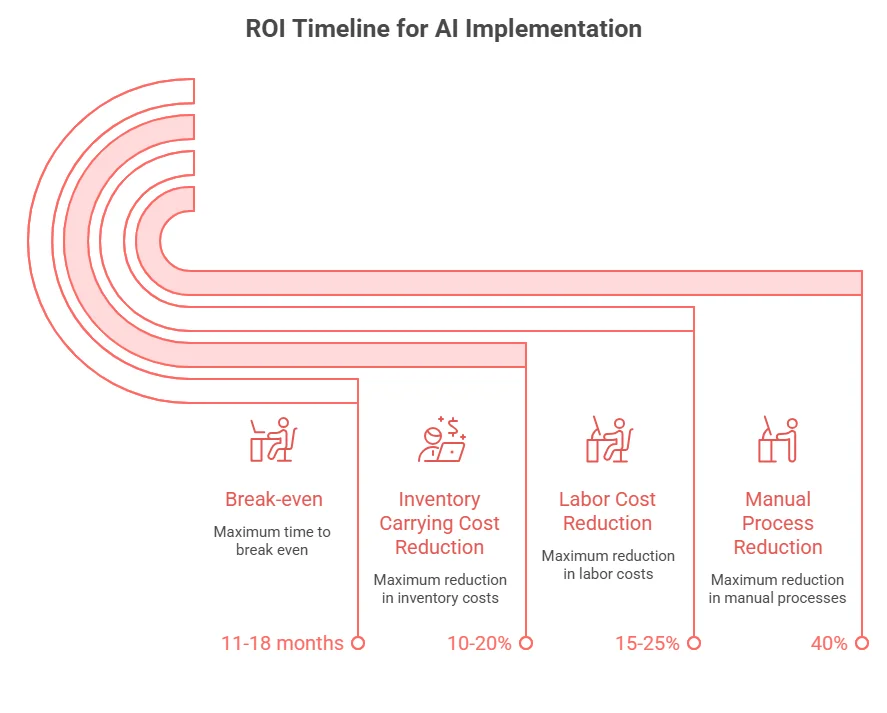
Operational ROI: Break-even within 11–18 months, 15–25% labor cost reduction, up to 40% manual process reduction, 10–20% lower inventory carrying costs.
Implementation Efficiency: Average deployment of 2–12 months depending on company size, 89% report <48 hours downtime, 92% rate migration “smooth” or “very smooth”.
Cost & TCO Advantage: Up to 65% lower 5-year TCO than SAP, Oracle, or Microsoft Dynamics. Flat per-user pricing, automated upgrades, and no forced bundles drive affordability.
Cloud & AI Adoption: 60% of apps are AI-enabled, automated invoice OCR adoption up 35%, predictive sales & demand planning reducing stock-outs 20–30%.
Global Expansion: Strongest growth in Western Europe, India, UAE, Saudi Arabia, Latin America, and North Africa, driven by modular flexibility, cost sensitivity, and local compliance.
Odoo ERP’s modularity, cost-effectiveness, speed, and AI/cloud features make it a top choice for SMEs and mid-market companies. Its growth signals vendor stability, a mature ecosystem, and proven ROI, making the real question how quickly it can boost operational efficiency.
More Related Guides:
AI in App Development Statistics 2026: Explores how AI integration in mobile and web apps is driving engagement, automation, and measurable ROI in 2026.
Global Mobile App Download Statistics 2026: Highlights worldwide mobile app download trends, user growth, and adoption patterns shaping the app ecosystem.
Telemedicine Statistics 2026: Reveals key telehealth adoption metrics, patient engagement trends, and digital healthcare growth in 2026.
Mobile App Development Market Growth and Size Statistics: Covers global market size, growth forecasts, and investment trends in mobile app development for 2026.
AI Chatbot Technology in 2026: Explores how AI chatbots are being adopted across mobile and web apps, driving automation, cost reduction, and measurable business ROI in 2026.
App Monetization Statistics 2026: Breaks down global app revenue benchmarks, monetization models, retention metrics, and AI-driven growth strategies shaping profitable apps in 2026.
Mobile vs Web App Revenue Statistics 2025–2026: Analyzes global consumer spend, SaaS growth, hybrid monetization, and platform economics shaping app profitability and retention in 2026.
AI Cloud Cost Statistics, Trends & Optimization (2026): Explores rising cloud spending, cost drivers, optimization strategies, and how AI is reshaping cloud efficiency and ROI in 2026.
SaaS Development & Adoption Statistics 2026: Highlights global SaaS market growth, adoption trends, revenue benchmarks, churn metrics, and AI-driven innovations shaping scalable software businesses in 2026.
E-commerce App Development Statistics 2026: Covers market size, mobile commerce growth, user behavior, AI adoption, development costs, and ROI insights shaping high-performing e-commerce apps in 2026.
AI Automation Statistics for Enterprises (2026): Covers adoption, ROI, costs, and key trends shaping enterprise AI execution.
Frequently Asked Questions
Over 170,000 companies globally use Odoo ERP, spanning 16+ million individual users across SMEs and mid-market enterprises. Adoption is growing by ~120,000 new customers per year, driven by modular, cloud-first deployment and cost-effective pricing. Key verticals include manufacturing, retail, distribution, professional services, eCommerce, hospitality, and real estate.
Odoo holds 5.77% of the global ERP market and a 12–15% share in the SME ERP segment, positioning it among the fastest-growing ERP platforms worldwide. Its modular architecture, competitive pricing, and rapid implementation cycles make it highly attractive for mid-market businesses in Europe, India, and the Middle East.
Yes. In the SME and mid-market segment, Odoo’s user base grows at a 20–25% CAGR, significantly faster than SAP, Oracle, or Microsoft Dynamics, which are more established in large enterprises. With 120,000+ new customers annually and rapid geographic expansion, Odoo is scaling like a SaaS platform rather than a traditional ERP vendor.
Odoo generated €650M in revenue in 2025, with 42% annual recurring revenue (ARR) growth, and is projected to exceed €800M in 2026. The company targets €1B revenue by 2027, with a valuation exceeding $5B. Strong revenue growth underlines financial stability, reinvestment capacity in R&D, and ecosystem expansion.
Odoo supports 10,000+ concurrent users, millions of daily transactions, multi-company, and multi-currency reporting. With 60% of core apps AI-enabled, predictive sales & demand planning, automated OCR invoicing, and cloud-first deployment, Odoo is AI-augmented, cloud-native, and fully scalable for mid-market enterprises.
Top industries include: • Manufacturing: 25–35% production lead-time reduction, 40% MRP accuracy improvement. • Retail & eCommerce: 113,000+ online stores powered, 20–30% faster POS checkout, 15% inventory accuracy improvement. • Distribution & Wholesale: Multi-warehouse optimization, automated procurement. • Professional Services: 20–30% faster billing cycles, better project margin tracking. • Hospitality & Real Estate: Pre-configured modules reduce setup time 40–60%.
Zohra is a technical project manager specializing in enterprise platform architecture and systems integration. With 11 years of experience spanning software engineering and technical project management, she now leads Odoo, Sitecore, AWS, and Microsoft Dynamics 365 engagements at AppVerticals.
Share This Blog
We’re AppVerticals
AppVerticals is where innovative startups and Fortune 500s come for transformation.
Choosing between Sitecore and WordPress depends on your organization’s scale, complexity, and digital experience goals. Sitecore provides an enterpris...
Odoo vs Microsoft Dynamics 365 comes down to a single honest distinction: Odoo is a cost-effective, all-in-one modular ERP built for flexibility, whil...
Odoo is better for faster, lower-cost, and modular ERP adoption, while SAP is better for large enterprises requiring deep process standardization, glo...
Zohra Jabeen
14 min read
Contact Us
Let’s Build Your Digital Future Great
Wait! You're So Close to Something Great
AppVerticals has developed 2000+ apps and digital products. Our experts are ready to help you build something amazing.
Still Thinking It Over?
Submit your details, and our team will reach out to explore how we can bring your idea to life.
A Technology Partner You Can Rely On
1000+ brands trust AppVerticals to create high-performing digital solutions.
Catherine
Founder, Real Estate Agency
They delivered a top-tier solution that’s fast, user-friendly, and packed with features tailored to the real estate industry. The team was professional, detail-oriented, and easy to work with from start to finish.
Bruce Wilson
CEO, Logistics SaaS Startup
The app came together exactly how we hoped. If you're looking for a team that knows what they’re doing and respects your time, they’re a solid choice.
Amit Chopra
Head of Marketing, Al Rostamani Group
Successfully delivered the project on time and within budget. They remained flexible and cooperative with backend content organization, and their support, company culture, and client-centric approach truly stood out.
Trusted by Global Industry Leaders
Your Next Big Idea Needs the Right Team
Share a few details and get a clear timeline, cost estimate, and technical roadmap, tailored to your idea.

















 ChatGPT
 Perplexity
 Claude
 Google AI