














 ChatGPT
 Perplexity
 Claude
 Google AI
Fintech app development can start around $25,000 to $35,000 for a simple MVP and reach $150,000+ for compliance driven or highly complex products in 2026. Mid complexity fintech MVPs generally fall around $35,000 to $80,000, while products involving advanced financial workflows, multiple integrations, real time transactions, extensive security, or regulatory requirements can require substantially larger budgets.
The final fintech app development cost depends on more than the number of screens. App type, feature complexity, platforms, banking and payment integrations, security, compliance, infrastructure, and development scope can all increase the budget.
McKinsey’s fintech analysis estimates that global fintech revenue reached approximately $650 billion in 2025, growing about 21% year over year. As fintech products become more sophisticated, development budgets increasingly need to account for security, compliance, financial infrastructure, and ongoing operating costs.
This guide breaks down fintech app development costs by app type, features, development factors, security and compliance, developer rates, timelines, ongoing expenses, and first year ownership costs, followed by an AppVerticals framework for estimating a project budget.
How Much Does Fintech App Development Cost in 2026?
A practical way to estimate fintech app development cost is to start with AppVerticals’ existing mobile app development cost and MVP cost bands, then account for the additional work created by fintech specific requirements.
| Development Scope | Baseline Cost | Fintech Cost Drivers |
|---|---|---|
| Simple fintech MVP | 25,000–35,000 | Limited features, one core workflow, minimal integrations |
| Mid complexity fintech MVP | 35,000–80,000 | Multiple workflows, custom backend logic, financial APIs, additional security |
| Complex fintech product | 80,000–150,000+ | Multiple integrations, advanced workflows, multiple platforms, stronger infrastructure |
| Compliance intensive fintech platform | $150,000+ | Regulated workflows, extensive security, KYC/AML, fraud controls, audits, complex integrations |
These are starting bands rather than fixed fintech prices. A fintech product can move above the baseline when it introduces requirements that are more demanding than a typical mobile app. Banking integrations, payment processing, fraud prevention, real time transactions, multi market compliance, advanced security, and multiple user roles can all increase the development effort.
For example, a simple financial management MVP may stay closer to the lower end of the baseline, while a regulated lending, banking, or payment platform can move substantially higher because of the additional technical and compliance work.
The important distinction is that fintech app development cost is a scope based estimate, not a fixed price based on app category alone. The same type of fintech application can fall into very different budget ranges depending on what it needs to do and which financial infrastructure it must connect to.
What Does a Fintech App Cost by Type?
Fintech app development cost varies by product type because each financial product requires different workflows, integrations, security controls, and regulatory considerations. Instead of assigning a fixed price to every category, it is more useful to compare each app type by the relative development complexity it typically introduces.
| Fintech App Type | Typical Complexity | Major Cost Drivers |
|---|---|---|
| Digital banking app | High | Account management, transfers, cards, KYC, banking infrastructure, compliance |
| Payment app | Medium to high | Payment processing, transaction workflows, payment gateways, fraud controls |
| Investment app | High | Market data, portfolios, trading workflows, brokerage integrations |
| Lending app | High | Loan workflows, credit data, eligibility logic, repayments, KYC/AML |
| Personal finance app | Low to medium | Budgeting, transaction aggregation, dashboards, financial APIs |
| Insurance app | Medium to high | Policies, claims, documents, payments, insurer integrations |
| Cryptocurrency app | High | Wallets, transactions, market data, identity verification, blockchain integrations |
Digital Banking Apps
Digital banking applications generally sit toward the higher end of fintech development complexity because they combine several financial workflows within one product. Account management, transfers, card services, transaction history, KYC, notifications, and banking integrations can all contribute to the scope.
Payment Apps
Payment applications can range from relatively focused MVPs to highly complex transaction platforms. A basic payment workflow requires less development than a product supporting multiple payment methods, currencies, merchants, fraud controls, and real time transaction processing.
Investment Apps
Investment platforms typically require more specialized functionality, including portfolio management, market data, investment tracking, trading workflows, analytics, and account verification. Brokerage and financial data integrations can significantly increase the technical scope.
Lending Apps
Lending products require workflows for applications, borrower profiles, eligibility, documentation, repayment schedules, and loan management. Credit bureau integrations, automated decisioning, risk assessment, and regulatory requirements can add further complexity.
Personal Finance Apps
Personal finance applications can be relatively straightforward when they focus on budgeting, expense tracking, savings goals, and dashboards. Connecting multiple financial accounts, automatically categorizing transactions, or generating personalized insights increases the development scope.
Insurance Apps
Insurance applications can support policy management, quotes, claims, payments, documents, and customer support. Integrations with insurers and external data sources can make these products considerably more complex.
Cryptocurrency Apps
Cryptocurrency applications can require wallets, asset tracking, transfers, trading, market data, identity verification, and blockchain integrations. The scope depends heavily on whether the product uses existing infrastructure or requires custom blockchain functionality.
The key point is that the app type provides a starting point. The final estimate should be calculated from the actual features, integrations, platforms, security requirements, compliance scope, and infrastructure behind the product.
What Factors Affect Fintech App Development Cost?
Fintech development costs are influenced by more than the number of screens or features. Financial apps often require specialized infrastructure, security controls, third party integrations, and regulatory considerations that can add substantial development work. The main cost factors include:
- App Complexity and Feature Scope: The number and complexity of features directly affect development effort. Basic functionality such as registration, profiles, transaction history, and notifications requires less work than features such as real time payments, automated financial analysis, trading, lending workflows, or fraud detection.
- Security Requirements: Security is a core development requirement for fintech products because the application may handle sensitive financial and personal information. Costs can increase when the project requires multi factor authentication, encryption, secure session management, role based access controls, transaction monitoring, fraud prevention, or additional security testing.
- Regulatory and Compliance Requirements: Fintech applications may need to comply with financial regulations and data protection requirements that vary by country, financial service, and business model. Requirements related to KYC, AML, identity verification, transaction records, consent, and data handling can introduce additional development and integration work.
- Third Party Integrations: Integrations can become one of the largest sources of development effort. A fintech app may connect with payment gateways, banks, open banking platforms, KYC providers, credit bureaus, financial data providers, card networks, or fraud detection services.
- Platforms and Devices: Building for iOS, Android, and web increases the scope compared with launching on a single platform. Even when a cross platform framework is used, developers still need to account for platform specific behavior, testing, security requirements, and device compatibility.
- Backend and Financial Infrastructure: The visible mobile interface is only one part of a fintech product. The backend may need to manage accounts, transactions, balances, permissions, notifications, financial records, integrations, and audit logs. Apps that require real time transaction processing or high availability generally need more sophisticated infrastructure than a basic financial management app.
- User Roles and Workflows: A fintech product may have separate experiences for customers, merchants, financial agents, administrators, or compliance teams. Each role can require different permissions, dashboards, workflows, and backend logic. A single user experience is therefore much simpler to build than a platform supporting several roles with different access levels.
- UI/UX Design Requirements: Fintech interfaces need to make complex financial information understandable while maintaining consistency and trust. Costs increase when the project requires extensive UX research, custom interfaces, interactive dashboards, prototypes, usability testing, or a comprehensive design system.
- Development Team and Location: Developer rates vary based on experience, specialization, location, and engagement model. A team with fintech and security experience may charge more than a general mobile development team, but relevant expertise can reduce the risk of costly architectural or compliance mistakes.
- Maintenance and Post Launch Requirements: Fintech development does not end when the app is released. Security updates, operating system changes, third party API changes, bug fixes, infrastructure monitoring, compliance updates, and new financial integrations can create ongoing costs.
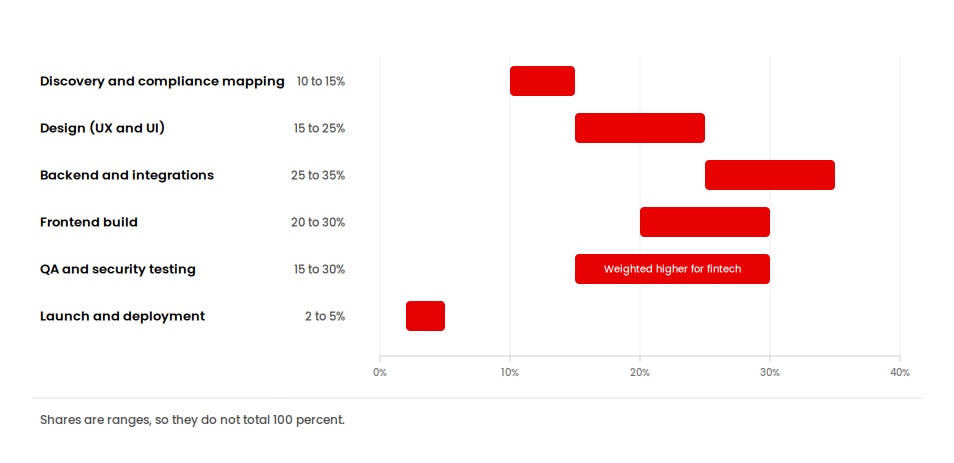
It also helps to see where a fintech budget actually gets spent, phase by phase. Discovery, the stage where requirements, compliance scope, and integration partners get mapped out, typically runs 10 to 15 percent of the total budget. Skipping it does not remove that cost, it just moves it later into rework once a compliance gap or an integration limitation surfaces mid build.
| Budget Phase | Indicative Share of Effort | What Happens Here |
|---|---|---|
| Discovery and compliance mapping | 10–15% | Requirements, target markets, regulatory scope, and integration partners get defined |
| Design (UX and UI) | 15–25% | Flows, wireframes, and the visual system for accounts, transactions, and statements |
| Backend and integrations | 25–35% | Ledger logic, banking or payment API connections, and core business rules |
| Frontend build | 20–30% | The application itself, across the platforms in scope |
| QA and security testing | 15–30% | Functional, regression, and security testing, weighted higher for fintech than for a standard app |
| Launch and deployment | 2–5% | App store submission, production environment setup, and monitoring configuration |
How Do Fintech App Features Affect Development Cost?
Features affect fintech app development cost based on the amount of backend logic, security, integrations, testing, and financial processing they require. Two apps can have the same number of screens but very different development budgets because one may contain simple information displays while the other handles sensitive financial transactions.
| Feature | Cost Impact | Why It Adds Development Work |
|---|---|---|
| User registration and authentication | Low to medium | Account creation, verification, authentication, and session management |
| Financial dashboard | Low to medium | Account data, balances, charts, transaction states, and responsive layouts |
| KYC verification | Medium | Identity verification API, document handling, status tracking, and compliance workflows |
| Payment processing | Medium to high | Payment gateway integration, transaction states, security, and error handling |
| Bank account connectivity | Medium to high | Banking APIs, account aggregation, data synchronization, and authorization |
| Money transfers | High | Transaction logic, validation, security, records, and failure handling |
| Fraud detection | High | Monitoring rules, alerts, third-party services, and transaction analysis |
| Investment or trading | High | Market data, portfolios, orders, brokerage integrations, and real-time information |
| Lending workflows | High | Applications, eligibility logic, documents, repayment schedules, and credit integrations |
| Admin and compliance dashboards | Medium to high | Multiple roles, permissions, reporting, audit trails, and monitoring |
The most expensive features are the ones that introduce financial logic, external integrations, real time processing, security controls, or regulatory obligations.
For example, adding a transaction history screen is relatively straightforward when the backend already stores the required data. Building the transaction system itself is much more involved because it requires validation, authorization, records, error handling, security, and potentially fraud monitoring.
This is why feature based estimates should consider the work behind each feature, rather than assigning a flat price to every screen.
How Do Security and Compliance Requirements Affect Fintech App Cost?
Security and compliance can make fintech app development more expensive than a standard mobile app because financial applications handle sensitive data, payments, and transactions. The cost increases based on the regulations your app must follow, the type of financial data it processes, and the security controls required.
Common cost drivers include:
- Data encryption: Encrypting sensitive data both in transit and at rest protects financial and personal information.
- Identity and access controls: Features such as multi factor authentication, biometric login, role based access, and session management add development and testing work.
- Payment security: Apps that process card payments may need to meet requirements such as PCI DSS, depending on how payments are handled.
- Regulatory compliance: Fintech apps may need to support requirements related to KYC, AML, data privacy, consumer protection, or financial reporting, depending on the market and product.
- Security testing: Penetration testing, vulnerability assessments, code reviews, and ongoing monitoring add to both development and maintenance costs.
- Audit and monitoring: Detailed transaction logs, access logs, alerts, and audit trails may be required to detect suspicious activity and demonstrate compliance.
For example, a basic personal finance app that only displays account information may require fewer compliance controls than a digital banking or payment app that handles transactions directly.
As a result, security and compliance should be included in the initial fintech app development cost estimate rather than treated as an optional layer added after development. Building these requirements into the architecture from the start can also reduce the cost and disruption of fixing compliance gaps later.
How Much Do Fintech App Developers Charge?
Fintech developers may charge different hourly rates depending on their location, experience, specialization, and engagement model. However, the hourly rate should not be used by itself to estimate fintech app development cost. The total number of hours required for financial workflows, integrations, security, compliance, testing, and backend infrastructure can have a much larger effect on the final budget.
For the AppVerticals costing model used in this guide, the blended development rate is $25 to $35 per hour. This rate is applied after the project scope has been broken into modules and the required development effort has been estimated.
That distinction matters because a lower hourly rate does not automatically produce a lower project cost. A team that takes significantly more hours to implement a complex financial workflow can ultimately cost more than a team with a higher rate and greater fintech experience.
How Long Does It Take to Develop a Fintech App?
Fintech app development can take several months, depending on the product scope, number of platforms, integrations, security requirements, compliance work, and testing requirements. A focused MVP with one core financial workflow can move faster than a banking or lending platform involving several external systems and regulated processes.
A typical development process can be broken down into:
| Development Stage | What It Includes |
|---|---|
| Discovery and planning | Requirements, user flows, technical architecture, compliance scope, integration planning |
| UI/UX design | Wireframes, prototypes, interface design, design system |
| Backend development | APIs, databases, financial logic, authentication, transaction workflows |
| Frontend development | Mobile or web application development and platform-specific implementation |
| Integrations | Payment gateways, banking APIs, KYC providers, financial data services |
| QA and security testing | Functional testing, regression testing, vulnerability checks, security validation |
| Deployment | Production configuration, app store submission, monitoring, and launch preparation |
The timeline can increase when the project requires multiple financial integrations, complex transaction workflows, extensive compliance controls, penetration testing, or multiple platforms.
For budgeting purposes, it is better to estimate the timeline after defining the MVP scope rather than assigning a fixed number of months to every fintech app. A smaller scope can reduce both development cost and time to launch without removing the security and compliance requirements that the product actually needs.
What Are the Ongoing Costs of a Fintech App?
Fintech app expenses continue after launch. Along with hosting and maintenance, you may have recurring costs for payment processing, SMS verification, security monitoring, compliance, and other third party services. These costs often scale with usage, which means a growing user base can increase your operating expenses.
| Ongoing Cost | Typical Cost Consideration |
|---|---|
| Maintenance and updates | Often estimated as a percentage of the original development cost |
| Cloud hosting and infrastructure | Depends on traffic, storage, transaction volume, uptime, and architecture |
| Third-party APIs and services | Usage-based or subscription fees for financial, identity, payment, and data services |
| Security monitoring and testing | Recurring monitoring, vulnerability assessments, and periodic security testing |
| Compliance and audits | Depends on the product, market, regulatory obligations, and audit requirements |
| Payment processing | Transaction-based fees that increase with payment volume |
| Identity verification | Usage-based costs for KYC and identity verification services |
| SMS and communications | Usage-based costs for OTPs, alerts, and transactional messaging |
For example, third party service fees can scale directly with usage. Stripe pricing lists transaction based payment fees, while Twilio SMS pricing charges based on messaging usage and destination. Actual costs depend on the provider, country, payment method, transaction volume, and service configuration.
These examples show why fintech operating costs can grow alongside the business. A consumer app that gains users mainly adds servers and supports demand. A fintech app can add server load plus transaction processing fees, verification messages, fraud monitoring, compliance activity, and security requirements as transaction and user volumes increase.
This is why it is important to account for usage based services when estimating the total cost of a fintech app. Maintenance and compliance should not be treated as fixed expenses alone. Your year one budget should also account for costs that scale with transactions, users, and the volume of financial activity.
What Does a Fintech App Cost in Its First Year?
The first year of a fintech product costs more than the initial development budget because the business also has to operate, secure, monitor, and maintain the application after launch.
A useful year one model is:
Year One Cost = Initial Development + QA and Security + Compliance + Infrastructure + Third Party Services + Maintenance + Support
| Cost Component | How to Budget It |
|---|---|
| Initial development | Based on product scope and applicable AppVerticals cost band |
| QA and security testing | Based on application complexity and security requirements |
| Compliance and audits | Based on target markets and regulatory obligations |
| Cloud infrastructure | Based on expected traffic, storage, transaction volume, and uptime |
| Third-party APIs | Based on provider pricing and expected usage |
| Maintenance and updates | Budgeted as an ongoing percentage of development cost |
| Support and monitoring | Based on users, transaction volume, service requirements, and support coverage |
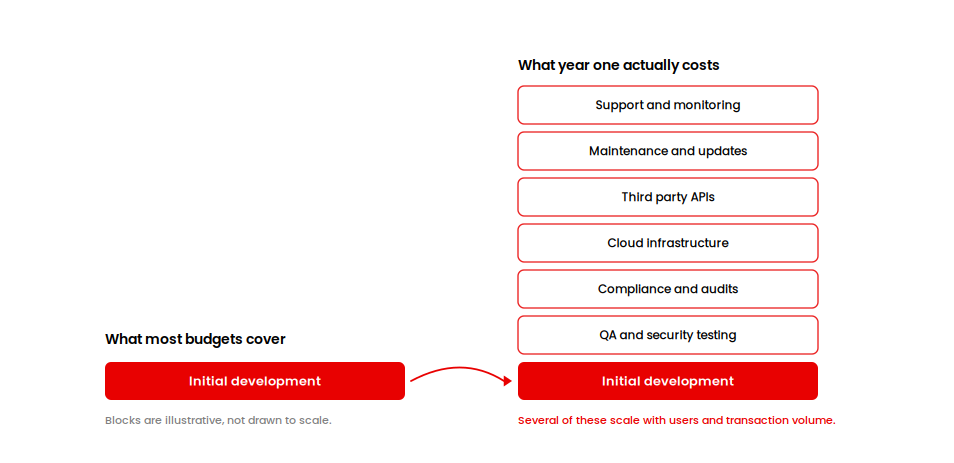
For example, a simple fintech MVP that falls within the 25,000–35,000 baseline will have a very different first year cost from a compliance driven platform starting at $150,000+. The difference comes not only from development effort but also from the security, infrastructure, integrations, compliance work, and ongoing services required to operate each product.
This distinction is important when planning a fintech app development budget. Development cost tells you what it takes to build the product. First year cost tells you what it takes to build and operate it.
How to Estimate Your Fintech App Development Cost
A fintech app cannot be estimated reliably by counting screens or applying a generic mobile app calculator. The real cost depends on what the app does with money and financial data, which regulations apply, how many systems it connects to, and how much security the product requires.
To make these variables easier to evaluate, AppVerticals uses a Fintech App Cost Estimation Framework built around eight dimensions that influence development effort.
| Framework Dimension | What to Assess | Cost Impact |
|---|---|---|
| 1. App Type | Wallet, banking, lending, investment, payment, or financial management | Defines the baseline complexity |
| 2. Feature Complexity | Basic, moderate, and advanced financial workflows | Increases engineering and QA effort |
| 3. Platforms | iOS, Android, web, or multiple platforms | Adds frontend and testing scope |
| 4. Integrations | Banking APIs, payment processors, KYC, credit bureaus, market data | Adds integration and maintenance work |
| 5. Security | Authentication, encryption, access controls, fraud monitoring | Adds architecture, testing, and monitoring requirements |
| 6. Compliance | KYC, AML, PCI DSS, PSD2, and applicable regional rules | Adds technical, documentation, and testing requirements |
| 7. Infrastructure | Transaction volume, uptime, storage, and real-time processing | Determines backend and infrastructure complexity |
| 8. Development Scope | Focused MVP versus full multi-workflow platform | Determines how much is built initially |
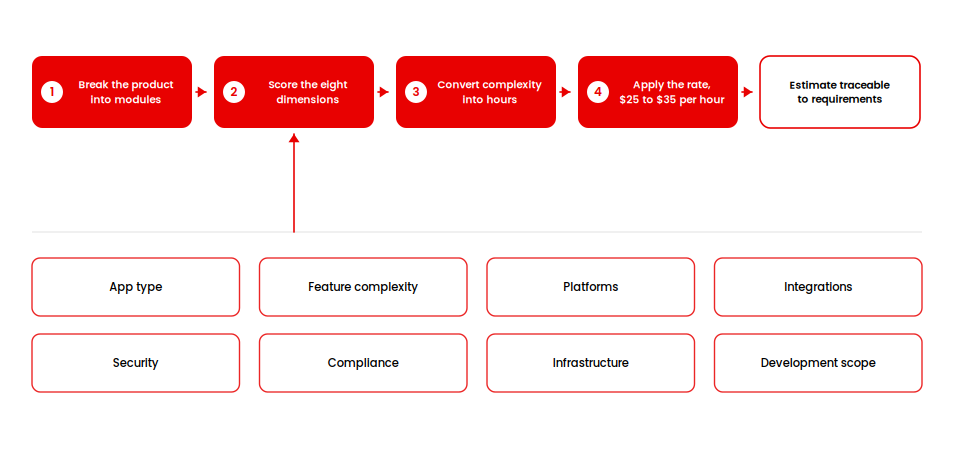
The framework is designed to show why a project costs what it does, rather than produce a generic number from a feature checklist.
Want a Rough Number First?
If you are still shaping the product, our app development cost calculator returns an indicative range in a few minutes based on your platforms, features, and scope. Treat the result as your baseline, then layer on the fintech drivers in this guide, integrations, security, and compliance, to get closer to a realistic figure.
Try the App Development Cost CalculatorDestination:
1. Break the product into modules
Start with the actual workflows the app must support, such as onboarding, account management, payments, transfers, KYC, fraud controls, notifications, reporting, and administration. Each module is assessed separately so major requirements do not disappear inside a broad project description.
2. Score the eight cost dimensions
Each dimension is classified according to the product’s requirements and technical complexity. For example, a single platform wallet with one financial integration will generally have a smaller scope than a multi market lending platform with credit bureau integrations and regulated workflows.
3. Convert complexity into development hours
The assessed requirements are translated into engineering, design, QA, security, and integration work. Security and compliance can have an outsized impact because they involve more than implementation. Testing, documentation, reviews, monitoring, and remediation may also be required.
4. Apply the development rate
Once the required effort has been estimated, the hours are multiplied by the applicable development rate. For the AppVerticals costing model used in this guide, the blended rate is $25 to $35 per hour. This creates an estimate that can be traced back to specific requirements instead of presenting a founder with one unexplained figure.
Why This Approach Produces Better Estimates
The eight dimensions make it easier to identify which requirements are pushing the budget higher. This also helps founders decide what belongs in the MVP and what can wait until a later release.
For example, reducing the number of platforms or postponing advanced analytics can lower the initial scope. Removing essential authentication, transaction security, KYC, or compliance controls is not an appropriate cost saving because those requirements may be fundamental to the product.
The goal is therefore not to make a fintech product as cheap as possible. It is to build the smallest viable financial product that can operate securely and meet the requirements of its target market.
AppVerticals applies the same principle of accounting for regulated requirements during initial planning across compliance sensitive products. VisionZE, for example, involved HIPAA compliance considerations that had to be incorporated into the product from the beginning.
For fintech projects, the same planning principle applies to requirements such as KYC, AML, payment security, audit logging, data protection, and financial integrations. These requirements should be identified before development begins because adding them after the architecture has been established can create additional rework.
How to Reduce Fintech App Development Costs
Reducing fintech development costs does not mean cutting security or compliance. The better approach is to control the initial scope, reuse proven financial infrastructure, and postpone nonessential features until the core product is validated.
A focused MVP can reduce the initial development effort, while established payment, banking, identity, and financial data services can prevent the team from having to build specialized infrastructure from scratch. The key is to identify which capabilities are essential to the first release and which can be introduced later.
Here are practical ways to keep the budget under control:
- Start with one core financial workflow: Instead of launching payments, lending, investments, budgeting, and multiple account types together, build the workflow that proves the business model first. A focused MVP requires fewer development hours and lets you validate demand before expanding.
- Use established fintech infrastructure: Payment processors, KYC providers, banking APIs, and other specialized services can eliminate the need to build complex financial infrastructure from scratch. The broader build vs. buy software decision can also help determine which capabilities are worth building internally and which are better handled through existing solutions.
- Launch on one platform first: If your target users can be served through iOS, Android, or web initially, avoid building every platform at once. Expanding after validating the product can prevent you from paying for multiple codebases before you know which features users actually need.
- Choose cross platform development where appropriate: For products that do not require highly platform specific functionality, technologies such as Flutter or React Native can reduce the work involved in maintaining separate mobile codebases.
- Plan compliance before development starts: Trying to retrofit KYC, AML, audit logging, or security controls after the product has been built can create expensive rework. Defining these requirements during discovery helps the team design the right architecture from the beginning.
- Build for the next stage, not every future stage: Your MVP should have an architecture that can support growth, but you do not need enterprise scale infrastructure on day one. Add advanced fraud monitoring, additional payment rails, complex analytics, and other expensive capabilities when the product actually needs them.
Can You Build a Fintech App for Under $60,000?
Yes. A focused fintech MVP can fit within a $60,000 budget, particularly when the product uses existing financial infrastructure and limits the initial scope to one core workflow.
Based on the AppVerticals cost baseline, a simple MVP may fall within the 25,000–35,000 range, while a mid complexity MVP can reach approximately 35,000–80,000 depending on its requirements.
A fintech MVP within a $60,000 budget could focus on:
- Secure user registration and authentication
- A basic financial dashboard
- One core payment or transaction workflow
- Basic KYC onboarding through a third party provider
- One payment or banking integration
- Essential security controls
- Basic administration functionality
- QA and deployment
The budget becomes harder to maintain when the product adds multiple platforms, several banking integrations, complex lending logic, advanced fraud detection, multi market compliance, real time financial processing, or sophisticated analytics.
The smarter approach is to fund the smallest version that can support a real financial workflow securely, validate the business model, and provide a foundation for later development. The goal is not to squeeze every planned feature into a $60,000 budget. It is to determine which capabilities are essential to the first release.
Final Thoughts
Fintech app development cost depends on the financial product you are building, its feature scope, integrations, security requirements, compliance obligations, platforms, and infrastructure. The most reliable estimate comes from breaking those requirements into measurable cost drivers rather than relying on a generic app price.
Use the AppVerticals Fintech App Cost Estimation Framework to identify your major cost drivers, separate development expenses from first year operating costs, and determine which capabilities belong in your MVP.
If you already have a fintech product in mind, the next step is to define its core workflows, integrations, target market, and compliance requirements before requesting a development estimate.
Have a Fintech Product in Mind?
Before development begins, it helps to understand what your product will require across features, integrations, security, and compliance. Our fintech development team can help you define those requirements and shape them into a practical development plan.
Talk to Our Fintech App Development Experts