About Us
About App VerticalsWe're a future-focused tech partner working with some of the world's top enterprises.

 Health Tech
EdTech
Logistics
Real Estate
Ecommerce
Sports
Fintech
Travel
Restaurant
Automotive
Health Tech
EdTech
Logistics
Real Estate
Ecommerce
Sports
Fintech
Travel
Restaurant
Automotive
HIPAA-compliant digital solutions for hospitals, clinics, and healthtech startups driving better patient outcomes.
What We Do:
Scalable learning platforms for schools, universities, and EdTech startups transforming education delivery.
What We Do: Real-time tracking and automation solutions for freight companies, warehouses, and delivery services.
What We Do: PropTech platforms for brokerages, property managers, and real estate marketplaces are streamlining operations.
What We Do: High-converting commerce platforms for D2C brands, retailers, and online marketplaces are driving revenue growth.
What We Do: Fan engagement platforms for sports teams, leagues, and betting operators are creating immersive experiences.
What We Do: PCI-DSS compliant solutions for digital banks, payment platforms, and InsurTech companies, ensuring security.
What We Do: Booking and hospitality solutions for OTAs, hotels, and tourism platforms, enhancing traveler experiences.
What We Do: Online ordering and operations software for restaurants, cloud kitchens, and food delivery platforms.
What We Do: Connected vehicle platforms for automotive OEMs, dealerships, and mobility providers are accelerating innovation.
What We Do: - Featured In

AppVerticals was featured in Inc. 5000 as America’s Fastest Growing Tech Company
Resources
-
Blogs
-
Podcast
-
App Cost Calculator
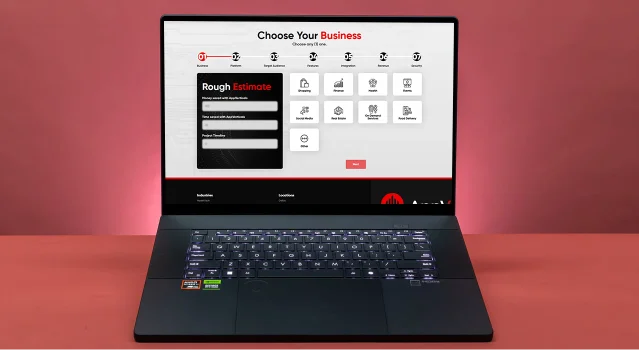
App Cost CalculatorSee what it might cost to bring your app idea to life. Our calculator gives you a quick, simple estimate based on what you need.

-























How We Consolidated Five Disconnected Systems into One Platform Running Customer Engagement for 10 Dealerships and 10,000 Users
Traver Connect's Multi-Tenant Dealership Engagement Platform
Traver Connect runs business development centers for automotive dealerships across the US. Its teams managed leads, calls, texts, appointments, and reporting across separate legacy systems, so a single agent juggled four tools to handle one lead, and managers had no clear view of follow-up. We built one multi-tenant platform that holds CRM, calling, SMS, email, appointments, training, and live reporting, with role-based access for seven user types and four dealership configurations. Cost dropped by half. The whole operation now runs in one place.
The Impact
A BDC Operator Whose Service Outgrew the Tools Behind It
Traver Connect provides business development center services for automotive dealerships, handling customer engagement, appointments, leads, communications, and retention. They are based in Texas and work with dealerships across the US, on a mix of B2B SaaS and managed services.
When they came to us they supported around 10 dealerships and roughly 10,000 users. We had worked with them before, so the conversation started from an existing relationship.
They wanted a long-term technical partner who could own the architecture of a complex, scalable platform and the third-party calling and communication integrations underneath it. They were building something that had to support years of growth, and they wanted a team that would take responsibility for how it was built and how it evolved.
One Lead Took Four Systems to Handle
A BDC agent picking up a new lead opened one system for the customer record, another to place or track the call, a third for texting or email, and a fourth for reporting and appointment tracking. Each lead moved through four disconnected tools.
Managers had little visibility into what agents were doing or how follow-up was going, so lead progression and appointment conversion were hard to track.
The cost showed up as duplicated work, slow responses, inconsistent follow-up, and leads and appointments that fell through. BDC agents, sales managers, service managers, dealer administrators, and super administrators all worked around the same fragmentation.
Left alone, the operation would have stayed capped by its tooling: every new dealership and user added more manual coordination, holding back the growth the business was after.

We Built the Multi-Tenant Foundation before Any Feature
The data model came first. Traver Connect’s tenant is a dealership, and dealerships nest in four configurations: standalone, a parent supervising sub-dealerships, a dealership with its own sub-dealerships, and parent-child hierarchies. A Traver Connect super admin creates a dealership, then the client admin is invited in. Every later feature reads from that structure, so we built it, the authentication and role hierarchy, and the integration strategy before writing any module.
Once the foundation held, CRM, communications, reporting, training, and dealership management were built in parallel against the same domain model. That kept the modules consistent and shortened delivery.
We chose .NET Core and Azure because they hold up for large, long-lived US enterprise systems with deep support and infrastructure, and Azure’s standalone services suited the architecture. React handled the portal interfaces across roles and integrated cleanly with OnSIP, which powers the real-time calling and pushes updates without polling. We kept the backend stateless behind REST APIs so it scales independently of any single client.
On reporting, the client asked for Power BI embedded in the app. Its templating and refresh behavior worked against us, so we recommended building the reports inside the application instead. The in-app version refreshes live and stays under our control.
One Platform, Seven Roles, Four Portal Surfaces
A Six-Month Build, Then Four Years of Iteration
The platform was built from scratch over six months, from April to September 2022, by an eleven-person team spanning frontend, backend, design, DevOps, and QA.
It ran as a product-engineering partnership. The client joined requirements gathering, workflow mapping, backlog prioritization, sprint planning, feature reviews, and UAT. They knew the dealership workflows cold; we knew how to turn them into a system, so most sessions were spent walking real call and appointment flows screen by screen.
The hardest piece was OnSIP. Integrating live calling into a multi-role, multi-tenant environment while keeping call workflows reliable and reporting accurate took the most care, alongside holding data consistent across several third-party systems at scale.
The Whole Operation Runs in One Place
A BDC agent now works one platform. The customer record, the call, the text, the email, the appointment, and the reporting all live in the same system, scoped to that agent’s dealership and role.
Managers see agent activity and follow-up as it happens, so appointment conversion and customer follow-up are now things they can track and improve. Running costs fell by about half once the distributed tooling was retired, and day-to-day efficiency rose by roughly 40%.
The platform carries around 10 dealerships and thousands of users across four tenant configurations, and it absorbs new dealerships without adding manual coordination. Six months of building turned into a partnership now past four years, still adding features and scaling.
Testimonials
"We came to AppVerticals with a process we knew inside out and systems that couldn't keep up with it. They learned how our dealerships actually work, then built us one platform to run all of it. Four years later they're still the team we built with."

Distributed Operations, Consolidated at Scale
If you're running a distributed operation across multiple locations on tools that no longer talk to each other, that's the kind of consolidation we build. We've done it for a multi-tenant network at scale.
Start a conversation