














 ChatGPT
 Perplexity
 Claude
 Google AI
Generative AI in business enables organizations to automate repetitive work, generate content and code, and extract actionable insights from large datasets. Companies applying it to customer support report 40% faster ticket resolution, while marketing teams reduce content production time by 5x. In software engineering, AI-assisted coding improves development speed and reduces manual errors.
Despite the potential, 30% of generative AI pilots fail after proof of concept, often due to incomplete data, insufficient workflow integration, or unclear ROI (Gartner). Effective adoption requires selecting high-value workflows, preparing clean and accessible data, embedding AI into existing systems, and establishing governance and measurement frameworks.
This guide provides a step-by-step approach to generative AI in business, covering applications across functions, risk mitigation, implementation steps, and ROI benchmarks.
It also includes insights of a generative AI development company, giving executives and product leaders a practical framework to evaluate and deploy AI where it delivers measurable results.
What is Generative AI in Business?
Generative AI in business refers to AI systems that create, summarize, classify, or analyze content, code, designs, or data to support workflows and decision-making. It is distinct from the predictive AI organizations have used for years. Predictive AI tells you what is likely to happen next. Generative AI produces something new: a draft contract, a working code function, a customer response, a 10-page research summary distilled from 500 documents.
McKinsey estimates the long-term opportunity at $2.6 trillion to $4.4 trillion in additional productivity value from corporate use cases. That figure is the incremental productive output that AI makes possible when embedded directly into workflows.
Why Generative AI Matters for Businesses in 2026
Generative AI matters in 2026 because it has moved from experimentation into core workflow infrastructure, where businesses gain advantage by automating repeatable work, improving decision speed, and measuring ROI before scaling.
More than 50% of organizations now use generative AI in at least one business function, but adoption alone is not the real story. The real gap is between companies testing AI tools and companies redesigning workflows around them.
Accenture’s research found that organizations which have fully modernized AI-led processes achieve 2.5x higher revenue growth and 2.4x greater productivity compared to their peers. That gap is not closing. It is widening.
For business leaders, AI at scale is becoming part of business continuity, operating efficiency, and competitive planning.
In 2026, the question is not whether to adopt generative AI. The question is which workflows to target first, how to prove value early, and how to avoid the implementation mistakes that turn promising pilots into sunk costs.
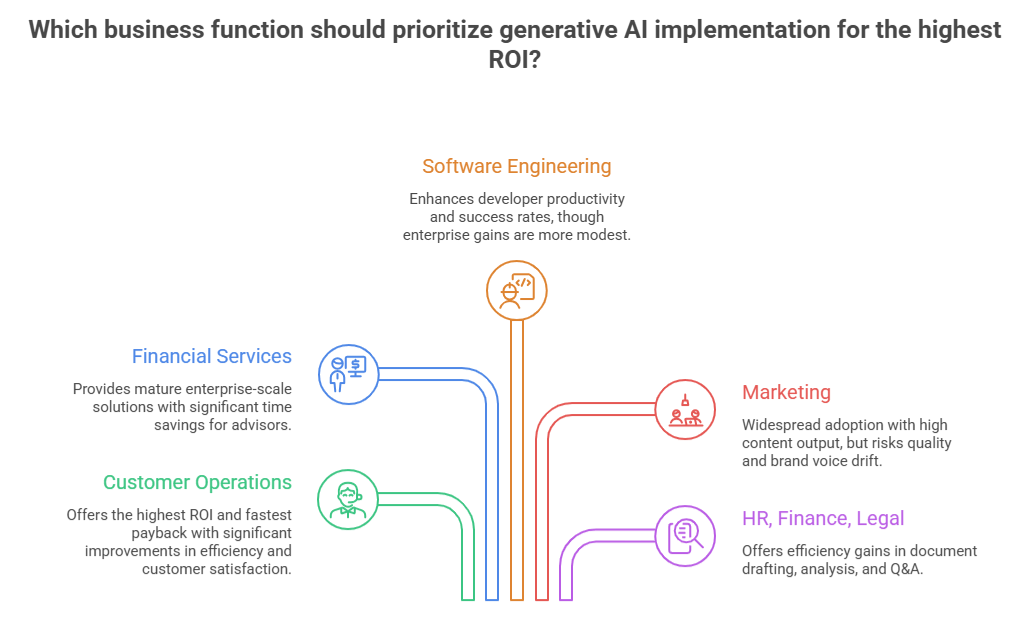
Generative AI Business Applications by Function
The most effective way to evaluate generative AI for your organization is by function, not by technology.
Here is what other applications actually show.
1. Customer Operations and Support
This is consistently the highest-ROI, fastest-payback function for generative AI. The Klarna case study is the most documented example at scale.
In February 2024, Klarna deployed an OpenAI-powered customer service assistant that handled 2.3 million conversations in its first month. The assistant resolved issues in under two minutes compared to 11 minutes for human agents, drove a 25% drop in repeat inquiries, and contributed to a projected $40 million profit improvement.
Human-AI ratio matters more than full automation. Klarna’s most durable gains came from AI handling tier-1 volume while humans focused on judgment-intensive cases.
2. Financial Services and Wealth Management
Morgan Stanley’s deployment of AI at Morgan Stanley Debrief is the most mature enterprise-scale wealth management implementation on record.
The system, built on OpenAI’s GPT-4 and launched in early 2024, indexed more than 350,000 proprietary research documents and made them queryable in seconds versus the 30-plus minutes advisors previously spent on manual research.
By late 2025, the tool had achieved 98% adoption among the firm’s wealth management advisors, with nearly 50% of all Morgan Stanley employees using generative AI tools.
3. Software Engineering
GitHub’s most rigorous study, a controlled experiment with 95 professional developers, found that access to GitHub Copilot reduced average task completion time from 2 hours 41 minutes to 1 hour 11 minutes, a 55% improvement in coding speed. Success rates also improved from 70% to 78%.
At the enterprise scale, a field experiment at Microsoft with 1,663 developers showed 12.92% to 21.83% more pull requests completed per week. At Accenture, a separate experiment with 311 developers showed 7.51% to 8.69% productivity improvements.
These numbers are smaller than the controlled lab results, which is expected. Enterprise codebases are more complex, and integration with existing tools takes time.
But they are consistent and measurable.
4. Marketing and Content Operations
Marketing is the function where generative AI adoption is most widespread and where measurement is most inconsistent. According to Salesforce, more than 60% of marketing leaders have already used generative AI for content creation.
The production efficiency gains are real: teams generating 5x more content output with the same headcount are not unusual. The risk, documented across multiple implementations, is quality and brand voice drift when AI-generated content bypasses editorial review.
5. HR, Finance, and Legal
HR teams use generative AI for job description drafting, resume screening, onboarding content, and employee policy Q&A. Finance teams have cut report drafting time by an average of 40 to 60% in production deployments. Legal teams use document review AI to cut contract analysis from hours to minutes.
A European bank replaced its rule-based customer chatbot with a generative AI version and found it 20% more effective at answering queries, with further improvements expected to double that figure.
Highest-ROI Generative AI Use Cases for Business
The highest-ROI generative AI use cases share three traits: high task volume, measurable output, and clear workflow ownership. Financial services currently leads on ROI, followed by media, telecommunications, mobility, retail, energy, manufacturing, healthcare, and education.
| Use Case | Real-World Evidence | Avg ROI Range | Time to Value |
|---|---|---|---|
| AI Customer Support Agent | Klarna: $40M profit gain, 85% faster resolution, 2.3M chats/month (Feb 2024) | 3x to 5x | 3 to 6 months |
| Internal Knowledge Assistant | Morgan Stanley Debrief: 98% advisor adoption, 350K+ docs indexed, seconds vs. 30 min | 2x to 4x | 6 to 12 months |
| Code Generation / Dev Assist | GitHub Copilot: 55% faster task completion, 12-22% more PRs/week at Microsoft | 3x to 6x | 4 to 8 months |
| Marketing Content at Scale | United Airlines: scaled from 15% to 50% flight coverage with same team | 4x to 8x | 2 to 4 months |
| Sales Enablement | Verizon: 40% sales increase, 95% query resolution, 100K churns prevented | 3x to 5x | 3 to 6 months |
| Document Automation (Legal/HR/Finance) | European bank: 20% lift over rule-based system; finance teams: 40-60% drafting time cut | 2x to 5x | 4 to 9 months |
Generative AI Implementation: A Step-by-Step Roadmap
Successful AI deployments take less than 8 months on average and organizations realize value within 13 months. That timeline is achievable. It is also frequently blown when organizations skip the foundational steps in favor of moving straight to model selection.
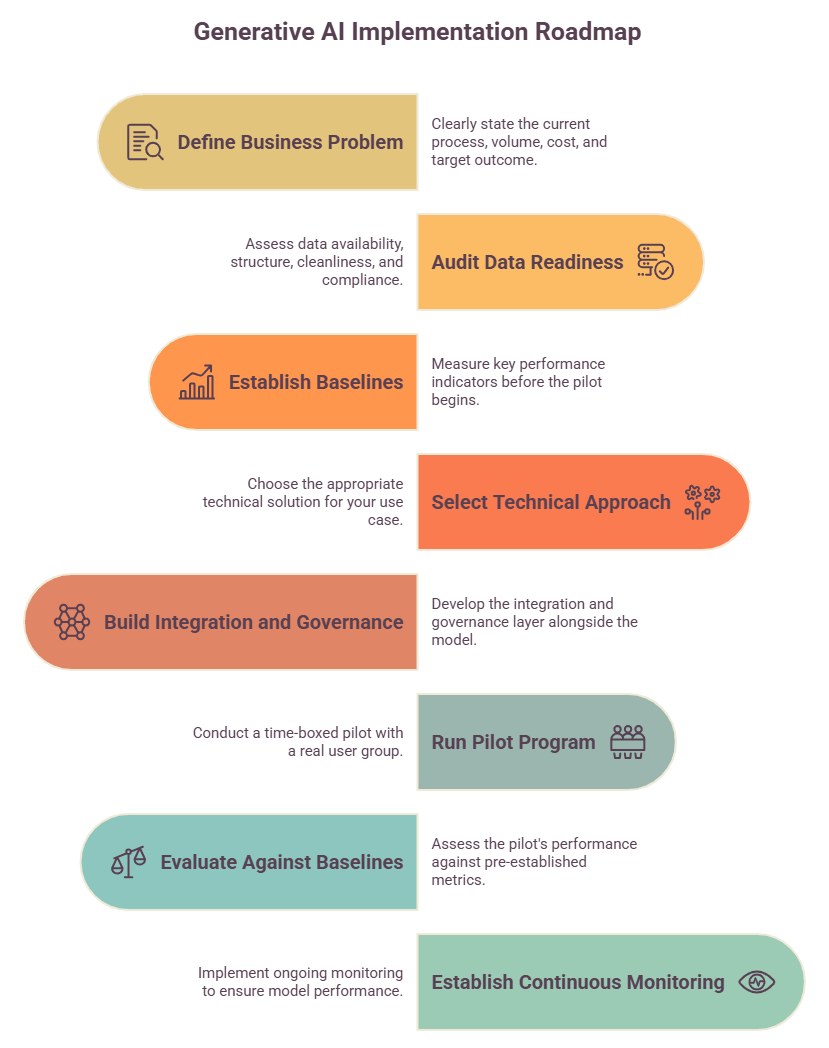
Here is the sequence that consistently produces results.
1. Define the business problem before touching any technology.
State the current process, the volume, the cost per unit, and the target outcome in measurable terms. ‘Customer support handles 10,000 tier-1 tickets per month at an average of 12 minutes each.
Target: resolve 60% through AI in under 2 minutes with equivalent satisfaction scores.’ That is a solvable problem. ‘We want to explore AI’ is not.
2. Audit data readiness before selecting any tool.
What data does this workflow require? Where does it live? Is it structured, clean, and accessible without violating privacy or compliance requirements?
3. Establish baselines and success metrics before the pilot begins.
Measure handle time, error rate, output volume, cost per task, and any other KPI you expect to move. Organizations that skip this step have no way to prove ROI, and without provable ROI, the program does not scale.
McKinsey’s AI survey found that organizations reporting significant financial returns are twice as likely to have redesigned end-to-end data workflows before selecting modeling techniques.
4. Select the right technical approach for your use case.
The five options, and when each applies, are covered in the Build/Buy/Customize section below.
5. Build the integration and governance layer alongside the model, not after it.
The integration connects the AI to your existing systems. The governance layer establishes output logging, human review queues, and monitoring.
Both must exist from day one in regulated or customer-facing deployments.
6. Run a time-boxed pilot with a real user group, not an internal demo.
30 to 60 days, defined user cohort, measurement against your pre-established baselines. Klarna’s production launch followed roughly 6 months of internal testing, alpha deployment, and limited beta rollout before going live across 23 markets. That pipeline is typical of implementations that succeed.
7. Evaluate against baselines.
If the pilot meets your ROI threshold, expand. If it does not, diagnose the gap before scaling. Most scaling failures trace directly to gaps that were visible in the pilot but ignored under pressure to move fast.
8. Establish continuous monitoring. AI models drift.
A system that performed at 90% accuracy at launch can degrade as your data, products, or customer base changes. Build monitoring into your operational model from the start.
What Architecture Does a Business GenAI System Need?
Most business AI deployments are not a single model. They are a stack of components, and the architecture you choose determines what the system can do, how reliably it does it, and how much it costs to maintain. Understanding the stack helps you evaluate AI development services, avoid vendor lock-in, and plan governance correctly.
The Five-Layer GenAI Architecture Stack
The 5-layer generative AI architecture stack includes foundation model layer, retrieval layer, orchestration layer, integration layer, and governance.
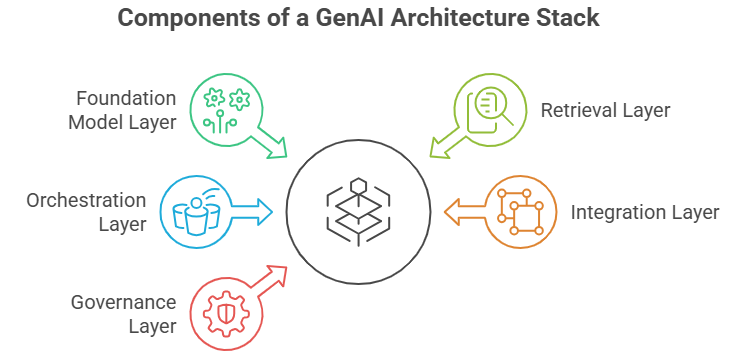
1. Foundation model layer:
The LLM is accessed via API (GPT-4o, Claude 3.5, Gemini, Llama 3, Mistral) or deployed on-premise for sensitive data environments. In 2026, more than 50% of enterprises are running an average of 4.2 AI models in production.
2. Retrieval layer (RAG)
A vector database or search index that retrieves relevant internal documents before each query, grounding model outputs in your specific data context. This is the layer that makes a general-purpose LLM behave like an expert in your domain.
3. Orchestration layer
Middleware such as LangChain, LlamaIndex, or custom-built frameworks that manage prompts, tool calls, memory, and multi-step reasoning. This layer is where workflow logic lives.
4. Integration layer
APIs and connectors linking the AI to your CRM, ticketing system, ERP, database, or communication tools. Without this layer, AI outputs do not reach the systems and people who need them.
5. Governance layer
Output logging, access controls, human review queues, bias monitoring, and performance dashboards. Companies are twice as likely to uncover AI failures when governance is in place.
AI agents add an action layer on top of this stack. Instead of just generating text or answers, agents call APIs, query databases, trigger downstream workflows, and complete multi-step tasks with minimal human input between steps.
Generative AI Risks and Governance Checklist
Approx. 40% of enterprises deploying generative AI cited content integrity and governance as one of their top three operational risks. Governance is not a compliance checkbox. It is an engineering requirement that determines whether your AI system remains reliable at scale.
The Six Core Risk Categories of Gen AI in Business
These include:
1. Hallucinations and factual errors
Models generate confident, coherent outputs that are factually wrong. In low-stakes workflows this is a quality problem. In legal, medical, financial, or regulatory contexts it is a liability. Every high-stakes output needs a human review checkpoint.
2. Data leakage and privacy exposure
Sending sensitive internal data to external model APIs without proper data processing agreements creates compliance exposure.
3. Model drift
AI systems degrade over time as your data, products, or customer base changes. A model that performed well at launch requires ongoing monitoring to catch drift before it affects output quality.
4. Prompt injection
Malicious inputs can manipulate AI agent behavior, particularly in systems where users control portions of the prompt context. This is a meaningful attack surface in customer-facing deployments.
5. Over-reliance and skill atrophy
Teams that stop applying critical judgment because the AI handles it create operational risk. Human oversight must be designed into the process, not bolted on after an incident.
6. Regulatory and IP risk
AI-generated content may reproduce copyrighted material. Outputs in regulated industries may conflict with disclosure requirements or fiduciary standards. These risks must be evaluated by function, not treated as uniform.
Governance Checklist by Priority
| Governance Control | Priority Level | Responsible Owner |
|---|---|---|
| Output logging and complete audit trail | Critical | Engineering |
| Human review checkpoint for high-stakes outputs | Critical | Operations / Legal |
| Data classification and role-based access controls | Critical | Security / Legal |
| PII and sensitive data handling policy | Critical | Legal / Compliance |
| Vendor data processing agreements | Critical | Procurement / Legal |
| Model performance monitoring dashboard | High | Engineering / Analytics |
| Bias detection and fairness audits | High | Quality / Compliance |
| User training on AI limitations and failure modes | High | HR / L&D |
| Incident response plan for AI failures | High | Operations |
| Periodic output quality spot-checks | Medium | Quality Assurance |
Why Generative AI Projects Fail After Proof of Concept
Data quality failure.
The model is only as good as the data behind it. If the source data is incomplete, outdated, duplicated, or trapped across disconnected systems, the output becomes unreliable no matter how strong the model is.
No measurable business objective.
Projects started with ‘let’s explore AI’ rarely scale. Without a defined metric and baseline, there is no way to declare success or justify continued investment.
According to Fullstack, only 15% of US employees report that their workplaces have communicated a clear AI strategy.
Workflow integration failure.
AI deployed on top of a broken or poorly documented process does not fix the process. It accelerates the dysfunction. Generative AI reveals workflow problems it cannot solve on its own. The pre-integration audit is not optional.
Change management underinvestment.
Teams that do not trust AI outputs either do not use them or over-correct for errors in ways that eliminate the efficiency gain. High adoption rates require training, communication, visible leadership involvement, and workflow redesign that makes AI use natural rather than forced.
Cost overruns without ROI tracking.
Organizations spend on model API costs, infrastructure, and integration without tracking savings or revenue impact. When CFOs ask what they got for the investment, there is no answer.
Governance gaps causing incidents.
One data leakage event or AI-generated error in a regulated context can end a program. Governance cannot be retrofitted after deployment.
How to Measure ROI from Generative AI in Business
Measuring it requires a framework, not a gut feeling.
ROI Measurement Framework by Value Bucket
This is the measurement framework AppVerticals applies when establishing baselines with clients before an AI pilot begins.
| Value Bucket | What to Measure | How to Measure It |
|---|---|---|
| Labor efficiency | Hours saved per task per week across the user group | Time tracking pre/post; manager surveys |
| Process velocity | Cycle time reduction: from request to output | Ticket close time, content turnaround, report generation time |
| Output quality | Error rate, rework frequency, customer satisfaction | QA audits, revision tracking, NPS/CSAT |
| Decision speed | Time from question to actionable insight | Stakeholder surveys, report timestamps |
| Revenue impact | Pipeline influenced, conversion lift, retention | CRM attribution, cohort analysis, A/B testing |
| Cost avoidance | Headcount not added relative to output growth | Capacity planning models, annualized labor cost |
TCO vs ROI Comparison
| TCO Factor | What to Include | Why It Matters for ROI |
|---|---|---|
| Model usage cost | API calls, token volume, inference, fine-tuning | High usage can reduce ROI if costs are not tracked by workflow. |
| Infrastructure cost | Cloud hosting, vector database, monitoring tools | AI systems need supporting infrastructure beyond the model itself. |
| Integration cost | CRM, ERP, helpdesk, database, or internal API connections | ROI improves only when AI is connected to real workflows. |
| Governance cost | Audit logs, access controls, human review, compliance checks | Risk control is part of operating cost, not an optional layer. |
| Maintenance cost | Prompt testing, model updates, monitoring, retraining | AI performance changes over time and requires active upkeep. |
| Training cost | User onboarding, workflow training, adoption support | Teams need clear usage rules to turn AI output into business value. |
Build, Buy, or Customize: Which Generative AI Approach Fits Your Business?
This is one of the most consequential decisions in a generative AI program. The wrong choice wastes money. The right choice depends on three factors: workflow complexity, data sensitivity, and internal technical capacity.
| Approach | Best Fit | Examples | Core Advantages | Core Limitations |
|---|---|---|---|---|
| Prebuilt SaaS tools | Standard, high-volume tasks with no proprietary data requirements | ChatGPT Enterprise, Jasper, Copy.ai, Notion AI | Fastest to deploy; lowest cost to start | Limited customization; no internal data integration |
| API-based LLM | Custom prompt workflows where you control the context | OpenAI API, Anthropic API, Google Vertex AI | Flexible; scalable; no vendor UI lock-in | Requires dev capacity; prompt engineering expertise needed |
| RAG system | Internal knowledge retrieval where answers must come from your data | Custom doc search, contract analysis, HR policy Q&A | Grounded in your specific context; reduces hallucinations significantly | Data preparation is intensive and ongoing |
| Fine-tuned model | Domain-specific output patterns that general models do not replicate | Industry-specific language, proprietary writing style, specialized classification | High accuracy on the target task | Expensive to train; requires labeled data and MLOps expertise |
| AI agents | Multi-step autonomous workflows that require tool use and decision-making | Support ticket resolution, sales outreach, data pipeline orchestration | Handles complexity that single-turn LLMs cannot | Highest governance requirement; production failure modes are non-trivial |
Most organizations start with prebuilt or API tools and customize incrementally as adoption grows and requirements become clearer. Jumping to fine-tuning or custom AI agents on day one is almost always premature.
AI development services become relevant when your workflow complexity exceeds what prebuilt tools support, your data is too sensitive for third-party processing, or your process requires a custom integration architecture.
A qualified AI development partner designs and builds the system to your specifications, integrates it with your existing stack, and hands off with documentation and monitoring in place.
How to Choose the First Generative AI Use Case
The ideal first use case scores high on volume, labor intensity, and measurability, and low on risk. Customer support ticket handling, marketing content drafts, and internal document search consistently meet this profile across industries.
Use Case Selection Scoring Matrix
AppVerticals uses this scoring model to evaluate which use case a client should build first.
| Selection Criterion | High Priority Signal (Score: 3) | Moderate Signal (Score: 2) | Low Priority Signal (Score: 1) |
|---|---|---|---|
| Task volume | 100+ occurrences per week | 25 to 99 per week | Fewer than 25 per week |
| Labor intensity per task | 30+ minutes per occurrence | 10 to 30 minutes | Under 10 minutes |
| Output measurability | Clear quantitative KPI within 60 days | Measurable but longer lag | Subjective or difficult to quantify |
| Data readiness | Clean, accessible, structured, compliant | Partial gaps, fixable in 30 days | Scattered, inconsistent, or siloed |
| Risk level | Low stakes; errors are reversible | Moderate stakes with review step | High stakes; irreversible or regulated |
| User receptiveness | Team actively interested and involved in scoping | Neutral; willing to try | Active resistance or skepticism |
Avoid starting with the most complex, most sensitive, or most politically charged workflow in your organization. Win with a simple problem, prove the model, build internal credibility, then tackle the harder problems.
Conclusion
Generative AI delivers business value when applied to well-defined workflows with clear baselines, clean data, and governance built in from the start. The organizations producing the highest returns are winning because they disciplined their implementation, measured obsessively, and scaled only what was proven.
The high failure rate across generative AI pilots shows how often organizations skip the foundational work. Data readiness, workflow integration, human-AI ratio calibration, and governance are not optional steps. They are the work. For more expertise, explore our case studies.
Evaluating which generative AI use cases to prioritize?
AppVerticals helps you consider whether to build a custom AI system or deploy a prebuilt solution for your business.
Explore Generative AI development services