












 ChatGPT
 Perplexity
 Claude
 Google AI
AI product development is the journey from an idea to a product that is safely in production, whether it is a new product built from the ground up to be AI-native or a single AI feature added to a product you already ship. I have been working on AI features for real products for 6 years, and the model is never the most difficult part. The AI product development process moves through idea, data, build, test, launch, and monitoring, but rarely in a straight line. The moment things actually break is when the prototype becomes a feature ready for real users, real data, and real failure modes. Gartner reports that only 48 percent of AI projects reach production and that the average project takes eight months to get there. That gap between prototype and production is where most of the real work in AI product development needs to go.
Key Takeaways
- AI product development runs through six stages: idea, data and prototyping, building, production hardening, launch, and monitoring.
- Only 48 percent of AI projects reach production, and the average project takes eight months to get there, according to Gartner.
- The handoff between a working demo and a production-ready feature is where AI initiatives most often stall.
- Start with an API. Add retrieval-augmented generation when the feature needs to be grounded in your own data. Reserve fine-tuning or a custom model for cases that justify the added cost.
- A deployable AI feature needs monitoring, guardrails, a fallback path, and a named owner, not only a passing evaluation score.
- The team matters as much as the model selected: product, AI engineering, data, and quality assurance working together from day one.
What Is AI Product Development, Really?
AI product development is the process of creating an AI feature or product that runs reliably for real users, past the demo and proof-of-concept stage.
It is the same as product development: Identify a real problem, design a solution, and ship it. The middle section is the only thing that is different. The work is based on a model that may be incorrect in unexpected ways, on data that the team does not fully control, and on non-deterministic code. This is the fundamental concept behind generative AI product development: designing around a system that reasons probabilistically, not by fixed rules.
This is a different discipline from AI-powered product design, which is about the interface and the experience. It is the harder half of AI-powered product development.
Product development is the entire journey from idea to data, prototype, production hardening, launch, and post-launch. The difference is important because each phase has a different type of risk. A design flaw is evident and can be fixed during a review. A model that silently fails in production, or that has different behavior on inputs that the team has never tested, can be missed for weeks. This guide focuses on building for that reality, rather than assuming that a model behaves like deterministic code.
The AI Product Development Lifecycle, Stage By Stage
The AI in product development lifecycle consists of six phases, from initial concept to post-launch.
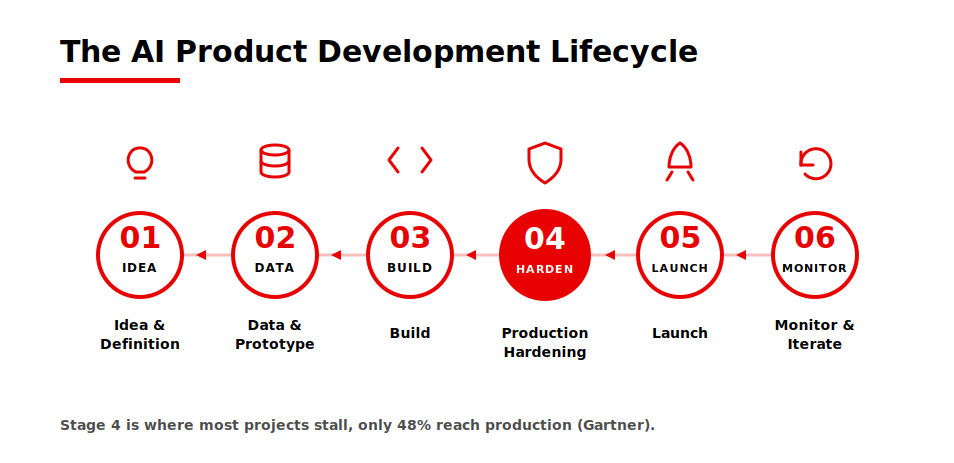
- Idea and problem definition. Choose a problem worth solving with AI, and confirm honestly that it actually is one.
- Data and prototype. Quickly develop a working version with real user input , typically on an existing API.
- Build. Turn the prototype into a real feature with proper architecture, proper error handling, and a deployment path beyond a development notebook.
- Production-hardening. Add monitoring, guardrails, and a fallback path. This stage decides whether the feature survives contact with real users.
- Launch. Ship to real users, usually in phases rather than all at once.
- Monitor and iterate. Observe the model’s behavior in the real world and continue fine-tuning.
Where Most AI Products Actually Stall (And Why)
S&P Global Market Intelligence’s 2025 enterprise survey found that the share of companies abandoning most of their AI initiatives before production rose from 17 percent to 42 percent in a single year, with the average organization scrapping close to half of its proofs of concept before anything shipped.
Very little of that abandonment occurs at the idea stage, and very little occurs at the prototype stage, since prototypes are now cheap and fast to make. That ease is exactly the trap. A working demo gets mistaken for a finished feature, when production is a different environment entirely, with messier data, adversarial users, higher volume, and a real cost attached to every request.
In my experience, the stall almost always comes down to one of three causes: nobody owns what the model does once it is live, no monitoring exists to catch it drifting, or the team never built a fallback for when the model is wrong.
These are ownership and process problems. They can be solved if planned for prior to the build.
The cost of getting this wrong compounds over time. When an AI project is stuck, it does not usually remain a team project. Budget approved for one feature gets spent again on a second attempt, stakeholders lose confidence in future proposals, and a competitor that solved the same production-hardening problem earlier gets to market first.
All of that is a planning cost, and it is far cheaper to plan for up front than to recover from later.
Idea And Problem Definition: What Is Actually Worth Building
Not all features are suitable for AI. Before writing a line of code, check the idea against a few honest questions.
- Is the failure mode tolerable? A wrong summary is recoverable. A wrong medical or financial answer usually is not.
- Is there data to ground it? A model with no relevant data behind it is guessing with confidence.
- Does an imperfect answer still help? Some tasks are useful even at 80 percent accuracy. Others are not worth shipping if they are below 99.
- Is this really a good fit for a model, or is it being added because AI is in this year’s budget?
- Can success be measured before launch? A problem without a clear metric for correct versus incorrect output is difficult to evaluate later.
The ideas that make it to production are usually the boring ones: a real, bounded problem, with a tolerable failure mode, and data to back it up. The more interesting the pitch, the more you need to double-check it against these questions.
From Idea To Prototype: Proving It Works
Once a real problem is identified, prove it fast. Build against an existing model API before considering anything more custom. Very few ideas require special infrastructure to determine if they are viable.
Test the prototype against real examples: actual user queries, real documents, and messy data from the production environment. Learn how to scope this stage without overbuilding with our guide on planning an AI MVP.
The result of this stage should be a clear “go” or “no go” decision based on actual evidence and not on enthusiasm for the demo or a sunk-cost mentality that the work has already begun.
Decide the evaluation metric before the prototype exists. A support-ticket summarizer might be judged on whether a support representative accepts the summary without editing it. A pricing recommendation might be judged on how often it matches what an experienced analyst would have chosen. If this decision is not made beforehand, teams will evaluate the prototype based on how impressive it appears during a walkthrough.
From Prototype To Production: The Stage Nobody Explains
Everything changes between a demo and production: the data becomes messier, the volume increases, the cost per request becomes real, and someone other than the builder now depends on it working.
This exact pattern plays out repeatedly: a prototype that impressed everyone in the room, followed by months of unplanned work, because monitoring, guardrails, and a fallback plan were never part of the original scope.
Budget for this stage from the start. It usually takes as long as the original build, and skipping it is the single biggest reason a working demo never becomes a shipped feature.
Build Approach: API, Rag, Or Custom Model: When Each Is Right
Choosing generative AI for product development usually comes down to one mistake: many teams overbuild by default. The sequence covered in more depth in our guide to custom AI development is to escalate only when the simpler option has run out of road.
- Start with an API such as OpenAI or Anthropic. These are the AI tools for product development most teams reach for first, the same category of tool GitHub’s own research found measurably speeds up developer output.
- Add retrieval-augmented generation when the model needs to answer using proprietary data rather than general knowledge.
- Only fine-tune or build custom models when the accuracy, latency, or cost of the off-the-shelf model is insufficient or when the data is proprietary and provides a true competitive edge.
The more you go up this ladder, the more time, money, and maintenance it will require. Only take it when the step below has really come to an end.
Testing, Monitoring, And Guardrails Before You Ship
Before launch, build an evaluation set from real examples rather than invented ones, and set a bar the model must clear. Include the edge cases and adversarial inputs that are easy to overlook.
Guardrails catch known failure modes: content that should not be generated, actions the model should not take on its own, and inputs designed to break it. Evaluation and guardrail practices increasingly align with frameworks such as the NIST AI Risk Management Framework, which sets expectations for testing before deployment.
Monitoring catches what was not known in advance. Monitor accuracy, cost, and latency after the feature is deployed, and monitor for model drift as real usage deviates from the test set.
Red-teaming deserves a deliberate pass rather than an afterthought. Test the feature with a third party who is not part of the build team: contradictory instructions, attempts to extract system prompts, and inputs that elicit an unsafe or off-brand response. The exercise results should be added to the guardrail list before the exercise.
If the feature involves an AI agent taking actions rather than only answering questions, guardrails and human review matter even more. An AI agent that is wrong quietly is riskier than a chatbot that is wrong out loud.
What A Deployable AI Feature Actually Needs (A Short Checklist)
These are the best practices for AI-driven product development that distinguish a shipped feature from a permanent demo. Run any AI feature against this list before you call it done.
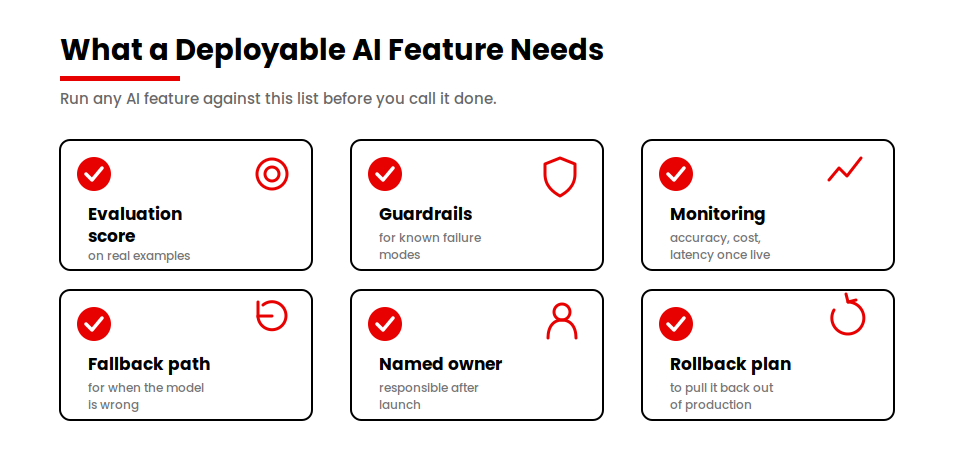
- An evaluation score, on real examples, that clears a bar set in advance.
- Guardrails for the failure modes already known in advance.
- Monitoring for accuracy, cost, and latency once the feature is live.
- A fallback behavior for when the model is wrong or cannot answer.
- A named owner who remains responsible for the feature’s behavior after launch, not only during the shipping sprint.
- A rollback plan if the feature needs to come back out of production.
A missing item on this list is a gap to close before real users find out first.
A short scoping conversation will identify whether it is ready to harden for production or still needs work.Not Sure Where Your Feature Stands?
What AI-driven Product Development Actually Costs And Takes
A single, well-scoped AI feature built on an existing API usually reaches production in 6 to 12 weeks. A full AI-native product, or one requiring a custom or fine-tuned model, takes several months longer. RAND Corporation research puts the overall AI project failure rate above 80 percent, roughly twice the rate of comparable non-AI IT projects, which is exactly why the production-hardening stage above is worth the extra time. For the full cost breakdown by stage, see what AI app development actually costs.
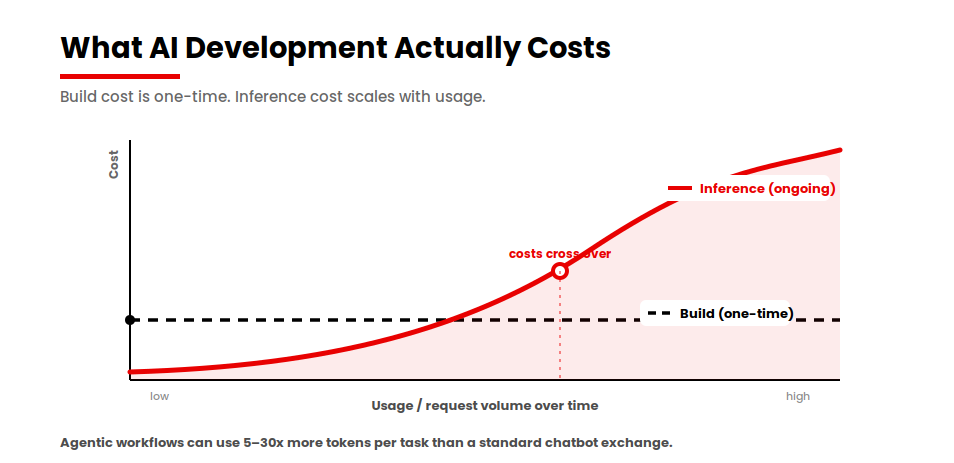
The number that matters more than the build cost is the ongoing one: inference cost per request, monitoring, and the team time required to maintain it. Budget for that figure before budgeting for the build itself.
Inference cost scales with usage in a way a one-time build cost does not. Agentic workflows can consume five to thirty times more tokens per task than a standard chatbot exchange, and Gartner expects overall enterprise inference spend to keep rising even as per-token prices fall.
A feature that looks cheap at a hundred requests a day can look very different at a hundred thousand, particularly if it calls a large model for every request instead of routing simpler queries to a smaller, cheaper one. Model routing by query complexity is one of the most reliable ways to keep that number under control as adoption grows.
Who You Need On The Team
A small team with the right people beats a large team with the wrong people.
- A product owner who will say no to features that have drifted from the original problem definition.
- An AI/ML engineer who owns the model choice, evaluations, and guardrails.
- A data engineer, if the feature depends on proprietary data, which most useful features do.
- A backend engineer to deal with integration, scaling, and anything that is not the model.
- Someone in quality assurance who tests against real, messy inputs rather than only the happy path.
- An owner after launch, the one who is responsible when the model starts acting weird after business hours.
The size of the team should be proportional to the complexity of the features, not the size of the company. Two to three people with multiple roles can manage one well-scoped feature of an existing API. A full AI-native product typically requires a dedicated role for each of the following tasks: evaluation and monitoring, which can be a full-time job once real users are involved.
Where This Leaves You
Weak monitoring, missing guardrails, and no fallback plan cause more AI features to fail before shipping than a bad model does. If you are looking to invest more time or money into your next AI feature, test it against the above checklist and be honest about where it actually stands. If it is in between demo and production, that is a specific, solvable problem, and it is one I have helped teams work through more than once.
If that is the situation, the next step is a conversation.
Talk to Our AI Team
Have an AI feature stuck between demo and production? We will help identify exactly what it needs to ship.
Start with a scoping conversationKeep reading
For readers scoping their own AI feature, these go deeper on the pieces that matter most: when to build custom AI versus using an API, how to integrate an AI agent into an existing product, and what AI app development actually costs.