














 ChatGPT
 Perplexity
 Claude
 Google AI
Enterprise AI adoption rarely happens through a single, centrally managed initiative. Different teams often introduce AI capabilities at different speeds, from vendor-enabled features and internal copilots to autonomous agents connected with business workflows. Without a clear governance model, organizations can quickly lose visibility into what systems exist, who owns them, and how risks are being managed.
Enterprise AI governance is the operating system for deciding how AI systems are proposed, assessed, built, purchased, released, monitored, changed, and retired. It connects business ownership with engineering, data, security, privacy, legal, risk, procurement, and operations to ensure AI decisions are made with accountability and control.
This guide explains how enterprises can move from AI governance principles to a practical operating model, defining ownership structures, risk assessments, approval processes, monitoring controls, and evidence requirements needed to scale AI responsibly.
What Is Enterprise AI Governance?
Enterprise AI governance is the system of decision rights, lifecycle controls, technical enforcement, and retained evidence used to manage AI across an organization. It covers internally developed models, third-party AI services, generative AI applications, prompts, retrieval data, vendor features, and AI agents.
Decision rights identify who may approve a use case, accept a risk, authorize access to data, release a model, expand an agent’s permissions, or suspend a system. Each material decision needs an accountable owner, defined contributors, and an escalation path.
Visibility comes first. AI can enter through software development, customer support, analytics, finance, human resources, security operations, marketing tools, and software-as-a-service products purchased by individual departments.
A useful AI inventory records the complete use and the technical components that make it work. At minimum, I want the record to identify:
- The business purpose and intended users
- The accountable business owner
- The technical or application owner
- The model and model provider
- The prompt or instruction set
- Data sources and data classifications
- Retrieval-augmented generation, or RAG, sources
- Tools, APIs, and systems the AI can access
- Deployment environment and operating locations
- Affected customers, employees, or other stakeholders
- Risk tier and required approvers
- Monitoring, incident, and retirement requirements
- Current lifecycle state and latest approved version
RAG is a design pattern in which an AI application retrieves information from approved sources before producing an answer. The retrieved content introduces governance questions around source ownership, access controls, freshness, retention, and untrusted content that could influence the model.
I treat AI as an operational actor whenever it can take action. At that point, the inventory also needs an action-surface record showing what the AI can do, which credentials it uses, and where human approval applies.
That distinction separates a drafting assistant from an agent that can issue refunds or update patient records. Both use AI, though their consequences and required controls differ sharply.
A working governance model should answer six questions:
- What AI exists?
- What business purpose does each use serve?
- Who owns its value, operation, and risk?
- What data, tools, models, and vendors does it depend on?
- What controls apply before and after release?
- What evidence proves those controls operated?
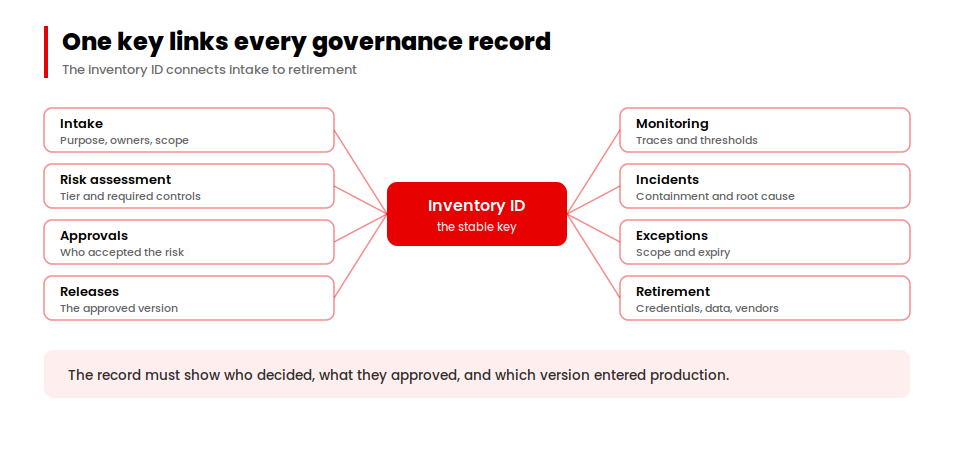
A control without retrievable evidence exists only on paper. The record must show who decided, what they approved, and which version entered production.
Why Enterprise AI Governance Needs an Operating Model
A policy can express principles such as fairness, accountability, privacy, security, and human oversight. An operating model turns those principles into assigned work, approval paths, technical controls, and evidence.
Policy alone stalls. The gap becomes visible when a product team wants to release an AI feature and nobody has established who owns its risk classification, who approves the vendor model, or what monitoring is required after launch.
A practical operating model assigns responsibilities across the lifecycle:
| Responsibility | Typical accountable role | Core decision |
|---|---|---|
| Business purpose and value | Business or product owner | Should this AI use proceed? |
| Risk classification | Risk owner or governance lead | Which control tier applies? |
| Data use | Data owner and privacy stakeholders | Which data may the system process? |
| Technical design | Engineering or architecture owner | Does the architecture enforce required controls? |
| Security | Security owner | Are access, credentials, and attack surfaces controlled? |
| Vendor assurance | Procurement and vendor-risk owner | Can the organization accept the supplier exposure? |
| Release | Product, engineering, and risk approvers | Is the approved version ready for production? |
| Runtime operation | Application or operations owner | Is the AI behaving within its approved limits? |
| Incident response | Incident commander and system owner | Should the system be contained, rolled back, or suspended? |
| Independent review | Audit or assurance function | Can the enterprise demonstrate control operation? |
The exact titles vary by organization. What matters is that each material decision has one accountable owner, a documented group of contributors, and a clear escalation route.
Governance has to follow the delivery workflow
I place governance decisions inside the systems teams already use. Intake belongs in portfolio or product workflows, engineering controls belong in source control and continuous integration and continuous delivery pipelines, and production controls belong in runtime infrastructure.
Continuous integration and continuous delivery, usually shortened to CI/CD, is the automated process used to test and release software. A governance release gate can use that process to verify that required evaluations, approvals, and version records exist before a production deployment proceeds.
This design keeps governance connected to delivery. It also makes evidence collection easier because the control result is produced while the work happens.
The same principle applies after launch. Monitoring signals should feed operational dashboards, incident systems, and risk reviews.
Evidence should be created as work happens
A governance program needs evidence that can reconstruct a decision. That evidence may include the intake record, risk assessment, data approval, model evaluation, prompt version, security test, release approval, monitoring result, user complaint, incident response, and retirement decision.
The record should show:
- What was proposed
- Which version was evaluated
- Which data and tools were involved
- What risks were identified
- Which controls were required
- Who approved the decision
- Which exceptions were accepted
- What entered production
- What happened during operation
- What changed afterward
I call this a runtime enforcement decision log when it records decisions surrounding agent actions. The log should identify the agent, requested action, policy evaluated, decision result, human approver where applicable, execution result, and relevant trace identifiers.
A trace identifier is a unique reference used to connect events across systems. It allows an investigator to follow an agent request from the initial user instruction through model calls, policy checks, tool execution, and the final business outcome.
Operational governance lessons from controlled remote workflows
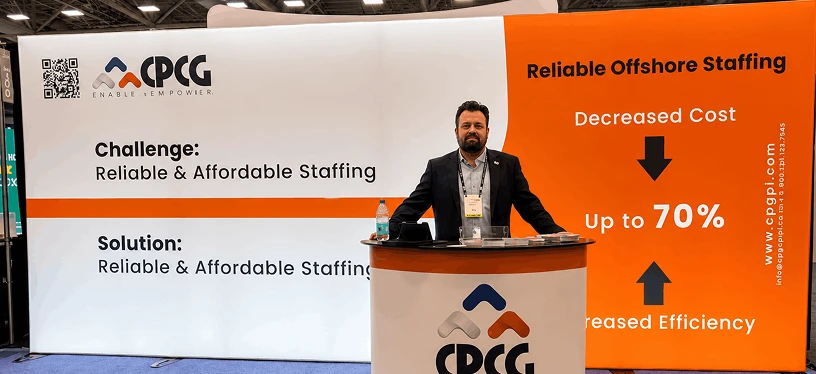
The value of these controls is clear in systems where software acts through business workflows, even when AI sits outside the original project scope. AppVerticals’ work for Collaborative Patient Care Group (CPCG), a healthcare outsourcing and consulting firm, involved a platform connecting remote representatives with unattended kiosks in healthcare facilities.
The workflow required schedule-based access, centralized assignments, role-based control panels, remote operations, activity reporting, and an audit module. Those controls established who could act, which resource they could access, when access was valid, and how activity could be reviewed.
The delivered outcome included, in the project record’s words, “Enhanced security and compliance with controlled login windows, audit trails, and role-based access across admin, manager, and super admin levels.” The system also enabled “Data-driven decision-making through real-time usage reports, OCSR activity logs, and kiosk performance metrics.”
This control pattern applies directly to enterprise AI agent governance. Before an agent can act through a business system, the enterprise needs equivalent answers for identity, role, approved target, permitted context, action logging, supervision, and containment.
Governance requirements added late also create architecture debt. Teams may have to retrofit identity boundaries, separate shared credentials, rebuild logs, version prompts, or redesign integrations after an application is already in use.
That debt belongs alongside other forms of AI technical debt because deferred governance decisions affect maintainability, security, audit readiness, and future releases. The debt compounds.
The Enterprise AI Governance Architecture
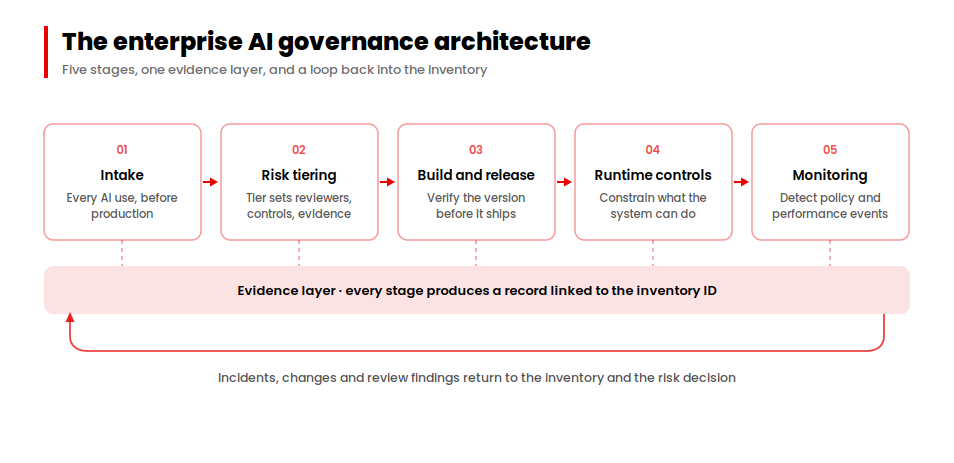
I organize enterprise AI governance architecture into five linked stages: intake, risk classification, build and release controls, runtime enforcement, and continuous monitoring. Organizational authority connects directly to technical enforcement at each stage.
Evidence follows every stage. Each decision produces a record connected to the AI use case, model, prompt, data source, vendor, release, agent, or incident involved.
The operating flow is:
- A team submits an AI use case through a common intake process.
- The use case enters the enterprise AI inventory and receives accountable owners.
- Risk classification determines the required reviewers, controls, and evidence.
- Build and vendor controls verify the system before release.
- Runtime controls constrain what the deployed system or agent can do.
- Monitoring identifies performance, policy, security, and operational events.
- Incidents, changes, and review findings feed back into the inventory and risk decision.
The governance control matrix turns that flow into explicit ownership and release decisions:
| Control area | Owner | Trigger | Evidence | Release decision |
|---|---|---|---|---|
| Inventory | AI governance lead | New use case | Registry record | Classify |
| Risk tiering | Risk owner | Material change | Risk assessment | Approve or escalate |
| Agent authority | Application owner | Tool request | Permission record | Allow or deny |
| Monitoring | Operations owner | Production event | Trace log | Remediate |
| Incident response | Incident commander | Control failure | Incident record | Recover |
Intake, inventory, and ownership
Every AI use should have an intake record before production use. Lightweight intake can cover isolated experiments, with fewer required fields when the work has no production data, external users, or business-system access.
The form should capture enough information to classify the use. Asking every possible governance question at intake creates friction and can still miss system-specific risks that emerge during architecture review.
A practical intake form asks:
- What business problem will the AI address?
- Who is accountable for the business outcome?
- Who owns the application in production?
- Who will use or be affected by the output?
- Will the AI recommend, decide, generate, or act?
- Which data classifications will it process?
- Will it use a third-party model or embedded vendor feature?
- Which systems or tools can it access?
- Does a person review the output before it affects a customer, employee, or business record?
- Where will the system operate?
- What happens if the AI gives a wrong answer or takes an incorrect action?
The final question often exposes operational criticality faster than abstract scoring. A wrong internal summary has a different failure path from an incorrect financial decision or an agent changing a production account.
Ownership must be explicit. The business owner accepts responsibility for purpose and impact, the technical owner maintains the deployed system, and the risk owner decides whether the remaining exposure fits the organization’s tolerance.
A governance lead coordinates the process and keeps it consistent. Business and engineering teams should retain ownership of the risks they create and control.
The inventory also needs lifecycle states such as proposed, experimental, approved for limited use, production, suspended, and retired. A system that has been switched off may still have retained data, active credentials, dependent workflows, or contractual obligations requiring closure.
Risk tiers and decision rights
Risk classification determines the depth of review. Proportionate control gives internal, low-impact tools a lighter path while high-impact or autonomous systems receive deeper scrutiny.
Implementation assumption: The four-tier model below is a starting point. Each organization should validate the criteria with its legal, risk, security, privacy, technical, and business stakeholders.
| Tier | Typical trigger | Decision authority | Minimum evidence | Release gate |
|---|---|---|---|---|
| Tier 1: Limited | Internal productivity use with low-sensitivity data and no automated business action | Business and application owner | Inventory record, acceptable-use confirmation, data check | Owner approval |
| Tier 2: Controlled | AI informs an employee or customer workflow and can affect service quality | Product, technical, and risk owners | Risk assessment, evaluation results, monitoring plan, user guidance | Cross-functional approval |
| Tier 3: High impact | AI materially influences people, regulated processes, financial exposure, or sensitive operations | Senior business, risk, legal, security, and technical authorities | Impact assessment, validation, security review, human-oversight design, incident plan | Formal approval with documented residual risk |
| Tier 4: Agentic or critical | AI takes consequential, multi-step actions or uses privileged tools with limited human review | Executive risk authority and designated technical approvers | Full action-surface inventory, permission design, runtime policy tests, rollback evidence, traceability review | Restricted authorization with continuous oversight |
Risk scoring should consider impact and operational autonomy. A model producing a high-impact recommendation may require strict controls even when a human clicks the final approval button.
A human review step also needs a quality assessment. If reviewers lack context, time, authority, or an understandable explanation, the review provides weak protection.
The boundary matters. For an isolated sandbox with synthetic data, no external users, and no business-system access, the full production workflow is excessive; the organization can record the experiment and keep it contained.
Material changes should trigger reassessment. Common triggers include:
- A new model or model version
- A significant system-prompt change
- A new RAG source
- A new customer or employee population
- A new deployment location
- Expanded data access
- A new agent tool
- Increased action authority
- Reduced human review
- A vendor change
- A production incident
- Evidence of performance drift
The risk tier can rise or fall after reassessment. The decision and its evidence should remain linked to the system’s inventory history.
Build, release, and vendor controls
Build controls translate governance requirements into engineering work. They define which evaluations, security checks, data validations, and approvals must pass before a specific version enters production.
Versioning is essential. For a generative AI application, I expect the release record to identify the model, system prompt, retrieval configuration, safety rules, tool definitions, code version, data dependencies, and evaluation set.
An evaluation set is a collection of test inputs and expected criteria used to assess the system. Depending on the use case, those criteria may cover answer quality, prohibited content, privacy exposure, bias, citation behavior, tool selection, refusal behavior, or resistance to adversarial instructions.
Prompt governance should include:
- Named ownership for system prompts
- Version control and change history
- Review requirements based on risk tier
- Tests covering expected and disallowed behavior
- Separation of trusted instructions from untrusted user or retrieved content
- Rollback to a previously approved version
- Production monitoring tied to prompt and model versions
Model governance adds provenance, usage terms, performance evaluation, drift monitoring, and retirement planning. Provenance means knowing where a model came from, which version is in use, and what documentation supports its approved purpose.
Vendor governance should assess the supplier and the specific AI feature. A vendor may change models, subprocessors, data handling, training practices, service locations, retention rules, or product behavior over time.
The review should establish:
- Which model or AI service is being supplied
- How submitted data is used and retained
- Whether customer data is used for provider training
- Which subcontractors or subprocessors participate
- Where data processing occurs
- How model or feature changes are communicated
- Which security and incident commitments apply
- How logs and evidence can be obtained
- What happens during provider outages or control failures
- How the organization can exit and remove retained data
Third-party AI remains part of the enterprise’s risk picture. Procurement approval should connect to the same inventory, risk tier, monitoring, and incident processes used for internally developed systems.
Release gates can be automated where evidence is machine-readable. A CI/CD pipeline might check for a valid inventory ID, approved evaluation result, security scan, model card, risk decision, and monitoring configuration before allowing deployment.
A model card is a structured document describing a model’s intended purpose, limitations, evaluation results, and other relevant characteristics. I supplement it with an application-level record because business behavior also depends on prompts, data, tools, code, and user context.
Runtime controls for AI agents
Enterprise AI agent governance starts with a narrow grant of authority. An agent should receive only the access required for its approved task, and the technical architecture should enforce that boundary during every action.
Authority must be narrow. An agent’s action surface includes every tool, API, command, record, workflow, and external communication it can invoke.
For every tool, record:
- The tool name and business purpose
- Permitted operations
- Data objects the tool can read or modify
- Credential and identity used
- Environmental scope, such as test or production
- Rate, value, or transaction limits
- Geographic or account restrictions
- Human-approval threshold
- Logging and trace requirements
- Timeout, retry, and rollback behavior
- Named owner and escalation path
Agents should use scoped identities instead of shared credentials. A scoped identity grants access only to the resources and actions required for the approved task.
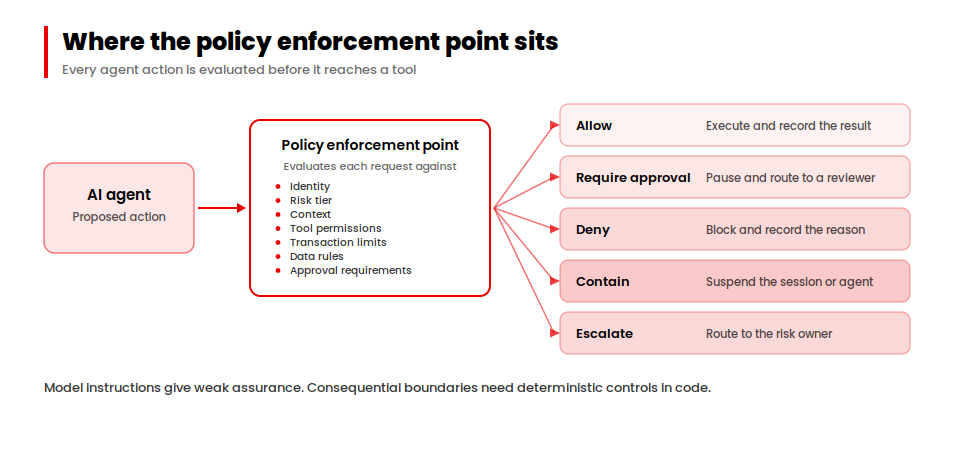
The policy enforcement point should sit between the agent and its tools. This component evaluates the requested action against identity, risk tier, context, tool permissions, transaction limits, data rules, and approval requirements.
A runtime decision may produce one of several outcomes:
| Decision | Meaning | Example response |
|---|---|---|
| Allow | The action falls within preapproved boundaries | Execute and record the result |
| Require approval | The action exceeds an autonomous threshold | Pause and route to an authorized reviewer |
| Deny | The action conflicts with policy or permission | Block and record the reason |
| Contain | The request indicates a control or security problem | Suspend the session or agent |
| Escalate | The system cannot make a safe determination | Route to the application or risk owner |
Human approval should capture the requested action, affected resource, business context, expected consequence, model rationale where useful, and a clear statement of what approval authorizes. A button click without that context gives the reviewer little basis for a decision.
High-risk actions may benefit from deterministic controls. These are rules enforced in code, such as transaction ceilings, permitted account lists, schema validation, geographic restrictions, or a mandatory second approval.
Model instructions provide weak assurance for consequential boundaries. An agent may misunderstand them, receive conflicting context, or encounter a tool response that changes its plan.
I also separate planning authority from execution authority where the risk warrants it. An agent may generate a proposed sequence while a policy service or human reviewer authorizes each sensitive step.
The CPCG workflow discussed earlier demonstrates the operational pattern. Schedule-based access, role-specific control, audit trails, centralized assignments, and activity records provide the same control categories an enterprise needs when software acts through privileged workflows.
For AI agents, I extend that pattern with model and prompt versioning, policy evaluations, tool-call traces, input and output handling, and explicit approval records. The result is a replayable history of what the agent was asked to do, what it attempted, which controls were evaluated, and what happened.
Monitoring, incidents, and evidence
Production monitoring should cover business performance, model behavior, agent actions, security events, and control operation. A single accuracy score cannot represent that picture.
The monitoring plan should be tied to the system’s risks and intended purpose. Useful measures may include:
- Task completion and failure rates
- Human correction or override frequency
- Unsupported or unverifiable output rates
- Policy denials and approval requests
- Invalid or unauthorized tool-call attempts
- Sensitive-data handling events
- Changes in model or prompt behavior
- Retrieval quality and stale-source events
- Latency and operating cost
- User complaints and reported harms
- Security alerts
- Rollback and recovery events
Drift means that system behavior or performance changes over time. It may come from changing input data, model updates, new user behavior, retrieval-source changes, altered tools, or a shift in the business environment.
Monitoring thresholds should trigger a defined response. The response may involve investigation, additional human review, permission reduction, rollback, temporary suspension, or formal incident handling.
Logs need context. An AI incident record should connect:
- The affected AI use case and owner
- Model, prompt, application, and tool versions
- Date, time, user, and operating context
- Relevant inputs, outputs, and actions
- Policies and controls evaluated
- Detection source
- Affected people, systems, or records
- Containment and recovery steps
- Root-cause analysis
- Corrective actions
- Reapproval requirements
- Evidence-retention decision
Sensitive inputs and outputs require controlled evidence handling. The organization may need redaction, encryption, limited retention, role-based access, or tokenization to preserve useful records while respecting privacy and security requirements.
An evidence repository should preserve links among governance records. The inventory ID becomes the stable key connecting intake, risks, approvals, releases, monitoring, incidents, exceptions, and retirement.
| Evidence type | Created when | Accountable owner | Retention purpose | Review trigger |
|---|---|---|---|---|
| Intake and inventory record | Use case proposed | Governance lead and business owner | Establish scope and ownership | Material use-case change |
| Risk assessment | Initial classification or change | Risk owner | Document exposure and required controls | New data, model, user group, or authority |
| Evaluation result | Build or release candidate tested | Technical owner | Demonstrate approved behavior | Model, prompt, retrieval, or tool change |
| Vendor assessment | Supplier or feature reviewed | Vendor-risk owner | Record supplier dependencies and commitments | Contract, model, or processing change |
| Agent permission record | Tool access requested | Application owner | Prove approved action boundaries | New tool or expanded authority |
| Release decision | Production deployment proposed | Release approvers | Identify the approved version | New production release |
| Runtime trace | System or agent operates | Operations owner | Reconstruct behavior and control decisions | Alert, complaint, or incident |
| Incident record | Control failure or harmful event | Incident commander | Support containment and remediation | Post-incident review |
| Retirement record | AI use is decommissioned | Business and technical owners | Close credentials, data, vendors, and dependencies | Final assurance review |
This evidence architecture supports periodic management review. Leaders can see where controls repeatedly fail, where approvals take too long, and where older systems carry unresolved governance debt.
The record must survive scrutiny. That is the standard.
How NIST AI RMF and ISO/IEC 42001 Fit Together
The NIST AI RMF and ISO/IEC 42001 serve complementary purposes. I use the NIST AI RMF to organize risk activity and ISO/IEC 42001 to structure the organizational management system around that activity.
They solve different problems. The NIST AI RMF is voluntary, and its Core organizes AI risk work into four functions: Govern, Map, Measure, and Manage.
- Govern establishes policies, roles, accountability, culture, inventory, and oversight.
- Map establishes the system context, intended purpose, stakeholders, dependencies, and potential impacts.
- Measure assesses identified risks through analysis, testing, metrics, and evaluation.
- Manage prioritizes and treats risks, monitors results, and responds to change.
NIST describes Govern as a cross-cutting function infused throughout the other three. That structure fits enterprise implementation because ownership, policy, and evidence remain active through design, release, operation, and retirement.
ISO/IEC 42001:2023 specifies requirements for establishing, implementing, maintaining, and continually improving an Artificial Intelligence Management System, or AIMS. An AIMS connects policies, objectives, responsibilities, processes, and continual improvement at the organizational level.
ISO/IEC 42001 follows a Plan-Do-Check-Act management cycle:
- Plan: Define scope, objectives, responsibilities, risks, opportunities, and treatment plans.
- Do: Implement controls and operational processes.
- Check: Monitor, measure, audit, and review performance.
- Act: Correct problems and improve the management system.
Here is the practical crosswalk I use when discussing enterprise AI governance compliance and implementation:
| Operating need | NIST AI RMF contribution | ISO/IEC 42001 contribution | Practical artifact |
|---|---|---|---|
| Governance scope and accountability | Govern | AIMS scope, leadership, roles, and policy | Governance charter and responsibility matrix |
| AI inventory | Govern | Documented management-system processes | AI system and use-case registry |
| System context and stakeholder impact | Map | Risk and opportunity planning | Use-case intake and impact assessment |
| Evaluation and risk analysis | Measure | Performance evaluation and operational control | Evaluation plan, test results, and risk record |
| Treatment and release decisions | Manage | Operational planning and control | Release gate and residual-risk approval |
| Runtime oversight | Govern, Measure, Manage | Monitoring, measurement, and control | Dashboard, trace log, and exception record |
| Incident response | Manage | Nonconformity and corrective action | Incident and corrective-action record |
| Continual improvement | Govern and Manage | Plan-Do-Check-Act cycle | Management review and improvement backlog |
Using the two together still requires interpretation. An organization has to map its actual systems, business risks, contractual commitments, and applicable legal requirements with qualified stakeholders.
The NIST AI RMF provides no certification. ISO/IEC 42001 can support a formal management-system certification path, though adopting its structure and earning certification remain separate matters.
For U.S. enterprises, standards alignment should connect with existing security, privacy, vendor-risk, records-management, and industry compliance programs. Legal counsel should determine the obligations that apply to a specific organization, jurisdiction, and AI use.
The strongest implementation artifact is a control map linking each framework outcome or requirement to an owner, system scope, control, evidence source, and review frequency. That is the operating layer.
Enterprise AI Governance Best Practices Checklist
- Define AI governance ownership, decision authority, escalation paths, and accountability across business, technical, security, privacy, and risk teams.
- Establish an AI inventory that tracks use cases, owners, models, data sources, vendors, agents, and lifecycle status.
- Create risk-based AI classification criteria with required approvals, controls, testing, and monitoring for each risk level.
- Integrate governance checks into AI development, procurement, deployment, and change-management workflows.
- Control AI agent permissions by limiting tools, data access, actions, and autonomy based on business risk.
- Implement monitoring for AI performance, security risks, policy violations, data handling, and unexpected behavior.
- Extend incident response processes to cover AI failures, including investigation, rollback, containment, and remediation.
- Maintain governance evidence, review controls regularly, track exceptions, and continuously improve the program based on operational lessons.
AI Governance Implementation Cost-Planning Inputs
The brief supplied no approved project ranges, so I would avoid assigning a dollar estimate to this work. Cost depends on the number and complexity of AI uses, the maturity of existing controls, integration requirements, and the remediation discovered during assessment.
A scoped estimate should account for these workstreams:
| Cost area | Primary cost pressure | Discovery evidence needed |
|---|---|---|
| Inventory and discovery | Number of business units, vendors, environments, and unknown AI uses | Application portfolio, procurement records, cloud accounts, interviews |
| Governance design | Stakeholder count, existing risk processes, and decision complexity | Policies, approval structures, risk taxonomy |
| Standards mapping | Target frameworks and current control maturity | Existing control library, audits, management-system documents |
| Engineering integration | Number of repositories, CI/CD systems, models, prompts, and applications | Architecture diagrams, pipeline access, release process |
| Agent runtime controls | Number of tools, APIs, identities, approval paths, and transaction rules | Agent designs, tool definitions, permission records |
| Monitoring and evidence | Telemetry availability, retention requirements, and system integration | Logging architecture, incident tools, data classifications |
| Remediation | Shared credentials, missing versioning, weak logs, or unsupported systems | Technical assessment and control-gap register |
| Training and rollout | Number of roles, business units, and governance responsibilities | Stakeholder map and adoption plan |
These inputs give procurement and delivery leaders a defensible basis for estimation. Scope comes first.
When to Bring in AI Governance Implementation Support
Implementation support becomes useful when governance intent exists while operating controls remain fragmented. I see the strongest need when leaders have policies and review groups but still lack a reliable inventory, tiered release path, agent permission model, or evidence architecture.
Common triggers include:
- Business units are adopting AI faster than the central team can assess it.
- Vendor AI features appear without a consistent review process.
- Ownership remains unclear after an AI use reaches production.
- Every AI use receives the same review regardless of risk.
- Product teams cannot identify the evidence required for release.
- Agents use broad credentials or undefined tool permissions.
- Human approvals happen outside the system of record.
- Runtime logs cannot reconstruct an agent’s actions.
- Incident procedures lack AI-specific containment and rollback.
- Standards mapping exists while operating controls and evidence remain disconnected.
- Governance reviews are slowing delivery because the workflow is manual.
- Leadership needs an implementation roadmap before investing in tooling.
I would begin with an architecture and control assessment. The assessment should review representative AI systems, trace one or two uses through the lifecycle, examine agent authority where applicable, and identify where required evidence is created.
The output should include:
- A current-state inventory and ownership assessment
- A risk-tier and decision-rights design
- A control map aligned with NIST AI RMF and ISO/IEC 42001
- A target governance architecture
- Build, release, vendor, and runtime control requirements
- An evidence-retention model
- A prioritized remediation backlog
- An implementation sequence with accountable owners
Prioritization should follow risk and dependency. Inventory and ownership usually come first because later decisions depend on knowing what exists and who can approve changes.
Agent action controls may require early attention when deployed systems already have access to production tools. Monitoring and evidence should be designed alongside those controls so activity can be reviewed from the first approved release.
The architecture above gives you a way to assess ownership, release controls, agent authority, monitoring, and evidence as one operating system. Start with one live AI use and trace it from intake to its latest production event.
That trace will expose the real gaps. I would turn those findings into a sequenced implementation backlog with named owners.
Turn enterprise AI governance requirements into operating controls
Assess your AI inventory, decision rights, agent controls, standards mapping, and evidence architecture.
Discuss your enterprise AI governance requirements