
























 ChatGPT
 Perplexity
 Claude
 Google AI
Fine-tuning an LLM is the process of taking an already trained foundation model, such as Llama, Mistral or GPT and continuing its training on a smaller, task-specific dataset so the model permanently learns your domain, tone and output format. A general LLM is the right choice when prompting alone meets your accuracy bar and a fine-tuned model is the right choice when you need consistent, specialized behavior that prompting cannot hold. In this guide, I explain how LLM fine-tuning works step by step, compare full fine-tuning against LoRA and QLoRA, put real dollar figures on the cost and show how much data you actually need before the work pays off.
The decision is no longer optional for most product teams because 88% of organizations now report regular AI use in at least one business function, according to McKinsey’s 2025 State of AI survey and the teams pulling ahead are the ones customizing models instead of shipping raw API calls.
Key Takeaways
- LLM fine-tuning continues the training of a pre-trained foundation model on a task-specific dataset so specialized behavior is baked into the model weights.
- Parameter-efficient methods dominate real projects, since LoRA cuts trainable parameters by roughly 10,000 times compared with full fine-tuning.
- QLoRA fine-tunes a 65B model on a single 48GB GPU, which puts large-model customization within reach of mid-market budgets.
- A LoRA run on a 7B model costs tens of dollars in compute at current GPU cloud rates, while data preparation consumes most of the real budget.
- Most use cases need 500 to 5,000 curated examples and dataset quality decides the outcome more than dataset size.
- Fine-tuning changes behavior and format, while RAG supplies fresh knowledge and the full decision framework lives in our RAG vs fine-tuning guide.
- Skip fine-tuning when your accuracy gap is factual, your data is thin or your requirements change weekly because prompting and retrieval solve those problems cheaper.
What Is LLM Fine-Tuning?
LLM fine-tuning is the process of further training an already trained large language model on a specialized, task-specific dataset. The additional training adjusts the model’s weights so it adopts the behavior, vocabulary, tone and formatting of that dataset, which makes it reliably specialized for domains like legal analysis, medical documentation or customer support.
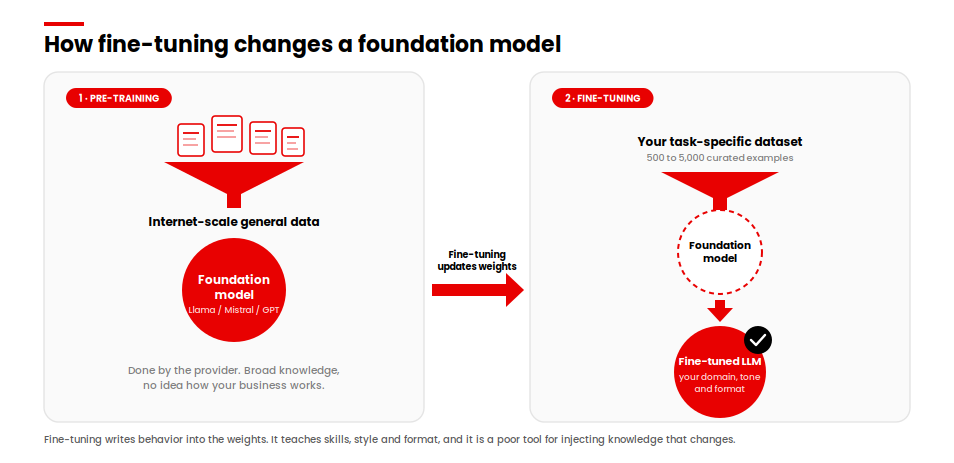
The distinction from a general LLM matters at the weight level. A general model such as GPT, Claude, Gemini, Llama or Mistral holds broad knowledge from pre-training and follows whatever instructions you place in the prompt on each call. A fine-tuned LLM has your requirements written into its parameters, so the behavior persists across every request without a two-page system prompt carrying the load.
I frame it for clients as the difference between briefing a contractor and training an employee. The contractor can do good work if you re-explain the job every time. The employee has internalized how your company works. That persistence is what you are buying. Fine-tuning teaches skills and style and it is a poor tool for injecting knowledge that changes.
How Does LLM Fine-Tuning Work? A Step-by-Step Workflow
LLM fine-tuning works by running supervised training passes over prompt-and-response pairs until the model’s outputs match the patterns in your dataset. Every production fine-tune I have shipped follows the same six steps and the projects that fail usually skipped step one.
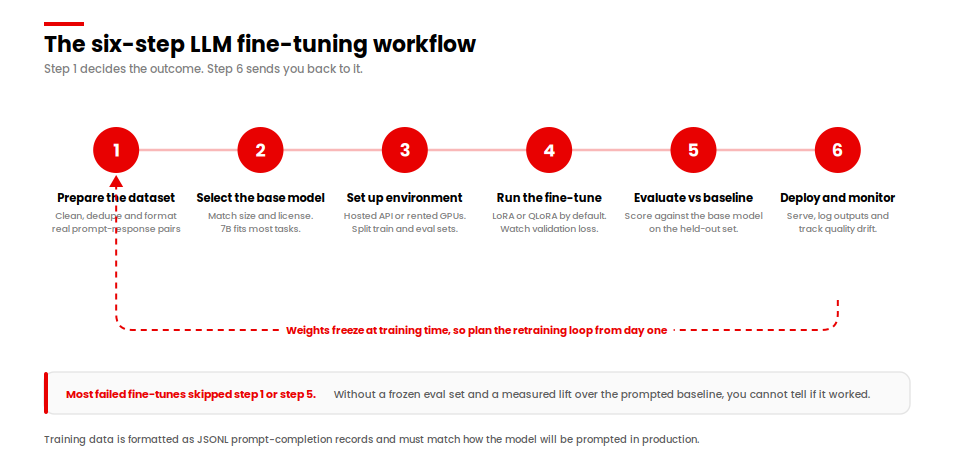
- Prepare the dataset: Collect real examples of the inputs your product receives and the outputs you want, then clean, deduplicate and format them as prompt-completion pairs. This step decides the result. On our engagements, it routinely takes more calendar time than the training itself.
- Select the base model: Match model size and license to the task. A 7B open-weight model handles most classification and formatting work, while nuanced domain reasoning may justify 13B to 70B or a hosted proprietary model.
- Set up the training environment: Choose between a hosted fine-tuning API, where the provider manages compute and a self-hosted run on rented GPUs using libraries like Hugging Face PEFT and TRL. Split your data into training and held-out evaluation sets before anything trains.
- Run the fine-tune: Train with a parameter-efficient method such as LoRA or QLoRA unless you have a documented reason for full fine-tuning. Watch training and validation loss to catch overfitting early.
- Evaluate against a baseline: Score the fine-tuned model against the base model on the held-out set using task metrics and human review. If you cannot show a measured lift over the prompted baseline, do not ship it.
- Deploy and monitor: Serve the model, log outputs and track quality drift. Fine-tuned weights are frozen at training time, so schedule periodic retraining as your data and requirements evolve.
A practical note on step one because this is where most questions land. Training data for a chat model is formatted as JSONL records containing a system message, a user message and the assistant response you want the model to learn. The formatting must match how the model will be prompted in production, including the same system message or the fine-tune teaches behavior your application never triggers. We also strip anything from the corpus we would not want the model to reproduce, since the trainer does not distinguish between the parts of an example you liked and the parts you tolerated.
The step teams underestimate is evaluation. A fine-tune that looks better in spot checks and worse on a measured test set is a common outcome and without the baseline you will never know. That is an evaluation problem.
What Are the Main LLM Fine-Tuning Techniques?
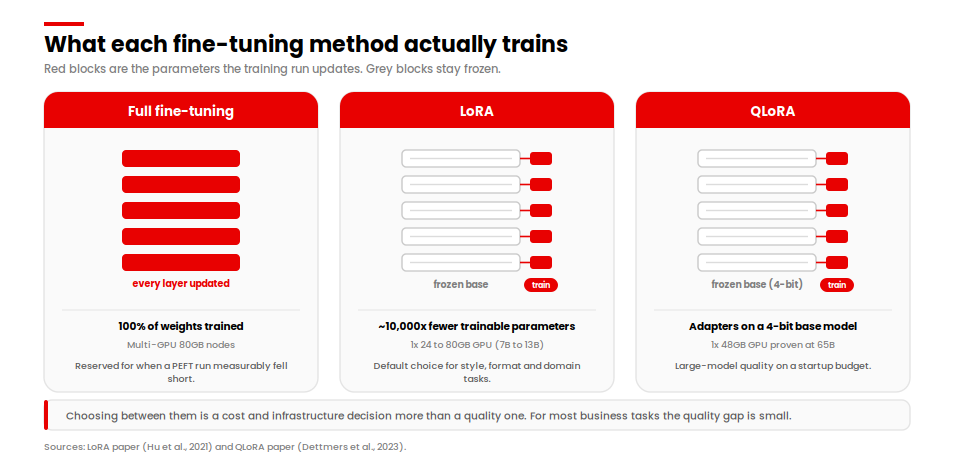
The main LLM fine-tuning techniques are full fine-tuning, parameter-efficient fine-tuning (PEFT), LoRA and QLoRA and they differ in how many model weights the training updates. Choosing among them is a cost and infrastructure decision more than a quality decision because for most business tasks the quality gap between them is small.
Full Fine-Tuning
Full fine-tuning updates every parameter in the model. It offers maximum capacity to reshape behavior and it carries maximum cost, since a 70B model requires multi-GPU clusters, large curated datasets and careful management of catastrophic forgetting, where the model loses general ability while specializing. I reserve it for cases where a parameter-efficient run has already been tried and measurably fell short.
Parameter-Efficient Fine-Tuning (PEFT)
PEFT is the umbrella term for methods that freeze the base model and train a small set of added parameters. The Hugging Face PEFT library is the standard open-source toolkit and PEFT methods are what make fine-tuning affordable for teams without a research lab.
LoRA (Low-Rank Adaptation)
LoRA freezes the original weights and trains small low-rank matrices injected into the model’s layers. The original LoRA paper reports reducing trainable parameters by roughly 10,000 times and GPU memory requirements by about 3 times compared with full fine-tuning of GPT-3 175B, with comparable output quality. LoRA is my default recommendation for nearly every client fine-tune.
QLoRA (Quantized LoRA)
QLoRA applies LoRA on top of a 4-bit quantized base model, which cuts memory usage far enough that the QLoRA paper demonstrates fine-tuning a 65B parameter model on a single 48GB GPU while preserving full 16-bit task performance. When a client wants large-model quality on a startup budget, QLoRA is usually the answer.
Instruction tuning and RLHF sit alongside these methods. Instruction tuning is supervised fine-tuning on instruction-and-response data and RLHF aligns outputs to human preference rankings. Most product teams never need to run RLHF themselves because the base models already ship with it.
| Technique | What Trains | Typical Hardware (7B to 70B) | When I Choose It |
|---|---|---|---|
| Full Fine-Tuning | All model weights | Multi-GPU 80GB nodes, clusters for 70B models | PEFT measurably fell short and the budget supports full training |
| LoRA | Small low-rank adapter matrices | Single 24 to 80GB GPU for 7B to 13B models | Default choice for style, format and domain-specific tasks |
| QLoRA | LoRA adapters on a 4-bit base model | Single 48GB GPU handles models up to 65B parameters | Large models are needed but compute budget is constrained |
| Hosted API Fine-Tuning | Provider-managed model customization (for example, OpenAI) | No dedicated hardware required; upload training data | No ML infrastructure team and a preference for a proprietary base model |
How Much Does LLM Fine-Tuning Cost?
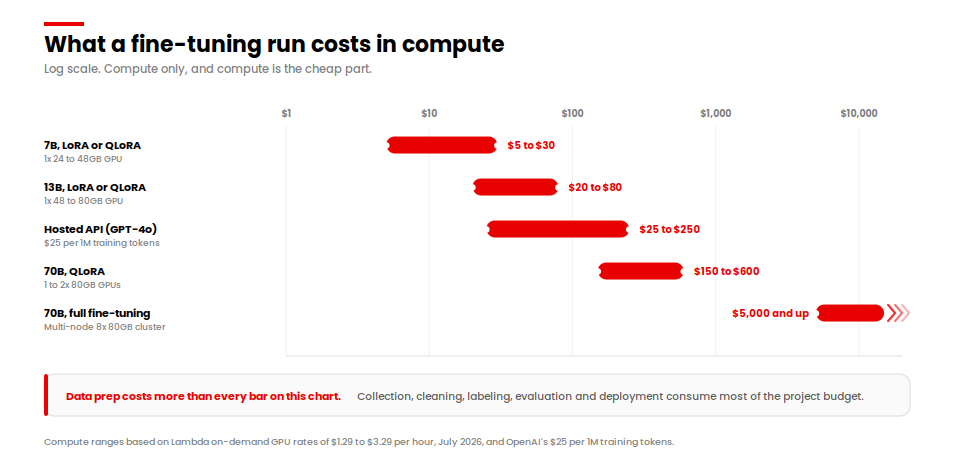
Fine-tuning an LLM costs anywhere from under one hundred dollars in compute for a LoRA run on a small model to well over five figures for full fine-tuning of a large model and data preparation usually costs more than the training itself. The compute line item is the part everyone asks about first, so here are current, sourced anchors.
On the hosted route, OpenAI prices GPT-4o fine-tuning at $25 per million training tokens and smaller models on its current price sheet train for under a dollar per million tokens. On the self-hosted route, on-demand GPU rates at Lambda run from $1.29 per hour for A100-class cards to $3.29 and up for H100-class cards as of July 2026.
| Model Size and Method | Hardware | Compute Effort | Compute Cost Range |
|---|---|---|---|
| 7B, LoRA or QLoRA | 1x 24 to 48GB GPU | Roughly 2 to 8 GPU hours on a 5,000 to 10,000 example dataset | $5 to $30 |
| 13B, LoRA or QLoRA | 1x 48 to 80GB GPU | Roughly 6 to 20 GPU hours | $20 to $80 |
| 70B, QLoRA | 1 to 2x 80GB GPUs (single 48GB proven at 65B) | Roughly 40 to 150 GPU hours | $150 to $600 |
| 70B, Full Fine-Tuning | Multi-node 8x 80GB clusters | Hundreds to thousands of GPU hours | $5,000 and up, often far more |
| Hosted API (GPT-4o) | Provider managed | Priced per training token at $25 per 1M tokens | $25 to $250 for typical 1M to 10M token jobs |
Those compute numbers surprise most CTOs because they expected fine-tuning to start at six figures. The honest budget conversation is about everything around the training run. Data collection, cleaning, labeling, evaluation harnesses and deployment engineering consume the majority of project cost on our engagements and inference on a fine-tuned hosted model also bills at a premium over the base model. I walk through how those line items fit an overall AI budget in our guide to generative AI in business.
Budget for inference as well as training because the two bills behave differently. On the hosted route, inference on a fine-tuned GPT-4o runs $3.75 per million input tokens and $15 per million output tokens, a premium over the base model that compounds with volume. On the self-hosted route, a fine-tuned open-weight model costs the same to serve as its base model, which is one reason high-volume products often land on fine-tuned small open models. A specialized 7B model that matches a large general model on your one task is a permanent latency and cost win.
Fine-tuning is also dramatically cheaper than training a model from scratch. Pre-training a competitive foundation model costs millions of dollars in compute, which is why virtually no product company should attempt it. Fine-tuning inherits that investment for the price of a training run.
How Much Data Do You Need to Fine-Tune an LLM?
Most production fine-tunes need 500 to 5,000 high-quality examples and quality beats volume every time. Hosted providers accept far less and OpenAI’s fine-tuning workflow runs with as few as 10 examples but small sets only move narrow behaviors. The table below reflects the benchmarks we use to scope client projects.
| Use Case | Example Count | What the Data Must Capture |
|---|---|---|
| Classification and Routing | 500 to 5,000 | Balanced coverage of every label, including ambiguous cases |
| Tone, Style and Brand Voice | 1,000 to 5,000 | Real approved outputs that represent the desired voice and style |
| Structured Output (JSON, Reports) | 500 to 2,000 | Every schema variant and edge case the parser must handle successfully |
| Deep Domain Specialization | 5,000 to 50,000+ | Expert-reviewed examples covering the domain’s full vocabulary and complexity |
A recent engagement shows why quality dominates. A logistics client asked us to fine-tune a model for extracting structured fields from freight documents after a prompted baseline kept breaking on format edge cases. The first training set was large but scraped and the fine-tune underperformed the baseline. We cut the set down to a smaller, fully reviewed corpus of real documents, retrained with QLoRA on a single GPU and the fine-tuned model beat the prompted baseline on extraction accuracy in held-out evaluation. The fix was the dataset.
Synthetic data deserves a caution here. Generating training examples with a larger model is a legitimate way to expand coverage of rare cases and we use it on most projects. It fails when it replaces real data instead of augmenting it because the fine-tune then learns the generating model’s habits rather than your users’ actual inputs. My working ratio is that synthetic examples should extend a real corpus and every synthetic example still goes through the same human review as a real one.
The pattern repeats across use cases we build, from document automation to the support systems covered in our AI chatbot development services guide. Teams that invest in 1,000 clean examples outperform teams that dump 50,000 noisy ones into a trainer.
Fine-Tuning vs Prompt Engineering: Which Do You Need?
Fine-tune when the behavior must be permanent, and engineer prompts when it only needs to be good enough today. Prompt engineering shapes the model’s output through instructions on every call, which makes it the cheapest technique to try and the easiest to change. Fine-tuning writes the behavior into the model’s weights, which makes it the technique that holds under volume, edge cases, and long production lifespans.
| Decision Dimension | Prompt Engineering | Fine-Tuning |
|---|---|---|
| Accuracy Needs | Good for general tasks. Performance ceilings appear with specialized formats and complex edge cases. | Strongest for consistency. Maintains format, tone, and classification accuracy across repeated requests. |
| Data Sensitivity | Data travels with each prompt to the provider unless you self-host the model. | Highest control with self-hosted open-weight models. Training data stays within your infrastructure. |
| Knowledge Freshness | Base model knowledge is frozen, but instructions can be updated instantly. | Weakest for changing information. Model weights freeze during training and updates require retraining. |
| Budget | Lowest cost. Requires mainly engineering time for prompt design and testing. | Compute can be inexpensive (for example, $5 to $30 for a 7B LoRA run), but data preparation is usually the larger cost. |
| Latency | Increases with longer prompts, and large instruction blocks add cost on every request. | Faster at runtime because desired behavior is embedded in the model weights and prompts can be shorter. |
| Team Maturity | Any developer can begin experimenting and deploying quickly. | Requires ML expertise or a partner with experience in training, evaluation, and deployment. |
Read the matrix against your hardest constraint, not by counting wins. My rule on engagements is to push prompting until it measurably fails, then fine-tune the gap.
Not Sure Whether Your Product Needs Fine-Tuning, Prompt Engineering or Both?
Talk to AppVerticals’ Generative AI team and we will scope the right approach against your data and budget in one discovery call.
Explore Our Generative AI Development ServicesWhich LLM Is Best for Fine-Tuning?
Open-weight models from the Llama and Mistral families are the strongest default for fine-tuning because you own the resulting weights, control deployment and can use QLoRA to train large variants on modest hardware. Proprietary models from OpenAI and Google are the better fit when you want managed infrastructure and already run on those APIs.
- Llama family (Meta): The most widely supported open-weight line, with sizes that map cleanly to the cost table above. Review the Llama community license against your use case, since it is permissive for most commercial products but is a license.
- Mistral family: Strong quality per parameter, with several models under the permissive Apache 2.0 license, which simplifies legal review for commercial deployment.
- GPT via OpenAI fine-tuning API: The lowest-friction hosted path. You upload data and pay per training token and the trade-off is that the weights stay on OpenAI’s servers and inference carries a premium.
- Gemini via Google Cloud: The managed option that makes sense for teams already committed to the Google Cloud stack and its compliance tooling.
My selection rule is simple. Choose the smallest model that hits your accuracy bar in evaluation because every parameter you do not need is latency and cost you pay forever. Data sensitivity pushes toward self-hosted open weights and a thin infrastructure team pushes toward a hosted API.
In practice, we settle the question with a bake-off rather than a debate. We take the same curated dataset, run cheap LoRA fine-tunes on two or three candidate base models and score all of them against the frozen evaluation set. The whole exercise costs less than one planning meeting at the compute rates in the table above and it replaces opinions about which model family is stronger with a measured answer for your specific task.
What Are the LLM Fine-Tuning Best Practices That Actually Matter?
The best practices that decide outcomes are baseline evaluation, dataset curation and starting small and none of them involve exotic hyperparameters. These are the rules we enforce on every fine-tuning engagement.
- Benchmark the prompted baseline first: If a well-engineered prompt on a strong base model hits your accuracy target, stop there. You cannot justify a fine-tune without a measured gap.
- Hold out an evaluation set before training: Deciding the pass criteria after training invites motivated reasoning. Freeze the test set and the target metric on day one.
- Curate ruthlessly: Every mislabeled or off-brand example teaches the model the wrong lesson at scale. One reviewer pass over the full dataset is the highest-ROI hour in the project.
- Start with LoRA on a small model: A cheap 7B run answers whether fine-tuning helps at all before you commit large-model budgets.
- Watch for catastrophic forgetting: Test general capabilities after training, so specialization does not quietly break everything else.
- Plan the retraining loop: Weights freeze at training time, so schedule refreshes and keep the data pipeline that produced version one alive for version two.
The single most common failure I see is a team treating the fine-tune as a one-time project instead of a maintained asset. The model ships, the data pipeline is dismantled and six months later nobody can reproduce the training run when requirements shift. Version the dataset, the training configuration and the evaluation results together, exactly as you would version code. The first thing I tell a client at kickoff is that we are building a retraining capability and the model is only its first output.
When Should You NOT Fine-Tune an LLM?
Do not fine-tune when your problem is missing knowledge, thin data or fast-changing requirements because cheaper tools solve all three. A vocal school of thought argues fine-tuning is almost always wasted effort and that argument is right about a real failure mode even though it overreaches as a blanket rule. The failure mode is teams reaching for fine-tuning before exhausting prompting and retrieval.
- Run this checklist before any fine-tuning budget is approved. If you check any box, fine-tuning is premature.
- The model gets facts wrong about your business. That is a knowledge gap and retrieval fixes it without a training run.
- You have fewer than a few hundred quality examples. Below that floor, few-shot prompting typically wins.
- Requirements or source content change weekly. A fine-tuned model is a snapshot and you will be retraining forever.
- You have not benchmarked a well-engineered prompt on a current frontier model. Base models improve fast and yesterday’s gap may already be closed.
- Nobody on the team can define the evaluation metric. Without a metric, you cannot know whether the fine-tune worked.
Training a model from scratch deserves an even harder no for product companies. Pre-training burns millions in compute to recreate what open-weight models already give you free. Fine-tuning exists precisely so you never have to make that trade.
Final Thoughts
Fine-tuning earns its budget when you need durable, specialized behavior and parameter-efficient methods have pushed the compute cost low enough that mid-market teams can afford it. The hard parts are the decision and the dataset. Deciding whether your gap is behavioral or factual determines whether you should be here at all and curating the examples determines whether the training run pays off. Get those two right and the technique itself is the easy part.
Decide Before You Rent a GPU
A 7B LoRA run costs $5 to $30 in compute. The expensive mistake is training on the wrong dataset, or training at all when retrieval would have closed the gap. Bring us both and we will scope it in one call.
Explore Our Generative AI Development Services
Keep reading: Custom AI Development vs Using an API: When to Build Your Own