About Us

About Us
We’re a future-focused tech partner working with some of the world’s top enterprises. At AppVerticals, we design solutions that drive growth and reimagine digital experiences.

Services
Software Development
Mobile App Development
Web Design & Development
Tell us what you're looking for, and we'll tailor a solution based on your business needs.
Talk to Experts
Health Tech

EdTech

Logistics

Real Estate

Ecommerce

Sports

Fintech

Travel

Restaurant

Automotive
HIPAA-compliant digital solutions for hospitals, clinics, and healthtech startups driving better patient outcomes.
What we do:
Scalable learning platforms for schools, universities, and EdTech startups transforming education delivery.
What we do:
Real-time tracking and automation solutions for freight companies, warehouses, and delivery services.
What we do:
PropTech platforms for brokerages, property managers, and real estate marketplaces are streamlining operations.
What we do:
High-converting commerce platforms for D2C brands, retailers, and online marketplaces are driving revenue growth.
What we do:
Fan engagement platforms for sports teams, leagues, and betting operators are creating immersive experiences.
What we do:
PCI-DSS compliant solutions for digital banks, payment platforms, and InsurTech companies, ensuring security.
What we do:
Booking and hospitality solutions for OTAs, hotels, and tourism platforms, enhancing traveler experiences.
What we do:
Online ordering and operations software for restaurants, cloud kitchens, and food delivery platforms.
What we do:
Connected vehicle platforms for automotive OEMs, dealerships, and mobility providers are accelerating innovation.
What we do:
Platforms
Our Odoo implementation brings financial discipline, operational visibility, and process control across departments. From accounting automation to manufacturing workflows, we design ERP systems that reduce operational leakage and provide real-time decision clarity.
We use Sitecore to drive measurable revenue growth through intelligent personalization and behavior-driven content delivery. By aligning marketing automation, data orchestration, and omnichannel engagement, we help brands turn digital touchpoints into retention engines.
We architect AWS environments that stay stable under scale, traffic spikes, and compliance pressure. From secure cloud migrations to CI/CD automation and cost governance, we engineer cloud foundations that protect performance while enabling rapid product evolution.
We implement Dynamics 365 to align systems with actual business operations, bringing clarity, control, and accountability across CRM, ERP, and service functions. From sales to finance, configurations eliminate inefficiencies and enable confident, real-time decisions.
Tell us what you're looking for, and we'll tailor a solution based on your business needs.
Talk to ExpertsPortfolio
AppVerticals was featured in Inc. 5000 as
America’s Fastest Growing Tech Company
See what it might cost to bring your app idea to life. Our calculator gives you a quick, simple estimate based on what you need.


 verified expert
Senior Writer and Editor - App, AI, and Software
Muhammad Adnan is a Senior Writer and Editor at AppVerticals, specializing in apps, AI, software, and EdTech, with work featured on DZone, BuiltIn, CEO Magazine, HackerNoon, and other leading tech publications. Over the past 6...
See Full Bio24 minutes read
I’ve led enough ERP implementations to know that most organizations don’t fail on software. They fail on data, process, and change management and the industry data supports that reality. According to research from ERP analysts, 55 %–75 % of ERP projects fail to meet their objectives due to poor execution rather than technology limitations.
Odoo is no different.
Odoo’s modular design across accounting, inventory, CRM, manufacturing, and HR offers real flexibility, but without disciplined implementation, that flexibility becomes a liability. Success rarely depends on features. It depends on how the system is implemented.
This guide explains how Odoo implementations actually unfold in manufacturing, distribution, and service businesses, where projects break down, and what must be controlled before go-live, beyond the sales pitch.
A successful Odoo ERP implementation is not a linear setup. It is a controlled business transformation that follows this core flow:
Define → Design → Build → Migrate → Test → Train → Go-Live → Optimize
Odoo projects fail when organizations skip discovery, rush data migration, or over-customize.
They succeed when process discipline, clean data, and user adoption are treated as first-class deliverables.
Get a 20–30 minute review of scope, data readiness, and risk areas before you commit to a timeline.
Request an Odoo Readiness ReviewOdoo implementation is the structured process of deploying Odoo ERP to manage your business operations, transforming how data flows through finance, supply chain, sales, manufacturing, and HR functions.
It’s not software installation. It’s business process reengineering enabled by technology.
The implementation encompasses six technical workstreams:
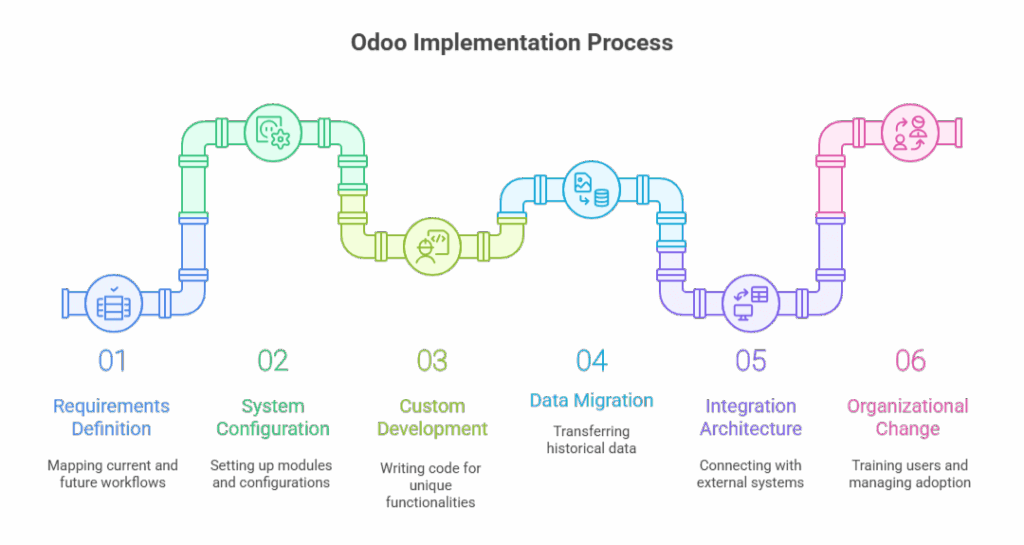
Most organizations underestimate items 1, 4, and 6. They budget for technical configuration but neglect the organizational readiness work that determines whether users actually adopt the new system.
For enterprises requiring enterprise-grade consulting support, implementation becomes a strategic transformation initiative rather than an IT project. The distinction matters: IT projects focus on technology deployment, transformation initiatives focus on business outcomes.
Note: Think of Odoo implementation as constructing a building. The software is your raw material, steel, concrete, and glass. Implementation is the architectural design, foundation work, and construction management that transforms materials into a functional structure. You can have premium materials and still produce an unusable building if the construction methodology fails.
Receive a scoped checklist for requirements, migration, integrations, and UAT based on your modules and user count.
Talk to an Odoo ConsultantI’ve watched CTOs select ERP systems based on feature matrices and Odoo pricing comparisons, then act surprised when implementations fail. The platform isn’t usually the problem; the execution methodology is.
According to Panorama Consulting’s 2023 ERP Report, 55% of organizations experienced budget overruns during ERP implementation, and 28% reported that their system failed to deliver expected business benefits within the first year. These failures stem from poor requirements definition, inadequate change management, and unrealistic timeline expectations, not software deficiencies.
When an Odoo implementation fails, it’s rarely a clean failure. What I see instead:
The antidote to these failures is structured implementation discipline. That’s what the rest of this guide covers.
Before any Odoo partner logs into your demo environment, you need internal clarity on three questions:
This isn’t about documenting what you do today. It’s about defining what you will do after go-live. If your sales team closes deals using five different quote approval paths, you must rationalize those into one or two standard workflows before configuration begins.
I recommend AS-IS/TO-BE process mapping for every department touching the ERP:
The gap between AS-IS and TO-BE reveals where you need training, where you need customization, and where you need organizational change management.
Odoo pricing structures create an illusion that Community edition is “free” and Enterprise is a premium upsell. That’s not how you should evaluate the decision.
Choose Community edition if:
Choose Enterprise edition if:
Budget isn’t the constraint—operational risk tolerance is. I’ve seen companies select Community to save $15/user/month, then spend $100K on custom development to replicate features included in Enterprise.
Your implementation partner becomes your de facto ERP Program Manager for 4-6 months. Vet them like you’re hiring a VP of Operations.
Evaluation criteria I use:
| Criterion | What to Validate | Red Flags |
|---|---|---|
| Industry Experience | Implementations in your sector with similar process complexity | Generic “we work with all industries” positioning |
| Odoo Certification Status | Gold or Silver Odoo partner with certified developers | No visible certification or partner listing on Odoo.com |
| Post-Go-Live Support Model | Dedicated support team, SLAs, and escalation paths | “We’ll train your team to self-support” |
| Methodology Transparency | Documented phases, deliverables, and sign-off gates | Vague “agile approach” without a work breakdown structure |
| Reference Checks | 3+ client references from projects delivered in the past 12 months | Only testimonial quotes, no live client references |
I also request code review access if they’ve built custom modules for previous clients. Code quality tells you whether you’re hiring engineers or scripters.
For organizations without internal ERP expertise, consider an ERP implementation partner that provides both technical execution and strategic consulting. The best partners challenge your requirements and push back on unnecessary customization.
Most Odoo partners present implementation as a linear sequence: requirements → configuration → training → go-live. That’s a simplified sales narrative.
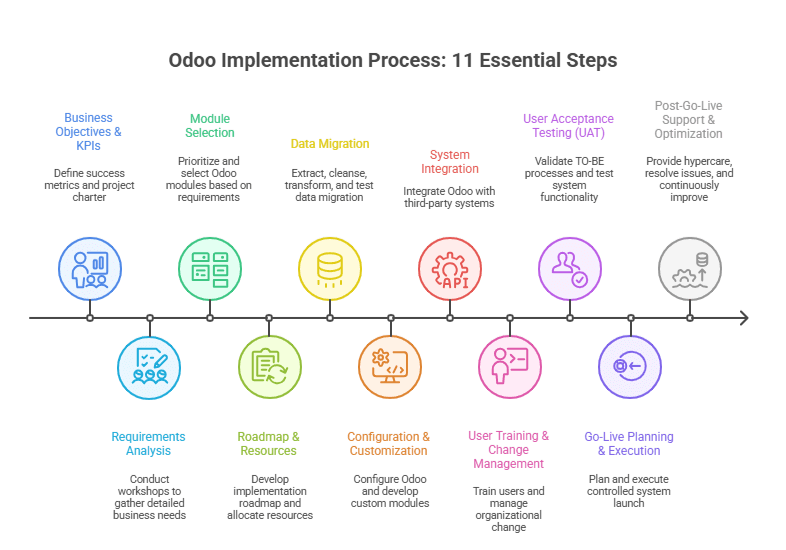
Real implementations are iterative, with feedback loops between phases. Here’s how I structure Odoo ERP implementation projects:
Duration: 1 week
Owner: Executive sponsor + ERP Program Manager
Every implementation starts with a question: What does success look like 12 months after go-live?
I document this in a project charter with measurable KPIs:
These KPIs become your implementation guardrails. When stakeholders request custom features, you evaluate them against these success metrics. If a request doesn’t advance a defined KPI, it’s scope creep.
Duration: 3-4 weeks
Owner: Implementation partner + department heads
This is where 80% of implementation failures are prevented—or locked in.
I conduct structured requirements workshops with each department:
Finance/Accounting:
Inventory/Supply Chain:
Sales/CRM:
Manufacturing (if applicable):
Each workshop produces a requirements traceability matrix linking business requirements to Odoo configuration decisions. This document becomes your scope boundary and change control reference.
Duration: 1 week
Owner: Solution architect + IT lead
Odoo’s modular architecture means you don’t deploy everything at once. I prioritize modules based on dependency chains and business criticality.
Core foundation modules (Phase 1 deployment):
Secondary modules (Phase 2 deployment, 2-3 months post-go-live):
Tertiary modules (Phase 3 deployment, 6+ months post-go-live):
This phased approach prevents overwhelming users and allows you to stabilize core operations before adding complexity.
Module selector guide:
Business Process → Odoo Module → Dependencies
Quote-to-Cash → Sales + Invoicing → Requires: CRM (lead source), Inventory (availability check)
Procure-to-Pay → Purchase + Inventory → Requires: Accounting (AP posting)
Make-to-Order → Manufacturing + Inventory → Requires: Sales (demand signal), Purchase (component procurement)
Project Delivery → Project + Timesheet → Requires: Sales (contract), Invoicing (billing milestones)Duration: 1 week
Owner: ERP Program Manager
I build implementation roadmaps using a work breakdown structure (WBS) with defined deliverables, owners, and dependencies.
Sample roadmap for a mid-size distribution company (4-6 month timeline):
| Week | Phase | Key Deliverables | Go / No-Go Gate |
|---|---|---|---|
| 1–4 | Discovery & Requirements | Signed requirements document, TO-BE process maps | Executive sign-off on scope |
| 5–8 | Data Migration Preparation | Data extraction, cleansing rules, validation scripts | Data quality audit passed |
| 9–14 | Configuration & Development | Configured Odoo environment, custom module development | UAT environment ready |
| 15–18 | User Training & UAT | Training materials, UAT test cases executed | >90% test case pass rate |
| 19–20 | Go-Live Preparation | Cutover plan, rollback procedures, support rota | Go-live readiness checklist |
| 21–22 | Go-Live & Stabilization | Production launch, hypercare support | Day-7 system health check |
| 23–26 | Post-Go-Live Optimization | Issue resolution, process refinement | Month-1 KPI review |
Resource allocation includes both internal FTEs and partner consultants. I typically see 20-30% FTE commitment from department heads during requirements and UAT phases. This isn’t a “set it and forget it” project.
Duration: 4-6 weeks (parallel with configuration)
Owner: Data migration lead + IT team
Data migration is your highest technical risk in any Odoo ERP implementation.
I follow a four-stage migration process:
Stage 1: Data extraction and profiling
Stage 2: Data cleansing and transformation
Stage 3: Migration testing (3 cycles minimum)
Stage 4: Cutover and validation
I allocate 30-40% of the total implementation effort to data migration. Underestimate this, and you’ll go live with corrupt data that destroys user trust in the new system.
Case Study: A $40M industrial equipment distributor I worked with discovered during migration that 35% of their product master data had incomplete cost records. They’d been running on institutional knowledge and Excel lookups for years. We spent an extra 3 weeks cleansing cost data before migration, but that investment prevented thousands of hours of post-go-live data corrections.
Get a migration plan that includes validation cycles, reconciliation checks, and cutover controls.
Request a Data Migration PlanDuration: 5-7 weeks
Owner: Odoo implementation partner + internal IT
Configuration means setting up Odoo using native features. Customization means writing Python code to extend functionality.
The 80/20 rule applies: aim for 80% configuration, 20% customization. Every custom module you build creates technical debt—ongoing maintenance, upgrade complexity, and documentation burden.
Configuration priorities:
When to customize (sparingly):
For customization work, I require full-stack product engineering teams that follow Odoo’s development guidelines and use version-controlled repositories. Custom code without proper documentation becomes a liability during upgrades.
Config vs. custom decision tree:
Need new functionality?
├─ Is it available in standard Odoo module?
│  └─ YES → Use standard module (configure, don't customize)
├─ Is it available in Odoo App Store?
│  └─ YES → Evaluate third-party app (test before committing)
├─ Can workflow process change accommodate standard features?
│  └─ YES → Revise business process (most cost-effective option)
├─ Is it a regulatory/compliance requirement?
│  └─ YES → Approve customization (document compliance mapping)
└─ Is it a competitive differentiator worth ongoing maintenance cost?
   └─ YES → Approve customization (with TCO analysis)
└─ NO → Reject or defer to Phase 2Duration: 3-4 weeks (parallel with configuration)
Owner: Integration architect + IT team
Most organizations don’t run pure Odoo, they integrate with payment gateways, EDI networks, shipping carriers, eCommerce platforms, and industry-specific applications.
Integration patterns I use:
| Integration Type | Method | Use Case |
|---|---|---|
| Real-Time API | REST / JSON or XML-RPC | Payment processing, CRM synchronization, eCommerce order imports |
| Scheduled Batch | SFTP file exchange or API polling | EDI transactions, bank statement imports, data warehouse exports |
| Direct Database | PostgreSQL replication or database views | Business intelligence tools and reporting platforms |
| Middleware / iPaaS | Zapier, Make, Celigo | Low-code integrations for non-critical or auxiliary workflows |
For companies with legacy system modernization needs, I sometimes run Odoo in parallel with the existing ERP for 30-60 days before full cutover. This dual-run period validates data sync accuracy and gives teams confidence before decommissioning legacy systems.
Duration: 3-4 weeks
Owner: Change management lead + department heads
Training isn’t about showing people where buttons are. It’s about helping them understand why their daily work changes and how to execute new processes.
I structure training in three tiers:
Tier 1: Executive briefing (2 hours)
Tier 2: Power user training (2-3 days)
Tier 3: End user training (4-8 hours)
Training should happen 2-3 weeks before go-live, close enough that knowledge is retained, far enough that there’s time for practice in the UAT environment.
Change management runs parallel to training. I send weekly email updates from the executive sponsor explaining project progress, upcoming changes, and why the new system matters. People resist change when they don’t understand the “why.”
Duration: 2-3 weeks
Owner: Business process owners + QA lead
UAT validates that Odoo executes your defined TO-BE processes correctly. This isn’t software testing—it’s business process validation.
I create test scenarios based on real transaction patterns:
Sales order to invoice workflow:
Each scenario includes expected results and acceptance criteria. For example: “Invoice should reflect volume discount, payment terms should match customer master data, accounting entries should post to correct GL accounts.”
UAT pass rate should exceed 90% before proceeding to go-live. Any critical or high-priority defects must be resolved—no exceptions. I’ve delayed go-live decisions three times in my career when UAT revealed data integrity or configuration issues. Every time that delay prevented a catastrophic production failure.
Duration: 1-2 weeks
Owner: ERP Program Manager + IT operations
Go-live isn’t a single event, it’s a controlled deployment with defined phases, rollback triggers, and support coverage.
Go-live checklist (non-exhaustive):
I prefer phased go-lives when possible:
Full big-bang cutover is the highest risk and should only happen when business operations are simple enough to validate quickly (typically sub-50 users with limited module scope).
Case Study: A $120M food distributor I advised wanted to launch Odoo across 4 warehouses simultaneously. I recommended a phased go-live starting with their smallest site. Good decision, we discovered a critical issue with lot number traceability during the first week. We fixed it before rolling out to the other three sites, preventing a compliance failure that could have triggered FDA scrutiny.
Duration: Ongoing (3-6 months intensive support)
Owner: Internal support team + implementation partner
The first 30 days post-go-live are hypercare—intensive monitoring and rapid issue resolution.
I establish a tiered support model:
During hypercare, I run daily standups (15 minutes) to review open issues, user feedback, and system performance metrics. These standup meetings replace formal status reports and enable rapid decision-making.
After stabilization (30-60 days), shift to continuous improvement:
The implementation partner relationship doesn’t end at go-live. I typically maintain a retainer for the first 6-12 months to support optimization, minor enhancements, and periodic health checks.
Odoo timelines depend on scope complexity, data quality, and organizational readiness, not company size.
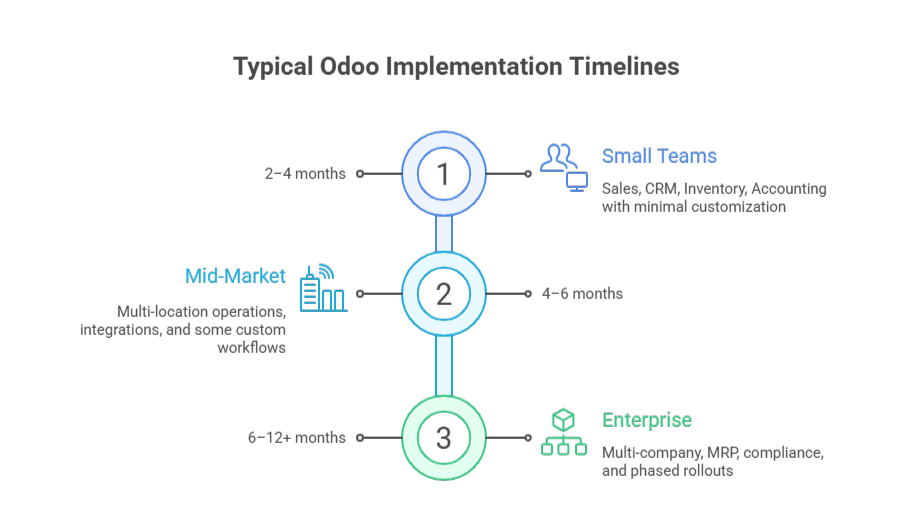
Typical ranges
Small teams (10–50 users): 2–4 months
Sales, CRM, Inventory, Accounting, with minimal customization
Mid-market (50–250 users): 4–6 months
Multi-location operations, integrations, and some custom workflows
Enterprise (250+ users): 6–12+ months
Multi-company, MRP, compliance, and phased rollouts
Projects often extend to 12–18 months when data is fragmented, customization is high, or stakeholders are not fully dedicated.
See the full timeline by business size and complexity: Odoo Implementation Timeline →
Odoo license pricing is straightforward (Community is free to self-host; Enterprise starts around $24.90/user/month), but licenses are usually ~20–30% of total year-one cost. The bigger drivers are implementation services, migration, integrations, and training.
Typical mid-market budget mix
Ballpark ranges
Hidden costs buyers miss
See the full breakdown: Odoo Implementation Cost →
Most Odoo ERP failures are caused by execution mistakes, not by the platform itself.
These controls turn Odoo from a risky software rollout into a stable, scalable ERP system.
Based on 50+ implementations across manufacturing, distribution, professional services, and eCommerce, here are the practices that separate successful projects from troubled ones:
No configuration work until requirements document is signed by all department heads. Changes after configuration begins go through formal change control with impact assessment, re-baselining, and executive approval. This single practice prevents 60% of budget overruns.
Don’t wait until go-live week for your first migration attempt. I run 3-4 migration rehearsals starting 8-10 weeks before go-live. Each cycle reveals data quality issues, giving you time to remediate rather than panic-fixing during cutover weekend.
Don’t over-engineer Odoo to handle every edge case and exception scenario. Configure for your high-volume, standard transactions. Train users on manual workarounds for the 20% of exceptions. This prevents configuration bloat and maintains system simplicity.
Establish your tiered support model, help desk ticketing system, and escalation procedures 2-3 weeks before go-live. Have support team shadow during UAT so they’re trained on common issues. The worst time to figure out support escalation is during a production incident on Monday morning.
Track the success metrics you defined in Step 1, weekly, not monthly. If order processing time is increasing or inventory accuracy declining, you need to know immediately so you can intervene before users lose confidence. Weekly KPI reviews create accountability and enable rapid course correction.
Every custom Python module you build creates technical debt, including ongoing maintenance, upgrade testing, and documentation burden. Challenge every customization request: “Can we achieve this through configuration and process change?” Reserve custom development for regulatory requirements or competitive advantages worth the 5-year TCO.
Don’t treat go-live as the end of partner engagement. I maintain support retainers for 6-12 months post-launch. This gives you access to experts who understand your configuration when optimization needs arise. Trying to bring in new consultants 6 months later costs more—they have to reverse-engineer your system.
Create a “configuration guide” that explains why settings were chosen, what business rules they enforce, and what happens if they’re changed. When your ERP Program Manager leaves 18 months later, this documentation prevents institutional knowledge loss. Include: approval hierarchies, pricing logic, reorder calculations, and GL account mappings.
Organizations seeking guidance on these practices should partner with proven ERP implementation specialists who can provide both technical execution and strategic advisory throughout the project lifecycle.
Use this as a readiness assessment before starting your project:
If your implementation plan isn’t locked on requirements, data, and UAT gates, you’re taking avoidable risk.
Talk to an Odoo ExpertI’ve led successful Odoo implementations for $10M companies and failed ones for $500M enterprises. The difference wasn’t budget or technical complexity—it was execution discipline.
The organizations that succeed treat Odoo implementation as business process reengineering enabled by software, not as a software installation project. They invest in requirements rigor, data quality, change management, and user adoption. They challenge customization requests and embrace standard processes.
The organizations that fail treat it as an IT initiative, underestimate data migration complexity, skip change management, and customize recklessly.
If you’re evaluating Odoo or fixing a troubled implementation, focus less on feature comparisons and more on your organizational readiness. The best ERP system poorly implemented delivers worse outcomes than a mediocre system well implemented.
Before you start: define your success metrics, secure executive sponsorship, and commit to process discipline. Then find an implementation partner who will challenge your assumptions and hold you accountable to best practices, not just execute whatever you request.
Odoo can absolutely run your business. But only if you run the implementation correctly.
The primary drivers of timeline are:
Process complexity
Data quality
Organizational readiness
Not company size. A $100M manufacturer with clean master data and standardized workflows can go live faster than a $5M distributor running on spreadsheets and fragmented systems.
For most organizations, year-one total cost of ownership (TCO) falls into these ranges:
Small businesses with 10–50 users typically invest $50,000 to $150,000.
Mid-market companies with 50–250 users usually spend $150,000 to $500,000.
Large enterprises with 250+ users and multi-entity operations often exceed $500,000 and can reach $2M or more.
Only 15–25% of that total is Odoo Enterprise licensing. The majority of the budget goes into:
• ERP consulting and system configuration
• Data migration and validation
• API integrations (payments, ecommerce, logistics, BI tools)
• User training and change management
• Infrastructure and cloud hosting
• Post-go-live stabilization and optimization
This is why choosing Odoo Community to avoid license fees often backfires. Organizations then spend far more on custom Python development and long-term maintenance than they would have on Enterprise.
QuickBooks → Odoo Accounting
Salesforce → Odoo CRM & Sales
Shopify → Odoo eCommerce
NetSuite / Dynamics → Odoo full ERP stack
When implemented correctly, Odoo eliminates:
Double data entry
Revenue leakage
Inventory mismatches
Financial reconciliation errors
The real value comes from one data model across finance, sales, inventory, and operations.
Self-implementation is realistic when:
You have <10 users
You deploy <4 modules
You have Python + PostgreSQL developers
You accept limited support and documentation
Once you introduce accounting, inventory, or manufacturing, a certified Odoo implementation partner becomes critical to avoid data errors, audit failures, and workflow collapse.
User abandonment → teams go back to Excel
Financial reporting errors → CFO loses trust
Runaway consulting costs → project stalls
ERP replacement → Odoo is scrapped
Recovery costs are usually 2–4× higher than doing it correctly the first time.
That’s why experienced organizations run Odoo audits and readiness assessments before go-live.
In finance, teams track reductions in Days Sales Outstanding (DSO) and faster month-end close cycles.
In operations, the focus is on order-to-cash speed and inventory accuracy.
Sales teams measure quote-to-order conversion rates and deal cycle times.
Supply chain teams monitor stock-out rates and inventory carrying costs.
IT departments look at license consolidation, system uptime, and support cost reduction.
Most companies begin to see operational improvements within 6–12 months of go-live.
Full financial ROI, where labor savings, cash-flow improvements, and reduced software spend outweigh implementation costs, typically appears within 12–18 months.
This is why Odoo should be evaluated as a business transformation platform, not a software purchase.
Accounting localization packs
Studio (no-code workflows)
MRP, barcode, IoT, helpdesk
SLA-backed support
Odoo Community is a developer framework. It is not a full ERP unless heavily customized.
Enterprise is the correct choice for regulated, multi-location, or revenue-critical operations.
Bills of Materials (BOMs)
Work orders & routings
Quality control
Lot and serial traceability
Cost roll-ups
However, manufacturing Odoo projects fail when:
Master data is incomplete
Workflows are not standardized
Customizations replace native MRP logic
This makes Odoo manufacturing implementation one of the most technical ERP deployments.
Multiple legal entities
Consolidated reporting
FX revaluation
Intercompany transactions
But this requires correct chart-of-accounts design and fiscal mapping during implementation.
Misconfiguration here creates audit risk.
Upgrade cost
Regression risk
Testing burden
Well-run Odoo programs keep customization under 20% of total logic and rely on configuration wherever possible.
Role-based access control
Audit logs
Encryption
GDPR & accounting compliance
But security depends on how it is configured and hosted, not on the platform alone.
Most ERP breaches occur through bad permissions and weak integrations, not Odoo itself.
verified expert
Muhammad Adnan is a Senior Writer and Editor at AppVerticals, specializing in apps, AI, software, and EdTech, with work featured on DZone, BuiltIn, CEO Magazine, HackerNoon, and other leading tech publications. Over the past 6 years, he’s known for turning intricate ideas into practical guidance. He creates in-depth guides, tutorials, and analyses that support tech teams, business leaders, and decision-makers in tech-focused domains.
 We’re AppVerticals
AppVerticals is where innovative startups and Fortune 500s come for transformation.
View About Us Odoo
Odoo
In 2026, Odoo ERP powers over 16 million users globally and 170,000+ active enterprises, making it a statistically validated growth engine reshaping t...

14 min read
 Odoo
Odoo
When executives ask, Odoo vs SAP, which ERP is right for us? I start by focusing on what really impacts your investment: total cost, implementation ri...

14 min read
![Odoo_Implementation_Cost__Complete_Pricing_Guide_&_TCO_Breakdown[1]](https://www.appverticals.com/blog/wp-content/uploads/2026/01/Odoo_Implementation_Cost__Complete_Pricing_Guide__TCO_Breakdown1.png) Odoo
Odoo
In 2026, Odoo implementation typically costs $15,000–$40,000 for small businesses, $50,000–$100,000 for mid-market companies, and $120,000–$250,000+ f...
30 min read
Discover how our team can help you transform your ideas into powerful Tech experiences.
AppVerticals © 2026 | All Rights Reserved

Get In Touch.







 ChatGPT
 Perplexity
 Google AI