About Us

About Us
We’re a future-focused tech partner working with some of the world’s top enterprises. At AppVerticals, we design solutions that drive growth and reimagine digital experiences.

Services
Software Development
Mobile App Development
Web Design & Development
Tell us what you're looking for, and we'll tailor a solution based on your business needs.
Talk to Experts
Health Tech

EdTech

Logistics

Real Estate

Ecommerce

Sports

Fintech

Travel

Restaurant

Automotive
HIPAA-compliant digital solutions for hospitals, clinics, and healthtech startups driving better patient outcomes.
What we do:
Scalable learning platforms for schools, universities, and EdTech startups transforming education delivery.
What we do:
Real-time tracking and automation solutions for freight companies, warehouses, and delivery services.
What we do:
PropTech platforms for brokerages, property managers, and real estate marketplaces are streamlining operations.
What we do:
High-converting commerce platforms for D2C brands, retailers, and online marketplaces are driving revenue growth.
What we do:
Fan engagement platforms for sports teams, leagues, and betting operators are creating immersive experiences.
What we do:
PCI-DSS compliant solutions for digital banks, payment platforms, and InsurTech companies, ensuring security.
What we do:
Booking and hospitality solutions for OTAs, hotels, and tourism platforms, enhancing traveler experiences.
What we do:
Online ordering and operations software for restaurants, cloud kitchens, and food delivery platforms.
What we do:
Connected vehicle platforms for automotive OEMs, dealerships, and mobility providers are accelerating innovation.
What we do:
Portfolio
AppVerticals was featured in Inc. 5000 as
America’s Fastest Growing Tech Company
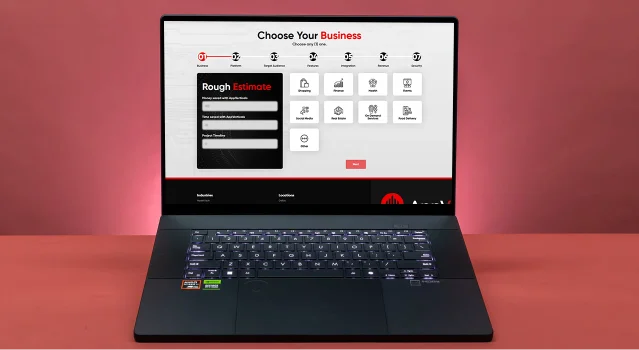
See what it might cost to bring your app idea to life. Our calculator gives you a quick, simple estimate based on what you need.


 verified expert
Senior Content Writer — Mobile & Software Development, AI
Zainab helps tech brands sound more human. She takes app ideas, features, and updates and turns them into content people actually want to read. Whether it’s for a launch, a campaign, or just making things...
See Full Bio17 minutes read
When working with a mobile app development company, these costs can vary significantly based on their location, expertise, and the complexity of your project.
The longer answer is what this guide is for. If you’re a CTO evaluating vendors, a startup founder scoping your first product, or a product lead trying to justify a development budget to your board, you don’t need another article that just says it depends. You need real numbers, the factors that affect them, and a framework to help you make a confident decision.
That’s what this guide delivers.
Experience Level:
Hiring Model:
Project Complexity:
Geographic Location:
App Type Cost Estimates:
Where to Hire:
Understanding the cost structure is essential when considering how to choose a mobile app development company or a developer. The right company will provide transparency on their pricing model, helping you avoid any hidden costs or misunderstandings down the line.
Before you can evaluate a quote, you need to understand how that number was built. App developers use three primary billing structures, and the one your developer defaults to will shape your total cost more than their hourly rate will.
This is the most common billing model for ongoing or evolving projects. The developer logs hours, typically tracked through tools like Toggl or Harvest, and you pay for what’s used.
It works well when your scope isn’t fully locked in. It’s the right structure for iterative product development, MVP development, or long-term partnerships where requirements shift. The risk is straightforward: without clear milestones or a project manager enforcing scope discipline, it’s easy for costs to drift.
You agree on a scope, and the developer delivers at a set price. Simple in concept, but this model shifts risk sharply. Developers building on fixed price will pad their quotes to absorb unknowns. Any scope change becomes a change order, with additional cost.
It works best when requirements are completely documented before work begins, which, in practice, is rarely the case for complex products.
A retainer locks in a developer or team at an agreed monthly rate. There’s no per-hour accounting, you’re buying capacity. This model is increasingly popular among Series A+ companies who want predictability and deep product familiarity without the overhead of full-time employment.
| Billing Model | Best Fit | Budget Predictability | Scope Flexibility |
|---|---|---|---|
| Time-and-Material | MVP, iterative builds | Medium | High |
| Fixed-Price | Defined, static projects | High | Low |
| Retainer / Dedicated | Ongoing product development | High | Medium |
Get a precise cost estimate for hiring developers based on your project needs. Let’s break down the numbers so you can plan accordingly.
This is where most budget conversations start, and where most estimates go wrong. Developers don’t quote in a vacuum. Their rates reflect local cost of living, market competition, and the talent density of their region.
When considering mobile app development cost, it’s essential to remember that the rates you see aren’t just for coding, they reflect the entire development process, including design, testing, and maintenance. The costs can significantly vary depending on your location and project requirements.
Here’s what the market looks like across key geographies in 2025:
| Region | Junior (0–2 yrs) | Mid-Level (2–5 yrs) | Senior (5+ yrs) |
|---|---|---|---|
| United States / Canada | $65–$90/hr | $100–$130/hr | $130–$150+/hr |
| United Kingdom | $60–$80/hr | $85–$110/hr | $100–$120/hr |
| Western Europe (Germany, France, Netherlands) | $50–$70/hr | $70–$90/hr | $80–$100/hr |
| Eastern Europe (Poland, Ukraine, Romania) | $25–$40/hr | $35–$55/hr | $45–$70/hr |
| Latin America (Mexico, Brazil, Argentina) | $20–$35/hr | $30–$50/hr | $40–$60/hr |
| Southeast Asia (India, Vietnam, Philippines) | $10–$20/hr | $18–$35/hr | $30–$45/hr |
| Eastern Asia (China, South Korea) | $20–$35/hr | $35–$50/hr | $45–$60/hr |
Hiring a full-time US-based mobile app developer costs an average of $110,000 per year, with iOS app development specialists in San Francisco reaching $151,000 annually.
Offshore development (India, Vietnam, and Eastern Europe) brings hourly rates down to the $27–$55/hour range or $20,000–$60,000 per year for full-time equivalents.
The rate gap between a senior US developer and a senior developer in Eastern Europe is roughly 2–3x on an hourly basis. Whether that gap is worth it depends entirely on your product, not on a generalized preference for one region over another.
Southeast Asia, particularly India, Vietnam, and the Philippines, offers the lowest absolute rates. But low rates and low cost are not the same thing.
What matters is cost per unit of quality output. A $20/hour developer who requires three rounds of rework on every sprint costs more than a $50/hour developer who gets it right the first time. When evaluating offshore talent, assess portfolio depth, communication quality, and timezone overlap, not just the rate.
Eastern Europe consistently offers the strongest value-to-quality ratio for mid-to-senior development work. Latin America offers a compelling alternative for US-based companies that prioritize timezone alignment.
Rate tables are a starting point. The total cost to hire an app developer for your specific project is shaped by what you’re building, not just where your developer sits.
As the app development industry continues to grow, with global mobile app downloads expected to reach 143 billion in 2026, up from 2021 figures, the demand for skilled developers is steadily increasing. This growth only underscores the importance of securing a top-tier developer or team to keep your product competitive.
This single decision can move your development budget by 30–50%.
| Approach | Codebase | Typical Cost Delta | Best For |
|---|---|---|---|
| Native iOS + Android | Two separate | Baseline (higher) | High-performance apps, complex UI, deep OS features |
| React Native | Single (JavaScript) | 30–40% less than native | Consumer apps, rapid MVP, tight budgets |
| Flutter | Single (Dart) | 25–35% less than native | Cross-platform with near-native performance |
For a startup building an MVP, cross-platform is almost always the right economic decision. For an enterprise application with complex performance requirements or a fintech app requiring deep biometric and security integration, native is worth the premium.
The type of application you’re building sets a floor on your development cost regardless of where you hire.
| App Category | Complexity Tier | Typical Cost Range | Key Cost Drivers |
|---|---|---|---|
| Simple MVP / Utility App | Low | $5,000 – $50,000 | Basic features, minimal backend, single platform |
| Mid-Complexity Consumer App | Medium | $50,000 – $120,000 | User accounts, third-party API integrations, push notifications |
| SaaS Platform | Medium-High | $80,000 – $200,000 | Multi-tenant architecture, subscription logic, admin dashboard, scalable backend |
| E-Commerce App | Medium-High | $60,000 – $150,000 | Product catalog, payment gateway, inventory sync, UX complexity |
| Fintech App | High | $100,000 – $300,000+ | Security architecture, compliance (PCI-DSS, KYC/AML), encrypted data handling |
| Enterprise / B2B Mobile App | High | $150,000 – $500,000+ | System integrations, role-based access, audit logging, scalability |
If you’re building in fintech, healthcare, or any compliance-heavy vertical, factor in an additional cost layer that most standard quotes don’t include:
These aren’t optional line items. They’re the cost of operating in regulated spaces, and a developer who doesn’t raise them in your initial scoping conversation is one you should not hire.
Our developers are among the best in the industry, ready to bring your vision to life. Start your journey with the best in the business!
The quote your developer sends you covers their time. It doesn’t cover everything else. Here are the costs that show up after the contract is signed, and the ones that catch most project budgets off guard.
Every new developer, freelance or agency, requires onboarding. That means time spent by your existing team on knowledge transfer, access provisioning, codebase orientation, and communication workflows. Estimate 20–30% of the first sprint’s timeline as non-productive ramp-up. This isn’t billable on the developer’s side, it’s an internal cost that doesn’t appear on any invoice.
Testing isn’t optional, and it isn’t cheap. Budget for it explicitly.
Rework from requirement changes or miscommunication: Unplanned, but plan for it, industry average for software rework is 15–20% of total project cost
This is the cost most startup budgets ignore entirely. Apps don’t stay functional on their own.
A $100,000 app that costs $20,000 per year to maintain costs $120,000 in year one. Factor that into your financial model before you finalize your development budget.
These costs don’t appear on any developer invoice but accumulate quickly:
This one is hardest to quantify and most expensive in practice. A poor hiring decision, a developer who writes brittle code, misunderstands requirements, or disappears mid-project, doesn’t just cost you the fees paid. It costs you the time and budget to re-hire, re-scope, and often rebuild significant portions of what was already delivered.
Conservative estimates put the true cost of a bad technical hire at 1.5–3x the original contract value when your account for rework, delay, and replacement. Vetting is not overhead, it’s risk management.
The cheapest option per hour is rarely the lowest total cost. Choosing a hiring model is a strategic decision that should be made based on your company stage, project complexity, and internal bandwidth, not rate sheets alone.
For businesses looking for highly skilled, reliable developers, AppVerticals, a leading mobile app development company, is known for its exceptional team of developers who deliver high-quality results, whether you opt for freelancers, agencies, or dedicated teams.
With their expertise, they help guide the decision-making process, ensuring you get the best value and a seamless development experience.
| Hiring Model | Hourly Rate Range | Best For | Risk Profile | Total Cost Context |
|---|---|---|---|---|
| Freelancer (Solo) | $50–$300/hr | MVPs, short-term feature work, prototypes | High (single point of failure, IP risk) | Low upfront, high rework risk |
| Development Agency | $75–$250/hr | Full-service projects with defined scope | Medium (accountability, but high overhead) | Higher upfront, more predictable delivery |
| Dedicated Offshore Team | $27–$82/hr | Ongoing product development, scaling teams | Low-Medium (if vetted properly) | Best long-term cost-per-output |
| In-House Hiring | $100–$180K/yr (US) | Core product teams, Series A+ companies | Low (full alignment) | Highest total cost; highest retention value |
A freelancer is fast to engage and often the right call for an MVP, a specific feature, or a prototype you need to validate before committing to a larger build. The risk is proportional to the dependency. If they go dark, get overcommitted, or deliver code you can’t maintain, you have no contract recourse beyond small claims.
Use a freelancer when the work is bounded, the deliverable is clear, and the cost of delay is manageable.
Agencies provide accountability structures that solo developers can’t: project management, QA, design, and a team that doesn’t disappear when one person leaves. They’re more expensive per hour, but when a project has a real scope and a real deadline, that overhead is often worth it.
The trap is paying agency prices for junior execution. Always ask who will actually build your product, not just who will manage the account.
This is the model that consistently delivers the strongest cost-per-output for companies with ongoing development needs. You get a team deeply familiar with your codebase, your product context, and your engineering standards, at offshore rates.
The upside: Eastern European and Southeast Asian dedicated teams at $35–$55/hour can deliver work equivalent to US-based developers at $120–$150/hour when properly vetted and managed.
The requirement: You need an internal technical lead or CTO who can evaluate output quality and manage the relationship. A dedicated team without internal technical oversight is a risk, not a solution.
For companies at Series A and beyond, in-house hiring makes sense for core product roles. The fully-loaded cost of a senior US-based mobile developer, salary, benefits, equity, equipment, and onboarding, runs $150,000–$200,000+ per year in most major US markets.
That’s not a reason to avoid in-house hiring. It’s a reason to be deliberate about which roles belong in-house and which can be delivered more effectively through a dedicated external team.
Let us help you build your app with clarity and confidence. Request a personalized quote based on your unique project requirements.
The hiring process itself has a cost, and a cost of failure. These are the non-negotiables.
A developer contract that doesn’t address these points will create problems:
The question isn’t what it costs to hire an app developer. The question is what it costs to build the right product, with the right team, structured in a way that doesn’t collapse at the first scope change or post-launch support request.
Every number in this guide is a starting point, not a ceiling or a floor. The actual cost to hire an app developer for your project will be shaped by decisions you make before you ever send a contract: what you’re building, how well you’ve defined it, which market you hire from, and how you structure the engagement.
Make those decisions with full information, and the cost becomes a variable you control. Leave them to default, and the cost controls you.
Learn how to get the best value for your budget. Let our experts guide you through the most cost-effective strategies for hiring developers.
verified expert
Zainab helps tech brands sound more human. She takes app ideas, features, and updates and turns them into content people actually want to read. Whether it’s for a launch, a campaign, or just making things clearer, she’s all about simple words put together to form stories that stick.
 We’re AppVerticals
AppVerticals is where innovative startups and Fortune 500s come for transformation.
View About Us Mobile App
Here are the best anonymous messaging apps for iOS and Android to keep your conversations private and secure. These apps help you chat without sharing...

19 min read
 Mobile App
Boston has quietly become a center for product-grade mobile engineering. Massachusetts biopharma companies alone attracted $7.89 billion in VC funding...

14 min read
 Mobile App
Seattle has become one the most competitive tech markets in the U.S., thanks to the rapidly growing startup culture, proximity to global giants like A...

10 min read
Discover how our team can help you transform your ideas into powerful Tech experiences.
AppVerticals © 2026 | All Rights Reserved

Get In Touch.














 ChatGPT
 Perplexity
 Google AI