
















 ChatGPT
 Perplexity
 Claude
 Google AI
E-commerce app development has become the backbone of modern retail. Mobile commerce now drives over 70-78% of all e-commerce transactions worldwide, making apps the dominant revenue channel for digital businesses.
Businesses investing in mobile-first, AI-driven apps are capturing more market share, while web-only brands fall behind. Apps are no longer an extension; they drive revenue, engagement, and retention.
This blog compiles key statistics on market size, user behavior, AI adoption, costs, ROI, and emerging trends, giving a complete view of e-commerce app development in 2026.
Key Takeaways | E-commerce App Development in 2026
- Mobile-first dominance: Mobile commerce drives 70–78% of global e-commerce transactions, making apps the primary revenue channel.
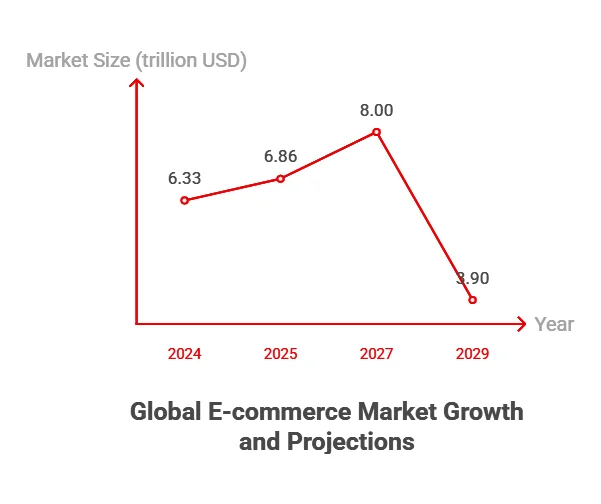
- Global market growth: The e-commerce market reached $6.86T in 2025, projected to hit $8T by 2027, with apps alone contributing $3.9T by 2029.
- Top markets lead adoption: The U.S., U.K., Germany, India, and Canada lead in app-based commerce, offering prime opportunities for mobile-first growth.
- Revenue impact: AI-powered e-commerce apps generate 20–30% more revenue than mobile websites, with personalized features driving up to 40% uplift.
- Retention is key: High-performing apps retain 32% of users after 90 days, compared to just 15% for apps with poor UX; seamless checkout and fast performance are critical.
- AI and social commerce: 77% of e-commerce professionals use AI daily, boosting engagement by 14.6% and revenue by 40%, while social commerce drives discovery and conversions.
- Cost vs ROI: App development ranges from $10k–$350k+, depending on complexity; ROI can surpass 10× for brands with retention-driven, AI-powered apps.
- Emerging trends: Voice commerce, AR/VR shopping, blockchain, and sustainability are shaping next-gen app experiences, enhancing engagement and boosting conversion by up to 30%.
What Is The Current Size And Future Growth Of The Global E-commerce Market?
By 2029, online shoppers are expected to reach 3.9 billion, while the e-commerce app market alone is projected to be $3.9 trillion.
This demonstrates that apps are not merely supplementary; they are driving industry growth. Businesses without apps risk losing market share to mobile-first competitors.
Which Countries Lead In E-commerce App Development And Mobile Commerce Growth?
The United States, the United Kingdom, Germany, India, and Canada lead globally, driven by high mobile adoption and strong digital spending. These markets offer the biggest opportunities for scalable, app-first e-commerce growth.
| Country | Number of E-commerce App Companies | Mobile/Revenue Stats |
|---|---|---|
| United States | ~17,000 | Mobile commerce sales in the U.S. reached approximately $564 billion in 2024 (44% of total eCommerce revenue), projected to reach ~$745 billion by 2026 |
| United Kingdom | 4,500+ | mCommerce accounts for 60% of transactions |
| Germany | 2,900 | €122B in online sales |
| India | 2,400+ | Smartphone-driven e-commerce: $120B (2025) |
| Canada | 2,100 | 55% of online sales |
Insight: Regional stats highlight where the biggest opportunities lie for app development, especially in mobile-first countries.
What Are The Latest Mobile Commerce (mCommerce) Statistics?
This confirms that mobile-first strategies are essential for maximizing engagement and revenue.
What Do The Latest User Behavior And Conversion Statistics Reveal For E-commerce Apps?
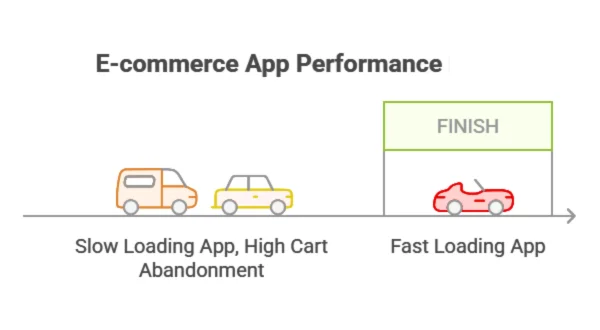
However, 53% abandon an app if it takes longer than 3 seconds to load, and global cart abandonment is 69.99%. Push notifications increase conversions by 88%, emphasizing engagement strategies.
Insight: Fast performance, smooth UX, and timely engagement are critical for retention and revenue.
How Do E-commerce Apps Impact ROI And Revenue Growth?
Businesses aiming to maximize ROI can benefit from AppVerticals’ mobile app development services, delivering AI-powered, mobile-first, high-performing e-commerce apps.
What Are The Retention And Churn Trends In E-commerce Apps?
High retention requires fast load times, seamless checkout, and engaging features, which directly affect revenue and ROI.
How Is AI Transforming E-commerce App Development?
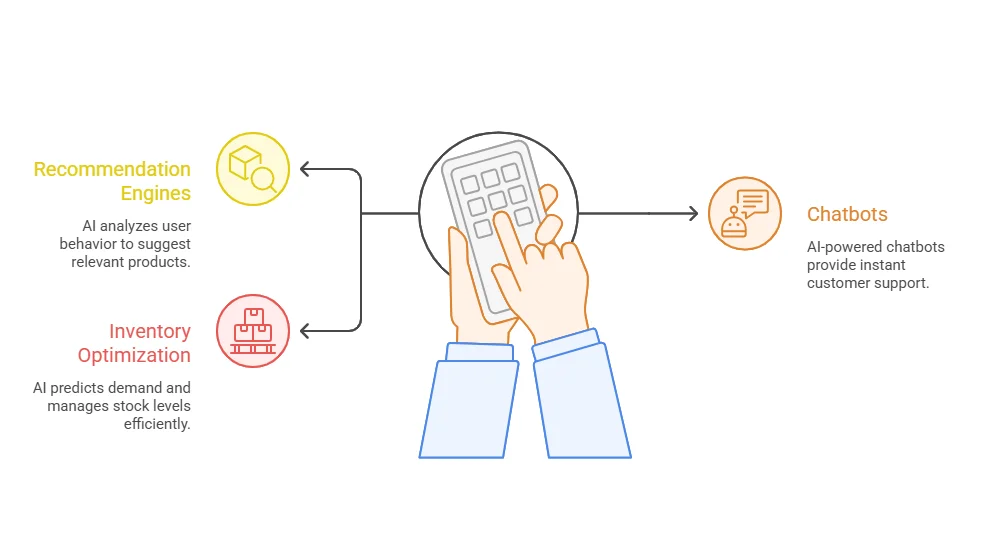
AI powers recommendation engines, chatbots, and inventory optimization, and is projected to grow into a $45.72B market by 2032, solidifying its role in modern app development.
In my experience specifically on the companies I have been involved in AI has not played a role in development of the user-facing applications. However, it’s heavily used in data analysis and Customer Support to assist the agents
– Anna Yocum, Web Developer
What Are The Latest Social Commerce Statistics And Trends For E-commerce Apps?
Apps that integrate social commerce features, like influencer-driven content and live shopping, see higher engagement and conversion rates.
How Much Does It Cost to Develop an E-Commerce App and How Long Does It Take?
Insight: Higher investment often yields better ROI, scalability, and retention.
I think it’s more of the development cost. So every year new technologies change, and that means each developer or mobile app developer has to research and implement the new technologies to make the app better and also be up to date.
If we still follow the old trends, you could get kicked out of using the old technologies, but once you upgrade, you won’t have a problem with that.
Most founders don’t follow these trends, and they think it’s the same concept that was probably 5 years ago that is still ongoing, but nope, things have changed.
Another relatable example is Apple or iOS development. If you are using a MacBook from 10 years ago to develop, you can’t upload your app to App Store, you need 5 years or the latest MacBook to do that, and most founders aren’t aware that the development cost of getting the latest MacBook should also be included.
That’s how I see that development cost is misleading to founders.
– Chibundom Ejimuda | iOS and Android App Developer
Which Technologies and Platforms Power Modern E-Commerce Apps?
Cross-platform frameworks like React Native (52%) and Flutter (38% YoY growth), along with e-commerce platforms such as Magento, Shopify, and WooCommerce (61%), are widely used to build scalable, high-performance applications. Cloud platforms like AWS and Google Cloud power 81% of serverless apps, reducing costs and improving performance.
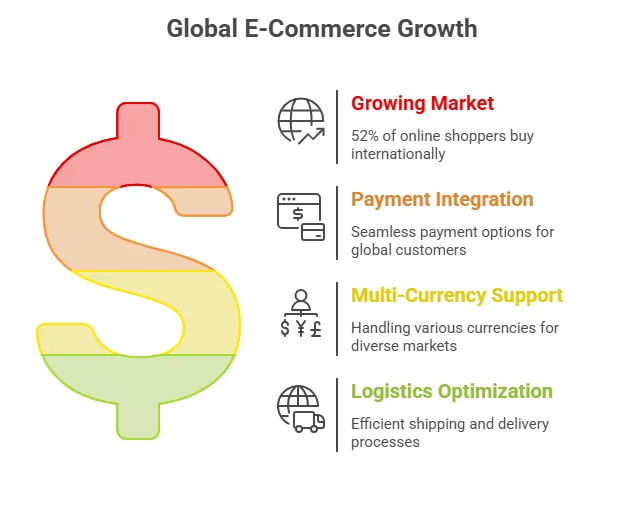
What Are the Latest Cross-Border and Global E-Commerce Shopping Trends?
What Are the Emerging Trends in E-Commerce App Development?
- AI & Machine Learning: Enable smarter personalization, predictive inventory management, and fraud detection, driving up to revenue 40%uplift.
- Voice Commerce: Conversational interfaces allow users to search and purchase via voice, improving accessibility and engagement. Voice shopping adoption is projected to reach $19.4B in 2026.
- AR/VR Shopping: Immersive product experiences increase engagement and reduce purchase hesitation, boosting conversion rates by up to 30% in fashion and furniture apps.
- Sustainability & Ethical Commerce: 55% of Gen Z and Millennials prefer apps showcasing eco-friendly or ethically sourced products.
- Blockchain Integration: Provides secure, transparent payments and builds trust, particularly for high-value transactions and international e-commerce.
Unlock the Power of App Development Statistics
Turn insights into action! Leverage 2026 app development statistics to launch AI-powered, mobile-first e-commerce apps that boost revenue and retention.
Case Studies
1. Starbucks Mobile App
Starbucks’ app increased customer retention by 30% and mobile orders by 22% through personalized recommendations, gamification, and push notifications. Their seamless mobile experience demonstrates how AI and app design directly impact revenue and engagement.
2. Sephora Beauty App
Sephora leveraged AI-driven product recommendations and virtual try-ons to boost in-app purchases by 25%, while loyalty program integration led to 40% higher repeat purchases. This case highlights the importance of personalization and immersive technology.
3. Amazon Mobile App
Amazon’s app accounts for over 60% of its total online sales, with features like 1-click checkout, personalized recommendations, and voice search. Amazon sets the benchmark for mobile-first e-commerce, proving the ROI of robust app experiences.
Bottom Line
Businesses that invest in fast, AI-powered, mobile-first e-commerce apps are seeing 15–25% higher annual revenue, stronger retention, and significantly higher lifetime value.
Those that don’t are competing at a structural disadvantage in a market where speed, personalization, and experience define success.
Regional adoption, cross-border capabilities, and technology choices further differentiate success. Businesses investing in robust apps, like Starbucks, Sephora, and Amazon, demonstrate the measurable value of strategic app development.
More Related Guides:
- AI in App Development Statistics 2026: Explores how AI integration in mobile and web apps is driving engagement, automation, and measurable ROI in 2026.
- Global Mobile App Download Statistics 2026: Highlights worldwide mobile app download trends, user growth, and adoption patterns shaping the app ecosystem.
- Telemedicine Statistics 2026: Reveals key telehealth adoption metrics, patient engagement trends, and digital healthcare growth in 2026.
- Mobile App Development Market Growth and Size Statistics: Covers global market size, growth forecasts, and investment trends in mobile app development for 2026.
- AI Chatbot Technology in 2026: Explores how AI chatbots are being adopted across mobile and web apps, driving automation, cost reduction, and measurable business ROI in 2026.
- App Monetization Statistics 2026: Breaks down global app revenue benchmarks, monetization models, retention metrics, and AI-driven growth strategies shaping profitable apps in 2026.
- Odoo ERP Market & Adoption Statistics 2026: Provides global user, revenue, and adoption insights, highlighting cloud, AI, and modular ERP trends driving mid-market growth in 2026.
- Mobile vs Web App Revenue Statistics 2025–2026: Analyzes global consumer spend, SaaS growth, hybrid monetization, and platform economics shaping app profitability and retention in 2026.
- AI Cloud Cost Statistics, Trends & Optimization (2026): Explores rising cloud spending, cost drivers, optimization strategies, and how AI is reshaping cloud efficiency and ROI in 2026.
- SaaS Development & Adoption Statistics 2026: Highlights global SaaS market growth, adoption trends, revenue benchmarks, churn metrics, and AI-driven innovations shaping scalable software businesses in 2026.
- AI Automation Statistics for Enterprises (2026): Covers adoption, ROI, costs, and key trends shaping enterprise AI execution.
- Google Play Store Statistics 2026: This article delves into the latest Google Play Store statistics for 2026, focusing on app download trends, user engagement, and the rising dominance of AI-driven applications.