About Us

About Us
We’re a future-focused tech partner working with some of the world’s top enterprises. At AppVerticals, we design solutions that drive growth and reimagine digital experiences.

Services
Software Development
Mobile App Development
Web Design & Development
Tell us what you're looking for, and we'll tailor a solution based on your business needs.
Talk to Experts
Health Tech

EdTech

Logistics

Real Estate

Ecommerce

Sports

Fintech

Travel

Restaurant

Automotive
HIPAA-compliant digital solutions for hospitals, clinics, and healthtech startups driving better patient outcomes.
What we do:
Scalable learning platforms for schools, universities, and EdTech startups transforming education delivery.
What we do:
Real-time tracking and automation solutions for freight companies, warehouses, and delivery services.
What we do:
PropTech platforms for brokerages, property managers, and real estate marketplaces are streamlining operations.
What we do:
High-converting commerce platforms for D2C brands, retailers, and online marketplaces are driving revenue growth.
What we do:
Fan engagement platforms for sports teams, leagues, and betting operators are creating immersive experiences.
What we do:
PCI-DSS compliant solutions for digital banks, payment platforms, and InsurTech companies, ensuring security.
What we do:
Booking and hospitality solutions for OTAs, hotels, and tourism platforms, enhancing traveler experiences.
What we do:
Online ordering and operations software for restaurants, cloud kitchens, and food delivery platforms.
What we do:
Connected vehicle platforms for automotive OEMs, dealerships, and mobility providers are accelerating innovation.
What we do:
Our Odoo implementation brings financial discipline, operational visibility, and process control across departments. From accounting automation to manufacturing workflows, we design ERP systems that reduce operational leakage and provide real-time decision clarity.
We use Sitecore to drive measurable revenue growth through intelligent personalization and behavior-driven content delivery. By aligning marketing automation, data orchestration, and omnichannel engagement, we help brands turn digital touchpoints into retention engines.
We architect AWS environments that stay stable under scale, traffic spikes, and compliance pressure. From secure cloud migrations to CI/CD automation and cost governance, we engineer cloud foundations that protect performance while enabling rapid product evolution.
We implement Dynamics 365 to align systems with actual business operations, bringing clarity, control, and accountability across CRM, ERP, and service functions. From sales to finance, configurations eliminate inefficiencies and enable confident, real-time decisions.
Tell us what you're looking for, and we'll tailor a solution based on your business needs.
Talk to ExpertsPortfolio
AppVerticals was featured in Inc. 5000 as
America’s Fastest Growing Tech Company
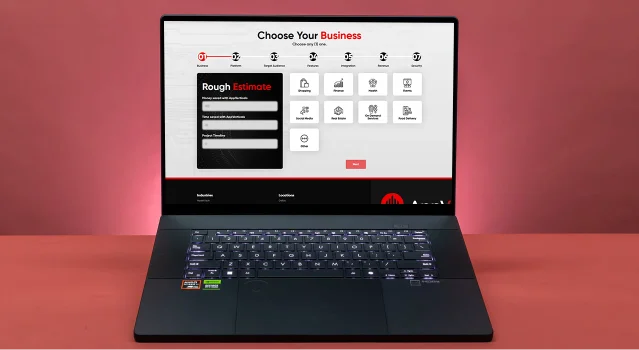
See what it might cost to bring your app idea to life. Our calculator gives you a quick, simple estimate based on what you need.


 verified expert
Senior Content Writer — Mobile & Software Development, AI
Zainab helps tech brands sound more human. She takes app ideas, features, and updates and turns them into content people actually want to read. Whether it’s for a launch, a campaign, or just making things...
See Full Bio19 minutes read
That range exists because “MVP” is a loaded word and how you define it determines everything about what you end up paying for. As Eric Ries, author of The Lean Startup and Incorruptible, NYT Bestsellers, puts it: “The minimum viable product is that version of a new product which allows a team to collect the maximum amount of validated learning about customers with the least effort.”
That definition reframes the entire budget conversation. If the goal is validated learning with the least effort, then every dollar in your MVP development budget should map to a question you are trying to answer, not a feature you want to ship. A $25,000 build and a $150,000 build can both be right, as long as the spend is proportional to what needs to be proven. Once you internalize that, the pricing logic below stops feeling arbitrary and starts feeling like a procurement decision.
Below is the same framework and cost breakdown drawn directly from a conversation with Zaid Tirmizi, a Senior Product and Customer Success Manager at AppVerticals, where he has overseen the delivery of 30+ MVPs and full-scale project developments across SaaS, fintech, healthtech, and consumer mobile.
He has worked with clients ranging from early-stage startups to enterprise organizations including Coca-Cola. We sat with Zaid to get ground-level insight from someone who has navigated real budget constraints and seen what actually drives cost on live Fortune 500 projects, illustrated with MVPs AppVerticals has actually built.
Founders usually get into trouble when they ask for building an MVP without first defining the type of MVP. A login-and-dashboard product, a marketplace, and an AI-assisted mobile app all sit under the same label, but they don’t carry the same delivery cost, testing burden, or infrastructure footprint.
Steve Blank, co-founder of the Lean Startup Movement and many more Silicon Valley startups, captures this nuance well: A minimum viable product is not always a smaller/cheaper version of your final product. Think about cheap hacks to test the goal.
So the smartest way to budget is to think in tiers.
| MVP Tier | 2026 Budget Band | Usually Includes | Typical Timeline |
|---|---|---|---|
| Simple MVP | $25,000 – $35,000 | Landing page, auth, basic CRUD flow, simple dashboard, no-code or cross-platform build | ~3–8 weeks |
| Mid-Complexity MVP | $35,000 – $80,000 | Multi-role workflows, payments, admin panel, analytics, third-party integrations | ~6–12 weeks |
| Complex MVP | $80,000 – $150,000+ | AI features, real-time sync, advanced permissions, custom architecture, security/compliance logic | ~3–6+ months |
A simple MVP is the cheapest viable route to market because it focuses on one job-to-be-done. Think: a single-user SaaS workflow, a booking flow, a waitlist plus concierge backend, or a no-code app with basic auth and one core action.
We are currently building Toyota Libya’s CRM-integration MVP, a tightly scoped, integration-style build that proves a single business workflow (CRM-to-operations sync) without rebuilding the entire stack.
This is the textbook lean B2B MVP: small surface area, clear success criteria, and a low-five-figure budget. Integration-only MVPs are an underrated path for enterprise clients who want to test workflow value before committing to a full platform overhaul.
This is where most serious startup MVPs land. You usually have multiple user roles, an admin view, third-party services, a more thoughtful UX layer, and enough logic to validate monetization or retention.
Highlights App is a useful proof point in this tier. Currently in its beta-testing phase, AppVerticals built the MVP for this mobile app that helps padel-court players automatically get their best moments captured from on-field cameras and delivered to their phones within five to ten minutes, triggered by a physical button that records the previous one to two minutes of gameplay.
Built on React Native and Node.js and deployed via AWS with load balancing and auto-scaling, the app supports clip sharing across social channels alongside a free-to-premium upgrade path and an ad-based monetization layer.
Consumer mobile apps with video capture, media processing pipelines, social-share integrations, and a monetization layer carry enough scope to sit comfortably in the mid-tier band, and the beta-testing approach validates real demand before scaling.
Once you add advanced backend logic, AI modules, regulated data, multi-platform delivery, or enterprise security expectations, MVP pricing climbs fast.
Coca-Cola is the marquee case study for a complex MVP that scales. AppVerticals built the MVP for Coca-Cola Dubai’s app first, which then grew into a massive enterprise-scale digital platform. The real outcomes were staggering: 2M+ peak users handled, 99.98% uptime, 45% faster user journeys, 150+ prototypes tested, a 1.2s median page load speed, and zero critical bugs at launch.
Delivered in 9 months by a 10-member design and engineering team, the platform also achieved strict AA accessibility compliance using a tech stack of React Native, Node.js, PostgreSQL, and AWS.
Learn more about how we helped Coca-Cola Dubai meet their mobile-first transformation goals in this detailed case study.
The MVP-first approach worked even at Coca-Cola scale because the first build was tightly scoped to prove core load, speed, and accessibility outcomes before broadening features.
Share what your MVP needs to validate in the next 90 days. We’ll come back with an honest budget range, a delivery model recommendation, and the one question most founders forget to ask before they spend anything.
An MVP isn’t “the cheapest thing you can ship.” It’s the smallest product that can generate real learning.
That distinction: valuable, usable, and feasible, is what separates a working MVP from a rough prototype or deck-only concept.
Based on AppVerticals’ project experience, a significant share of MVPs that fail to progress to full development do so not because of technical failure but because the product did not address a validated market gap. This is a problem that earlier-stage customer discovery would have identified before a single line of code was written.

Scope is the biggest cost driver, full stop. Every extra workflow, role, or dashboard expands engineering time. Y Combinator’s Michael Seibel puts it bluntly: “Launch something bad, quickly.” That advice is as much about cost control as it is about speed.
A web-only MVP is generally cheaper than separate native iOS and Android apps. Cross-platform frameworks compress cost. For instance, Highlights App leverages cross-platform mobile development to efficiently reach players on both major app stores simultaneously without doubling the codebase.
Simple stacks move faster. But once you need real-time features, AI services, event-driven architecture, or custom security controls, the stack becomes more expensive to build and maintain. Backend setup, APIs, and advanced integrations often consume 30–40% of the total MVP budget.
Freelancers can lower upfront spend, but they shift coordination and quality risk back to the founder. Agencies cost more upfront but bundle PM, QA, UX, and delivery accountability. Coca-Cola’s MVP success required a 10-member integrated team (design and engineering working in one rhythm), that kind of multi-discipline orchestration is hard to replicate with a fragmented freelancer setup.
Furthermore, in-house teams are typically the most expensive fixed-cost route, often running 3 to 4 times the total cost of an offshore agency engagement when you factor in salaries, benefits, hiring overhead, and management time. Freelancers sit at the lower end of the cost spectrum but shift coordination and quality risk back to the founder, making the effective cost higher than the hourly rate suggests.
Regional rate differences are real:
Basic UI is cheaper. Branded UX systems, custom components, and multi-state flows are not. Fully custom UI work can add 25–40% to design investment vs. template-driven builds.
Payments, messaging, analytics, cloud storage, and distribution carry costs:
The gap is in feature effort. Real-time features like video calling, live broadcasting, live streaming, or video capture and processing inherently push budgets higher because they require media servers, encoding, storage, and specialized delivery infrastructure.
A CRUD dashboard with authentication is simply not the same engineering shape as a media-processing pipeline. If you look at Highlights App’s video capture pipeline that turns raw court footage into shareable user clips in minutes, that heavy backend lifting is exactly why media apps cost more than standard data-entry apps.
| Industry | Typical 2026 Budget | Why It Costs What It Costs |
|---|---|---|
| SaaS MVP | $30K – $70K | Multi-role dashboards, admin logic, analytics, billing |
| Mobile App MVP | $25K – $50K+ | Native/cross-platform choices, store prep, push, device testing |
| Marketplace MVP | $30K – $80K+ | Search, profiles, payments, reviews, supply-demand workflows |
| E-commerce MVP | $15K – $50K+ | Catalog, checkout, payments, fulfillment integrations |
| Fintech MVP | $60K – $150K+ | Fraud, security, auditability, compliance |
| Healthtech MVP | $60K – $150K+ | HIPAA/data privacy, role permissions, sensitive data handling |
| AI MVP | $80K – $200K+ | Model calls, prompt engineering, evaluation, guardrails, infra |
Contrast Toyota Libya (a lean CRM integration MVP providing a single workflow), Highlights App (a consumer mobile app with video processing in the mid-tier), and Coca-Cola (an enterprise-scale platform with 2M+ peak users and 99.98% uptime at the top of the upper band).
These are three projects from a single partner AppVerticals but they carry three very different cost profiles because cost follows technical complexity, not branding.
| Model | Best For | Cost Reality | Main Trade-Off |
|---|---|---|---|
| Freelancer | Very narrow scope, strong founder oversight | Lowest upfront ($5K–$25K) | Coordination, QA, continuity risk |
| Offshore Agency | Fast validation with broader support | Mid-range ($20K–$70K) | Vendor quality varies widely |
| US/EU Agency | High-accountability delivery | Higher upfront ($60K–$150K+) | Stronger process, premium rates |
| In-House Team | Long-term product roadmap | Highest fixed cost ($400K+/year) | Salary + hiring + management overhead |
A professional mobile app development company brings experts across every domain, project managers, designers, and niche specialists in fintech, healthtech, AI, and more. With a freelancer, coordination, QA, and continuity risk all sit on the founder’s shoulders.
That’s the hidden cost most startups underestimate. When building for Coca-Cola’s massive 2M+ peak user scale or organizing Highlights App’s robust beta validation, an integrated team rhythm mattered immensely. In-house teams usually make financial sense after validation, not before it.
| Approach | 2026 Cost Range | Time to Launch | Best For |
|---|---|---|---|
| No-code (Bubble, Webflow, Glide, Softr) | $3K – $20K | 2–6 weeks | Demand validation, internal tools, single-workflow products |
| Low-code hybrid | $15K – $40K | 4–10 weeks | Early-stage SaaS, MVPs that may scale into custom |
| Custom code (web) | $25K – $80K | 8–16 weeks | Unique logic, performance needs, defensible IP |
| Custom code (native mobile + backend) | $50K – $150K+ | 12–24 weeks | App store products, hardware integrations, complex UX |
Bubble’s public pricing starts at $59/month Starter, $209/month Growth, and $549/month Team on annual billing, with a free tier usable for pre-launch building.
The wrong call here can cost you months. Get a straight answer from our team in a free 30-min consultation.
Yes, AppVerticals does cater to $10,000 MVP requests, but with realistic caveats.
The point is simple: $10K can absolutely buy you validation. It just shouldn’t be expected to buy you a production-ready platform

Every feature that isn’t directly tied to proving your core hypothesis is dead weight, and dead weight costs money.The goal is not a polished product; it is getting in front of users fast enough to learn something real. Zaid sees this repeatedly: founders who arrive with a 40-feature spec almost always end up rebuilding half of it after their first round of user feedback. Cut the spec and focus on the one problem your first users actually have.
Engineering goals are about building something that works. Learning goals are about finding out whether anyone wants it. These are not the same thing.
A no-code prototype or a manual concierge flow can answer the same market question as a fully engineered backend, at a fraction of the cost. Validate the learning goal first; let the engineering follow from what you find.
A bug that costs two hours to fix during development can cost two weeks post-launch, after it has already affected real users. Plan 25–30% of your total development cost toward QA and treat it as non-negotiable.
Chasing market intuition instead of validated demand is one of the most expensive mistakes in product development. A founder once approached AppVerticals wanting to merge TripAdvisor and Yelp into a single app, ambitious on paper, but with no evidence users wanted it.
Talk to your users before you write a single line of code.
Most MVP budgets are scoped around the build and stop there. Year 1 is the cost to develop. Year 2 is the cost to maintain, and that number scales with your traction. More users mean higher infrastructure bills, more support load, and faster pressure to iterate. Maintenance typically runs 20–30% of your initial build cost every year.
The cheapest quote is rarely the cheapest outcome. A low hourly rate means nothing if the output requires expensive rework or ships without adequate testing. A product needs to be valuable, usable, and feasible. Code that fails any of those checks is not a bargain.
Talk to our project team and scope your MVP the right way from day one.
At AppVerticals, the healthiest MVP budgets start with the question most founders skip: What must this product prove within the next 90 days? Answer that clearly, and budgeting gets simpler. You stop buying features and start buying evidence.
| Year-One Cost Bucket | What to Include | Typical % of Year-One Budget | Example Costs |
|---|---|---|---|
| Discovery | User flows, feature prioritization, technical planning | 5–10% | Vendor-specific |
| Build (Design + Dev) | Frontend, backend, integrations, admin | 50–60% | Vendor-specific |
| QA | Functional, device, regression, security testing | 15–20% | Bundled or separate |
| Launch | App store enrollment, deployment, analytics setup | 2–5% | Apple $99/yr, Google Play $25 once |
| Operations | Cloud, SMS, payments, monitoring | 5–10% | Firebase Blaze, Twilio $0.0083/msg, Stripe 2.9% + 30¢ |
| Maintenance | Fixes, minor iterations, support | 20–30% of build cost/year ongoing | Continues post-launch |
Most founders receive a single number at the end of a scoping call with no visibility into how it was calculated. At AppVerticals, every MVP estimate is built the same way: module by module, hour by hour, dollar by dollar. There is no black box.
Here is the exact framework we use:

Step 1 — Assist & List Requirements: Sit with the founder to gather and itemize every feature requirement, module by module. No assumptions.
Step 2 — Allocate Resource & Hours per Module (LOE — Level of Effort): Assign the right specialists (PM, designer, frontend, backend, QA) to each module and estimate Level of Effort.
Step 3 — Map Effort to Man-Hours: Convert LOE into actual man-hour estimates per module, building in buffers for revisions and QA cycles.
Step 4 — Map Man-Hours to Dollars: Apply a blended rate of $25–$35 per hour (used across all our MVP projects) to arrive at a transparent, line-item budget.
This hours-to-dollars approach is how we close the gap between client expectation and final cost — there’s no black box, just modules, hours, and rates.
MVP cost is ultimately a function of scope clarity. The founders who spend wisely are not the ones with the biggest budgets, they are the ones who can articulate exactly what their product needs to prove, and to whom.
Whether you are working with $25,000 or $150,000, the discipline is the same: buy evidence, not features. The tiers, frameworks, and case studies in this article are all pointing toward the same decision, define your learning goal first, and then build the smallest thing that tests it. Everything else is noise.
Talk to our experts and learn what it will realistically take to build it right the first time. That’s a 30-minute conversation, not a proposal.
verified expert
Zainab helps tech brands sound more human. She takes app ideas, features, and updates and turns them into content people actually want to read. Whether it’s for a launch, a campaign, or just making things clearer, she’s all about simple words put together to form stories that stick.
 We’re AppVerticals
AppVerticals is where innovative startups and Fortune 500s come for transformation.
View About Us Mobile App
The global sports app market is projected to reach $128.34 billion by 2027, growing at a CAGR of 17.24%. This surge reflects not just fan enthusiasm b...

5 min read
 ios
ios
If you want to build an iOS app with Claude Code, the appeal is obvious: less blank-page friction, faster prototyping, quicker UI scaffolding, and a m...

12 min read
 ios
ios
Hiring iOS developers may seem simple initially, but the real challenges emerge once you're faced with app store deadlines, debugging complex systems,...
14 min read
Discover how our team can help you transform your ideas into powerful Tech experiences.
AppVerticals © 2026 | All Rights Reserved

Get In Touch.










 ChatGPT
 Perplexity
 Google AI