About Us

About Us
We’re a future-focused tech partner working with some of the world’s top enterprises. At AppVerticals, we design solutions that drive growth and reimagine digital experiences.

Services
Software Development
Mobile App Development
Web Design & Development
Tell us what you're looking for, and we'll tailor a solution based on your business needs.
Talk to Experts
Health Tech

EdTech

Logistics

Real Estate

Ecommerce

Sports

Fintech

Travel

Restaurant

Automotive
HIPAA-compliant digital solutions for hospitals, clinics, and healthtech startups driving better patient outcomes.
What we do:
Scalable learning platforms for schools, universities, and EdTech startups transforming education delivery.
What we do:
Real-time tracking and automation solutions for freight companies, warehouses, and delivery services.
What we do:
PropTech platforms for brokerages, property managers, and real estate marketplaces are streamlining operations.
What we do:
High-converting commerce platforms for D2C brands, retailers, and online marketplaces are driving revenue growth.
What we do:
Fan engagement platforms for sports teams, leagues, and betting operators are creating immersive experiences.
What we do:
PCI-DSS compliant solutions for digital banks, payment platforms, and InsurTech companies, ensuring security.
What we do:
Booking and hospitality solutions for OTAs, hotels, and tourism platforms, enhancing traveler experiences.
What we do:
Online ordering and operations software for restaurants, cloud kitchens, and food delivery platforms.
What we do:
Connected vehicle platforms for automotive OEMs, dealerships, and mobility providers are accelerating innovation.
What we do:
Our Odoo implementation brings financial discipline, operational visibility, and process control across departments. From accounting automation to manufacturing workflows, we design ERP systems that reduce operational leakage and provide real-time decision clarity.
We use Sitecore to drive measurable revenue growth through intelligent personalization and behavior-driven content delivery. By aligning marketing automation, data orchestration, and omnichannel engagement, we help brands turn digital touchpoints into retention engines.
We architect AWS environments that stay stable under scale, traffic spikes, and compliance pressure. From secure cloud migrations to CI/CD automation and cost governance, we engineer cloud foundations that protect performance while enabling rapid product evolution.
We implement Dynamics 365 to align systems with actual business operations, bringing clarity, control, and accountability across CRM, ERP, and service functions. From sales to finance, configurations eliminate inefficiencies and enable confident, real-time decisions.
Tell us what you're looking for, and we'll tailor a solution based on your business needs.
Talk to ExpertsPortfolio
AppVerticals was featured in Inc. 5000 as
America’s Fastest Growing Tech Company
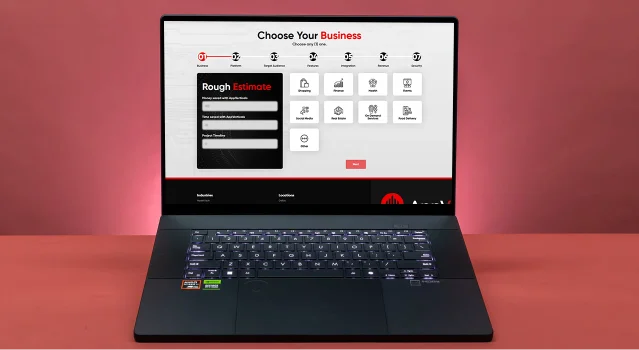
See what it might cost to bring your app idea to life. Our calculator gives you a quick, simple estimate based on what you need.


 verified expert
Senior Content Writer — Mobile & Software Development, AI
Zainab helps tech brands sound more human. She takes app ideas, features, and updates and turns them into content people actually want to read. Whether it’s for a launch, a campaign, or just making things...
See Full Bio11 minutes read
That matters because the market is still enormous. In 2025, consumers downloaded 100+ billion apps from Google Play and spent $49.2 billion there. At the same time, market intelligence providers tracked roughly 1.55M to 1.58M live apps on Google Play in 2025, underscoring how competitive Android distribution has become.
So the real question is not whether one model is better in the abstract. It is whether your product should optimize first for speed and reach, or for performance and platform-native depth.
Drawing from AppVerticals’ own examples, including the native apps built for Amaya Industries and cross-platform app development for VIP Medical, the answer depends on where your product actually creates value.
Let’s explore.
| Category | Native | Cross-Platform |
|---|---|---|
| Overview | Built separately for iOS and Android, offering deeper OS integration and better performance. | Uses a shared codebase for faster development and easier maintenance. |
| Performance | Best for apps requiring high performance, complex animations, or deep device-level access. | Works well for many commercial apps, but may face limitations in performance, complex animations, etc. |
| User Experience (UX) | Best UX for OS-specific behaviors. | Strong, polished interfaces with less effort, thanks to modern cross-platform tools. |
| Maintenance & Cost | Requires separate codebases for each platform, increasing long-term costs. | More cost-effective and easier to maintain with a single codebase. |
| Security & Compliance | Offers more control for security and OS-level integration. | Can be secure, especially with strong backend systems and compliant architectures. |
| Best Use Cases | Ideal for performance-intensive apps, platform-specific UX, or deep hardware access. | Best for MVPs, marketplaces, or apps focused on speed and reach. |
Native app development means building separately for each operating system using platform-specific tools, typically Swift for iOS app development and Kotlin for Android app development. That gives teams a deeper OS integration, finer performance control, and stronger alignment with platform-specific interaction patterns.
Cross-platform development means using a shared codebase, usually with frameworks like React Native or Flutter, to ship to both iOS and Android with much less duplicated engineering. That usually improves release parity, shortens delivery time, and lowers long-term maintenance overhead.
Here’s the practical difference:
| Factor | Native | Cross-Platform |
|---|---|---|
| Codebase | Separate iOS and Android codebases | Shared codebase with selective platform-specific work |
| Time to market | Slower | Faster |
| Initial cost | Higher | Lower |
| Maintenance | More duplication | More centralized updates |
| Performance | Best possible | Strong for many commercial apps |
| Hardware/API access | Deepest access | Good, but sometimes limited or delayed |
| UX fidelity | Best for OS-specific behavior | Strong, but may need extra tuning |
| Best fit | Performance-heavy, hardware-rich, premium UX products | MVP development, marketplaces, portals, healthcare access apps, SaaS companions |
Get a recommendation based on your product goals, budget, timeline, and platform requirements.
A lot of architecture conversations stay too engineering-centric. Leadership teams should zoom out and ask a more commercial question: where is reach actually coming from?
That scale changes the native vs cross-platform decision because serious products rarely stay single-platform for long. Research reports that 53% of American mobile apps are available on both iOS and Android, which reinforces a practical truth: most teams eventually need two-store reach, even if they do not fund two full native tracks on day one.
That is exactly why many startups and growth-stage teams lean toward cross-platform early. It is often the fastest way to maintain release parity across iOS and Android without doubling the mobile app development cost before the product has fully earned that complexity.
The right approach depends less on trend cycles and more on what your product needs to do exceptionally well. Native and cross-platform each win in different places.
Performance is still the cleanest argument for native. If your app depends on complex animations, low-latency interactions, advanced camera workflows, intensive background processing, or heavy device-level integrations, native remains the benchmark.
That is where the Amaya Industries’ app sits relevant. AppVerticals built the product using Swift for iOS and Kotlin for Android, and reports outcomes including 55% faster booking time, 99% booking completion, <1.2s API response, and 99% uptime. In products where responsiveness shapes conversion, native control is not just technical polish; it can affect commercial performance directly.
That said, cross-platform performance is no longer the weakness it used to be. For marketplaces, portals, patient access tools, field-service products, and SaaS companions, modern cross-platform stacks are often more than capable enough, especially when the harder problem is workflow orchestration, not graphics or hardware depth.
Many teams still assume cross-platform automatically means mediocre UX. That is outdated. A polished interface is possible with either model. The real question is whether platform-specific behavior itself is part of the product value.
Native becomes more compelling when the interaction model matters as much as the feature set. That is common in products like premium consumer apps, creator tools, device-heavy utilities, and some financial experiences where gestures, responsiveness, and OS-level behavior can shape trust or retention.
Cross-platform works extremely well when the core value is scheduling, onboarding, messaging, search, payments, forms, and dashboard access. In those categories, users care far more that the product works reliably everywhere than whether the same flow was implemented twice in different native stacks.
Maintenance is where cross-platform becomes especially attractive to founders, CTOs, and finance teams. A shared codebase usually means faster release parity, fewer duplicate bug fixes, easier rollouts, and lower long-term support overhead.
That does not mean zero native work. You still need platform-specific QA, UI tuning, and occasional bridge or module work. But if your roadmap changes weekly and the team is still learning what the market wants, reducing duplicate engineering can be a meaningful strategic advantage.
Security is more nuanced than native is secure, cross-platform is risky. Native is still stronger when you need deep OS-level control, immediate support for OS changes, or tighter hardware-security integration. But for many products, especially in regulated industries, the real security story lives in the full stack.
AppVerticals’ healthcare practice frames compliant delivery around HIPAA, HITECH, GDPR, PHIPA, FHIR, SOC 2, HL7, SaMD, and GxP, alongside secure APIs and protected backend systems. That makes an important point: in healthcare, strong security often depends more on architecture, auditability, and data handling than on whether the mobile front end is native or cross-platform.
We’ll help you assess performance needs, UX expectations, maintenance overhead, and security requirements before you commit.
Cross-platform is usually the better choice when you are building an MVP, an early-traction product, or a workflow-centric app where the bigger risk is getting to market too slowly. If the product thesis still needs validation, funding two full native tracks is often a luxury rather than an advantage.
It is especially effective when the value of the product comes from access, orchestration, and speed rather than hardware-deep interaction. That includes products like healthcare access apps, patient portals, telemedicine tools, marketplaces, field-service platforms, internal enterprise tools, customer portals, and SaaS companion apps.
Cross-platform is also often the more investor-friendly path early on because it lowers not just build cost, but change cost. Every onboarding experiment, roadmap shift, compliance tweak, and analytics update is usually cheaper to ship across both stores when the codebase is shared.
Native becomes the stronger choice when product performance is itself part of the differentiator. That includes apps with real-time interactions, advanced media handling, device-heavy workflows, complex motion, background intensity, or OS-specific experiences where small responsiveness gains materially affect conversion, retention, or monetization.
Native also makes more sense when deep platform control is non-negotiable. If your product gets closer to hardware-level behavior, latency-sensitive flows, complex offline states, or trust-sensitive experiences where platform-specific cues influence adoption, native usually justifies the extra investment sooner.
The smarter question is not React Native or Flutter? first. It is Do we need native at all right now? Architecture should come before framework choice.
If the answer is cross-platform, React Native still makes sense for teams that want hiring flexibility, JavaScript or TypeScript alignment, and faster early-stage iteration. Flutter often has the edge when UI consistency and design precision across platforms matter more. Native remains the better call when neither framework gives you the control your product needs.
That means the best cross-platform mobile app development framework choice is really a second-order decision. First decide whether your product is optimized for delivery efficiency or platform-native control. Then pick the framework or stack that serves that operating model best.
The Amaya Industries’ lesson is straightforward: native becomes worth the extra investment when responsiveness supports revenue. Faster booking, strong completion rates, low API latency, and high uptime are not vanity metrics in a service marketplace. They point to a product where engineering quality shapes commercial quality.
The VIP Medical app says it differently. As reflected in AppVerticals’ healthcare positioning, most products create value through secure onboarding, access continuity, compliance alignment, and reliable multi-device delivery. In such cases, cross-platform can be the more rational operating model without automatically weakening security.
That is why serious teams should stop treating native vs cross-platform like a philosophy debate. The better question is simpler: does your product win on device depth or on delivery speed?
If you need a simple leadership filter, use this:
Choose cross-platform if:
• you need to launch on iOS and Android quickly
• you want to control burn early
• release parity matters
• the product thesis is still being validated
• your core value is workflow, access, convenience, or speed
Choose native if:
• performance is central to the product experience
• the app depends on deep device or OS-level integration
• low latency or complex motion affects conversion
• offline intensity or background-heavy use is critical
• platform-specific UX is part of the product itself
If you are still unsure, that uncertainty often points to starting cross-platform, unless you already know the product will live or die on device performance.
Whether you need fast cross-platform delivery or native performance depth, we can help you scope the right roadmap.
For startup founders, CTOs, CFOs, and investors, the native vs cross-platform decision should be treated like any other capital allocation choice: fund the architecture that best supports the product’s real source of advantage.
If your upside comes from shipping fast across a massive two-store market, cross-platform is often the sharper bet. If your upside depends on flawless responsiveness, richer hardware access, or premium platform-specific behavior, native still wins.
The best teams do not pick the modern option or the traditional option. They pick the one that makes the product more investable.
Let’s map the best mobile approach for your product, reduce wasted spend, and build for the outcomes that matter most.
verified expert
Zainab helps tech brands sound more human. She takes app ideas, features, and updates and turns them into content people actually want to read. Whether it’s for a launch, a campaign, or just making things clearer, she’s all about simple words put together to form stories that stick.
 We’re AppVerticals
AppVerticals is where innovative startups and Fortune 500s come for transformation.
View About Us Mobile App
Orlando’s tech workforce hit 77,700 in 2024, growing 2.3% year-over-year and ranking among the fastest growing tech metro areas in the U.S. This growt...

7 min read
 Mobile App
Travelers expect speed, personalization, and seamless journeys. The right travel app delivers all three. With mobile bookings leading the market, trav...

12 min read
 Mobile App
With the rise of the food delivery app, customers can enjoy their favorite meals from the comfort of their homes or offices. The convenience, speed, a...
9 min read
Discover how our team can help you transform your ideas into powerful Tech experiences.
AppVerticals © 2026 | All Rights Reserved

Get In Touch.












 ChatGPT
 Perplexity
 Google AI