About Us

About Us
We’re a future-focused tech partner working with some of the world’s top enterprises. At AppVerticals, we design solutions that drive growth and reimagine digital experiences.

Services
Software Development
Mobile App Development
Web Design & Development
Tell us what you're looking for, and we'll tailor a solution based on your business needs.
Talk to Experts
Health Tech

EdTech

Logistics

Real Estate

Ecommerce

Sports

Fintech

Travel

Restaurant

Automotive
HIPAA-compliant digital solutions for hospitals, clinics, and healthtech startups driving better patient outcomes.
What we do:
Scalable learning platforms for schools, universities, and EdTech startups transforming education delivery.
What we do:
Real-time tracking and automation solutions for freight companies, warehouses, and delivery services.
What we do:
PropTech platforms for brokerages, property managers, and real estate marketplaces are streamlining operations.
What we do:
High-converting commerce platforms for D2C brands, retailers, and online marketplaces are driving revenue growth.
What we do:
Fan engagement platforms for sports teams, leagues, and betting operators are creating immersive experiences.
What we do:
PCI-DSS compliant solutions for digital banks, payment platforms, and InsurTech companies, ensuring security.
What we do:
Booking and hospitality solutions for OTAs, hotels, and tourism platforms, enhancing traveler experiences.
What we do:
Online ordering and operations software for restaurants, cloud kitchens, and food delivery platforms.
What we do:
Connected vehicle platforms for automotive OEMs, dealerships, and mobility providers are accelerating innovation.
What we do:
Our Odoo implementation brings financial discipline, operational visibility, and process control across departments. From accounting automation to manufacturing workflows, we design ERP systems that reduce operational leakage and provide real-time decision clarity.
We use Sitecore to drive measurable revenue growth through intelligent personalization and behavior-driven content delivery. By aligning marketing automation, data orchestration, and omnichannel engagement, we help brands turn digital touchpoints into retention engines.
We architect AWS environments that stay stable under scale, traffic spikes, and compliance pressure. From secure cloud migrations to CI/CD automation and cost governance, we engineer cloud foundations that protect performance while enabling rapid product evolution.
We implement Dynamics 365 to align systems with actual business operations, bringing clarity, control, and accountability across CRM, ERP, and service functions. From sales to finance, configurations eliminate inefficiencies and enable confident, real-time decisions.
Tell us what you're looking for, and we'll tailor a solution based on your business needs.
Talk to ExpertsPortfolio

AppVerticals was featured in Inc. 5000 as
America’s Fastest Growing Tech Company
See what it might cost to bring your app idea to life. Our calculator gives you a quick, simple estimate based on what you need.



 verified expert
Senior Writer and Editor - App, AI, and Software
Muhammad Adnan is a Senior Writer and Editor at AppVerticals, specializing in apps, AI, software, and EdTech, with work featured on DZone, BuiltIn, CEO Magazine, HackerNoon, and other leading tech publications. Over the past 6...
See Full Bio15 minutes read
Ecommerce website development stops being simple the moment your business stops being simple. More products, more regions, more systems, more edge cases.
That’s where architectural, cost, and integration decisions start colliding.
Not because the technology is unclear, but because trade-offs are. Cost versus flexibility. Speed versus control. Platform convenience versus long-term constraints.
If you’re considering custom ecommerce website development, you’re probably already dealing with ERP sync issues, brittle integrations, or performance workarounds that don’t scale.
These are usually the same issues teams surface when they start evaluating a website development company that can handle systems, not just screens. And rebuilding in 12–18 months is the outcome you’re trying to avoid.
This guide focuses on those decisions. Cost structures, architecture choices, and execution paths that still hold up as traffic grows, and the business moves past version one.
| Dimension | Ecommerce Website (Custom-Built) | Ecommerce Platform (Shopify, Magento, etc.) |
|---|---|---|
| Business logic control | Full control over pricing, checkout, promotions, workflows | Limited to platform rules and extensions |
| Architecture ownership | Owned and designed around your systems | Defined by platform constraints |
| Integrations (ERP, CRM, OMS) | Built as core system components | Added via plugins or middleware |
| Scalability model | Scales based on infrastructure and system design | Scales within platform and pricing limits |
| Performance optimization | Direct control over caching and performance | Constrained by platform performance layers |
| Custom workflows | Native to the architecture | Implemented through workarounds |
| Long-term flexibility | High, changes stay architectural | Decreases as customizations grow |
| Upfront effort | Higher planning and engineering effort | Faster initial setup |
| Long-term cost | Predictable if architecture is sound | Often increases with plugins and rebuilds |
| Best fit | Complex, growing, multi-system businesses | Simple to moderately complex stores |
An ecommerce platform is something you configure.
Global ecommerce sales will surpass $6.86 trillion by the end of 2026. A custom ecommerce website is something you design around how your business actually operates.
Custom ecommerce website development in 2026 typically costs $40k–$250k+, depending on how much business logic, integration depth, and scalability your system needs.
Website design cost is often overestimated, while integration, performance, and backend logic quietly drive most ecommerce development budgets.
Adobe cites a global ecommerce conversion rate of ~2.58% (typical range 1–4%). Costs rise when ecommerce handles complex pricing rules, real-time inventory, multi-region fulfillment, and tight ERP or OMS integrations. Performance and reliability also matter more than most teams expect.
The global average online shopping cart abandonment rate is ~70–75%, meaning roughly 7 out of every 10 carts never convert. This highlights how even minor friction in checkout or performance can erase revenue.
| Project Complexity | Typical Cost Range | What This Covers |
|---|---|---|
| Low complexity | $40k – $80k | Small catalog, limited integrations, single region, standard checkout |
| Mid complexity | $80k – $150k | Custom pricing logic, ERP/OMS integration, performance optimization |
| High complexity | $150k – $300k+ | Multi-region ecommerce, complex fulfillment, deep ERP/WMS integrations, scalability and security hardening |
Regional pricing reflects labor markets and delivery models, not capability alone. Long-term cost depends more on architecture ownership and integration discipline than hourly rates.
| Region | Typical Cost Range | Why Costs Differ |
|---|---|---|
| United States & Canada | $120k – $300k+ | Senior engineering, product ownership, compliance, accountability |
| Western Europe (UK, Germany, Nordics) | $90k – $220k | Strong engineering standards, balanced cost-quality ratio |
| Eastern Europe (Poland, Romania, Ukraine) | $60k – $150k | Solid technical talent, cost efficiency with tighter oversight |
| GCC (UAE, Saudi Arabia) | $70k – $180k | Hybrid delivery models, localization, enterprise focus |
| South Asia (India, Pakistan) | $40k – $120k | Cost-efficient development, quality depends on architecture leadership |
| Cost Driver | Why It Impacts ROI |
|---|---|
| Business logic complexity | Pricing, promotions, and workflows drive ongoing dev effort |
| Integrations (ERP, OMS, WMS) | Sync reliability affects orders, inventory, and support costs |
| Scalability & performance | Poor performance directly impacts conversion and revenue |
| Change frequency | Systems that change often need flexible architecture |
| Data consistency | Errors create refunds, support load, and trust issues |
Not all features carry equal ROI. Some are revenue multipliers. Others are cosmetic.Teams overspend when features are scoped without mapping them to measurable business impact.
Baymard Institute reports that the average cart abandonment rate is 70.22%, largely driven by checkout friction and performance issues, not missing features.
That means backend logic and performance optimization often deliver higher ROI than surface-level enhancements.
| Feature Type | Development Cost | Business Impact | ROI Profile |
|---|---|---|---|
| Checkout performance optimization | Medium | High (conversion lift) | High ROI |
| Inventory & pricing logic | Medium–High | High (order accuracy) | High ROI |
| ERP / OMS integration | High | High (ops efficiency) | High ROI |
| Custom animations | Low–Medium | Low | Low ROI |
| Theme-level UI polish | Low | Low–Medium | Moderate ROI |
| One-off marketing features | Medium | Short-lived | Low ROI |
If a feature does not reduce friction, errors, or manual work, it rarely justifies custom development cost.
Ecommerce budgets usually get wasted in predictable places. McKinsey reports CIOs estimate tech debt equals 20–40% of the value of their technology estate.
Many teams end up funding a website redesign not because branding changed, but because the original architecture couldn’t support new business requirements.
The first is over-customizing platforms instead of addressing architectural limits. Plugin stacks grow, logic fragments, and performance tuning becomes reactive.
The second is building features before stabilizing integrations, which leads to sync failures and rework.
The third is optimizing for launch speed instead of change velocity, forcing expensive rewrites when the business evolves.
I’ve seen teams spend more fixing these issues post-launch than they would have spent designing the architecture properly upfront. That’s not a development failure. It’s a planning failure.
Get a clear view of architecture, integrations, and long-term operating cost before committing a budget.
Get a Custom QuotePlatforms like Shopify and headless setups work when business rules are predictable and change is limited. Custom ecommerce development makes sense when pricing, inventory, integrations, and fulfillment logic are already complex or expected to become complex soon.
This is not a tooling preference. It’s a decision about control versus constraint. Platforms optimize for speed and standardization.
This is where discussions around low-code vs no-code in website development usually surface, often as a speed shortcut when architectural complexity is underestimated.
Custom architecture optimizes for flexibility and long-term operating efficiency. The wrong choice doesn’t fail immediately. It shows up later as workarounds, rising change cost, and fragile systems.
The question to answer honestly is simple: Can our future rules fit inside someone else’s constraints, or do they need to live in our architecture?
Platforms start to strain when teams keep adding logic they were never designed to own.
At that point, teams aren’t extending the platform. They’re compensating for its limits. Development slows, risk increases, and cost shifts from building value to maintaining workarounds.
Custom ecommerce architecture wins when business logic is the product, not an edge case.
In these cases, owning the architecture reduces friction over time. The system stays easier to reason about, cheaper to modify, and more resilient as the business evolves
Overpaying usually happens because scope, architecture, and responsibility are unclear. The right ecommerce development partner reduces long-term operating cost, not just initial build effort.
PMI reports the global average wasted investment due to poor project performance is ~5.2%.
The first thing to evaluate is how they think about architecture, not how many platforms they’ve worked with. A strong partner will ask uncomfortable questions early: system count, data ownership, change frequency, failure scenarios.
If the conversation stays at features and timelines, cost risk is already rising.
Second, pay attention to how scope is framed. Partners who quote aggressively low numbers often defer complexity into “later phases.” That cost doesn’t disappear. It just shows up as change requests, rework, and timeline drift.
A good partner helps you make fewer corrective decisions after launch. That’s where real savings come from.
These aren’t delivery risks. They’re cost multipliers.
Strong partners don’t sell certainty. They show judgment.
In most real projects, a production-ready build takes 3–6 months, depending on how many systems are involved and how stable the requirements are.
Timelines stretch when business logic is unclear, integrations are loosely defined, or architectural decisions are deferred.
The biggest mistake is treating ecommerce like a linear build. It’s not. Discovery, architecture, integration design, and delivery overlap.
When those phases are forced into a rigid sequence, timelines slip quietly and repeatedly.
The team structure should reflect decision load, not just workload.
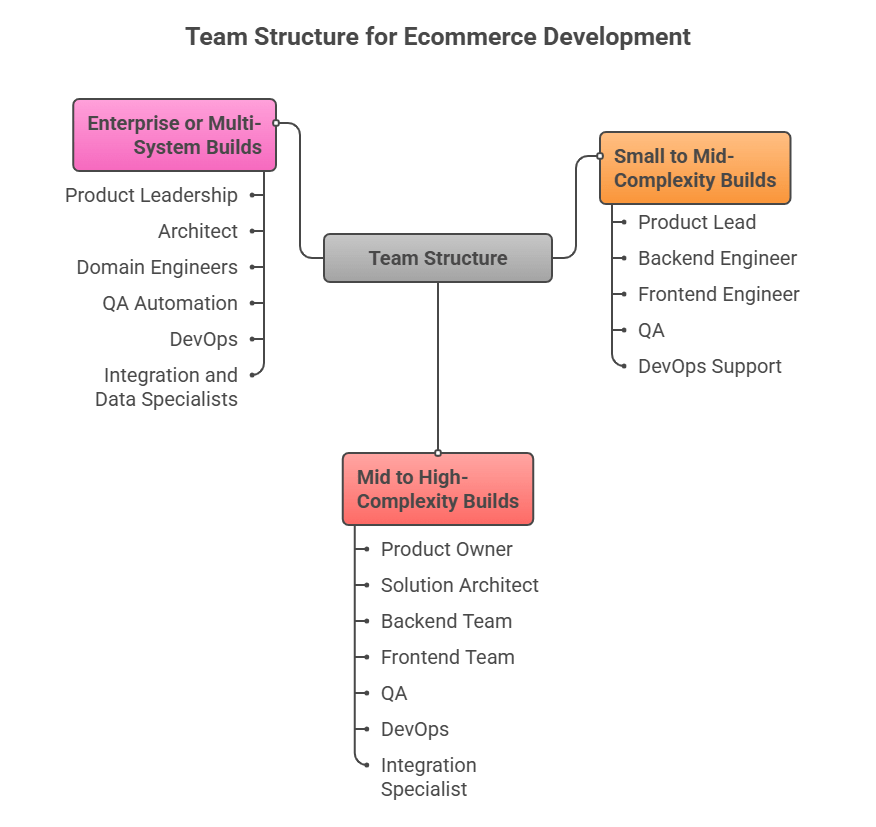
Understaffing architecture and integration roles is the fastest way to extend timelines later.
Timelines fail slowly, not suddenly. Most delays come from unresolved decisions, not slow execution.
The biggest risks in ecommerce website development don’t show up at launch. They surface after real traffic, real data volume, and real change hit the system. Performance, security, and scalability issues usually come from early architectural shortcuts, not bad execution.
Verizon DBIR notes ~88% of Basic Web Application Attack breaches involve stolen credentials
Most teams underestimate how tightly these risks are connected. Performance problems often trace back to integration design. Security gaps come from unclear data ownership.
According to Bigcommerce, ERP integration eliminates data silos and manual entry by syncing backend operations directly with ecommerce systems. Scalability breaks when systems weren’t designed to change safely.
These risks don’t fail loudly. They degrade the system over time and quietly increase operating cost.
If ecommerce is a revenue system, these risks are business risks, not technical edge cases.
Security issues usually come from assumptions, not negligence.
When security is layered on late, teams end up patching exposure instead of controlling it. Clear data boundaries and responsibility lines matter more than tools.
Performance debt builds when speed is optimized locally instead of system-wide.
Performance issues are rarely isolated. They’re signals that system interactions were never designed to operate under sustained load.
Custom ecommerce website development is the right move when your business logic no longer fits cleanly inside platform constraints and the cost of workarounds starts compounding. This usually happens when ecommerce becomes tightly coupled with operations, not just sales.
According to Google Business, as load time goes 1s → 3s, bounce probability increases 32%. You should seriously consider custom ecommerce development if most of the following are true:
Custom ecommerce is not about building everything from scratch. It’s about deciding which parts of the system need long-term control and which can stay standardized.
If ecommerce is a core revenue engine and an operational system at the same time, owning the architecture usually costs less than continuously adapting around someone else’s limits.
AppVerticals stands out by starting with system boundaries and long-term flexibility rather than just screens and features.
A concrete example is the Al Rostamani Group engagement, where AppVerticals delivered custom website development for one of the UAE’s largest conglomerates, unifying six distinct divisions into a modern, responsive digital presence.
This project involved creating a centralized content platform, cohesive design, accessibility improvements, and scalable performance to support diverse audiences across automotive, real estate, travel, and services.
AppVerticals’ approach helped:
If ecommerce logic and performance are central to your business success, AppVerticals brings the architecture discipline and execution rigor needed to avoid common pitfalls many teams face.
Ecommerce website development decisions compound over time. What looks like a reasonable shortcut early often becomes an expensive constraint later.
The difference between a system that scales and one that constantly needs fixing comes down to architecture, integration discipline, and how deliberately trade-offs are made.
If ecommerce is central to revenue and operations, it deserves to be treated as a long-term system, not a one-off build.
It’s to choose an approach that stays stable as complexity grows, changes remain manageable, and cost stays predictable as the business evolves.
It’s an architecture decision waiting to be revisited.
Discuss your project
verified expert
Muhammad Adnan is a Senior Writer and Editor at AppVerticals, specializing in apps, AI, software, and EdTech, with work featured on DZone, BuiltIn, CEO Magazine, HackerNoon, and other leading tech publications. Over the past 6 years, he’s known for turning intricate ideas into practical guidance. He creates in-depth guides, tutorials, and analyses that support tech teams, business leaders, and decision-makers in tech-focused domains.
 We’re AppVerticals
AppVerticals is where innovative startups and Fortune 500s come for transformation.
View About Us Web Development
Your CMS choice, Webflow or WordPress, shapes more than your site’s look; it impacts SEO, growth potential, budgets, workflows, and upkeep. At AppVert...

9 min read
 Web App
Every business leader wants to save money. So they buy an off-the-shelf software product. This is a mistake. You think you've saved a few thousand dol...

12 min read
 Web App
Choosing the right web application framework can make or break your project. With options like Django, React, and Laravel competing for attention, dec...

20 min read
Discover how our team can help you transform your ideas into powerful Tech experiences.
AppVerticals © 2026 | All Rights Reserved

Get In Touch.












 ChatGPT
 Perplexity
 Google AI