About Us

About Us
We’re a future-focused tech partner working with some of the world’s top enterprises. At AppVerticals, we design solutions that drive growth and reimagine digital experiences.

Services
Software Development
Mobile App Development
Web Design & Development
Tell us what you're looking for, and we'll tailor a solution based on your business needs.
Talk to Experts
Health Tech

EdTech

Logistics

Real Estate

Ecommerce

Sports

Fintech

Travel

Restaurant

Automotive
HIPAA-compliant digital solutions for hospitals, clinics, and healthtech startups driving better patient outcomes.
What we do:
Scalable learning platforms for schools, universities, and EdTech startups transforming education delivery.
What we do:
Real-time tracking and automation solutions for freight companies, warehouses, and delivery services.
What we do:
PropTech platforms for brokerages, property managers, and real estate marketplaces are streamlining operations.
What we do:
High-converting commerce platforms for D2C brands, retailers, and online marketplaces are driving revenue growth.
What we do:
Fan engagement platforms for sports teams, leagues, and betting operators are creating immersive experiences.
What we do:
PCI-DSS compliant solutions for digital banks, payment platforms, and InsurTech companies, ensuring security.
What we do:
Booking and hospitality solutions for OTAs, hotels, and tourism platforms, enhancing traveler experiences.
What we do:
Online ordering and operations software for restaurants, cloud kitchens, and food delivery platforms.
What we do:
Connected vehicle platforms for automotive OEMs, dealerships, and mobility providers are accelerating innovation.
What we do:
Portfolio
AppVerticals was featured in Inc. 5000 as
America’s Fastest Growing Tech Company
See what it might cost to bring your app idea to life. Our calculator gives you a quick, simple estimate based on what you need.



 verified expert
Senior Writer and Editor - App, AI, and Software
Muhammad Adnan is a Senior Writer and Editor at AppVerticals, specializing in apps, AI, software, and EdTech, with work featured on DZone, BuiltIn, CEO Magazine, HackerNoon, and other leading tech publications. Over the past 6...
See Full Bio19 minutes read
Let me be blunt. Most companies do not realize their website is hurting them until the pipeline starts feeling soft.
The ads are running. The product is solid. The sales team is doing their job. Yet deals are harder to close and inbound feels lower quality than it used to.
When I see that pattern, nine times out of ten the website is the problem for any web development company evaluating real growth signals.
In 2026, buyers don’t “browse” websites anymore. They use Google, LinkedIn, and AI tools like ChatGPT to shortlist vendors, then they use your website to decide whether you are credible enough to talk to.
According to Forbes, 63% of all web traffic came from mobile devices, underscoring the necessity of mobile-first design and performance optimization.
If that experience feels slow, generic, or out of sync with how your company actually operates, you are quietly disqualified.
This is why website redesign in 2026 makes a difference between a website that supports growth and one that quietly holds it back.
Modern website redesigns deliver measurable business impact by improving three things at once:
In 2026, you do not redesign to look modern. You redesign to make your website faster, more discoverable, and more profitable.
If your site starts slowing your teams down, misses measurable performance targets, or cannot absorb new integrations without workarounds, it is already a bottleneck. A two-second delay in page load time can increase bounce rates by +103%.
A scalable architecture should let you deliver new content and capabilities as fast in year two as year one.
In 2026 growth environments, a website is not a marketing asset. It is part of your growth stack. I look at three operational indicators:
A redesign is justified not when the design looks outdated, but when engineering dependency, performance risk, and structural fragility start limiting how fast the business can move.
Use this checklist to assess hidden architecture constraints:
If three or more of these are true for your stack, it is not a modernization opportunity. It is a redesign requirement, not just a refresh.
These are no longer optional metrics. They are visibility and conversion signals.
Core Web Vitals impact (real business outcomes):
Why it matters for 2026:
Meeting these KPIs is now part of growth revenue operations, not just engineering.
| UX Refresh | Full Rebuild |
|---|---|
| Architecture meets performance and integration needs | Architecture causes recurring performance, reliability, or scaling issues |
| CMS supports easy content and localization | CMS cannot scale multi-region or multi-product needs |
| Core Web Vitals thresholds can be met with tuning | Performance limitations persist even after tuning efforts |
| New modules integrate smoothly | New tools break flows or require bespoke code |
| Minimal dependency on developers | Every change triggers extensive engineering involvement |
Rule of thumb:
A modern website redesign that aligns website UX, performance, SEO, and analytics can lift conversion rates, shorten sales cycles, and increase funnel throughput without proportional increases in marketing spend.
Landing pages outperform other generic forms, with 23% average conversion rates when built for intent and performance. Here’s how I frame ROI for leadership and boards:
1) Baseline Attribution:
Measure the current funnel (traffic → leads → opportunities → closed revenue). If your site is the top entry point for qualified demand, even small percentage improvements multiply significantly at pipeline stages.
2) Lift Estimation:
Top redesigns often deliver:
3) Cost Layering:
Compare the redesign cost against incremental pipeline gains over 6–18 months. The goal is simple: ensure the redesign pays for itself in net new revenue within a 12-month window.
This is not theory. When done right, the website becomes a predictable growth channel rather than a variable expense.
When a website is redesigned to address experience, performance, and funnel clarity, the improvements you can expect are real business outcomes, not vanity metrics.
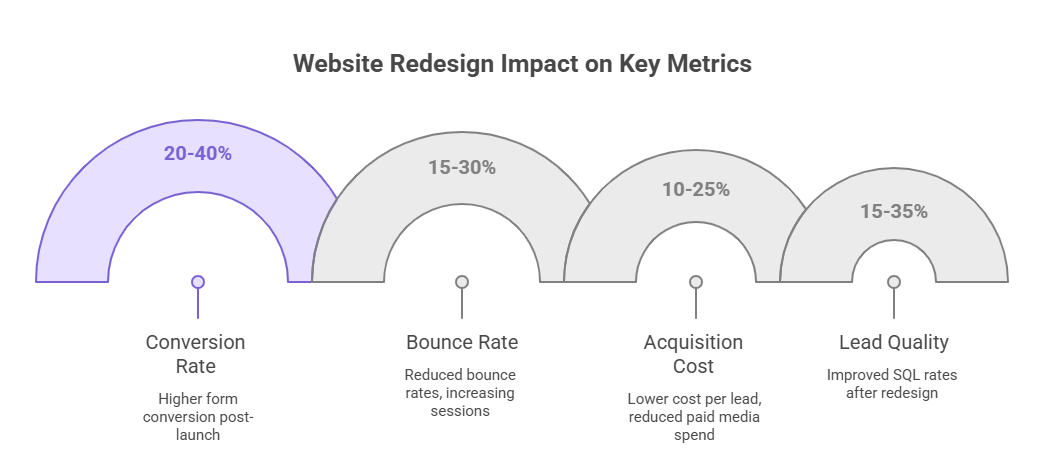
1. Conversion Rate:
Sites redesigned for optimized UX and performance commonly see 20–40% higher form conversion post-launch.
2. Bounce Rate / Session Depth:
Performance and clarity improvements can reduce bounce rates by 15–30%, increasing qualified sessions.
3. Acquisition Cost (CAC):
Higher on-site conversion lowers the cost per lead and often reduces paid media spend required to hit the same pipeline. Estimated 10–25% CAC improvement is typical in B2B benchmarking.
4. Lead Quality / SQL Rate:
By restructuring content around buyer intent and updating UX flows, SQL rates often improve by 15–35% after redesigns with strong analytics and personalization.
These are not vanity numbers. They represent the hard dollars that go into sales productivity and pipeline velocity.
A smart redesign should start paying back before the project is finished. Benchmark timeline includes:
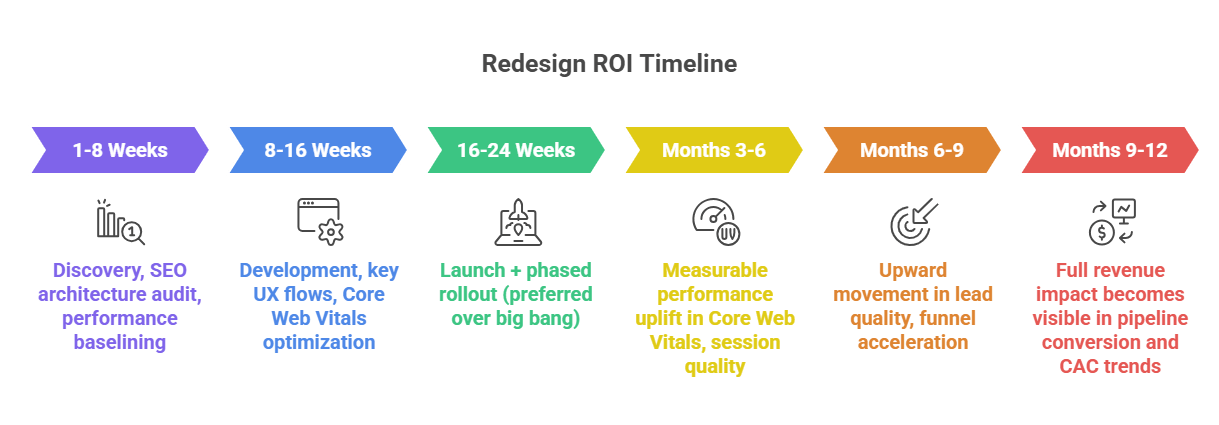
A fully justified redesign should show positive net impact well before 12 months if scoped and executed with the right measurement structure from day one.
| Industry | Why They See Lift | Typical Outcome |
|---|---|---|
| SaaS / Tech | High dependency on product demos and free trials through the site | Better trial sign-ups, shorter sales cycles |
| Healthcare | Complex buyer journeys and regulatory signals matter | Improved trust, better lead conversion |
| FinTech | Heavy scrutiny, security-trust signals required | Stronger credibility, higher SQL rates |
| E-commerce (B2B) | Performance directly affects revenue | Faster checkout + lower abandonment |
| Logistics / Supply Chain | B2B buyers need deep specification clarity | Higher quote requests |
| EdTech | Complex content + stakeholder layers | Better nurture + higher course adoption |
| Real Estate / Hospitality | Visual trust + localized experience | Higher qualified inquiries |
Some industries are more sensitive to performance and trust signals, which means redesigns there deliver higher ROI faster. In tech and SaaS, for example, a drop in friction directly maps to shorter deal cycles because buyers decide on trust and clarity, both frontloaded on the website.
You should budget based on complexity and business impact, not a flat “market price.”
For a mid-sized company planning modernization in 2026, a realistic budget range is:
This range reflects current market practice when you build for SEO readiness, AI discoverability, performance optimization, secure CMS workflows, and third-party integration robustness.
A $50k site can look modern, but without SEO architectural depth or scalable CMS governance, it will still limit growth.
Budgets above $150k absorb complexity and future needs: multivariate testing, personalization, headless CMS, and real-time analytics, all foundational in 2026.
Costs are influenced by three core drivers:
Lower costs come from simpler scope (single region, standard CMS, minimal API work).
Higher costs come from needing modular design systems, personalization layers, and tightly coupled integrations with CRM, automation, analytics, and commerce systems.
| Budget Band | What You Get (Real World) |
|---|---|
| ~$50k | Core redesign, basic CMS, improved UX flows, performance tuning, limited SEO fixes. Good for one-off refreshes, not long-term scalability. |
| ~$150k | Strategic redesign + SEO readiness, modern CMS with structured content, improved performance benchmarks, QA across devices, analytics hygiene, integrations with essential tools. |
| ~$300k+ | Enterprise-grade redesign: headless/hybrid CMS, personalization, A/B and multivariate testing, API-first architecture, solid automation + CRM integration, global performance and localization. |
Website redesigns go off track financially when:
The real redesign cost is not pixels. It is time, governance, and unpredictability. Projects that fail to lock scope, commit to milestones, or enforce QA invariably exceed budget.
In a world where AI and search engines evaluate your site in seconds, a redesign is a strategic investment in growth velocity. Budgeting correctly ensures you do not just modernize the look, you modernize the infrastructure that supports how customers discover, evaluate, and convert on your site.
Get a clear assessment of your site’s architecture, performance, SEO, and growth readiness from a senior AppVerticals web team.
Request a Growth Audit
If your website is already driving revenue, a redesign introduces risk across three layers at once: traffic, data, and automation.
The more systems your site feeds, the higher the blast radius when something breaks.
In 2026, most serious websites are not just frontends. They sit at the center of CRM pipelines, attribution models, email journeys, paid media, and sales reporting.
When you change URL structures, CMS logic, or frontend frameworks, those downstream systems do not politely adapt. They either stay aligned or silently drift, which is where the real damage happens.
The highest-impact risks cluster around three areas:
| Risk Area | What Breaks | Business Impact |
|---|---|---|
| SEO & URLs | Redirects, indexation, internal links | Traffic drops, rankings reset |
| Data & Tracking | Events, UTM logic, conversion goals | Funnel visibility disappears |
| Integrations | Forms, APIs, CRM sync | Leads stop flowing or get mis-attributed |
The damage usually comes from invisible breaks, not obvious crashes. Common failure modes include:
None of these show up as errors on the site. They show up weeks later as falling traffic, missing attribution, and sales teams questioning lead quality.
By then, the original signals are gone and recovery is slow and expensive.
A modern website is a hub that pushes data outward.

Redesigns break this chain when:
When that happens, leads still arrive, but they lose context. Sales sees contacts without source, marketing sees conversions without revenue, and finance sees numbers that do not line up.
The pipeline keeps moving, but no one can trust it.
A safe redesign launch is not a moment. It is a controlled transition. Before go-live:
At launch:
After launch:
This is how teams avoid losing months of demand in a single weekend.
A full redesign takes as long as it takes to protect revenue while changing the foundation. For most mid-sized companies in 2026, that means four to nine months, depending on scale and complexity.
Time is not driven by how fast screens are designed. It is driven by how many things the website is connected to.
SEO mapping, analytics validation, CRM sync, content migration, QA across devices, and release governance all move in parallel.
The more revenue your site touches, the more deliberate the timeline has to be. Rushing this stage is how companies lose traffic, data, and momentum.
| Site Size | Typical Duration | What Drives It |
|---|---|---|
| ~50 pages | 3 to 4 months | UX, core templates, light SEO and content migration |
| ~200 pages | 5 to 7 months | Multiple templates, SEO mapping, analytics, CRM and form logic |
| ~1,000 pages | 7 to 10 months | Large-scale migration, taxonomy, redirects, automation, and performance testing |
Page count matters, but structure matters more. A 200-page site with heavy integrations can take longer than a 1,000-page static site. Complexity, not volume, sets the clock.
Most delays do not come from development. They come from decisions. The biggest blockers are:
When these happen, timelines stretch not by days but by months.
You do not pause growth to redesign a revenue engine. You run them in parallel. High-performing teams:
This is how companies redesign without killing pipelines.
A redesign is only successful if it changes how much revenue you can generate from the same traffic. If your traffic, conversion, and pipeline quality do not move, the redesign was cosmetic, not strategic.
In 2026, measurement has to sit at the intersection of UX, SEO, and revenue. You are not tracking page views. You are tracking whether the site now attracts better buyers, converts them faster, and feeds cleaner data into sales and marketing.
When those three move in the right direction, the redesign worked.
A post-redesign dashboard should show movement across four layers:
When these improve together, you are not just seeing better UX. You are seeing a more efficient revenue engine.
After a modern redesign, the most important shift is not just rankings. It is how often and how accurately AI systems surface you.
A 2026-ready site with clean structure, strong performance, and clear entity signals:
When your pages are faster, better structured, and easier to interpret, AI tools extract and reuse your content instead of skipping it.
That visibility translates directly into higher-quality inbound demand, even when overall search volumes fluctuate.
AppVerticals works with mid-sized and enterprise clients where the website is central to revenue, not just aesthetics.
These case outcomes show how modern redesigns transform digital presence into measurable growth engines:
AppVerticals partnered with Coca-Cola to overhaul their digital presence into a mobile-first, performance-driven platform.
The result was a significant uplift in engagement and content velocity, making the site more agile for market campaigns and ROI-focused conversions.
The redesign of Nokia Al-Saudia delivered a unified learning ecosystem that automated enrollments and boosted engagement, improving platform uptime to 97 % and learner interaction rates by nearly 3x, a clear efficiency and retention outcome for digital transformation.
For a high-traffic property services platform, AppVerticals rebuilt spruce’s user experience and integrations to support hundreds of thousands of users.
Post-redesign data showed dramatic scale: over 685,000 customers onboarded and thousands of properties managed through more intuitive journeys that reduced friction and elevated adoption.
Across a diversified portfolio of web design and development projects, AppVerticals has delivered fast-loading, SEO-ready, and conversion-focused sites for clients in real estate, healthcare, e-commerce, and enterprise services
AppVerticals follows a consistent pattern: improved organic reach, improved UX metrics, and faster funnel progression.
These cases show the same principle in action: modern redesigns do more than refresh visuals.
A website redesign succeeds or fails on four things: whether the architecture can scale, whether performance and UX convert demand, whether SEO and AI systems can actually surface you, and whether data flows cleanly into revenue teams.
The cost, the timeline, and the risk only make sense when those fundamentals are protected. The case studies show what happens when they are done right: higher conversion, cleaner attribution, and faster growth without increasing spend.
If your current site cannot support those outcomes, the problem is no longer design. It is structural, and that is exactly why a redesign becomes a business decision.
Talk to AppVerticals about what a 2026-ready website should look like for your business.
Talk to Strategy Expert
verified expert
Muhammad Adnan is a Senior Writer and Editor at AppVerticals, specializing in apps, AI, software, and EdTech, with work featured on DZone, BuiltIn, CEO Magazine, HackerNoon, and other leading tech publications. Over the past 6 years, he’s known for turning intricate ideas into practical guidance. He creates in-depth guides, tutorials, and analyses that support tech teams, business leaders, and decision-makers in tech-focused domains.
 We’re AppVerticals
AppVerticals is where innovative startups and Fortune 500s come for transformation.
View About Us Web Development
To outsource web development strategically, scale delivery, reduce fixed hiring risk, and accelerate product execution by partnering with an external...

15 min read
 Web Development
Website design cost in 2026 typically ranges from $15,000 to $80,000 for most businesses, with higher budgets tied to performance standards, UX depth,...
17 min read
 Web App
Angular vs React is a strategic decision that affects scalability, hiring, and long-term maintainability. Whether you're building in-house or workin...
19 min read
Discover how our team can help you transform your ideas into powerful Tech experiences.
AppVerticals © 2026 | All Rights Reserved

Get In Touch.












 ChatGPT
 Perplexity
 Google AI