















 ChatGPT
 Perplexity
 Claude
 Google AI
Custom logistics software can deliver 100–200%+ ROI within 2–3 years through fuel savings, labor automation, and improved delivery performance. Companies that implement route optimization, automated order fulfillment, and real-time inventory tracking consistently cut costs and boost customer retention.
For example, UPS said its ORION route-optimization platform reduced average daily driving by six to eight miles per route and was expected to save 100 million miles and 10 million gallons of fuel annually when fully deployed in the U.S. Costa Logistics also reported a 10% reduction in cost per case, a 14% increase in pick rate, and a 14% reduction in direct labor hours after upgrading its WMS and analytics stack.
In this guide, we show you how to calculate your logistics software ROI, which metrics to track, and how to structure your investment for maximum returns.
What Is ROI in Logistics Software Development?
Return on Investment (ROI) is a financial metric used to assess the profitability of any investment relative to its cost. For logistics software, it answers a simple but critical question: how much value does the software generate compared to what you spent on it?
ROI for logistics software is about determining whether the benefits, cost savings, operational efficiency, revenue growth — outweigh the total costs of development, implementation, and ongoing maintenance. It measures the impact of the software on both short-term performance and long-term profitability.
Why Is ROI Important for Logistics Software?
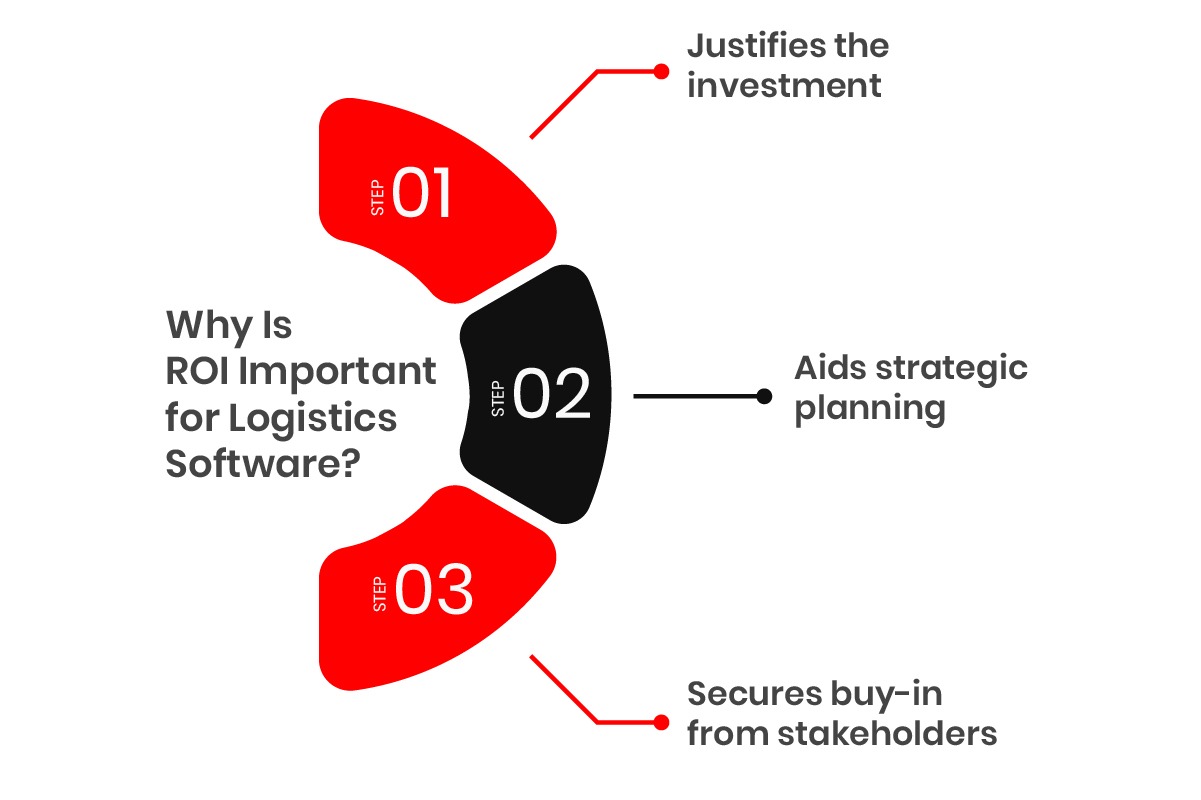 Why ROI matters for logistics software investment decisions
- Justifies the Investment: Whether you’re a logistics manager, CFO, or CEO, a clear ROI calculation validates the decision to invest in custom logistics software and demonstrates that the technology will pay for itself over time.
- Aids Strategic Planning: ROI isn’t just a number — it’s a roadmap. Understanding how it impacts your business helps you allocate resources, prioritize investments, and make decisions that support long-term goals.
- Secures Buy-In from Stakeholders: ROI is the language every stakeholder understands. A clear calculation gives them confidence that the project will produce measurable improvements.
Breaking Down the Key Components of ROI in Logistics Software
When calculating ROI, you’re not just looking at upfront costs. Several factors contribute to the total picture:
- Development Costs: Software design, engineering, testing, and project management. A custom platform integrating a warehouse management system (WMS), freight management system, and real-time analytics will require significant upfront investment, typically $80K–$500K+ depending on scope.
- Integration Costs: Connecting with existing ERP, WMS, and TMS systems adds roughly 15–25% to base development costs, depending on complexity.
- Operational Efficiency Gains: This is the real payoff. Automating manual tasks, optimizing routes, and improving inventory management generate immediate cost savings, route optimization alone can reduce fuel spend by up to 15%.
- Ongoing Maintenance & Support: Budget approximately 10–15% of initial development costs per year for updates, security patches, and scalability enhancements.
- Revenue Growth: Improved efficiency, faster deliveries, and higher customer satisfaction directly impact revenue. Companies with improved order fulfillment and real-time tracking report 15–20% higher customer retention rates.
For a full cost breakdown, see our guide on logistics software development cost.
Why ROI Should Be Your Key Metric
- Guides Future Investments: Strong ROI gives you the confidence to reinvest savings into further innovation.
- Enhances Operational Transparency: Clear ROI metrics reveal exactly where money is going and where it’s returning, helping you identify areas for improvement.
- Aligns with Business Goals: ROI directly links technology investments with core objectives — cost reduction, revenue growth, or customer satisfaction.
Why Custom Logistics Software Is the Key to Maximizing ROI
Off-the-shelf logistics software may appear cost-effective initially, but it consistently underperforms when it comes to adapting to your specific business needs. Custom logistics software is built around your workflows, making it more efficient, scalable, and capable of driving stronger returns. Here’s Why:
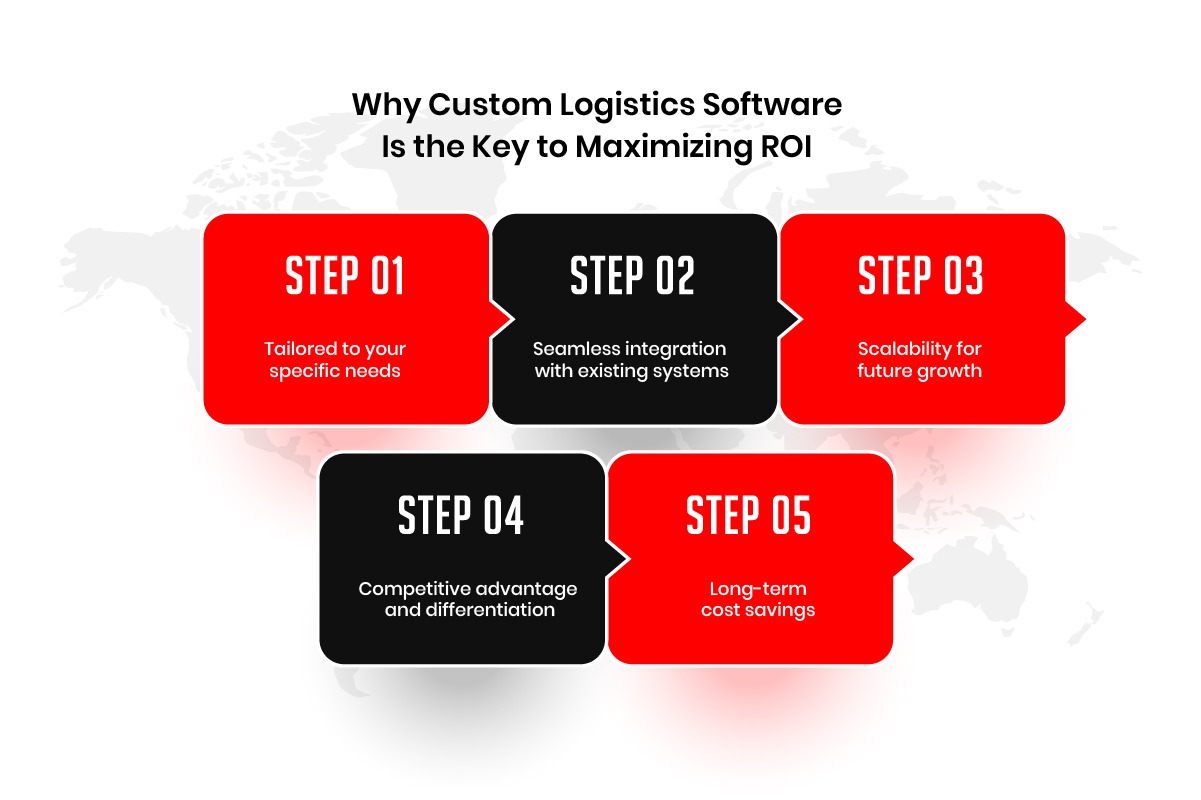
Tailored to Your Specific Needs
Custom software is built specifically for your operations, so you’re not paying for features you’ll never use or missing capabilities you need. If your business relies on multi-modal transportation, for example, custom software can manage the complexities of air, road, and sea logistics far more efficiently than a generic solution.
ROI impact: You get exactly the tools needed to improve efficiency, cut unnecessary costs, and optimize workflows — nothing more, nothing less.
Seamless Integration with Existing Systems
Custom software integrates directly with your existing ERP, WMS, TMS, and other platforms, providing a unified view of your logistics operations. This minimizes disruptions, reduces implementation time, and ensures real-time data flows between systems.
ROI impact: Smooth integration reduces productivity loss during transition and ensures your teams can make faster, data-driven decisions from day one.
Scalability for Future Growth
As your business expands into new regions or adds delivery routes, custom software scales with you — no need for a complete system overhaul. New features and increased volumes are handled through incremental upgrades.
ROI impact: Scalability protects your investment over the long term. You won’t need to re-invest in entirely new systems as your operations grow.
Competitive Advantage
Custom software enables capabilities that competitors using off-the-shelf tools simply can’t replicate — optimized delivery windows, real-time shipment tracking, proactive customer notifications, and more.
ROI impact: A stronger competitive position drives higher customer acquisition, better retention, and in some cases, premium pricing power.
Long-Term Cost Savings
Automation of order fulfillment, route optimization, and inventory management reduces human error, improves resource utilization, and eliminates overstock — all of which compound into significant cost savings over a 2–5 year horizon.
ROI impact: While upfront costs are higher, total cost of ownership over 3–5 years is typically lower than off-the-shelf alternatives when you factor in licensing fees, workaround costs, and productivity losses.
Key Metrics to Track for ROI in Logistics Software
To calculate and validate the ROI of logistics software, you need to track the right KPIs. Here are the categories and the specific numbers that matter.
Operational Cost Savings
- Fuel Savings: Route optimization reduces fuel consumption by up to 15%, directly impacting your bottom line.
- Labor Savings: Automation cuts manual task time by 25–40%. Inventory checks, data entry, dispatch coordination, these can all be automated.
- Inventory Holding Costs: Real-time tracking and smarter replenishment logic can reduce storage costs by 20–30%.
- Error Reduction: Fewer processing errors mean fewer costly returns, re-deliveries, and customer credits.
Efficiency & Productivity Gains
- Faster Order Fulfillment: Streamlined workflows reduce order processing cycles, allowing more orders to be processed with the same resources.
- Increased Throughput: Higher shipment volumes without proportional increases in headcount or equipment.
- Reduced Administrative Overhead: Automation handles up to 40% of routine administrative work, freeing staff for higher-value tasks.
- Improved Asset Utilization: Better vehicle scheduling and warehouse space management reduces idle time and wasted capacity.
Revenue & Customer Satisfaction
- On-Time Delivery Rates: Improved tracking and dispatch coordination drives higher on-time performance, which directly correlates with repeat business.
- Customer Retention: Even a 5% improvement in retention can increase profits by 25–95% over time, a well-documented effect in service businesses.
- New Revenue Streams: Enhanced capabilities unlock premium offerings such as same-day delivery, real-time tracking, or guaranteed delivery windows.
Data-Driven Insights
- Real-Time Tracking: Enables rapid identification and resolution of delays before they escalate into customer-facing failures.
- Predictive Analytics: Demand forecasting improves inventory positioning and reduces both stockouts and overstock situations.
- Continuous Optimization: Ongoing data analysis surfaces inefficiencies in routes, staffing, and resource allocation, turning improvement into a repeatable process rather than a one-time event.
How to Track These Metrics Effectively
- Use Built-In Dashboards: Most logistics platforms provide real-time analytics dashboards, use them actively, not just for reporting.
- Establish Baselines Before Launch: Document your pre-implementation KPIs so you can measure improvement accurately post-launch.
- Review Quarterly: ROI from logistics software compounds over time, regular reviews ensure you’re capturing improvements and identifying new optimization opportunities.
Step-by-Step Guide to Calculating Custom Logistics Software ROI
To calculate the ROI of your custom logistics software, follow these key steps:
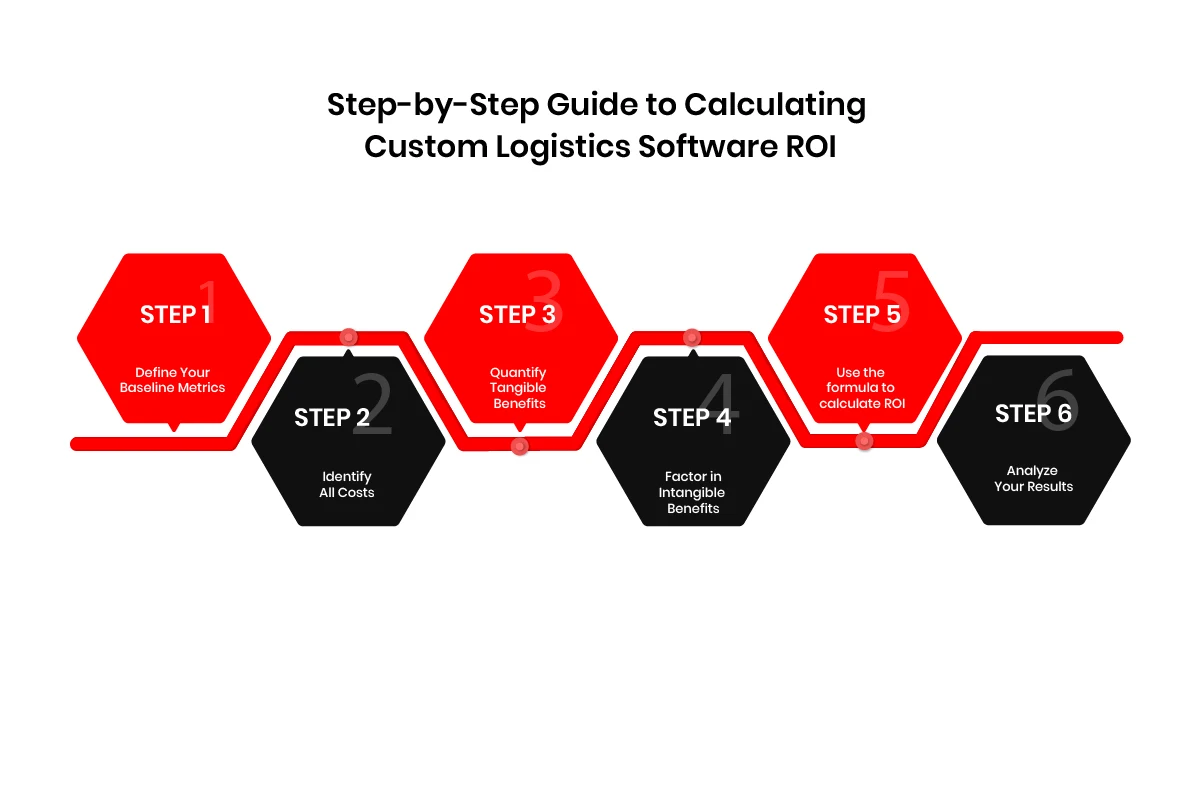
Step 1: Define Your Baseline Metrics
Start by gathering data on current operational costs (fuel, labor, inventory, etc.) and key performance indicators (KPIs) like order fulfillment time and customer satisfaction. This gives you a clear “before” picture.
Step 2: Identify All Costs
Calculate the total investment, including:
- Development costs: Developers, designers, and project management.
- Implementation costs: Integration with existing systems.
- Training and support costs: Onboarding and ongoing technical support.
- Maintenance costs: Updates and security.
Step 3: Quantify Tangible Benefits
Measure the direct benefits like:
- Cost savings: Fuel, labor, inventory holding.
- Revenue growth: Customer retention, faster deliveries, and new services.
Step 4: Factor in Intangible Benefits
Consider qualitative benefits like:
- Customer satisfaction: Leads to loyalty and repeat business.
- Employee productivity: Streamlined processes improve staff efficiency.
Step 5: Apply the ROI Formula
ROI Formula
ROI = ((Total Benefits − Total Costs) ÷ Total Costs) × 100
| Category | Amount ($) |
|---|---|
| Annual fuel savings | 80,000 |
| Annual labor savings | 120,000 |
| Inventory holding cost reduction | 60,000 |
| Revenue gain from improved retention | 80,000 |
| Total Annual Benefits | 340,000 |
| Development + integration cost | 200,000 |
| Year 1 maintenance | 25,000 |
| Total Year 1 Costs | 225,000 |
| ROI (Year 1) | 51% |
| 3-Year ROI (with annual maintenance) | ~170–200% |
Step 6: Analyze Your Results
Evaluate your ROI by looking at:
- Payback period: How long until you recoup your costs?
- Net Present Value (NPV): For a more accurate long-term view.
By following these steps, you can confidently calculate the ROI of your logistics software and track its ongoing impact on your operations.
Custom vs. Off-the-Shelf Logistics Software: ROI Comparison
A common question when justifying the investment in custom software is how it stacks up against buying an off-the-shelf solution. The table below provides a realistic comparison over a 3-year period for a mid-sized logistics operation.
| Factor | Off-the-Shelf Software | Custom Logistics Software |
|---|---|---|
| Upfront Cost | $20,000–$80,000 (licensing + setup) | $80,000–$500,000+ (development) |
| Annual Ongoing Cost | $15,000–$60,000 (subscriptions, per-user fees) | $8,000–$50,000 (maintenance, 10–15% of dev cost) |
| 3-Year Total Cost | $65,000–$260,000 | $104,000–$650,000 |
| Integration Fit | Partial — requires workarounds | Seamless — built for your systems |
| Scalability | Limited by vendor roadmap | Fully scalable with your growth |
| Workflow Match | You adapt to the software | Software adapts to you |
| Typical 3-Year ROI | 40–90% | 100–200%+ |
| Payback Period | 6–18 months | 18–36 months |
| Long-Term Value (5yr+) | Decreases as limitations compound | Increases as the system scales with the business |
Understanding Payback Period and Net Present Value (NPV)
ROI tells you the magnitude of your return. Payback period and NPV tell you when and whether that return is worth pursuing given the time value of money.
Payback Period
The payback period is how long it takes for cumulative benefits to equal your total investment. It is the most intuitive way to assess financial risk.
Total investment (development + integration): $200,000
Annual benefits (savings + revenue gains): $340,000
Annual maintenance: $25,000
Annual net benefit: $315,000
Payback Period = $200,000 ÷ $315,000 ≈ 7.6 months
For smaller operations with lower benefit volumes, a payback period of 18–30 months is typical and still represents a strong investment.
Net Present Value (NPV)
NPV accounts for the fact that money earned in the future is worth less than money today (due to inflation and opportunity cost). A positive NPV means your investment creates real value; a negative NPV means the costs outweigh the discounted future benefits.
Example (using a 10% discount rate over 3 years):
| Year | Benefit ($) | Discount Factor | Discounted Benefit ($) |
|---|---|---|---|
| Initial Investment | $200,000 | – | -$200,000 |
| Year 1 | $340,000 | 1.10 | $309,090 |
| Year 2 | $340,000 | 1.21 | $280,991 |
| Year 3 | $340,000 | 1.33 | $255,639 |
| Sum of Discounted Benefits | $845,720 | ||
| NPV | $645,720 — strongly positive | ||
For more conservative scenarios with a higher discount rate (15–20%) or lower benefit volumes, NPV analysis helps you stress-test the investment before committing.
Rule of thumb: If your payback period is under 24 months and your 3-year NPV is positive, the investment is financially sound for most logistics operations.
How to Maximize ROI from Your Custom Logistics Software
1. Continuously Optimize Software Use
Monitor KPIs on a regular cadence and use data insights to make iterative improvements to workflows. Small, consistent optimizations across routes, staffing, and inventory management compound into significant gains over time.
Why it matters: Continuous optimization keeps the software aligned with evolving business needs and prevents performance from plateauing after initial deployment.
2. Ensure Full User Adoption
Train your team thoroughly on all features — not just the ones immediately visible — and create feedback channels so users can report friction points. Underutilized features are wasted investment.
Why it matters: Studies consistently show that user adoption rate is one of the strongest predictors of software ROI. A 70% adoption rate does not generate 70% of the potential ROI, it often generates far less, because the highest-value features tend to be the most complex ones.
3. Design for Scalability from Day One
Work with your development partner to architect the system with future growth in mind. Plan for modular feature expansion, higher data volumes, and new geographic markets.
Why it matters: A system that can scale avoids costly re-development projects as your business grows, protecting the original investment well into the future.
4. Choose the Right Development Partner
Work with developers who have direct logistics domain experience, not just general software engineers. A partner who understands TMS, WMS, and freight operations will make better architectural decisions and anticipate integration challenges before they become expensive problems.
Why it matters: The development partner you choose will have an outsized impact on the long-term value of the software, not just whether it works on launch day, but whether it continues to deliver value for years afterward.
5. Use Phased Rollouts for Faster Early Returns
Implement in phases, starting with the highest-impact areas (route optimization, automated dispatch, or inventory tracking). Use real-world performance data from each phase to refine the next.
Why it matters: Phased rollouts allow you to start generating ROI while the full system is still being built, and they reduce the risk of a large-scale failure by letting you catch and fix issues early.
Final Thoughts
Investing in custom logistics software development offers significant potential for operational improvements, cost savings, and revenue growth. By accurately calculating ROI, tracking the right metrics, and continuously optimizing your system, you can unlock its full value and build a strong foundation for long-term success.
Maximizing ROI is an ongoing process, not a one-time event. It requires thoughtful planning from the architecture stage, full user adoption, scalable system design, and a development partner with genuine logistics domain expertise. When those elements come together, logistics software doesn’t just pay for itself. It becomes a sustainable competitive advantage.
At AppVerticals, we specialize in custom logistics software development tailored to the specific needs of your operation. Our team can help you build a solution that optimizes your logistics workflows, maximizes ROI, and scales with your business, from initial scoping through long-term support.
Future-Proof Your Logistics Operations
With scalable, tailored logistics software, your business can grow efficiently. Let’s discuss your custom software needs today.