About Us

About Us
We’re a future-focused tech partner working with some of the world’s top enterprises. At AppVerticals, we design solutions that drive growth and reimagine digital experiences.

Services
Software Development
Mobile App Development
Web Design & Development
Tell us what you're looking for, and we'll tailor a solution based on your business needs.
Talk to Experts
Health Tech

EdTech

Logistics

Real Estate

Ecommerce

Sports

Fintech

Travel

Restaurant

Automotive
HIPAA-compliant digital solutions for hospitals, clinics, and healthtech startups driving better patient outcomes.
What we do:
Scalable learning platforms for schools, universities, and EdTech startups transforming education delivery.
What we do:
Real-time tracking and automation solutions for freight companies, warehouses, and delivery services.
What we do:
PropTech platforms for brokerages, property managers, and real estate marketplaces are streamlining operations.
What we do:
High-converting commerce platforms for D2C brands, retailers, and online marketplaces are driving revenue growth.
What we do:
Fan engagement platforms for sports teams, leagues, and betting operators are creating immersive experiences.
What we do:
PCI-DSS compliant solutions for digital banks, payment platforms, and InsurTech companies, ensuring security.
What we do:
Booking and hospitality solutions for OTAs, hotels, and tourism platforms, enhancing traveler experiences.
What we do:
Online ordering and operations software for restaurants, cloud kitchens, and food delivery platforms.
What we do:
Connected vehicle platforms for automotive OEMs, dealerships, and mobility providers are accelerating innovation.
What we do:
Portfolio
AppVerticals was featured in Inc. 5000 as
America’s Fastest Growing Tech Company
See what it might cost to bring your app idea to life. Our calculator gives you a quick, simple estimate based on what you need.


 verified expert
Technical Writer — Platforms, SaaS & Digital Products
Vareesha writes about platforms and SaaS with a clear, experience-led approach. With 3+ years in technical writing, she translates complex business and technical concepts into structured, actionable content for founders and product teams. Having worked...
See Full Bio15 minutes read
The mobile app market itself continues to grow rapidly, projected to reach about $378 billion in 2026 and potentially exceed $1.2 trillion by 2035. With roughly half of new mobile apps now built using cross-platform frameworks, the approach has clearly moved from experimentation to mainstream software delivery.
In this guide, I’ll break down the best cross-platform mobile app development frameworks for 2026, sharing insights on performance, developer experience, architecture, platform coverage, and cost.
| Framework | Best For | Key Strength |
|---|---|---|
| Flutter | UI-heavy consumer apps | Consistent rendering & high performance |
| React Native | JavaScript-based teams | Large talent pool & hiring flexibility |
| Kotlin Multiplatform | Native mobile teams | Shared business logic with native UI |
| .NET MAUI | Microsoft ecosystem companies | Strong enterprise integration |
| Ionic | Web development teams | Fastest time-to-market |
| NativeScript | JS teams needing native APIs | Direct access to native APIs |
There is no single best app development framework for every company. The right answer depends on the shape of your product, your in-house skills, your hiring model, and how much native control you need.
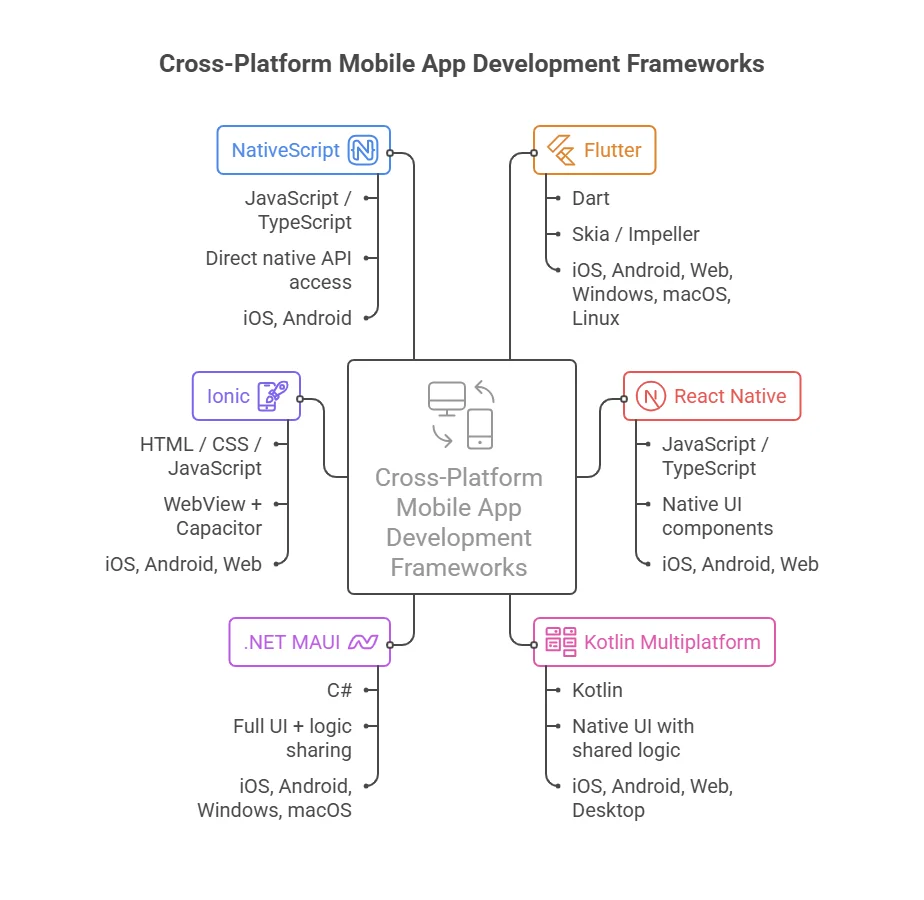
The most credible cross-platform frameworks in 2026 are:
When evaluating cross-platform mobile frameworks, the decision should focus on operational impact, not just feature lists.
I typically assess frameworks across five dimensions:
Selecting the right framework is critical for long-term success, working with experts in mobile app development makes this decision much easier.
The following frameworks represent the most credible cross-platform technologies in production environments today.
Rather than ranking them blindly, I’ll break down where each framework works best, where it struggles, and what type of team it fits.
 1. Flutter
| Attribute | Details |
|---|---|
| Language | Dart |
| Rendering Engine | Custom Skia / Impeller |
| Code Sharing Model | Single UI + logic codebase |
| Platform Support | iOS, Android, Web, Windows, macOS, Linux |
| Limitations | Larger binaries, higher memory usage, and a smaller Dart talent pool |
Flutter mobile development is my go-to for UI-heavy apps. Rendering its own interface ensures consistent animations and design across platforms. Recent updates to the Impeller engine reduce dropped frames and improve stability. Its ecosystem remains strong and widely adopted.
Flutter works particularly well for:
Large organizations, including BMW, Alibaba, and Google Ads, use Flutter in production.
| Attribute | Details |
|---|---|
| Language | JavaScript / TypeScript |
| Rendering Engine | Native UI components |
| Code Sharing Model | Shared logic with native rendering |
| Platform Support | iOS, Android, Web (via React Native Web) |
| Limitations | Package quality varies; large projects require stricter dependency governance |
I find React Native one of the most practical cross-platform choices for teams already using JavaScript or TypeScript.
Hiring is easier, the developer ecosystem is deep, and the framework benefits from the broader React ecosystem.
Technical credibility has also improved significantly with the React Native new architecture, which introduces:
These updates reduce historical performance bottlenecks caused by the older bridge model.
React Native works well for:
Major companies using React Native include Shopify, Tesla, Discord, and Meta products.
Stop wasting weeks on trial-and-error. Compare real performance, developer experience, and cost for your app type — UI-heavy consumer apps, marketplaces, or SaaS products.
Get My Framework Recommendation| Attribute | Details |
|---|---|
| Language | Kotlin |
| Rendering Approach | Native UI with shared business logic |
| Code Sharing Model | Shared core logic layer |
| Platform Support | iOS, Android, Web, Desktop |
| Limitations | Steeper learning curve, smaller ecosystem, limited shared UI |
Kotlin Multiplatform solves a different problem than most cross-platform frameworks. Instead of sharing the entire application, it allows teams to share core business logic while keeping native UI layers.
This architecture appeals strongly to companies with mature iOS and Android teams.
Typical shared components include:
The approach removes duplicated code while preserving native user experience standards.
KMP is ideal for:
Production adoption includes companies such as Forbes, McDonald’s, Cash App, and VMware.
| Attribute | Details |
|---|---|
| Language | C# |
| Code Sharing | Full UI + logic sharing |
| Platform Support | iOS, Android, Windows, macOS |
| Limitations | Smaller community, slower updates, weaker ecosystem compared to Flutter and React Native |
.NET MAUI is the successor to Xamarin and integrates closely with the Microsoft development ecosystem.
Organizations already using:
often find MAUI to be a natural extension of their stack.
The framework benefits from strong Visual Studio tooling and enterprise governance support.
.NET MAUI works well for:
| Attribute | Details |
|---|---|
| Language | HTML / CSS / JavaScript |
| Runtime Model | WebView + Capacitor |
| Platform Support | iOS, Android, Web |
| Limitations | WebView can limit performance for animation-heavy or hardware-intensive applications |
Ionic works best for web teams moving into mobile. Existing Angular, React, or Vue skills translate directly, reducing retraining. PWAs integration makes it perfect for testing demand before committing to native.
Ionic works best for:
| Attribute | Details |
|---|---|
| Language | JavaScript / TypeScript |
| Rendering Model | Direct native API access |
| Platform Support | iOS, Android |
| Limitations | Smaller ecosystem, fewer libraries, and limited long-term support |
NativeScript allows JavaScript developers to access native device APIs directly, without relying on WebView rendering.
This makes it more capable than many traditional hybrid frameworks.
NativeScript is useful for:
| Metric | Flutter | React Native | Native |
|---|---|---|---|
| Time to First Frame (iOS) | 16.67ms | 32.96ms | 41.37ms |
| Dropped Frames | 0% | ~15% | 1.61% |
| Avg FPS | 120 | 100–120 | 120 |
The following comparison summarizes the real trade-offs teams face when selecting a cross-platform framework.
| Framework | Primary Language | Performance Profile | Learning Curve | Enterprise Readiness |
|---|---|---|---|---|
| Flutter | Dart | Near-native rendering with custom engine | Medium | High |
| React Native | JavaScript / TypeScript | Near-native with Fabric architecture | Low | High |
| Kotlin Multiplatform | Kotlin | Native UI with shared logic | High | High |
| .NET MAUI | C# | Strong performance within .NET ecosystem | Low (for C# devs) | High |
| Ionic | HTML / CSS / JavaScript | WebView-based performance | Very Low | Medium |
| NativeScript | JavaScript / TypeScript | Direct native API access | Medium | Medium |
| Framework | Avg dev cost | Typical team | Delivery time |
|---|---|---|---|
| Flutter | $35K to $120K | 3 to 4 devs | 3 to 6 months |
| React Native | $30K to $150K | 3 to 5 devs | 3 to 7 months |
| Kotlin Multiplatform | $50K to $180K | 4 to 6 devs | 4 to 8 months |
| .NET MAUI | $40K to $130K | 3 to 4 devs | 3 to 6 months |
| Ionic | $20K to $80K | 2 to 3 devs | 2 to 5 months |
| NativeScript | $35K to $110K | 3 to 4 devs | 3 to 6 months |
Regional developer pricing still changes the equation materially. Recent public estimates place senior-market rates around $80 to $150 per hour in the US, UK, and Canada, roughly $40 to $80 in Eastern Europe, and about $20 to $50 in India and Southeast Asia.
Final budgets vary significantly depending on features, integrations, and the mobile app development services provider chosen.
Cross-platform development can slash your costs — but only when the framework aligns with your project, team, and goals. Get a tailored recommendation that ensures maximum ROI.
Get My Cost-Saving RecommendationIn most modern product scenarios, cross-platform mobile development is the right default choice. It allows teams to ship iOS and Android apps from a single codebase, reducing development time, simplifying maintenance, and accelerating feature releases.
However, native development still makes sense for performance-critical products that rely heavily on platform-specific capabilities or advanced device hardware.
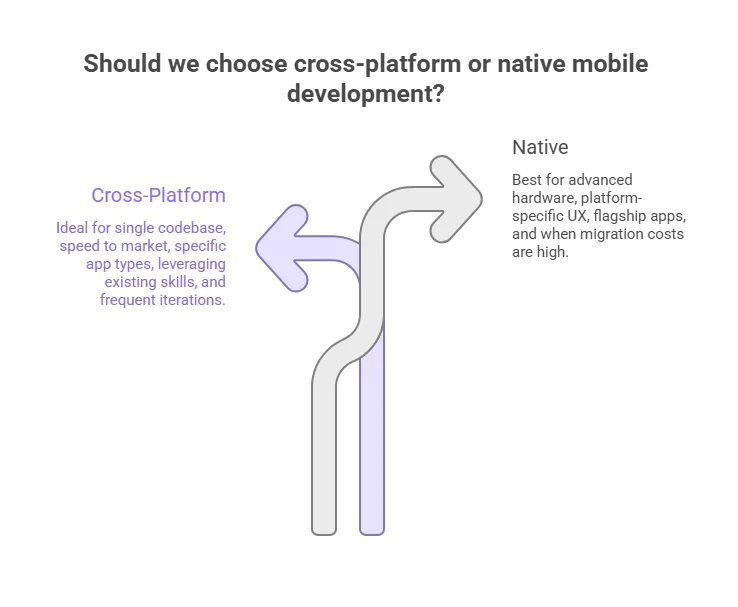
Choose cross-platform when:
Choose native when:
Most cross-platform development project failures are not caused by the framework itself, but by weak architecture decisions and poor implementation practices.
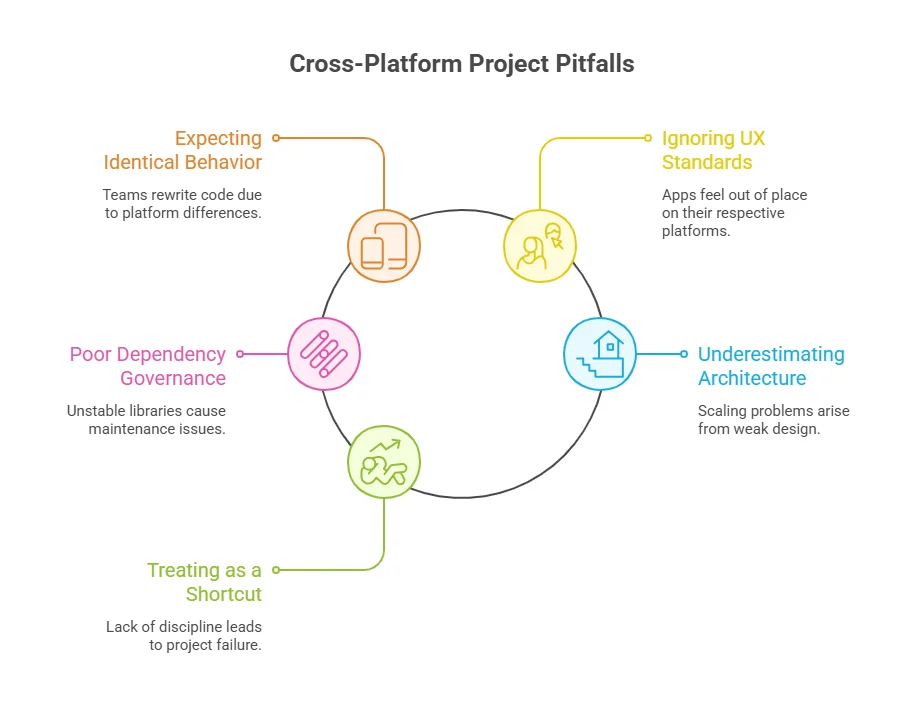
No serious mobile framework fully eliminates platform differences. Device APIs, OS behaviors, and UI expectations still vary between iOS app development and Android. Teams that assume 100% shared code often end up rewriting platform-specific components later.
Users expect iOS and Android apps to behave according to their platform conventions. Even frameworks like Flutter or React Native benefit from small platform-specific adjustments to navigation, gestures, and interaction patterns.
Multi-platform development ecosystems rely heavily on community packages. Without clear dependency policies, projects can accumulate unstable libraries that become difficult to maintain.
This risk is most visible in large React Native codebases but can appear in any framework.
Cross-platform apps benefit significantly from strong architecture patterns such as:
Teams that skip these practices often experience scaling issues as the codebase grows.
Cross-platform development frameworks reduce duplicated work, but they do not eliminate the need for a strong engineering discipline. The teams that succeed with these frameworks are usually the ones that apply the same architecture standards they would use in native development.
I would push CTOs to score each option against these factors before they approve a framework standard:
React Native is easier to staff because JavaScript talent is abundant. Flutter is easier to operate once the team is trained, but the initial hiring pool is smaller.
If your app is motion-heavy or design-sensitive, Flutter has a strong edge. If native UI is a requirement, KMP deserves serious attention.
Lightweight internal tools can justify Ionic or MAUI. Consumer apps with brand-heavy UI often justify Flutter. Mixed native estates often justify KMP.
If web and desktop matter alongside mobile, Flutter becomes more attractive. If mobile only is the brief, the answer may shift.
React Native can deliver very well, but package governance matters. Flutter offers more predictable single-codebase maintenance. KMP reduces duplication without forcing UI unification.
Google, Meta, Microsoft, and JetBrains all back serious options here. That reduces platform risk compared with fringe tools.
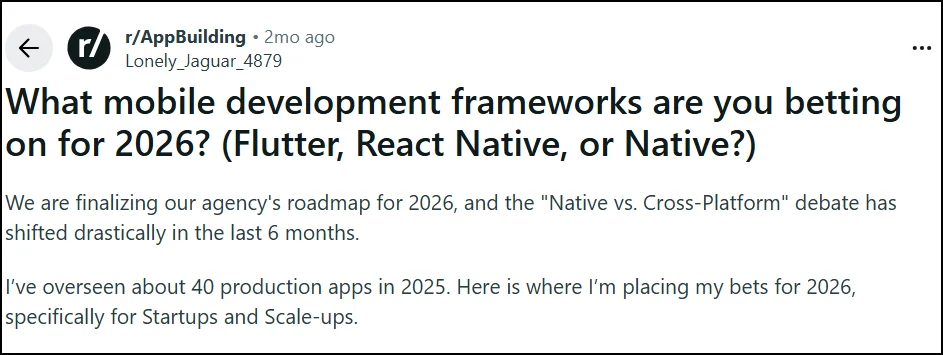
In a recent Reddit discussion about mobile frameworks for 2026, developers debated whether Flutter, React Native, or native development would dominate future projects. The thread was started by an agency lead who had overseen about 40 production apps in 2025, highlighting how rapidly the cross-platform vs native debate is evolving.
Many contributors pointed out that React Native remains attractive because of its JavaScript ecosystem and hiring flexibility, while others emphasized Flutter’s stronger UI consistency and predictable rendering for consumer-facing apps.
Framework decisions often differ depending on the company’s stage.
React Native and Ionic can be the fastest route to MVP development when teams already work in JavaScript. However, Flutter is often the better choice for design-driven consumer applications.
Organizations with strong Microsoft infrastructure often favor .NET MAUI. Companies with established native mobile teams frequently adopt Kotlin Multiplatform to eliminate duplicated business logic.
Flutter remains one of the safest multi-platform development options due to its predictable rendering model.
React Native and Flutter tend to offer the broadest flexibility across client projects.
The need for external help usually appears at one of three points:
That is where experienced cross-platform mobile app development support becomes useful. Not because the framework is too hard, but because production-grade delivery requires architecture design, testing strategy, release governance, and long-term maintainability.
The best cross-platform mobile app development framework for 2026 is the one that aligns with your product shape, engineering organization, and long-term maintenance model.
If you want the shortest practical summary:
That is the decision lens high-level buyers should use. Not which framework wins the loudest argument, but which one makes the product easier to build, easier to staff, and easier to sustain over time.
Avoid costly rewrites later. Get practical guidance on framework selection, architecture, and scaling mobile apps across platforms.
Schedule a Consultation
verified expert
Vareesha writes about platforms and SaaS with a clear, experience-led approach. With 3+ years in technical writing, she translates complex business and technical concepts into structured, actionable content for founders and product teams. Having worked closely on platform implementation and documentation, she brings real-world insight into how these systems function beyond the surface.
 We’re AppVerticals
AppVerticals is where innovative startups and Fortune 500s come for transformation.
View About Us Cross-Platform
In 2025, building scalable and cost-efficient mobile apps is more competitive than ever. With users spending an average of 4.8 hours daily on apps, bu...

16 min read
Discover how our team can help you transform your ideas into powerful Tech experiences.
AppVerticals © 2026 | All Rights Reserved

Get In Touch.











 ChatGPT
 Perplexity
 Google AI