About Us

About Us
We’re a future-focused tech partner working with some of the world’s top enterprises. At AppVerticals, we design solutions that drive growth and reimagine digital experiences.

Services
Software Development
Mobile App Development
Web Design & Development
Tell us what you're looking for, and we'll tailor a solution based on your business needs.
Talk to Experts
Health Tech

EdTech

Logistics

Real Estate

Ecommerce

Sports

Fintech

Travel

Restaurant

Automotive
HIPAA-compliant digital solutions for hospitals, clinics, and healthtech startups driving better patient outcomes.
What we do:
Scalable learning platforms for schools, universities, and EdTech startups transforming education delivery.
What we do:
Real-time tracking and automation solutions for freight companies, warehouses, and delivery services.
What we do:
PropTech platforms for brokerages, property managers, and real estate marketplaces are streamlining operations.
What we do:
High-converting commerce platforms for D2C brands, retailers, and online marketplaces are driving revenue growth.
What we do:
Fan engagement platforms for sports teams, leagues, and betting operators are creating immersive experiences.
What we do:
PCI-DSS compliant solutions for digital banks, payment platforms, and InsurTech companies, ensuring security.
What we do:
Booking and hospitality solutions for OTAs, hotels, and tourism platforms, enhancing traveler experiences.
What we do:
Online ordering and operations software for restaurants, cloud kitchens, and food delivery platforms.
What we do:
Connected vehicle platforms for automotive OEMs, dealerships, and mobility providers are accelerating innovation.
What we do:
Portfolio
AppVerticals was featured in Inc. 5000 as
America’s Fastest Growing Tech Company
See what it might cost to bring your app idea to life. Our calculator gives you a quick, simple estimate based on what you need.



 verified expert
Senior Content Writer — Mobile & Software Development, AI
Zainab helps tech brands sound more human. She takes app ideas, features, and updates and turns them into content people actually want to read. Whether it’s for a launch, a campaign, or just making things...
See Full Bio12 minutes read
If you want to build an iOS app with Claude Code, the appeal is obvious: less blank-page friction, faster prototyping, quicker UI scaffolding, and a much lower cost of experimentation than hiring a full team on day one.
And this is no longer just a fringe workflow. Anthropic says Claude is now generally available in Xcode 26, and Xcode 26.3 adds native support for the Claude Agent SDK, including autonomous task execution, project-wide reasoning, and even visual verification through Xcode Previews.
But there’s a difference between getting code and getting to the App Store.
The better question is whether a Claude Code iOS app development can survive architecture decisions, debugging, purchase flows, privacy disclosures, and App Store review without experienced human oversight.
Let’s explore that thoroughly in this detailed guide.
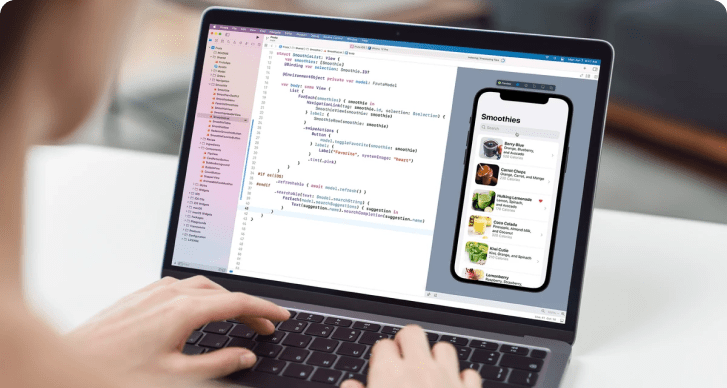
Anthropic’s official Xcode rollout matters because it moves Claude from helpful Chabot to embedded development workflow. Inside Xcode, Claude can work as a natural-language coding assistant, gather project context, explain highlighted code, generate SwiftUI previews and playgrounds, and make inline changes directly in the editor.
With the newer Agent SDK integration, Claude can also reason across the project, take on longer-running tasks, and use previews for visual verification.
At the same time, independent developer Simon Willison has been explicit about the other side of the story: coding agents are useful, but trust and guardrails still matter. His recurring concern is that prompt-based protections are not the same as robust sandboxing, which is a reminder that AI-generated output is not the same thing as dependable release engineering.
Claude can generate the initial code, but refining it into a reliable, scalable app requires a development team. Let us handle the architecture, testing, and App Store preparation.
Claude is strongest when the task is structured, local, and easy to evaluate.
That usually means early-stage work like product scoping, screen mapping, PRD drafting, SwiftUI scaffolding, boilerplate generation, refactors, and explaining compiler errors.
Anthropic positions Claude this way officially, and real builders on Reddit report the same pattern:
Claude is very effective when you break work into smaller chunks, define the feature clearly, and use it as a pair programmer rather than an unsupervised builder.
So yes, Claude can help you build an iOS app. But the highest-value use case is usually this:
The prototype phase is where Claude looks impressive. The App Store phase is where hidden costs show up.
AI-generated Swift and SwiftUI often rely on deprecated APIs, poor accessibility defaults, outdated navigation patterns, excessive GeometryReader, and inefficient view composition. That means a screen can appear “done” while still being technically weak.
That is a useful reality check: Claude can help with iOS, but it is still far less reliable when the work involves framework nuance, version-specific API behavior, or fragile native setup.
Apple does not review “how much AI you used.” Apple reviews the app against its rules for safety, design, privacy, legality, and minimum functionality.
Apple’s guidelines are explicit that developers must clearly disclose when personal data is shared with third parties, including third-party AI, and obtain explicit permission before doing so. For any AI-enabled app, that alone can become a serious implementation and policy task.
That is exactly the point: Claude can speed up creation, but real iOS release work still depends on disciplined QA.
The final trap is product quality, not just code quality. If the app feels derivative, thin, or “AI-generated,” review risk and market risk both go up. Apple explicitly pushes back on low-value or spam-like experiences through its minimum functionality standards.
Let our team optimize your Claude-generated MVP, handle security, and ensure it meets App Store guidelines before submission.
When deciding between Claude Code, ChatGPT, and GitHub Copilot for iOS development, it’s important to consider the strengths, weaknesses, and pricing for each tool. Each tool serves different needs depending on the complexity of the app, the workflow, and the team’s specific requirements.
Below is a quick comparison to help you understand which tool is best suited for your iOS development needs:
| Tool | Best fit | Strongest advantage | Weakness for iOS teams | Entry price |
|---|---|---|---|---|
| Claude / Claude Code | Native Apple teams, SwiftUI builders, founders using Xcode | Official Claude in Xcode integration, project context, inline edits, previews, longer autonomous tasks in Xcode | Still needs human review for architecture, deprecated APIs, QA, and App Store compliance | Claude Pro starts at $20/mo |
| ChatGPT / Codex | Cross-stack builders who want strong code generation, codebase explanation, review, and debugging | Codex is positioned as a coding agent that can write code, understand unfamiliar codebases, review code, debug, and automate dev tasks | In the sources reviewed here, it is not positioned around a native Xcode workflow the way Claude is | ChatGPT Plus starts at $20/mo |
| GitHub Copilot | Repo-centric teams already living in GitHub and IDE workflows | Strong split between synchronous IDE agent mode and asynchronous coding agent that can turn issues into PRs | Better for GitHub-heavy engineering workflows than for a Claude-style Apple-native positioning | Copilot Pro starts at $10/mo |
Claude is dramatically cheaper than developer labor for exploration. It is not dramatically cheaper than failure.
Anthropic’s public individual plans show Claude Pro at $20/month, Max 5x at $100/month, and Max 20x at $200/month. Meanwhile, the U.S. Bureau of Labor Statistics lists software developers at a median $63.20 per hour in its quick facts and a median annual wage above $133,000.
Put differently, a month of Claude Pro costs less than one-third of a median U.S. developer hour; even Claude Max 20x is roughly the cost of a few developer hours.
That makes Claude an exceptional tool for idea validation, PRD creation, first-pass wireframes, boilerplate, and MVP iteration. For companies looking to hire iOS developers for mobile app development, Claude offers an affordable solution to rapidly prototype ideas and reduce the iPhone app development cost in the early stages.
However, once the project transitions into more complex tasks such as architecture, backend reliability, data privacy, testing, and App Store readiness, the value of a professional team becomes clearer. A mobile app development company can bring in the necessary expertise to ensure that the app is scalable, secure, and ready for a successful launch.
Claude is often enough when you are:
That is exactly what the strongest public case studies show: fast progress, strong leverage, and real shipping momentum when the builder keeps tight control over scope.
Software engineer (16 years) built an iOS app in 3 weeks using Claude Code – sharing my experience
by
u/Street-Bullfrog2223 in
ClaudeAI
An expert team should step in when the app has to scale, handle paid subscriptions, connect to sensitive data, survive App Store review, deliver polished native performance, or support long-term maintenance.
That is where product judgment, Swift architecture, QA pipelines, CI/CD, compliance, and release management matter more than raw code generation speed. Apple’s rules make that especially important for apps touching AI, user content, payments, or personal data.
If you already used Claude Code to build an MVP, you do not need to throw it away.
But you probably do need to harden it.
That means reviewing the architecture, replacing outdated or brittle SwiftUI patterns, tightening privacy disclosures, testing real-device flows, validating subscriptions, checking entitlement and build settings, improving performance, and preparing for TestFlight and App Store submission. Those are the exact places where Claude-generated code often starts to wobble, and where experienced iOS teams create business value.
So if your team can already build an iOS app with Claude Code, who turns that Claude Code iOS app into a stable, review-ready product?
If Claude got you to an MVP, we help get you to launch at AppVerticals. We take early AI-built iOS apps and turn them into production-ready products through architecture cleanup, native Swift/SwiftUI refinement, QA, CI/CD, App Store readiness, and secure AI integration.
So, can Claude build an iOS app?
Yes, and public builder reports make that very clear.
Claude can help founders and lean teams move much faster through ideation, PRD creation, SwiftUI scaffolding, refactoring, debugging, and MVP iteration. With Claude now officially available in Xcode, and with deeper agent capabilities arriving through the Claude Agent SDK, the tooling is getting much more serious for Apple-platform development.
But Claude does not remove the hard parts of shipping. It does not eliminate App Store review risk, privacy obligations, architecture debt, weak testing, or product differentiation problems. And that is why the real divide is not AI versus developers. It is prototype speed versus production confidence.
If your goal is to explore, Claude may be enough.
If your goal is to launch, monetize, and scale, Claude is best understood as leverage, not a replacement for experienced iOS product and engineering judgment.
AppVerticals can help turn it into a polished, scalable, App Store-ready iOS product built for real users and real growth.
verified expert
Zainab helps tech brands sound more human. She takes app ideas, features, and updates and turns them into content people actually want to read. Whether it’s for a launch, a campaign, or just making things clearer, she’s all about simple words put together to form stories that stick.
 We’re AppVerticals
AppVerticals is where innovative startups and Fortune 500s come for transformation.
View About Us Mobile App
Looking for fun games to play without Wi-Fi? We’ve got you covered. This guide features the 18 best offline iPhone games that run smoothly without an...

24 min read
 Mobile App
In the current world, everyone needs quick cash to sort out an emergency due to overdue bills or any other difficult circumstances. Instant loan apps...

18 min read
 Mobile App
Finding the best trading app in UAE can be challenging with so many options available. The right platform makes trading easier, faster, and more secur...
11 min read
Discover how our team can help you transform your ideas into powerful Tech experiences.
AppVerticals © 2026 | All Rights Reserved

Get In Touch.










 ChatGPT
 Perplexity
 Google AI